
Chicken Eggs vs Duck Eggs: Which Has Fewer Calories?
The chicken egg wins on calories: 66 for a medium egg against 106 for a duck egg, with both counted raw so the comparison is honest. Per 100 g the gap narrows to 131 against 163. In the chicken eggs vs duck eggs contest, size decides most of it, and the duck's bigger yolk decides the rest.
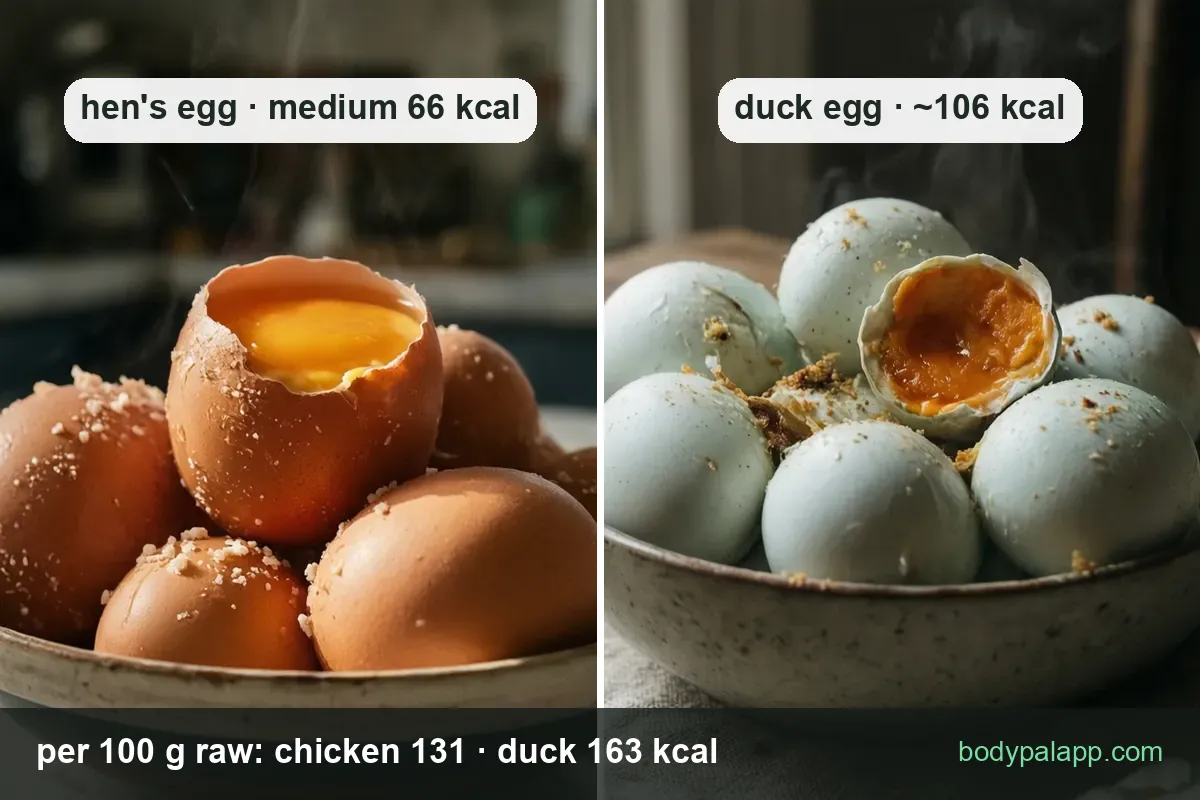
The numbers side by side
Both columns use the raw whole-egg rows, because no like-for-like boiled figure is published for duck eggs. For scale, boiling a chicken egg moves it from 131 to 143 kcal per 100 g, so cooked numbers sit slightly higher for both birds.
| Nutrient | Chicken egg, per medium egg (~50 g) | Chicken egg, per 100 g | Duck egg, per egg (~65 g) | Duck egg, per 100 g |
|---|---|---|---|---|
| Energy | 66 kcal / 276 kJ | 131 kcal / 548 kJ | 106 kcal / 443 kJ | 163 kcal / 682 kJ |
| Protein | 6.3 g | 12.6 g | 9.3 g | 14.3 g |
| Carbohydrate | 0 g (trace) | 0 g (trace) | 0 g (trace) | 0 g (trace) |
| of which sugars | 0 g (trace) | 0 g (trace) | 0 g (trace) | 0 g (trace) |
| Fat | 4.5 g | 9.0 g | 7.7 g | 11.8 g |
| Fibre | 0 g | 0 g | 0 g | 0 g |
| Salt | 0.20 g | 0.39 g | 0.20 g | 0.30 g |
Read the per-100 g columns first and the two eggs look like close relatives, which they are: zero carbohydrate, similar salt, protein within 2 g of each other. The duck egg is about a quarter more energy-dense because its yolk takes up a larger share of the shell, and yolk is where an egg keeps its fat.
Then read the per-egg columns, which is how anyone actually eats them. One duck egg costs 40 kcal more than one medium chicken egg. Swap one-for-one in a daily breakfast and that is 280 kcal a week without the plate looking any different.
When to pick chicken eggs
Pick them for everyday counting. The 66 kcal unit is smaller, cheaper, and comes graded in sizes, so two eggs at 132 kcal raw, or 143 boiled, is a controlled and repeatable breakfast. Per gram of protein the chicken egg is also marginally leaner, at 9.0 g of fat per 100 g against 11.8 g.
If a diary and a deficit are the point, the smaller unit is the better tool. Our full egg calories guide has the boiled, fried, poached and scrambled numbers.
When to pick duck eggs
Pick them when richness is doing a job. The bigger yolk carries more fat and more emulsifying power, which is why bakers rate duck eggs for sponges and custards, and why one fried duck egg feels like a centrepiece where a chicken egg feels like a component. At 9.3 g of protein per egg, one duck egg also gets you 19% of a day's protein reference intake in a single item.
Verified nutrition data
Numbers on this page come from CoFID, the UK government’s Composition of Foods Integrated Dataset, and from manufacturer labels where a branded product is named. Last verified August 2026. How we verify our data →
Count it as roughly one and a half chicken eggs and it fits any plan. The duck egg page covers portions, baking swaps and the salted variety.
Most popular egg brands in the United Kingdom
Ranked by how widely each product appears among foods sold in the United Kingdom, from the BodyPal food database of over 3.3 million products. Calories are the figures printed on each label. The one duck egg brand on the shelf tops the table by exactly the margin the comparison predicts.
| Product | Calories (per 100 g) |
|---|---|
| St Ewe Dabbling Duck Eggs | 163 kcal |
| Lodge Farms Free Range Eggs (Aldi) | 143 kcal |
| The Happy Egg Co. Large Eggs | 139 kcal |
| Clarence Court Burford Browns | 131 kcal |
Brand popularity: BodyPal food database. Nutrition: manufacturer labels.
Frequently asked questions
Which has fewer calories, a chicken egg or a duck egg?
The chicken egg, at 66 kcal for a medium egg against 106 for a duck egg, both raw. Per 100 g the figures are 131 and 163. Most of the per-egg difference is that a duck egg weighs around 65 g edible against about 50 g.
Do duck eggs have more protein than chicken eggs?
Yes, on both counts: 14.3 g per 100 g against 12.6 g, and 9.3 g per egg against 6.3 g. The per-egg gap is mainly size. Per calorie the two are close, so neither egg is a protein shortcut over the other.
Why are duck eggs richer than chicken eggs?
The yolk occupies a larger share of a duck egg, and yolk is where the fat lives: 11.8 g per 100 g against 9.0 g for chicken egg. That extra fat is what reads as richness in a fried egg and as a softer crumb in baking.
Can I substitute a duck egg for a chicken egg in a recipe?
Yes, one duck egg for one large chicken egg is the standard swap, adding around 24 kcal over the large egg's 82 boiled. Batters and bakes come out slightly richer. Going the other way, use a large chicken egg and accept a leaner result.
Which egg is better for weight loss?
The chicken egg, for its unit size rather than its composition: 66 kcal is easier to place in a day than 106, and sizes give you finer control. If you prefer duck eggs, one egg instead of two chicken eggs actually saves calories, at 106 against 132 raw.
More comparisons
- Chicken vs turkey — 147 vs 155 kcal per 100 g
- Bagel vs bread — the unit is the trap
- Crumpet vs toast — a 10-kcal tie with a salt catch
- Wrap vs bread — which has fewer calories
Count either egg without the maths
Photograph the pan and BodyPal tells the two eggs apart by portion, so the 40 kcal difference never goes missing.


One food is easy to picture; a whole day is harder. See how many calories you need a day and what a deficit actually looks like.