
Bagel vs Bread: Which Has Fewer Calories?
One bagel is 230 calories, which is nearly three slices of bread at 85 kcal each. Per 100 g the two doughs are close, 264 against 236, so the recipe is not what separates them. The unit is. A bagel is one dense 87 g ring; a slice is 36 g.
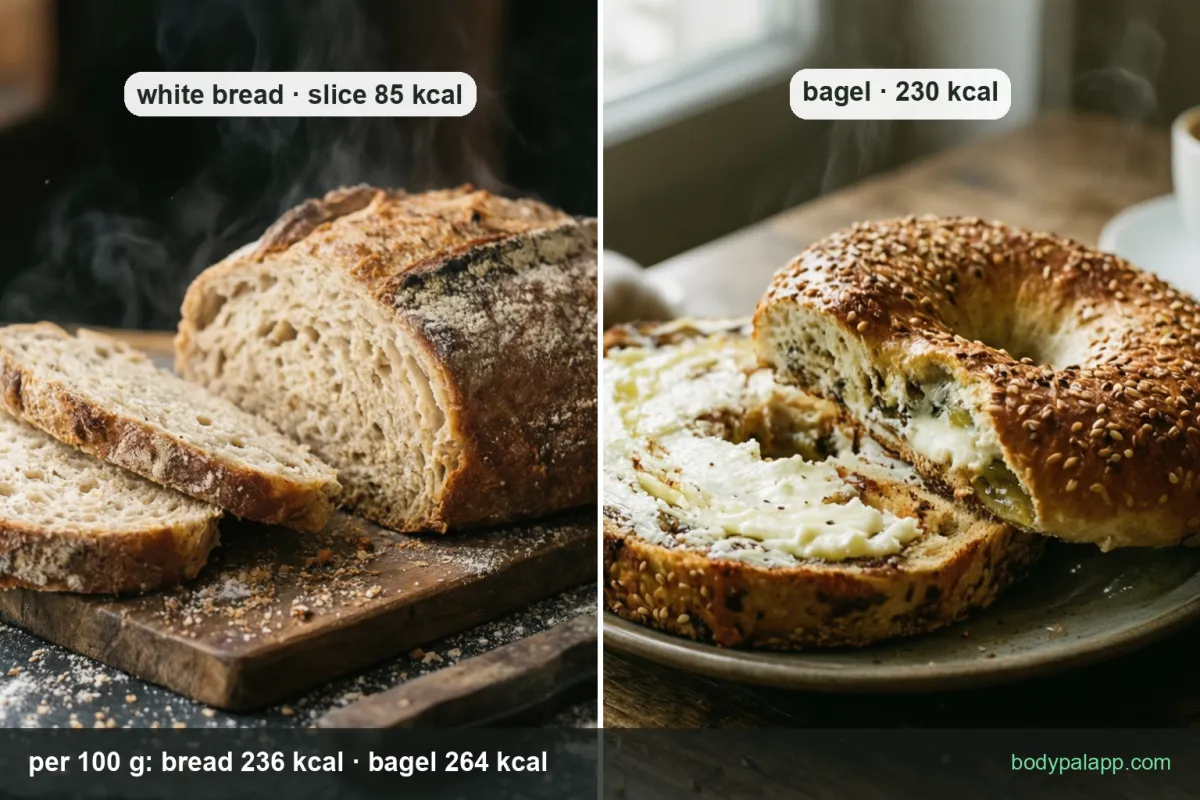
The numbers side by side
Bagel vs bread, per item and per 100 g:
| Nutrient | Bagel, per bagel (87 g) | Bagel, per 100 g | White bread, per slice (36 g) | White bread, per 100 g |
|---|---|---|---|---|
| Energy | 230 kcal / 962 kJ | 264 kcal / 1,105 kJ | 85 kcal / 356 kJ | 236 kcal / 987 kJ |
| Protein | 9.2 g | 10.6 g | 3.1 g | 8.7 g |
| Carbohydrate | 45.6 g | 52.4 g | 17.5 g | 48.7 g |
| of which sugars | 4.4 g | 5.0 g | 1.1 g | 3.0 g |
| Fat | 1.1 g | 1.3 g | 0.8 g | 2.1 g |
| Fibre | 1.4 g | 1.6 g | 1.0 g | 2.9 g |
| Salt | 0.92 g | 1.06 g | 0.36 g | 1.00 g |
Verified nutrition data
Numbers on this page come from CoFID, the UK government’s Composition of Foods Integrated Dataset, and from manufacturer labels where a branded product is named. Last verified August 2026. How we verify our data →
Read the two per-100 g columns and the foods look like near-twins: same low fat, same salt concentration, 28 kcal between them. Read the two per-item columns and one is nearly three times the other.
That gap is a weight difference and nothing else. Nobody eats 100 g of bread as a unit; they eat a 36 g slice, because that is how a loaf gets cut. A bagel is 87 g because it is boiled before baking, which leaves it dense rather than airy.
So the honest way to put it: a bagel is not fattier than bread in any meaningful way. It is simply more bread.
Where the bagel actually wins
Protein, and by a real margin per 100 g: 10.6 g against 8.7 g. Per calorie it is a smaller win, roughly 9% more protein for the same energy, but it goes the bagel's way either way. One bagel delivers 9.2 g of protein, and you would need two and a half slices of bread to match it.
Fat is the other one. At 1.3 g per 100 g the bagel is the leaner dough, below white bread's 2.1 g. Neither figure matters much next to what goes on top, but the bagel being the low-fat item surprises most people who assume the opposite.
Where bread wins
Portion control, which is the win that shows up in your diary. You can have one slice. You can have two and stop at 170 kcal. You cannot have a third of a bagel with a straight face, so the bagel's 230 kcal is close to a fixed cost every time.
Fibre is the second one, and it is bigger than it looks: 2.9 g per 100 g against 1.6 g, so per calorie bread carries about twice the fibre. Set against the 30 g a day the NHS suggests, neither is doing heavy lifting, but bread is doing more of it.
Salt splits the same way as calories. The two are almost identical per 100 g, at 1.06 g and 1.00 g, yet the bagel carries 0.92 g in one sitting, about 15% of the 6 g an adult is advised to stay under in a day. Two slices of toast come to 0.72 g.
When to pick the bagel
Pick it when the bread is the meal rather than the base of one. A bagel carries 9.2 g of protein against 6.2 g in two slices, and the fillings that suit it, smoked salmon, eggs, chicken, build on that.
It is also the better pick when you want one decision instead of a running total. A bagel is 230 kcal and that is that. No second slice appearing while the kettle boils.
When to pick bread
Pick bread when you are counting and the day is tight. One slice is 85 kcal, which is the smallest useful unit of bread there is, and that flexibility is worth more than any macro on the table. Two slices with a filling lands a sandwich around 300 to 400 kcal; the same filling in a bagel starts 145 kcal higher before anything goes in.
Bread also wins on the days when the bread is beside the point, holding an egg or mopping soup. The NHS puts starchy foods at the base of a balanced plate, and a slice is the version of that you can actually portion.
Full breakdowns with toppings and UK portions: bagel calories and white bread calories.
Most popular bagel and bread brands in the United Kingdom
Ranked by how widely each product appears among foods sold in the United Kingdom, from the BodyPal food database of over 3.3 million products. Calories are the figures printed on each label.
| Product | Calories (per 100 g) |
|---|---|
| New York Bakery Co Plain Bagels | 258 kcal |
| Warburtons Soft & Sliced Bagels | 259 kcal |
| Warburtons Danish Lighter White | 239 kcal |
| Kingsmill Thick Soft White | 238 kcal |
| Hovis Soft White Medium | 233 kcal |
Brand popularity: BodyPal food database. Nutrition: manufacturer labels.
Frequently asked questions
Are bagels healthier than bread?
On protein and fat, yes: 10.6 g and 1.3 g per 100 g for a bagel against 8.7 g and 2.1 g for white bread. On fibre, no, 1.6 g against 2.9 g. The larger difference is size, since one bagel is 230 kcal and one slice is 85 kcal.
How many slices of bread equal a bagel?
Nearly three. A bagel is 230 kcal and a medium 36 g slice of white bread is 85 kcal, so 2.7 slices match it, and three slices come to 255 kcal. By weight it is closer to two and a half, as a bagel weighs 87 g against 108 g for three slices.
Bagel vs toast: which has more calories?
The bagel, by 145 kcal against a single slice. Toasting adds nothing on its own, as it only drives off water, so a slice of toast stays at 85 kcal and two are 170 kcal. A bagel is 230 kcal, which is still more than two rounds of toast.
Are bagels good for weight loss?
They can be, with 9.2 g of protein and 1.1 g of fat per bagel, but 230 kcal is a large fixed cost for one item. Bread gives you an 85 kcal unit you can stop at. Pick the bagel when it is the whole meal, not when it is the side.
Why are bagels so high in calories?
Weight and density, not ingredients. At 264 kcal per 100 g a bagel is only 28 kcal above white bread, but it is boiled before baking, so there is little air in it, and one weighs 87 g against 36 g for a slice.
More comparisons
- Wrap vs bread — which has fewer calories
- Crumpet vs toast — a 10-kcal tie with a salt catch
- Chicken vs duck eggs — 66 vs 106 kcal each
- Chicken vs turkey — 147 vs 155 kcal per 100 g
Count it without the maths
BodyPal logs the bagel, the bread and everything you put on either one from a single photo.


Burning it off is one side of it. The other is knowing your number: work out how many calories you need a day, with macros and a goal date.