
Calories in a Bagel: 230 per Bagel, 264 per 100 g
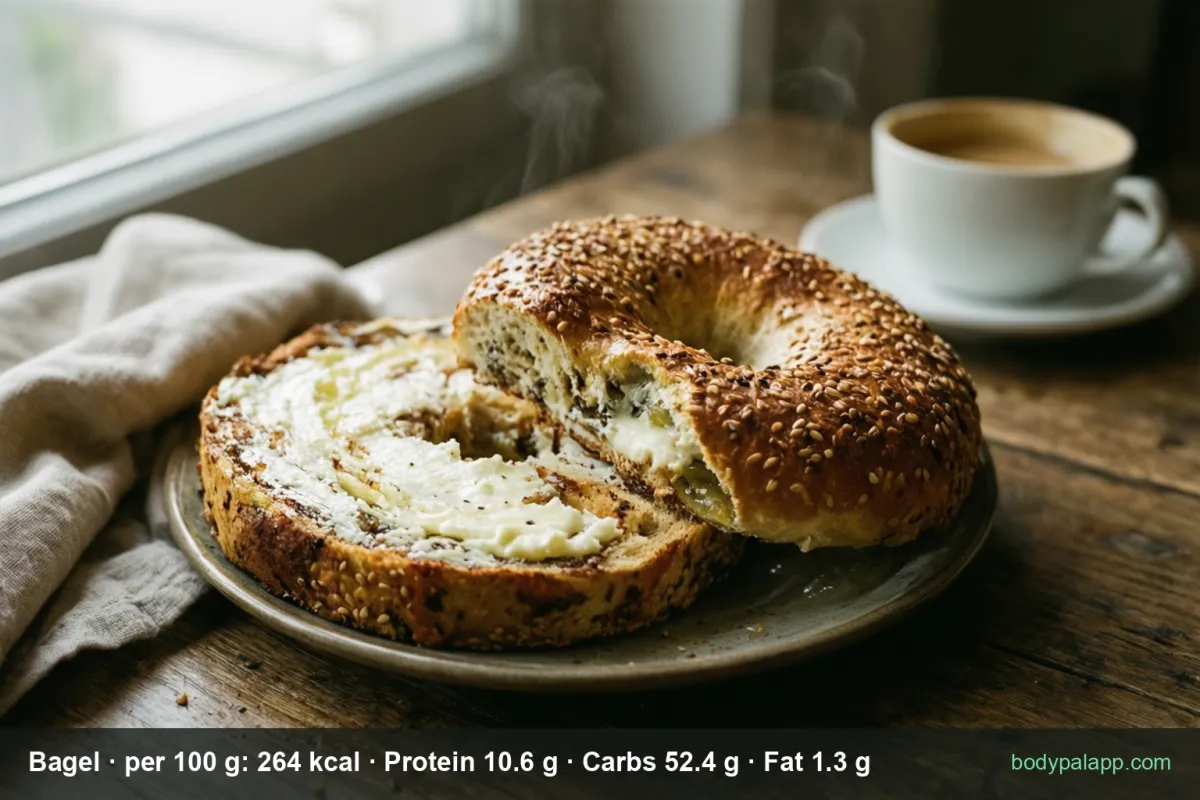
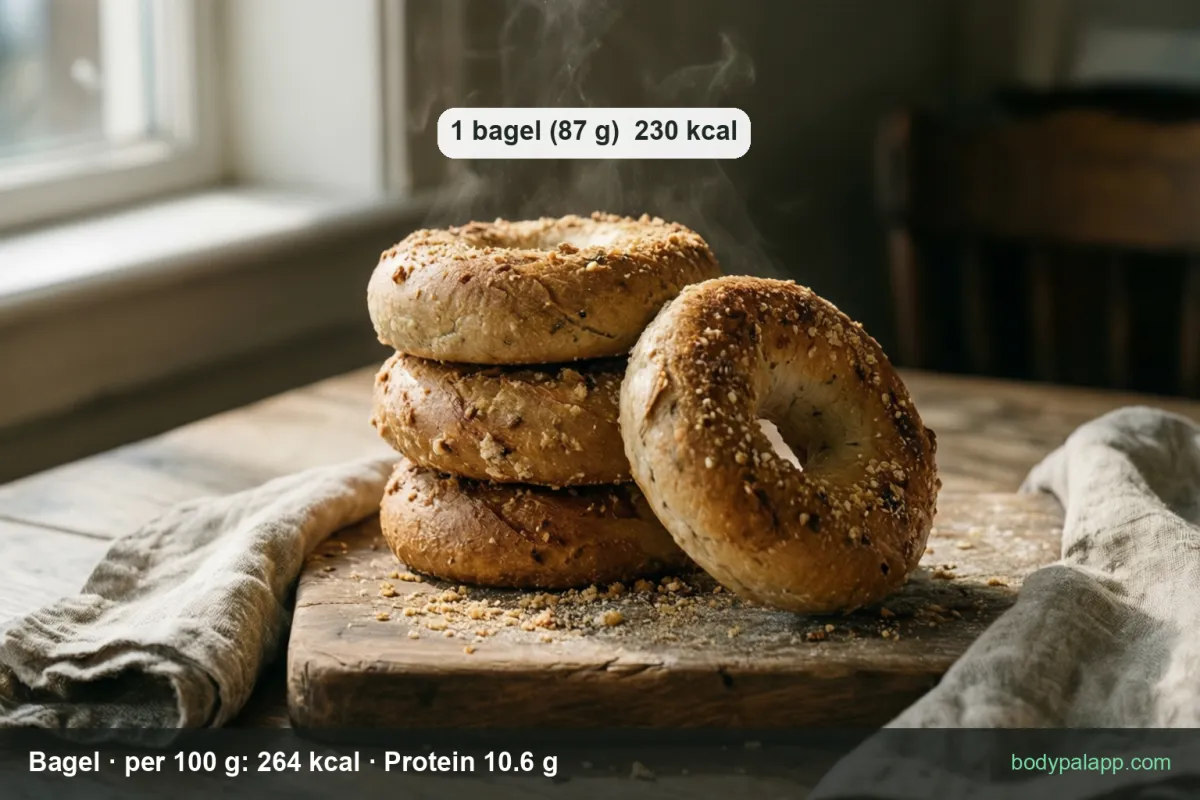
A plain bagel is 230 kcal for a typical 87 g ring, or 264 kcal per 100 g. Anyone checking the calories in a bagel usually looks twice at that: it is close to three slices of white bread packed into one ring. The upside is real protein.
On this page: Quick facts · UK portions · Toppings · How a bagel compares · The hole myth · Most popular bagel brands · FAQ
Quick facts
| Nutrient | Per bagel (87 g) | Per 100 g | RI% per bagel |
|---|---|---|---|
| Energy | 230 kcal / 962 kJ | 264 kcal / 1,105 kJ | 11.5% |
| Protein | 9.2 g | 10.6 g | 18.4% |
| Carbohydrate | 45.6 g | 52.4 g | 17.5% |
| of which sugars | 4.4 g | 5.0 g | 4.9% |
| Fat | 1.1 g | 1.3 g | 1.6% |
| Fibre | 1.4 g | 1.6 g | — |
| Salt | 0.92 g | 1.06 g | 15.3% |
Verified nutrition data
Numbers on this page come from CoFID, the UK government’s Composition of Foods Integrated Dataset, and from manufacturer labels where a branded product is named. Last verified August 2026. How we verify our data →
Two numbers do the heavy lifting. Protein at 10.6 g per 100 g is the highest in the bakery aisle, and fat at 1.3 g is almost nothing: a plain bagel is flour, water and salt, baked hard. Which is why the salt line matters. One bagel is 15% of the 6 g daily maximum the NHS advises, before anything goes on it.
UK portions
Supermarket bagels here — New York Bakery Co and the own-brand copies beside it — run roughly 85–95 g each, with labels between 220 and 250 kcal. The 87 g figure sits in the middle of that band, so treat 230 kcal as your working number.
- One plain bagel (87 g): 230 kcal
- Half a bagel (43–44 g): 115 kcal
- Two bagels (174 g): 460 kcal
Half a bagel is the portion nobody logs and everybody eats. Toast both halves, finish one, and you have had 115 kcal rather than 230.
Bagels are a starchy carbohydrate food, so they sit in the same slot as bread, rice and potatoes rather than as a treat. Fibre is the weak point at 1.6 g per 100 g, which is where a wholemeal version earns its place.
Toppings
What goes on the bagel usually decides the total, and the spread is wide.
With butter (10 g): +74 kcal → 304 kcal. Ten grams is a thin, honest scrape. Butter is 744 kcal per 100 g, so a heavy hand adds more than the half-bagel underneath it.
With jam (15 g): +39 kcal → 269 kcal. Jam is 261 kcal per 100 g, which sounds a lot until you notice how little of it a normal serving is. The cheapest topping here by some distance.
With peanut butter (20 g): +121 kcal → 351 kcal. At 607 kcal per 100 g it is the priciest of the three, and the one that adds most to the protein total.
With cream cheese: cream cheese (Philadelphia, 225 kcal per 100 g label; a 30 g spread adds 68 kcal, taking the bagel to 298).
How a bagel compares
| Food | Per 100 g | Per item |
|---|---|---|
| Bagel | 264 kcal | 230 kcal (87 g) |
| White bread | 236 kcal | 85 kcal (36 g slice) |
| Crumpet | 207 kcal | 95 kcal (46 g) |
| Croissant | 373 kcal | 187 kcal (50 g) |
Per 100 g the bagel is unremarkable, barely above white bread and well under a croissant. Per item it is the biggest breakfast on the list, because one bagel weighs more than two crumpets.
The verdict: if you are counting calories, the crumpet wins on arithmetic alone at 95 kcal, and it is the easiest swap to make. If you want the meal to hold until lunch, take the bagel: 9.2 g of protein and 45.6 g of carbohydrate beats everything else here, while the croissant gives you the least food for 187 kcal. The full bagel versus bread breakdown has the side-by-side.
The hole doesn't help
People assume a bagel is lighter than it looks because of the hole. It is the opposite. Bagel dough is boiled before baking, which sets the crust and keeps the crumb dense, so an 87 g bagel packs its flour into a smaller shape than a roll would. The hole is already priced in: the label weight is the weight in your hand.
Most popular bagel brands in the United Kingdom
Ranked by how widely each product appears among foods sold in the United Kingdom, from the BodyPal food database of over 3.3 million products. Calories are the figures printed on each label.
| Product | Calories (per 100 g) |
|---|---|
| New York Bakery Co Plain Bagels | 258 kcal |
| New York Bakery Co Sesame Bagels | 266 kcal |
| Warburtons Soft & Sliced Bagels | 259 kcal |
Brand popularity: BodyPal food database. Nutrition: manufacturer labels.
FAQ
How many calories are in a bagel?
A plain bagel is 230 kcal for an 87 g ring, or 264 kcal per 100 g. UK supermarket bagels weigh roughly 85–95 g, and their labels range from about 220 to 250 kcal each, so check the pack if you want the exact figure for your brand.
How many calories does a bagel with cream cheese have?
The bagel itself is 230 kcal; the cream cheese figure is cream cheese (Philadelphia, 225 kcal per 100 g label; a 30 g spread adds 68 kcal, taking the bagel to 298). For a comparison you can use today, 10 g of butter adds 74 kcal for a 304 kcal total, and 20 g of peanut butter adds 121 kcal for 351 kcal.
Are bagels healthy?
A bagel gives you 9.2 g of protein and 1.1 g of fat for 230 kcal, which is a good trade. The weak points are fibre, at 1.4 g per bagel, and salt, at 0.92 g — 15% of the 6 g daily maximum the NHS advises, before any topping.
Bagel or bread — which has fewer calories?
Per item, bread wins easily: a 36 g slice of white bread is 85 kcal against 230 kcal for a bagel. Per 100 g they are close, 236 against 264. The gap is weight, not recipe — one bagel is nearly three slices of bread in a single ring.
How many calories in a wholemeal bagel?
Wholemeal bagels vary by brand and CoFID has no generic entry, so check the pack label; expect similar calories to a white bagel with roughly double the fibre. The plain version is 264 kcal per 100 g with 1.6 g of fibre, and wholemeal versions are bought mainly for the fibre rather than for any large calorie saving. Read the pack, as recipes vary between bakeries.
How many calories in half a bagel?
Half a bagel is 115 kcal, from a 43–44 g portion. That also halves the salt to about 0.46 g and the protein to 4.6 g. Toasting both halves and eating one is the simplest way to keep a bagel breakfast under 200 kcal with a topping on it.
How many calories does a bagel with butter have?
A bagel with 10 g of butter is 304 kcal. Butter is 744 kcal per 100 g, so the spread costs 74 kcal at a thin scrape and considerably more if you butter it warm, when it soaks in. Jam is the cheaper option at 39 kcal for 15 g.
Does toasting a bagel change the calories?
No. Toasting drives off water, so a toasted bagel weighs slightly less than the 87 g you started with, but the 230 kcal stays where it is. Only what you put on afterwards changes the total — and warm bagels absorb noticeably more butter than cold ones.
Similar foods
- Baguette — 658 kcal whole
- Burger bun — 152 kcal each
- Focaccia — 252 kcal per 90 g square
- Flatbread — 234 kcal per Greek flatbread
- White bread — 85 kcal a slice
- Tortilla wrap — 196 kcal per large wrap
Logging a bagel
BodyPal logs a bagel and everything you put on it from one photo, so the topping maths above happens without you doing it.


How long does it take to burn off a bagel?
A plain bagel (87 g) is 230 kcal. Enter your weight and the amount you ate to see how long it takes you to burn that off:
lb
| Activity | Time to burn 230 kcal |
|---|---|
| Walking, brisk | 46 min |
| Cycling, moderate | 29 min |
| Swimming, moderate | 33 min |
| Jogging | 27 min |
| Weight training, moderate | 51 min |
Times are for a 154 lb (11 st) adult at a steady pace; change the weight to see yours. The amount is set to the portion in the text (87 g); change it to what you actually ate. BodyPal works this out from your steps automatically.
Burning it off is one side of it. The other is knowing your number: work out how many calories you need a day, with macros and a goal date.