
How Many Calories in Focaccia?
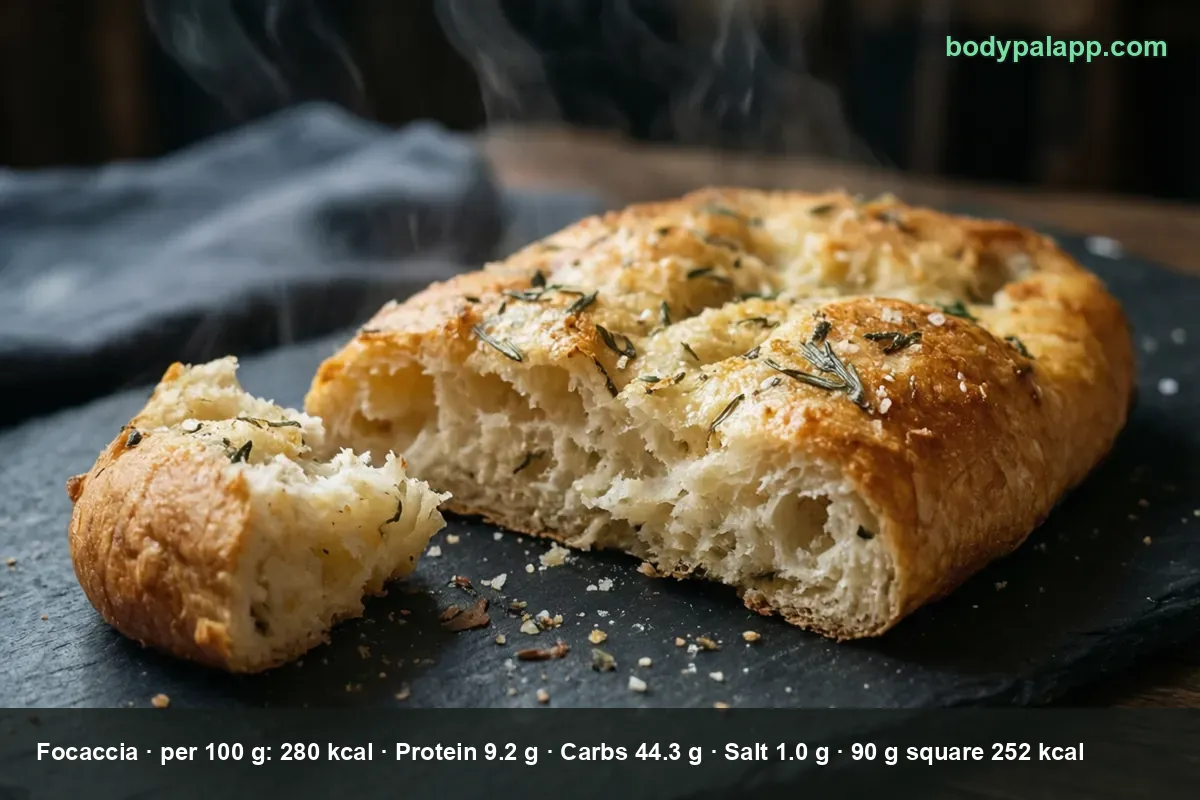
A 90 g square of focaccia is 252 calories, and the bread itself runs 280 kcal per 100 g. That is 44 kcal more per 100 g than plain white bread, and the gap is almost all olive oil. The 250 g sharing loaf sold as one piece comes to 665 kcal.
On this page
- Focaccia quick facts
- UK portions, square by square
- Where the olive oil actually goes
- Olives, tomatoes, cheese and garlic
- The salt is in the dough, not on top
- Focaccia against the bread aisle
- Popular focaccia brands
- Focaccia FAQs
Focaccia quick facts
The reference figure is plain rosemary-and-sea-salt focaccia, the version every UK supermarket bakes. Eleven of those labels sit between 266 and 299 kcal per 100 g, which is a tight spread for a bread with no legal recipe, and 280 is the middle of it.
| Nutrient | Per 100 g | 90 g square | RI%* |
|---|---|---|---|
| Energy | 280 kcal / 1,172 kJ | 252 kcal / 1,054 kJ | 13% |
| Protein | 9.2 g | 8.3 g | 17% |
| Carbohydrates | 44.3 g | 39.9 g | 15% |
| – of which sugars | 2.5 g | 2.3 g | 3% |
| Fat | 6.5 g | 5.9 g | 8% |
| – of which saturates | 1.0 g | 0.9 g | 5% |
| Salt | 1.0 g | 0.90 g | 15% |
Verified nutrition data
Numbers on this page come from CoFID, the UK government’s Composition of Foods Integrated Dataset, and from manufacturer labels where a branded product is named. Last verified September 2026. How we verify our data →
*RI% = one square's share of an adult's daily reference intake, based on 2,000 kcal.
There is no fibre row, and that is not an oversight. UK focaccia labels almost never declare fibre — the field is blank on all eleven products checked. For a rough marker, ciabatta made from the same kind of white dough carries 3.3 g of fibre per 100 g.
Three of those eleven labels are worth pausing on. Tesco's rosemary and sea salt focaccia, Morrisons' version of the same thing, and the Tesco Finest paninis match each other to the tenth of a gram: 284–285 kcal, 8.4 g protein, 45.4 g carbohydrate, 6.9 g fat. One contract bakery supplies all three. So 284 is not a coincidence of rounding, it is the British focaccia recipe.
UK portions, square by square
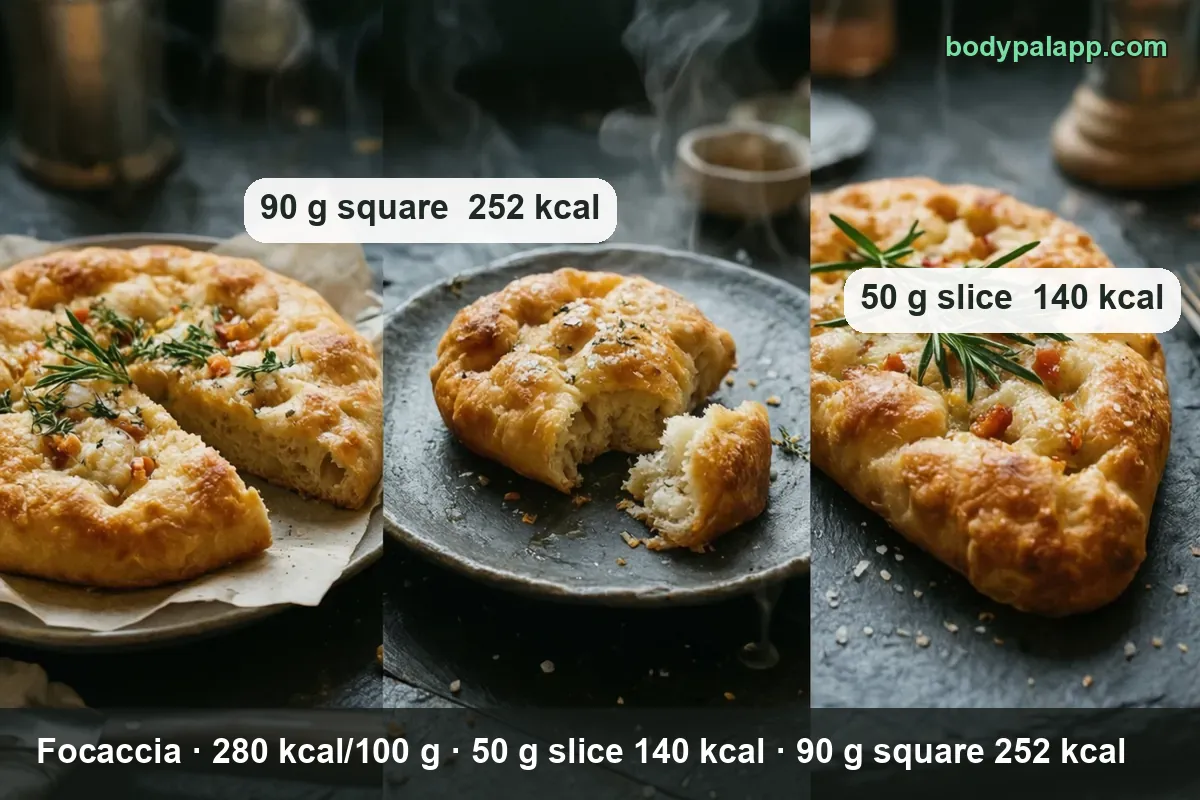
Supermarkets cut focaccia in three different ways, and the label serving jumps around accordingly. A pack of four soft slices divides at 80 g. A panini twin-pack divides at 90 g. Tesco calls a whole 95 g piece "1 focaccia". Marks & Spencer, more optimistically, puts its serving at 50 g.
| Portion | Weight | Calories | Salt |
|---|---|---|---|
| Small piece (M&S serving) | 50 g | 140 kcal | 0.50 g |
| Deli Kitchen square, quarter of a 300 g pack | 75 g | 210 kcal | 0.75 g |
| Aldi square, quarter of a 320 g pack | 80 g | 224 kcal | 0.80 g |
| Roll or panini square | 90 g | 252 kcal | 0.90 g |
| Tesco "1 focaccia" | 95 g | 266 kcal | 0.95 g |
| Whole sharing loaf | 250 g | 665 kcal | 1.60 g |
The honest answer for most people is the 90 g row. Squares cut at 75 g and 95 g land within 30 kcal of it either way, so 250 is the number to carry in your head for one piece of focaccia.
The 250 g loaf is the row that catches people out. Sainsbury's Taste the Difference focaccia is one flat bread in one bag, priced and shaped as a single item, and eating it between two makes 330 kcal each. Eating it alone with a bowl of soup makes it 665.
Where the olive oil actually goes
Focaccia has a reputation as the oily bread. The label says otherwise, and the arithmetic is short.
Per 100 g, focaccia carries 6.5 g of fat. White bread carries 2.1 g. The difference is 4.4 g — about a teaspoon of oil per 100 g of finished bread, or roughly 4 ml in a 90 g square. At 899 kcal per 100 g, olive oil turns that into +40 kcal per 100 g, which is essentially the whole gap between 236 and 280.
Split the 280 kcal by nutrient and the picture is plainer still. Carbohydrate supplies 177 kcal, or 63% of the total. Fat supplies 58 kcal, 21%. Protein supplies 37 kcal, 13%. Focaccia is bread with a fifth of its calories in oil, not oil in the shape of bread.
What the oil does change is the trade inside the dough. Against ciabatta, focaccia holds 6.5 g of fat against 3.9 g, and 44.3 g of carbohydrate against 52.0 g. Flour has been swapped for oil at almost identical energy: 280 against 271. Two breads, nine calories apart, built differently.
One more comparison earns its place, because it is the one that surprises people. Retail garlic bread is 348 kcal per 100 g with 16.7 g of fat and 8.63 g of saturates — 43% of an adult's daily saturates in 100 g of bread. Focaccia holds 1.0 g of saturates. The butter in garlic bread, not the olive oil in focaccia, is what the NHS guidance on fats is aimed at.
Olives, tomatoes, cheese and garlic
| Version | Per 100 g | 90 g square |
|---|---|---|
| Rosemary and sea salt (the standard) | 280 kcal | 252 kcal |
| Green olive | 278 kcal | 250 kcal |
| Tomato | 268 kcal | 241 kcal |
| Halkidiki olive | 251 kcal | 226 kcal |
| Cheddar and onion | 258 kcal | 232 kcal |
| Garlic focaccia | 359 kcal | 323 kcal |
Five of these six rows go down, which is the opposite of what a topping is supposed to do. Olives and roasted tomatoes are mostly water, so pressing them into the dough dilutes the bread rather than enriching it. A Halkidiki olive focaccia is 29 kcal per 100 g lighter than the plain one.
The garlic row is the exception and it is a large one. At 359 kcal per 100 g, garlic focaccia adds 71 kcal to every square — more than a tablespoon of oil — because garlic butter goes in on top of the oil already in the dough.
If you like the flavoured versions, take them. The only one that costs you anything is the garlic.
The salt is in the dough, not on top
Focaccia is finished with visible salt crystals, and they get all the blame. They deserve about a fifth of it.
Across UK labels the salt runs from 0.64 g to 1.73 g per 100 g, with most products near 1.0 g. A 90 g square therefore carries 0.6 g to 1.6 g of salt, or 10% to 26% of the adult limit of 6 g a day. Most of it is dissolved in the dough before baking, exactly as it is in any other loaf; the crystals scattered on the crust are the part you can see, not the part that counts.
Put next to a plain slice, the square is roughly two slices' worth of salt in a piece that weighs two and a half times more. Focaccia is not a salty bread by British standards. It is a bread you eat in larger pieces.
For the record, that 90 g square delivers 8.3 g of protein and 39.9 g of carbohydrate. The NHS puts starchy foods at just over a third of what people eat, and focaccia sits in that group as squarely as toast does.
Focaccia against the bread aisle
| Item | Per 100 g | Typical piece | Calories |
|---|---|---|---|
| Focaccia | 280 kcal | 90 g square | 252 kcal |
| Ciabatta | 271 kcal | — | — |
| White bread | 236 kcal | 36 g slice | 85 kcal |
| Wholemeal bread | 217 kcal | slice | 78 kcal |
| Baguette | 263 kcal | whole stick | 658 kcal |
| Pizza | 272 kcal | slice | 340 kcal |
Per 100 g, focaccia is the heaviest bread on that list and the difference is trivial — nine calories over ciabatta, seventeen over a baguette. Per piece, it is a different food entirely, because nobody serves focaccia in 36 g slices.
Here is the line worth keeping: a 90 g square is 252 kcal, and three slices of white bread are 255. People eat focaccia as one item and log it as one item, when by weight it is a sandwich's worth of bread with a teaspoon of oil in it.
Our take: if you are counting and you want bread with a meal, wholemeal at 78 kcal a slice wins on calories and wins by a mile on fibre. If focaccia is the point of the meal — dipped in oil, torn with soup — buy the pack that cuts into 80 g squares rather than the 250 g loaf, and the whole question goes away at 224 kcal.
Popular focaccia brands in the BodyPal food database
Ranked by how widely each product appears among foods sold in the United Kingdom, from the BodyPal food database of over 3.3 million products. Calories are the figures printed on each label.
| Product | Calories (per 100 g) |
|---|---|
| Forno Ludovico Focaccia con Pomodorini | 262 kcal |
| Forno Ludovico Focaccia con Olive | 267 kcal |
| Deli Kitchen Sliced Focaccia | 272 kcal |
| Rosemary and Salt Focaccia (Lidl) | 285 kcal |
| Crosta & Mollica Focaccia | 276 kcal |
Brand popularity: BodyPal food database. Nutrition: manufacturer labels.
Focaccia FAQs
How many calories in focaccia?
280 kcal per 100 g, which makes a 90 g square 252 calories. UK supermarket labels run from 266 to 299 kcal per 100 g for plain rosemary and sea salt focaccia, so a square is 240 to 270 calories depending on which one you buy.
How many calories in a slice of focaccia?
Between 210 and 266 kcal, because supermarket squares are cut at 75 g, 80 g, 90 g or 95 g. The most common size is 90 g at 252 kcal. A small 50 g serving, the one Marks and Spencer prints on the pack, is 140 kcal.
Focaccia or ciabatta — which has fewer calories?
Ciabatta, by nine calories per 100 g: 271 against 280. The difference is in the build rather than the energy. Focaccia carries 6.5 g of fat and 44.3 g of carbohydrate; ciabatta carries 3.9 g of fat and 52.0 g of carbohydrate.
How much olive oil is in focaccia?
About a teaspoon per 100 g of finished bread. Focaccia holds 6.5 g of fat against 2.1 g in white bread, a difference of 4.4 g, which is roughly 5 ml of oil and 40 kcal. A 90 g square contains around 4 ml.
Focaccia or white bread for calories?
White bread is lighter per 100 g at 236 kcal against 280, but portion size decides it. One 36 g slice is 85 kcal and one 90 g focaccia square is 252 — the same as three slices. Focaccia is not much denser, it is served much bigger.
How many calories in Tesco rosemary and sea salt focaccia?
284 kcal per 100 g, and the pack serving of 95 g comes to 270 kcal. It carries 8.4 g of protein, 45.4 g of carbohydrate and 6.9 g of fat per 100 g. Morrisons sells an identical product with identical figures.
How much salt is in focaccia?
Around 1.0 g per 100 g, so 0.90 g in a 90 g square — 15% of the 6 g daily limit. UK labels range from 0.64 g to 1.73 g per 100 g. Most of that salt is mixed into the dough; the crystals on the crust are a small part of the total.
Is focaccia healthy?
It behaves like any other white bread with a little oil added. A 90 g square gives 252 kcal, 8.3 g of protein, 0.9 g of saturates and 0.90 g of salt. Fibre is the weak point: focaccia is made from white flour, and UK labels do not declare a fibre figure at all.
Similar foods
- Flatbread — 234 kcal per Greek flatbread
- Bagel — 230 kcal each
- Baguette — 658 kcal whole
- Burger bun — 152 kcal each
- Tortilla wrap — 196 kcal per large wrap
- Hot cross bun — 218 kcal each
Log the square, not the loaf
Point the camera at the board and BodyPal works out the weight of the piece and the calories that go with it.


How long does it take to burn off focaccia?
A 90 g square is 252 kcal. Enter your weight and the amount you ate to see how long it takes you to burn that off:
lb
| Activity | Time to burn 252 kcal |
|---|---|
| Walking, brisk | 50 min |
| Cycling, moderate | 32 min |
| Swimming, moderate | 36 min |
| Jogging | 30 min |
| Weight training, moderate | 56 min |
Times are for a 154 lb (11 st) adult at a steady pace; change the weight to see yours. The amount is set to the portion in the text (90 g); change it to what you actually ate. BodyPal works this out from your steps automatically.
One food is easy to picture; a whole day is harder. See how many calories you need a day and what a deficit actually looks like.