
Calories in Bread: 78 kcal per Wholemeal Slice, 217 per 100 g
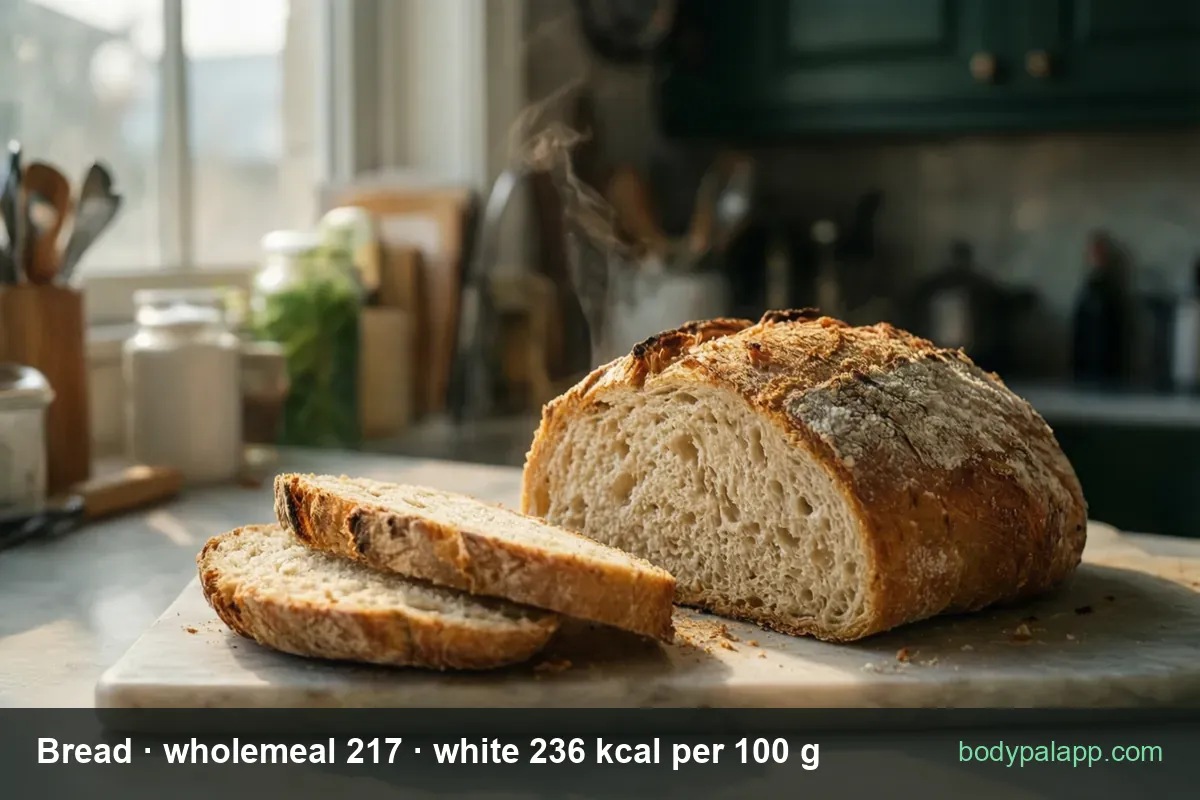
Bread's bad reputation does not survive contact with a scale: the calories in bread come to 78 kcal for a medium slice of wholemeal (36 g) and 217 kcal per 100 g. Two slices for a sandwich total 156 kcal. It is what goes between and on the slices that usually does the damage.
On this page
- Quick facts
- UK portion sizes
- Wholemeal vs white
- How does it compare?
- Does bread make you fat?
- Most popular wholemeal bread brands
- FAQ
Quick facts
This page is based on average wholemeal bread, the loaf UK guidance keeps nudging us towards. The right-hand column shows what one medium slice of 36 g contributes to an adult's daily reference intake (RI).
Verified nutrition data
Numbers on this page come from CoFID, the UK government’s Composition of Foods Integrated Dataset, and from manufacturer labels where a branded product is named. Last verified August 2026. How we verify our data →
| Nutrient | Per 100 g | Per medium slice (~36 g) | RI% (medium slice) |
|---|---|---|---|
| Energy | 217 kcal (908 kJ) | 78 kcal (326 kJ) | 4% |
| Protein | 9.4 g | 3.4 g | 7% |
| Carbohydrates | 42.0 g | 15.1 g | 6% |
| Fat | 2.5 g | 0.9 g | 1% |
| Fibre | 7.0 g | 2.5 g | — |
| Sugar | 2.8 g | 1.0 g | 1% |
| Salt | 1.0 g | 0.36 g | 6% |
Two rows earn a closer look. Fibre: 7.0 g per 100 g is a serious contribution, and it is the main argument for wholemeal. Salt: at 1.0 g per 100 g, each slice quietly takes 6% of the 6 g daily maximum, and because bread does not taste salty, nobody accounts for it.
UK portion sizes
Bread is sold sliced, which makes it one of the few foods you can log accurately without a scale. The medium slice from a standard 800 g-style loaf is the unit that matters:
| Portion | Weight | Calories |
|---|---|---|
| Medium slice, wholemeal | ~36 g | 78 kcal |
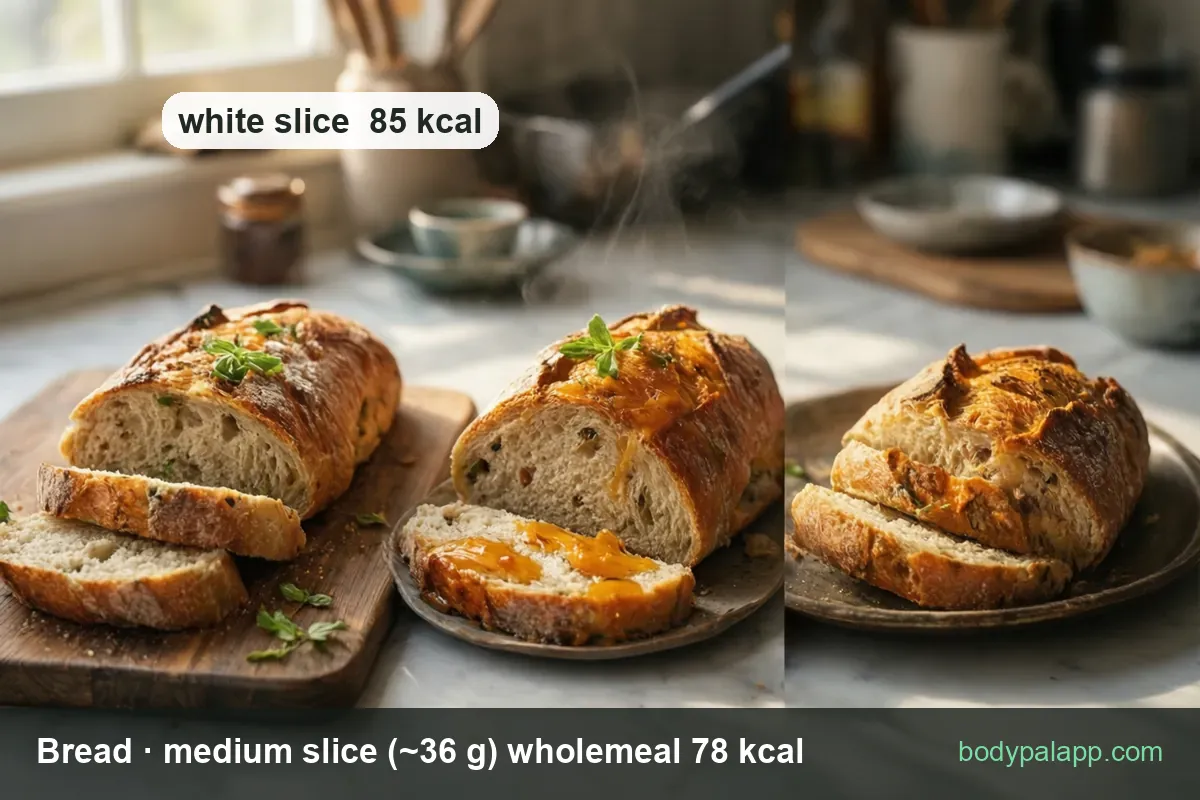
| Medium slice, white | ~36 g | 85 kcal |
| Two slices (a sandwich) | 72 g | 156 kcal |
A plain sandwich starts at 156 kcal before anything touches it. That is the honest baseline, and it is modest; a filling of cheese, mayonnaise or peanut butter routinely costs more than both slices combined. When a lunch surprises you, audit the filling first and the bread last.
Toasting changes none of these numbers, by the way. It removes water, not energy, so a toasted slice logs the same 78 kcal as a fresh one. The slice also brings 3.4 g of protein and 2.5 g of fibre along with those calories, which is more nutritional company than most 78 kcal snacks can claim.
Wholemeal vs white
The white loaf gets its own full page, so here is only the head-to-head that decides the swap.
| Bread | kcal per 100 g | kcal per slice | Fibre per 100 g |
|---|---|---|---|
| Wholemeal, average | 217 kcal | 78 kcal | 7.0 g |
| White, average | 236 kcal | 85 kcal | 2.9 g |
The calorie gap is a shrug: 7 kcal per slice. Nobody's week changes because of it. The fibre gap is the real story, 7.0 g against 2.9 g per 100 g, meaning wholemeal delivers well over double the fibre for slightly fewer calories. The Eatwell Guide backs starchy carbohydrates as the base of meals and asks you to pick wholegrain versions where you can; this table is that advice in numbers. For the white loaf's full breakdown and portions, see our white bread page.
How does it compare?
| Food | kcal per 100 g |
|---|---|
| Crumpet | 207 kcal |
| Wholemeal bread (this page) | 217 kcal |
| White bread | 236 kcal |
| Bagel | 264 kcal |
| Wrap | 306 kcal |
The table upends the usual assumptions. Wraps, the "light" choice of every meal deal, are the densest option here at 306 kcal per 100 g, while the humble crumpet is the lightest at 207. Our verdict: per 100 g, wholemeal bread beats everything except the crumpet, and once you add its 7.0 g of fibre, it is the clear default; treat bagels and wraps as the indulgent options they numerically are.
Does bread make you fat?
No food makes you fat by itself, and at 78 kcal a slice, bread is a strange scapegoat. A slice carries less energy than many single biscuits sold as "light". What happens in practice is stacking: butter on the toast, cheese in the sandwich, a roll on the side of a meal that already had enough carbohydrate.
Cutting bread often works for people not because bread was the problem, but because it takes the toppings down with it. If you enjoy bread, the numbers say keep it: base the meal on it as the Eatwell Guide suggests, choose wholemeal for the fibre, and weigh the spread once so you know what it really adds.
Most popular wholemeal bread brands in the United Kingdom
Ranked by how widely each product appears among foods sold in the United Kingdom, from the BodyPal food database of over 3.3 million products. Calories are the figures printed on each label.
| Product | Calories (per 100 g) |
|---|---|
| Hovis Wholemeal | 221 kcal |
| Warburtons Wholemeal | 231 kcal |
| Rowan Hill Bakery Wholemeal (Lidl) | 221 kcal |
Brand popularity: BodyPal food database. Nutrition: manufacturer labels.
FAQ
How many calories are in bread?
Average wholemeal bread has 217 kcal per 100 g, and average white has 236 kcal per 100 g. In practical terms, a medium slice is 78 kcal for wholemeal or 85 kcal for white, and a two-slice sandwich base comes to 156 kcal on wholemeal.
How many calories are in a slice of bread?
A medium slice from a standard loaf weighs about 36 g and contains 78 kcal if wholemeal, 85 kcal if white. Thick-cut slices weigh more, so their count rises in proportion. Toasting does not change the calories; it only removes water.
How many calories are in a bread roll?
Using bread's 217 to 236 kcal per 100 g range, a roll's calories depend entirely on its weight, and rolls are usually heavier than a single 36 g slice, often closer to two. Weigh one from your usual pack once, or check the packet, and reuse that figure.
How many calories are in bread and butter?
The slice itself is 78 kcal for wholemeal; the butter is the variable, and a generous spreading can rival the bread underneath it. Butter is far denser in calories than bread, gram for gram. Weigh your usual scrape once, then you can log bread and butter on autopilot.
Is bread healthy?
Wholemeal bread offers 7.0 g of fibre and 9.4 g of protein per 100 g for 217 kcal, and the NHS Eatwell Guide recommends basing meals on starchy carbohydrates, ideally wholegrain. The caveat is salt at 1.0 g per 100 g. As everyday foods go, a wholemeal loaf holds up well.
Is bread vegan?
A standard 78 kcal slice of wholemeal is usually vegan, since basic bread is flour, water, yeast and salt. The exceptions are loaves enriched with milk, butter or eggs, and some brioche-style breads. UK ingredient labels make it easy to check the specific loaf in your hand.
Is bread bad for you?
At 78 kcal and 2.5 g of fibre per wholemeal slice, bread itself is not the villain; the salt is the fair criticism, with each slice carrying 0.36 g, or 6% of the daily maximum. Eat it as a base for balanced meals and the numbers stay comfortably on your side.
Is bread bad for dogs?
Plain bread is not toxic to dogs, but at 78 kcal a slice it is a big, nutrition-poor addition to a small animal's day. Never share raw dough, which is dangerous, and skip breads with raisins or chocolate entirely. As an occasional pinch of crust, it is fine.
Similar foods
- Crumpet — 95 kcal each
- White bread — 85 kcal a slice
- Burger bun — 152 kcal each
- Baguette — 658 kcal whole
- Bagel — 230 kcal each
- Focaccia — 252 kcal per 90 g square
Count it without the maths
BodyPal recognises your sandwich from one photo and logs the bread, slice by 78 kcal slice, along with whatever you put inside it.


How long does it take to burn off bread?
A medium wholemeal slice (36 g) is 78 kcal. Enter your weight and the amount you ate to see how long it takes you to burn that off:
lb
| Activity | Time to burn 78 kcal |
|---|---|
| Walking, brisk | 16 min |
| Cycling, moderate | 10 min |
| Swimming, moderate | 11 min |
| Jogging | 9 min |
| Weight training, moderate | 17 min |
Times are for a 154 lb (11 st) adult at a steady pace; change the weight to see yours. The amount is set to the portion in the text (36 g); change it to what you actually ate. BodyPal works this out from your steps automatically.
One food is easy to picture; a whole day is harder. See how many calories you need a day and what a deficit actually looks like.