
Calories in a Wrap: 196, and Why It Feels Lighter
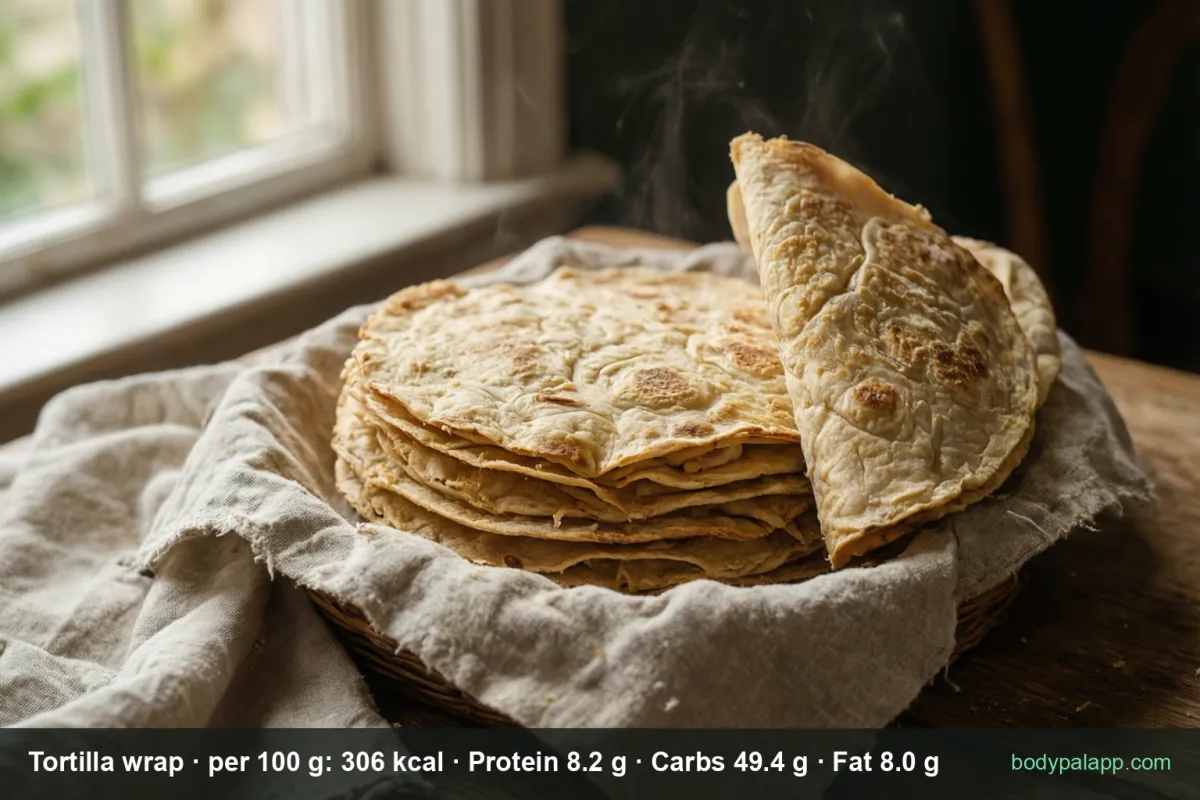
A large UK tortilla wrap is 196 kcal at 64 g, or 306 kcal per 100 g. The smaller 56 g size comes to 171. Hold on to that second number, because the calories in a wrap are 30% higher by weight than white bread, and almost nobody expects that.
On this page
- Wrap nutrition at a glance
- UK portions and what they weigh
- Why it feels lighter than bread
- Wholemeal wraps
- What the filling adds
- How does a wrap compare?
- Two things people get wrong
- Most popular tortilla wrap brands
- FAQ
Wrap nutrition at a glance
| Nutrient | Per 100 g | Per large wrap (64 g) | %RI* per wrap |
|---|---|---|---|
| Energy | 306 kcal / 1,280 kJ | 196 kcal / 820 kJ | 10% |
| Protein | 8.2 g | 5.2 g | 10% |
| Carbohydrate | 49.4 g | 31.6 g | 12% |
| of which sugars | 1.6 g | 1.0 g | 1% |
| Fat | 8.0 g | 5.1 g | 7% |
| Fibre | 3.5 g | 2.2 g | 7%† |
| Salt | 1.75 g | 1.1 g | 19% |
*%RI = percentage of the reference intake for an average adult (2,000 kcal; 70 g fat, 260 g carbohydrate, 90 g sugars, 50 g protein, 6 g salt). †The UK sets no reference intake for fibre, so this is measured against the 30 g a day the NHS suggests.
Verified nutrition data
Numbers on this page come from CoFID, the UK government’s Composition of Foods Integrated Dataset, and from manufacturer labels where a branded product is named. Last verified August 2026. How we verify our data →
Two lines stand out. Fat, at 8.0 g per 100 g, is roughly four times what a plain loaf carries, because tortilla dough is made with oil. Salt is the other one.
UK portions and what they weigh
| Portion | Weight | Calories |
|---|---|---|
| 1 large wrap (the standard supermarket size) | 64 g | 196 kcal |
| 1 smaller/lunchbox wrap | 56 g | 171 kcal |
| 2 large wraps | 128 g | 392 kcal |
The gap between the two sizes is 25 calories, which is not worth agonising over. Worth checking is which one is in your kitchen, because the gram weight hides in small print on the back of the pack.
Why it feels lighter than bread
A wrap looks thin, folds flat and has no crust, so it reads as the virtuous choice at the sandwich counter. By weight it is the densest thing on this page: 306 kcal per 100 g against 236 for white bread.
The lighter feeling is real, but it comes from the portion, not the dough. One wrap is 64 g of flour product; two slices of bread are 72 g. You eat less of a more concentrated food, and the two effects nearly cancel out.
Salt goes the same way. A wrap holds 1.75 g per 100 g where white bread holds about 1.0 g, so one wrap is 1.1 g of salt, close to a fifth of the 6 g a day the NHS advises adults to stay under. Two slices of bread come in at roughly 0.7 g. If salt is the thing you are watching rather than calories, bread is the better base.
Our position: the wrap is not the diet option it is dressed up as, and it is not a problem either. It is bread with the portion decided for you, which is genuinely useful if you tend to cut generous slices.
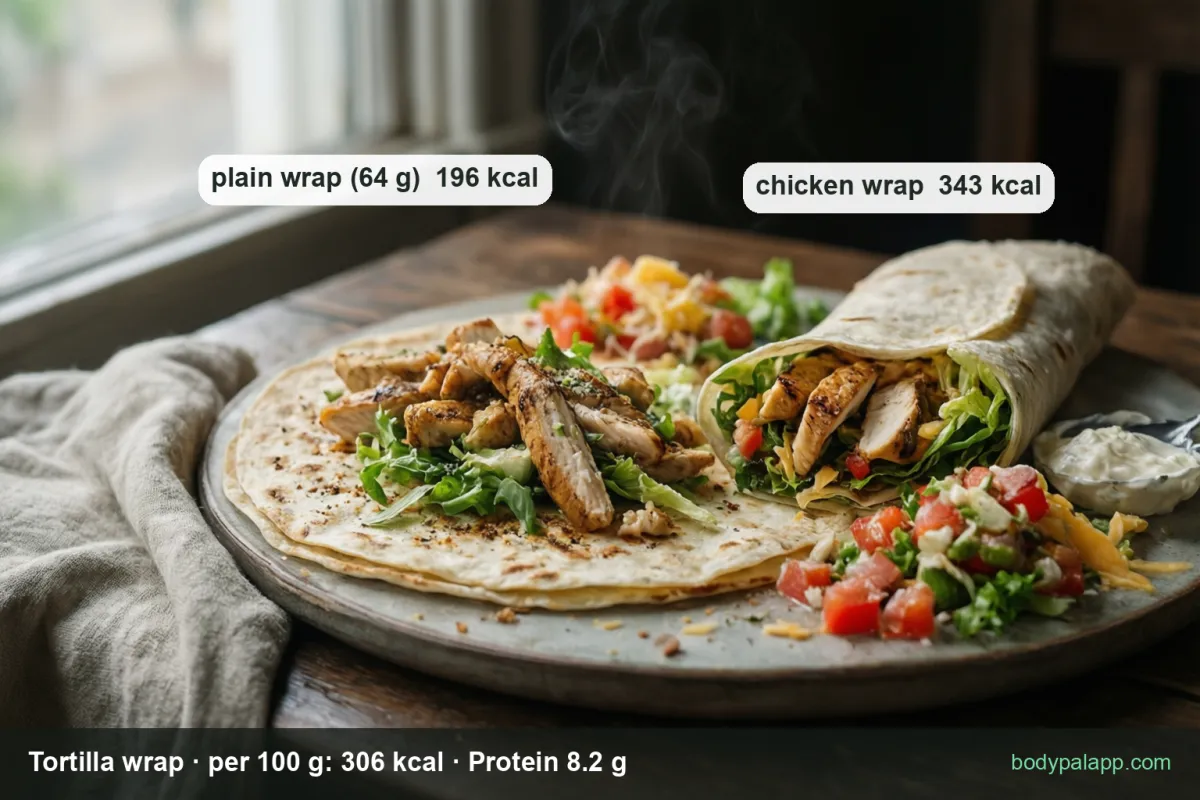
Two things change the total from here: swapping the wrap itself, and what goes inside it.
Wholemeal wraps: 198 kcal, and nearly triple the fibre
A wholemeal wrap is 310 kcal per 100 g, so 198 kcal in a 64 g wrap. That is two calories more than the white one. Nobody switches to wholemeal for the calories, and the numbers say they are right not to.
Fibre is where it earns its place: 9.8 g per 100 g against 3.5 g for white, which is 6.3 g in one wholemeal wrap versus 2.2 g. That single swap covers a fifth of the day's 30 g. Salt is lower too, at 1.54 g per 100 g, taking a wrap to almost exactly 1.0 g.
Same calories, three times the fibre, less salt. This is the rare swap with no trade-off attached.
What the filling adds
The wrap is the small half of the meal. Here is what a standard 100 g helping of the usual fillings does to a 196 kcal base.
| Filling | Per 100 g | In the wrap | Wrap total |
|---|---|---|---|
| Grilled chicken breast | 147 kcal | 100 g = 147 kcal | 343 kcal |
| Tuna mayo | 244 kcal | 100 g = 244 kcal | 440 kcal |
| Grated cheddar | 416 kcal | 30 g = 125 kcal | 321 kcal |
Grilled chicken keeps a wrap in the sensible bracket for lunch. Tuna mayo more than doubles the base, and the mayonnaise is doing all of that, not the tuna.
Cheddar is the sneaky one: 30 g is a modest handful of gratings, smaller than most people scatter, and it still costs more than half a wrap. Hummus sits around 166 kcal per 100 g on a typical supermarket label, though that is a label figure rather than a lab one.
How does a wrap compare?
| Food | Per 100 g | Typical UK portion | Per portion |
|---|---|---|---|
| Tortilla wrap | 306 kcal | 1 large wrap, 64 g | 196 kcal |
| White bread | 236 kcal | 2 medium slices, 72 g | 170 kcal |
| Bagel | 264 kcal | 1 bagel, 87 g | 230 kcal |
| Crumpet | 207 kcal | 1 crumpet, 46 g | 95 kcal |
The verdict: a wrap costs 196 kcal against 170 for the two slices of bread it replaces, so you are paying about 15% for the convenience of a parcel that does not leak. For a calorie deficit, take the bread, and take it wholemeal for the fibre. Pick the wrap when the filling is wet enough to ruin a sandwich, or when you want the portion capped without thinking about it. The full head-to-head, macro by macro, is at wrap vs bread.
The bagel is the one to watch: lower per 100 g than a wrap, yet the biggest number on the table, purely because a bagel is a heavy object. On carbohydrate, one wrap holds 31.6 g, a little under half of what sits in a medium jacket potato. The NHS puts starchy foods at the base of a balanced plate, and all four of these are exactly that.
Two things people get wrong
"A wrap is the light option." Per 100 g it is the heaviest food on the comparison table, at 306 kcal. The lightness lives in the portion size, not the recipe, and it disappears the moment you use two wraps instead of one.
"Wraps are low-carb." A flour tortilla is 49.4 g of carbohydrate per 100 g, so nearly half of it by weight. One wrap is 31.6 g, or 12% of an adult's daily reference intake. Low-carb wraps do exist, but they are a different product with their own label.
Most popular tortilla wrap brands in the United Kingdom
Ranked by how widely each product appears among foods sold in the United Kingdom, from the BodyPal food database of over 3.3 million products. Calories are the figures printed on each label.
| Product | Calories (per 100 g) |
|---|---|
| Mission Wraps | 305 kcal |
| Old El Paso Soft Tortillas | 299 kcal |
| Santa Maria Tortilla Original | 297 kcal |
| BFree Multigrain Wraps | 193 kcal |
Brand popularity: BodyPal food database. Nutrition: manufacturer labels.
How long does it take to burn off a wrap?
A large tortilla wrap (64 g) is 196 kcal. Enter your weight and the amount you ate to see how long it takes you to burn that off:
lb
| Activity | Time to burn 196 kcal |
|---|---|
| Walking, brisk | 39 min |
| Cycling, moderate | 24 min |
| Swimming, moderate | 28 min |
| Jogging | 23 min |
| Weight training, moderate | 44 min |
Times are for a 154 lb (11 st) adult at a steady pace; change the weight to see yours. The amount is set to the portion in the text (64 g); change it to what you actually ate. BodyPal works this out from your steps automatically.
Burning it off is one side of it. The other is knowing your number: work out how many calories you need a day, with macros and a goal date.
Frequently asked questions
How many calories are in a wrap?
A large UK tortilla wrap is 196 kcal at 64 g, and the smaller 56 g size is 171 kcal. Per 100 g a flour tortilla is 306 kcal. Weigh your own once if the pack does not print a per-wrap figure, since sizes vary between brands.
Are wraps healthier than bread?
Not by the numbers. A wrap is 306 kcal per 100 g against 236 for white bread, with 1.75 g of salt per 100 g against about 1.0 g. One wrap does come to 196 kcal versus 170 for two slices, so the gap per meal is small. Wholemeal narrows it further.
How many calories are in a wholemeal wrap?
A wholemeal wrap is 198 kcal at 64 g, or 310 kcal per 100 g, so two calories more than a white one. The reason to switch is fibre: 9.8 g per 100 g against 3.5 g, which is 6.3 g in a single wrap. Salt is lower too, at 1.54 g per 100 g.
How many calories are in a chicken wrap?
A wrap with 100 g of grilled chicken breast is 343 kcal: 196 for the wrap and 147 for the chicken. That is before sauce, cheese or dressing, each of which can add more than the meat did. It is the leanest of the common fillings by a distance.
Are wraps good for weight loss?
One wrap is 196 kcal with 5.2 g of protein, which fits a deficit comfortably as a lunch base. Its real advantage is that the portion is fixed, so it cannot creep the way slices of bread do. Its weak spot is protein, so the filling has to carry that job.
How many calories are in a tortilla?
A flour tortilla is 306 kcal per 100 g, which works out at 196 kcal for a standard large 64 g one. Tortilla and wrap are the same product under two names in UK supermarkets. Carbohydrate is 49.4 g per 100 g and fat is 8.0 g, most of it from oil in the dough.
How much salt is in a wrap?
A large wrap carries about 1.1 g of salt, from 1.75 g per 100 g. That is 19% of the 6 g an adult is advised to stay under in a day, and more than the roughly 0.7 g in two slices of white bread. Wholemeal wraps are slightly lower at 1.54 g per 100 g.
How many calories are in a tuna mayo wrap?
A wrap with 100 g of tuna mayo is 440 kcal, the filling adding 244 of those at 244 kcal per 100 g. It is the most expensive of the common fillings, and the mayonnaise accounts for nearly all of the difference. Plain tinned tuna with lemon lands far lower.
Similar foods
- Hot cross bun — 218 kcal each
- Flatbread — 234 kcal per Greek flatbread
- Jam doughnut — ~241 kcal each
- Focaccia — 252 kcal per 90 g square
- Bagel — 230 kcal each
- Baguette — 658 kcal whole
Count it without the maths
BodyPal logs the wrap and everything rolled inside it from one photo, so the cheese you scattered does not go missing.

