
How Many Calories in a Flatbread?
A folded flatbread is 109 calories. A Greek style flatbread from the same aisle is 232. A flatbread thin is 32. All three are sold under one word, and the median across 81 UK labels is 292 kcal per 100 g — a figure that describes none of them on its own.
On this page
- Flatbread quick facts
- One word, three different breads
- Why there is no official UK figure
- UK portions, pack by pack
- Folded flatbread against a wrap
- Flatbread thins are crackers
- Flatbread next to the rest of the bread aisle
- Popular flatbread brands
- FAQ
Flatbread quick facts
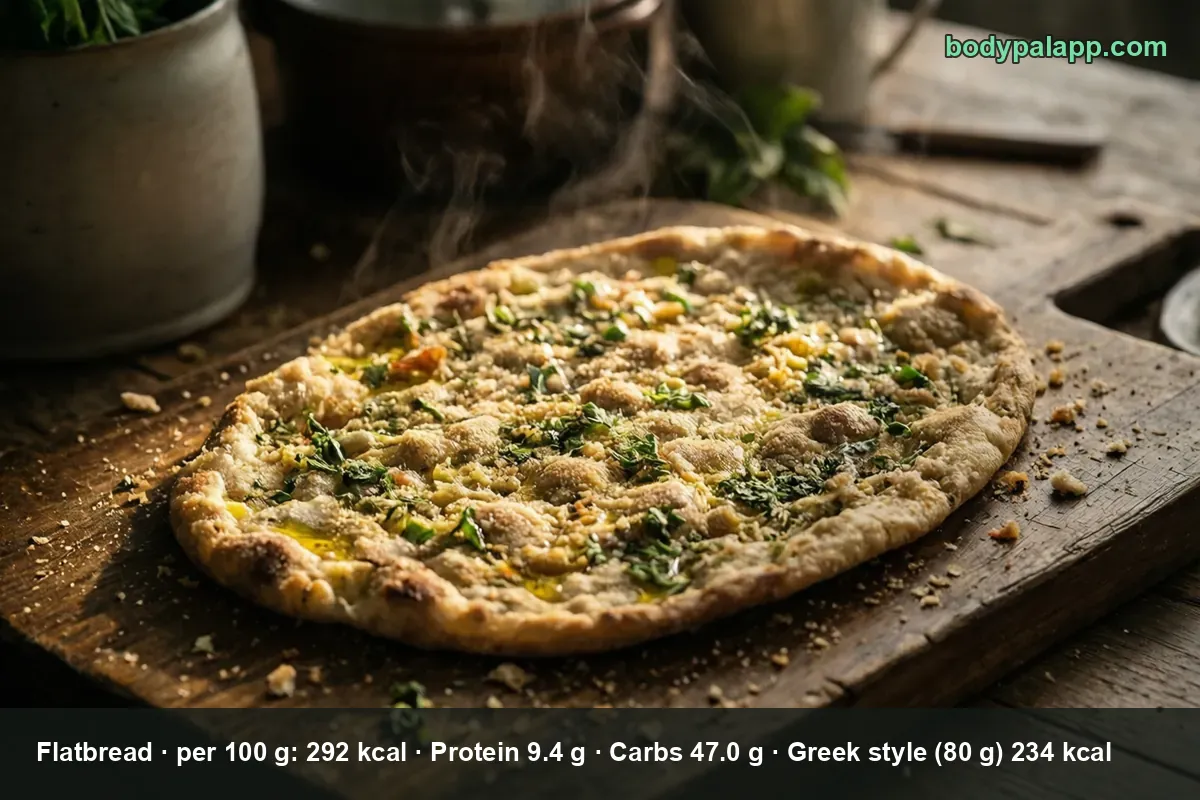
The per-100 g column is the median of 81 UK flatbread labels, plain and unfilled, with thins and flavoured versions taken out. The portion column is one Greek style flatbread, 80 g, because that is the piece most likely to be a meal rather than a component.
| Nutrient | Per 100 g | One Greek flatbread (80 g) | RI%* |
|---|---|---|---|
| Energy | 292 kcal / 1,222 kJ | 234 kcal / 979 kJ | 12% |
| Protein | 9.4 g | 7.5 g | 15% |
| Carbohydrates | 47.0 g | 37.6 g | 14% |
| – of which sugars | 2.9 g | 2.3 g | 3% |
| Fat | 6.2 g | 5.0 g | 7% |
| – of which saturates | 0.7 g | 0.6 g | 3% |
| Fibre | 4.2 g | 3.4 g | 11% |
| Salt | 0.8 g | 0.64 g | 11% |
Verified nutrition data
Numbers on this page come from CoFID, the UK government’s Composition of Foods Integrated Dataset, and from manufacturer labels where a branded product is named. Last verified September 2026. How we verify our data →
*RI% = one 80 g flatbread's share of an adult's daily reference intake, based on 2,000 kcal.
The protein row is the quiet surprise: 9.4 g per 100 g puts flatbread ahead of most sliced loaves. Salt at 0.8 g per 100 g is the other one, and it goes the right way too.
One word, three different breads
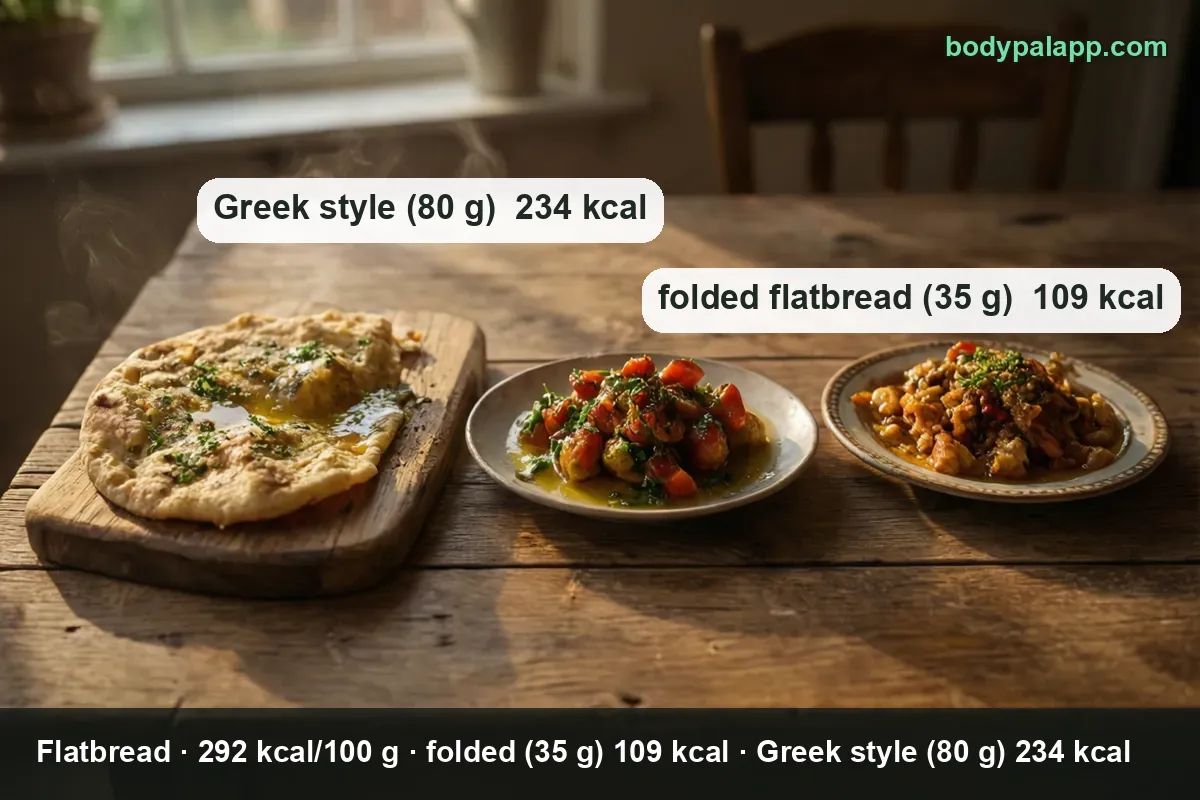
Type "flatbread" into a food diary and the app has no idea which of these you are holding. They differ by a factor of nine.
| Type | What it is | One piece | Per 100 g | Calories each |
|---|---|---|---|---|
| Folded flatbread | thin, soft, six to a pack, used instead of a wrap | 33–35 g | 310 kcal | ~109 kcal |
| Greek / Mediterranean | thick, soft, four to a pack, used for kebabs and grills | 80–100 g | 290 kcal | 232–290 kcal |
| Flatbread thins | a cracker with a bread name | 7–10 g | 422 kcal | 30–39 kcal |
Read the middle column and the thins look like the worst thing here — 422 kcal per 100 g against 310 for the folded. Read the last column and they are the lightest by a mile. Both readings are true, and the reason is weight: nobody eats 100 g of crispbread.
Note also that the Greek group's own median, 290 kcal per 100 g, lands within two calories of the all-flatbread median of 292. The big soft ones are the centre of gravity of the whole category.
Why there is no official UK figure
Search hard enough and you will notice something missing. The UK government's food composition table has pitta. It has naan, plain and peshwari. It has soft wheat tortilla, and chapatis both with and without fat. It does not have flatbread.
Not a rounding issue or a naming quirk — there is no entry at all. The category filled a supermarket shelf faster than the national dataset was revised, so every flatbread calorie figure in circulation, including ours, is built from manufacturer labels rather than a laboratory.
That is worth saying out loud, because it changes how much precision anyone should claim. The 81 labels behind the 292 figure spread from 202 to 365 kcal per 100 g. A median is the right tool for that spread; a single "official" number would be false comfort.
It also means the label in your hand beats this page. Where a pack states its own figure, use it.
UK portions, pack by pack
The packs do the arithmetic for you, and three separate chains agree on it.
Folded flatbreads come six to a 210 g pack — Tesco, M&S and Asda all print that weight — so one flatbread is exactly 35 g. Greek style ones come four to a 320 g pack, so one is 80 g. Tesco and Co-op sell an 85 g version in a 340 g pack. Crispbread thins run 7 to 10 g each in a 125 g box.
| Portion | Weight | Calories |
|---|---|---|
| One flatbread thin | 7–9 g | 30–39 kcal |
| One folded flatbread | 35 g | 109 kcal |
| Two folded flatbreads | 70 g | 217 kcal |
| One Greek style flatbread | 80 g | 232 kcal |
| One Greek style flatbread | 85 g | 247 kcal |
| One large flatbread | 100 g | 290 kcal |
| Warburtons Protein Flatbread | 62.5 g | 147 kcal |
The Warburtons row is the one worth circling. At 62.5 g it delivers 147 kcal and 8.1 g of protein — 5.5 g of protein per 100 kcal, against 3.2 g for an ordinary folded flatbread. Of all the products on the shelf using a nutrition word in the name, that is the one where the word earns its place.
Salt tracks the weight in the obvious way: 0.28 g in a folded flatbread, 0.64 g in an 80 g Greek one. The second is 11% of the 6 g a day NHS sets as the adult limit, which is unremarkable for bread — and considerably better than the tortilla it usually replaces.
Folded flatbread against a wrap
This is the swap that actually shows up in a food diary, so it deserves the real numbers rather than a shrug.
| Item | Per 100 g | One piece | Calories |
|---|---|---|---|
| Folded flatbread | 310 kcal | 35 g | 109 kcal |
| Wrap | 306 kcal | large, 64 g | 196 kcal |
| White bread | 236 kcal | two slices | 170 kcal |
| Bagel | 264 kcal | one | 230 kcal |
Per 100 g the flatbread and the wrap are practically identical, 310 against 306. Per item the flatbread costs 44% less, purely because it weighs half as much. A Mission Original wrap at 61 g and 308 kcal per 100 g comes to 188 kcal, which confirms the shape of it from a second brand.
Against two slices of white bread the folded flatbread saves 61 calories at roughly the same protein. Against a bagel it saves 121, which is the difference between a light lunch and a heavy one.
Our take: for the same sandwich, the folded flatbread is the best-value bread in this table and it is not a close contest. The wrap only wins if you need something that rolls without cracking. If you want the comparison in full, our wrap versus bread page runs the same arithmetic across a whole week of lunches.
Flatbread thins are crackers
Ryvita Thins, Peter's Yard, Nairn's, the Lidl and Aldi own-labels — all sold as flatbreads, none of them bread in any useful sense.
The median across 20 of them is 422 kcal per 100 g, ranging 359 to 461. For scale, our crisps page puts a bag of crisps at 493 kcal per 100 g. Flatbread thins sit 14% below crisps and 45% above an actual flatbread. As a density, they are in the cracker league, where they belong.
What saves them is the serving. One thin weighs 7 to 9 g, so it costs 30 to 39 calories — while a 25 g bag of crisps costs 123. Three thins with cheese is about 100 calories of base. The trap is only ever the fourth, fifth and sixth.
Fibre is genuinely high in this group, 6.5 to 9.4 g per 100 g on the labels, though a 7 g cracker turns that into a fraction of a gram. The NHS target of 30 g of fibre a day is not going to be met by crispbread.
Flatbread next to the rest of the bread aisle
| Item | Per 100 g | Salt per 100 g |
|---|---|---|
| Chapati, no fat | 202 kcal | 0.30 g |
| White pitta | 255 kcal | 1.00 g |
| Naan | 285 kcal | 0.90 g |
| Soft wheat tortilla | 285 kcal | 1.56 g |
| Flatbread, UK label median | 292 kcal | 0.80 g |
| Chapati made with fat | 328 kcal | 0.75 g |
Flatbread lands between the pitta and the fatty chapati, and within seven calories of both naan and tortilla. On calories alone there is nothing to choose between the four of them.
Salt is where the gap opens. At 0.80 g per 100 g the flatbread carries half the salt of a tortilla and a fifth less than a pitta. Since starchy foods make up the largest share of most British plates, and bread is one of the biggest single salt contributors in the national diet, that is the row that matters over a month.
Our take: pick the Greek style flatbread when it is the meal — 232 kcal with 5.4 g of fibre in the Deli Kitchen version is a better base than any pitta. Pick the folded one when the bread is just the wrapper, because 109 kcal is the cheapest way to hold a filling in this aisle. Leave the thins for cheese.
Popular flatbread brands in the BodyPal food database
Ranked by how widely each product appears among foods sold in the United Kingdom, from the BodyPal food database of over 3.3 million products. Calories are the figures printed on each label.
| Product | Calories (per 100 g) |
|---|---|
| White Folded Flatbreads (Tesco) | 291 kcal |
| Deli Kitchen Plain Folded | 295 kcal |
| Folded Flatbreads (Asda) | 309 kcal |
| Plain Folded Flatbreads (Sainsbury's) | 318 kcal |
| Deli Kitchen Greek Style | 255 kcal |
Brand popularity: BodyPal food database. Nutrition: manufacturer labels.
Flatbread FAQs
How many calories in a flatbread?
It depends which of three products you have. A folded flatbread of 35 g is 109 kcal, a Greek style one of 80 g is 232 kcal, and a flatbread thin of 7 to 9 g is 30 to 39 kcal. The median across 81 UK labels is 292 kcal per 100 g.
How many calories in a folded flatbread?
109 kcal for one 35 g flatbread, at a median of 310 kcal per 100 g. The pack weight settles the portion: six flatbreads in 210 g, printed identically by Tesco, M&S and Asda. Two of them come to 217 kcal.
How many calories in a Greek style flatbread?
232 kcal for an 80 g flatbread, which is four to a 320 g pack. The 85 g version sold by Tesco and Co-op is 247 kcal, and a 100 g piece reaches 290. The group median is 290 kcal per 100 g.
Flatbread or wrap — which has fewer calories?
The folded flatbread, by 87 calories: 109 kcal against 196 for a large wrap. Per 100 g they are nearly identical at 310 and 306, so the whole saving comes from weight — a flatbread is about half the size of a wrap.
How many calories in flatbread thins?
30 to 39 kcal per thin, depending on brand, from a median of 422 kcal per 100 g. Ryvita's 7 g version is 32 kcal and Nairn's 10 g sourdough is 44. As a density they sit closer to crisps at 493 kcal per 100 g than to bread.
Is flatbread lower in salt than other breads?
Yes, noticeably. The UK flatbread median is 0.80 g of salt per 100 g against 1.56 g for a soft wheat tortilla and 1.00 g for a white pitta. One 80 g Greek flatbread carries 0.64 g, which is 11% of the 6 g daily limit.
How much protein is in a flatbread?
9.4 g per 100 g at the median, so 7.5 g in an 80 g Greek flatbread and 3.3 g in a 35 g folded one. Warburtons Protein Flatbread is the outlier at 13.0 g per 100 g, giving 8.1 g in a 62.5 g piece for 147 kcal.
Why is there no official flatbread calorie figure?
Because the UK government food composition table has no flatbread entry. It covers pitta, naan, tortilla and chapati, but the category grew on supermarket shelves faster than the dataset was revised, so every published figure comes from manufacturer labels instead.
Similar foods
- Focaccia — 252 kcal per 90 g square
- Tortilla wrap — 196 kcal per large wrap
- Hot cross bun — 218 kcal each
- Bagel — 230 kcal each
- Baguette — 658 kcal whole
- Jam doughnut — ~241 kcal each
Count it without the maths
Photograph the pack and BodyPal works out which flatbread you are holding and what it costs.


How long does it take to burn off flatbread?
A folded flatbread (35 g) is 109 kcal. Enter your weight and the amount you ate to see how long it takes you to burn that off:
lb
| Activity | Time to burn 109 kcal |
|---|---|
| Walking, brisk | 22 min |
| Cycling, moderate | 14 min |
| Swimming, moderate | 16 min |
| Jogging | 13 min |
| Weight training, moderate | 24 min |
Times are for a 154 lb (11 st) adult at a steady pace; change the weight to see yours. The amount is set to the portion in the text (35 g); change it to what you actually ate. BodyPal works this out from your steps automatically.
Want the bigger picture? Calculate your daily calorie needs — your maintenance figure, a target for losing or gaining, and the date you get there.