
Wrap vs Bread: Which Has Fewer Calories?
Bread wins, both ways: two medium slices of white bread come to 170 kcal against 196 kcal for a single large flour wrap, and per 100 g the gap is wider still at 236 kcal versus 306 kcal. That makes a wrap about 30% more calorie-dense than the bread it replaces. So if you have ever wondered are wraps healthier than bread, the maths says no. The wrap's health-food image is packaging, not nutrition.
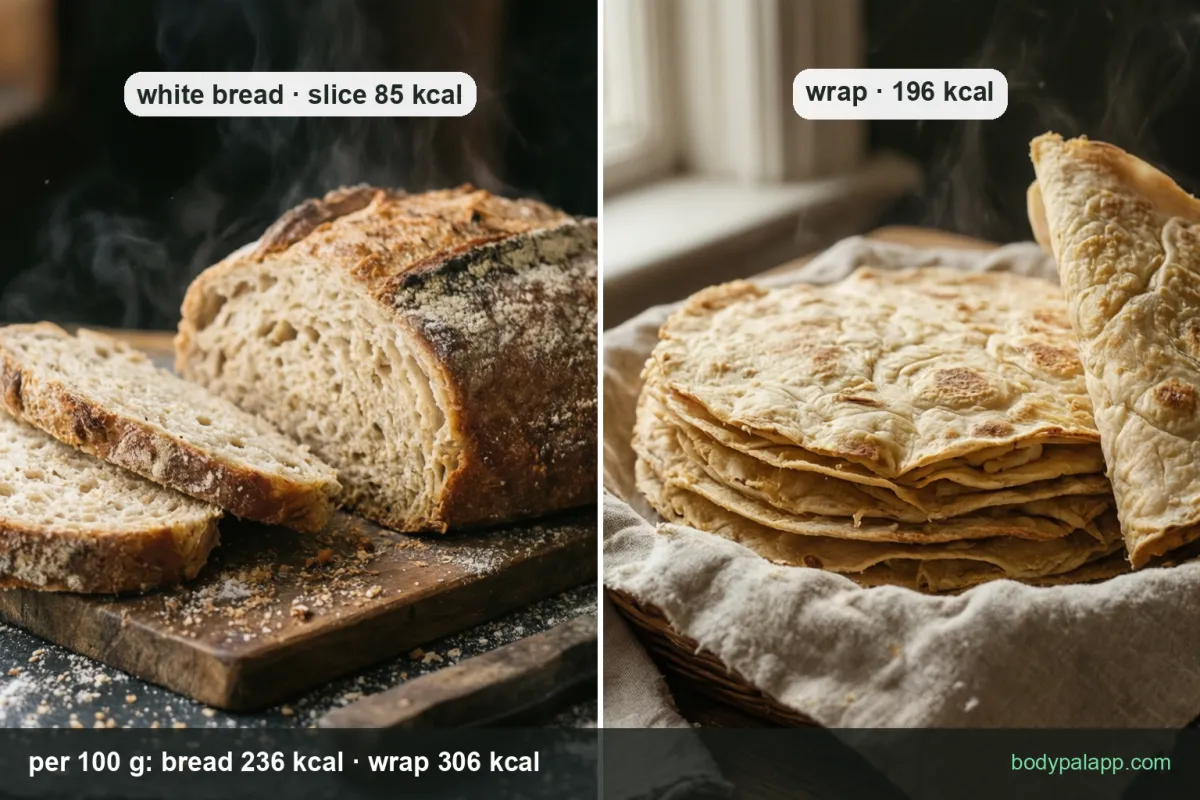
Wrap vs bread side by side
| Nutrient | Large wrap (64 g) | 2 slices white bread (72 g) | Wrap per 100 g | White bread per 100 g |
|---|---|---|---|---|
| Energy | 196 kcal / 820 kJ | 170 kcal / 711 kJ | 306 kcal / 1,280 kJ | 236 kcal / 987 kJ |
| Protein | 5.2 g | 6.3 g | 8.2 g | 8.7 g |
| Carbohydrate | 31.6 g | 35.1 g | 49.4 g | 48.7 g |
| Fat | 5.1 g | 1.5 g | 8.0 g | 2.1 g |
| Fibre | 2.2 g | 2.1 g | 3.5 g | 2.9 g |
| Salt | 1.1 g (18% RI) | 0.7 g (12% RI) | 1.75 g (29% RI) | 1.0 g (17% RI) |
Verified nutrition data
Numbers on this page come from CoFID, the UK government’s Composition of Foods Integrated Dataset, and from manufacturer labels where a branded product is named. Last verified August 2026. How we verify our data →
RI = Reference Intake for an average adult (2,000 kcal; salt 6 g).
Where the extra calories come from
Look at the fat row. A large wrap carries 5.1 g of fat against 1.5 g in two slices of bread, and that is the whole story. Flour tortillas are made with added fat to keep them pliable enough to roll without cracking. Bread gets its structure from gluten and time, so it needs almost none.
Everything else is close. Protein is near-identical, carbohydrate is near-identical, and fibre in the standard white versions differs by a rounding error. The wrap simply arrives with a tablespoon's worth of oil already worked into it.
Salt is the second gap, and it gets less attention than it deserves. One wrap delivers 1.1 g of salt before anything goes inside it, against 0.7 g for two slices. The NHS advises adults to stay under 6 g of salt a day, so a wrap-based lunch has spent nearly a fifth of that allowance on the container alone.
When to pick bread
Pick bread if you are counting calories. Two slices give you a full sandwich for 170 kcal, which is 26 kcal less than one wrap, and one medium slice on its own is just 85 kcal. That single-slice option matters: there is no half-wrap. Once you open a wrap you are committed to all 196 kcal, while bread lets you build an open sandwich or a piece of toast and stop there.
Bread is also the lower-salt choice at every serving size compared here. And it is easier to portion honestly, because slices are pre-measured and a "large" wrap in one shop is a "regular" in another. The full breakdown, including toast and thick-cut slices, is on our white bread calories page.
When to pick a wrap
Pick a wrap when you actually prefer eating one. A 26 kcal difference over a lunch is a rounding error next to the question of what actually keeps you fed until dinner, and a wrap holds fillings that fall straight out of a sandwich. Roasted vegetables, shredded chicken, anything with a sauce. If wraps make you eat a better lunch, the maths is on your side.
The other genuine reason is fibre, and this is where the wrap earns a real win. A wholemeal wrap comes in at 310 kcal per 100 g, so essentially the same energy as the white version, but it carries 9.8 g of fibre per 100 g against 2.9 g in white bread. That is close to three and a half times the fibre for no calorie penalty at all. Most UK adults fall short of the 30 g of fibre a day recommended in the Eatwell Guide, and swapping a white wrap for a wholemeal one is one of the cheaper ways to close part of that gap. Per-portion numbers for both styles sit on our wrap calories page.
The verdict, plainly: white wrap versus white bread, bread wins on calories and salt. Wholemeal wrap versus white bread, the wrap wins on fibre and loses on calories. There is no version of this comparison where a plain white wrap is the healthier choice.
Most popular wrap and bread brands in the United Kingdom
Ranked by how widely each product appears among foods sold in the United Kingdom, from the BodyPal food database of over 3.3 million products. Calories are the figures printed on each label.
| Product | Calories (per 100 g) |
|---|---|
| Mission Wraps | 305 kcal |
| Old El Paso Soft Tortillas | 299 kcal |
| Warburtons Danish Lighter White | 239 kcal |
| Kingsmill Thick Soft White | 238 kcal |
| BFree Multigrain Wraps | 193 kcal |
Brand popularity: BodyPal food database. Nutrition: manufacturer labels.
FAQ
Are wraps healthier than bread?
No, not as a rule. A large flour wrap is 196 kcal against 170 kcal for two slices of white bread, and per 100 g a wrap is 306 kcal versus 236 kcal. Wraps also carry more salt (1.75 g per 100 g against 1.0 g). The one real advantage is a wholemeal wrap's fibre.
Which has fewer calories, a wrap or bread?
Bread, on both measures. Two medium slices of white bread are 170 kcal, while one large wrap is 196 kcal. Per 100 g bread is 236 kcal against 306 kcal for a wrap, making wraps roughly 30% more calorie-dense. A single slice of bread is 85 kcal.
Are wraps good for weight loss?
They can be, but they are not the easier option. One large wrap is 196 kcal, and it cannot be split the way bread can, so a wrap lunch starts higher and stays there. If you want the lowest-calorie base, an open sandwich on one 85 kcal slice beats both.
Wrap or bread for sandwiches?
For calorie counting, bread: two slices at 170 kcal build a full sandwich for less than one 196 kcal wrap, with 0.7 g of salt against 1.1 g. Wraps hold loose or saucy fillings better, so pick them for practicality rather than nutrition.
Is a wholemeal wrap healthier than white bread?
On fibre, clearly yes. A wholemeal wrap has 9.8 g of fibre per 100 g against 2.9 g in white bread, close to three and a half times as much. It is still higher in calories at 310 kcal per 100 g versus 236 kcal, so it is a fibre upgrade rather than a calorie one.
More comparisons
- Bagel vs bread — the unit is the trap
- Crumpet vs toast — a 10-kcal tie with a salt catch
- Chicken vs duck eggs — 66 vs 106 kcal each
- Chicken vs turkey — 147 vs 155 kcal per 100 g
Track it either way
BodyPal logs a wrap or a round of sandwiches from one photo, with the calories, salt and fibre already filled in.


Burning it off is one side of it. The other is knowing your number: work out how many calories you need a day, with macros and a goal date.