
Chicken vs Turkey: Which Has Fewer Calories?
Chicken has fewer calories than turkey, 147 against 155 per 100 g of grilled breast, and that is the only line chicken wins. Turkey carries 35 g of protein to chicken's 29.8 and roughly half the fat, 1.7 g against 3.1. Per calorie of protein, turkey is the leaner meat.
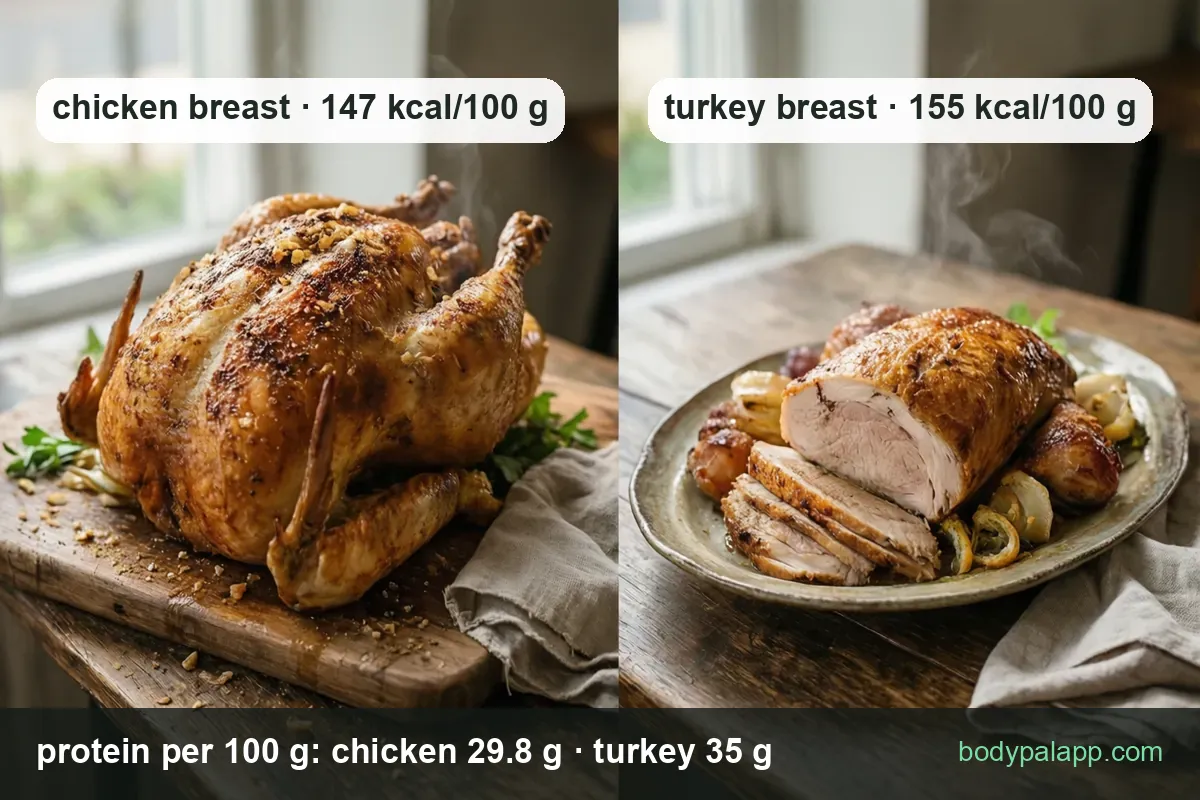
The numbers side by side
Grilled breast fillets, per item and per 100 g:
| Nutrient | Chicken breast, per fillet (~130 g) | Chicken, per 100 g | Turkey breast, per fillet (~125 g) | Turkey, per 100 g |
|---|---|---|---|---|
| Energy | 191 kcal / 799 kJ | 147 kcal / 615 kJ | 194 kcal / 812 kJ | 155 kcal / 649 kJ |
| Protein | 38.7 g | 29.8 g | 43.8 g | 35.0 g |
| Carbohydrate | 0 g | 0 g | 0 g | 0 g |
| of which sugars | 0 g | 0 g | 0 g | 0 g |
| Fat | 4.0 g | 3.1 g | 2.1 g | 1.7 g |
| Fibre | 0 g | 0 g | 0 g | 0 g |
| Salt | 0.20 g | 0.15 g | 0.29 g | 0.23 g |
On the plate the two fillets are three calories apart, which is nothing. The interesting rows are protein and fat, and both point the same way. Turkey fits 22.6 g of protein into every 100 kcal; chicken manages 20.3 g. Turkey's fat is 1.7 g per 100 g with 0.61 g saturated; chicken's is 3.1 g with 0.9 g saturated.
Why does the leaner meat carry more calories per 100 g? Density. Turkey breast holds less water, so each 100 g contains more actual meat, and protein brings energy with it. The extra 8 kcal is extra protein, not extra fat.
The picture holds beyond the breast. As roasting averages across light and dark meat, turkey comes out at 166 kcal per 100 g and chicken at 177, and turkey's casseroled thigh at 181 undercuts chicken's at 233 by a wide margin.
When to pick chicken
Pick chicken when the recipe does the deciding. It is cheaper per kilo in most shops, sold in more cuts, and its grilled breast still delivers 77% of a day's protein reference intake in one ~130 g fillet for 191 kcal. Nothing about chicken breast needs fixing.
Verified nutrition data
Numbers on this page come from CoFID, the UK government’s Composition of Foods Integrated Dataset, and from manufacturer labels where a branded product is named. Last verified August 2026. How we verify our data →
It is also the right call when you want skin-on flavour with a known cost: breast with the skin eaten is 173 kcal per 100 g, a modest premium over 147. Our chicken breast guide breaks down every cut, from drumstick at 152 to thigh at 233.
When to pick turkey
Pick turkey when protein is the point. A cutting diet built around 43.8 g of protein per 194-kcal fillet leaves more calories free for everything else on the plate, and the NHS advice on meat leans towards exactly this kind of lean cut.
Turkey is also the better dark-meat bird. If breast bores you, turkey thigh at 181 kcal per 100 g costs 52 less than chicken thigh, and the full cut-by-cut spread is in our turkey guide. The usual objection is dryness, and it is really a timing problem: less fat means less margin for overcooking.
Most popular chicken and turkey brands in the United Kingdom
Ranked by how widely each product appears among foods sold in the United Kingdom, from the BodyPal food database of over 3.3 million products. Calories are the figures printed on each label. Ready-to-eat deli slices; the fresh-meat figures in the table above are for plain fillet.
| Product | Calories (per 100 g) |
|---|---|
| Bernard Matthews Turkey Breast Slices | 97 kcal |
| Glensallagh Cooked Chicken Slices (Lidl) | 103 kcal |
| Glensallagh Cooked Turkey Slices (Lidl) | 104 kcal |
| Ashfield Farm Roast Turkey Breast Slices | 114 kcal |
| Butchers Choice Cooked Chicken Slices | 115 kcal |
Brand popularity: BodyPal food database. Nutrition: manufacturer labels.
Frequently asked questions
Which has fewer calories, chicken or turkey?
Chicken, narrowly: grilled chicken breast is 147 kcal per 100 g against 155 for grilled turkey breast. As whole roasted birds the order flips, with turkey meat averaging 166 kcal per 100 g and chicken 177, because turkey's dark meat is leaner.
Which has more protein, chicken or turkey?
Turkey. Grilled turkey breast holds 35 g of protein per 100 g against 29.8 g for chicken breast, and per 100 kcal it carries 22.6 g against chicken's 20.3. A single ~125 g turkey fillet supplies 43.8 g, close to the full 50 g daily reference intake.
Is turkey healthier than chicken?
On the numbers turkey is the leaner meat: 1.7 g of fat per 100 g of grilled breast against 3.1 g, and 0.61 g of saturated fat against 0.9 g. Both are lean, high-protein choices; turkey simply pushes the same profile further.
Which is better for weight loss, chicken or turkey?
Turkey, by a nose. A 194-kcal turkey fillet brings 43.8 g of protein, so each calorie buys more fullness, which is what a deficit runs on. Chicken breast at 191 kcal and 38.7 g is close enough that price and preference can settle it.
Is roast turkey lighter than roast chicken?
Yes. Averaged across light and dark meat, roast turkey is 166 kcal per 100 g and roast chicken 177. The gap widens at the thigh, 181 against 233, because turkey's dark meat carries roughly half the fat of chicken's.
More comparisons
- Chicken vs duck eggs — 66 vs 106 kcal each
- Bagel vs bread — the unit is the trap
- Crumpet vs toast — a 10-kcal tie with a salt catch
- Wrap vs bread — which has fewer calories
Count it without the maths
Whichever bird lands on the plate, BodyPal logs the fillet and everything beside it from one photo.


Want the bigger picture? Calculate your daily calorie needs — your maintenance figure, a target for losing or gaining, and the date you get there.