
Calories in Chicken Breast, and Every Other Cut on the Bird
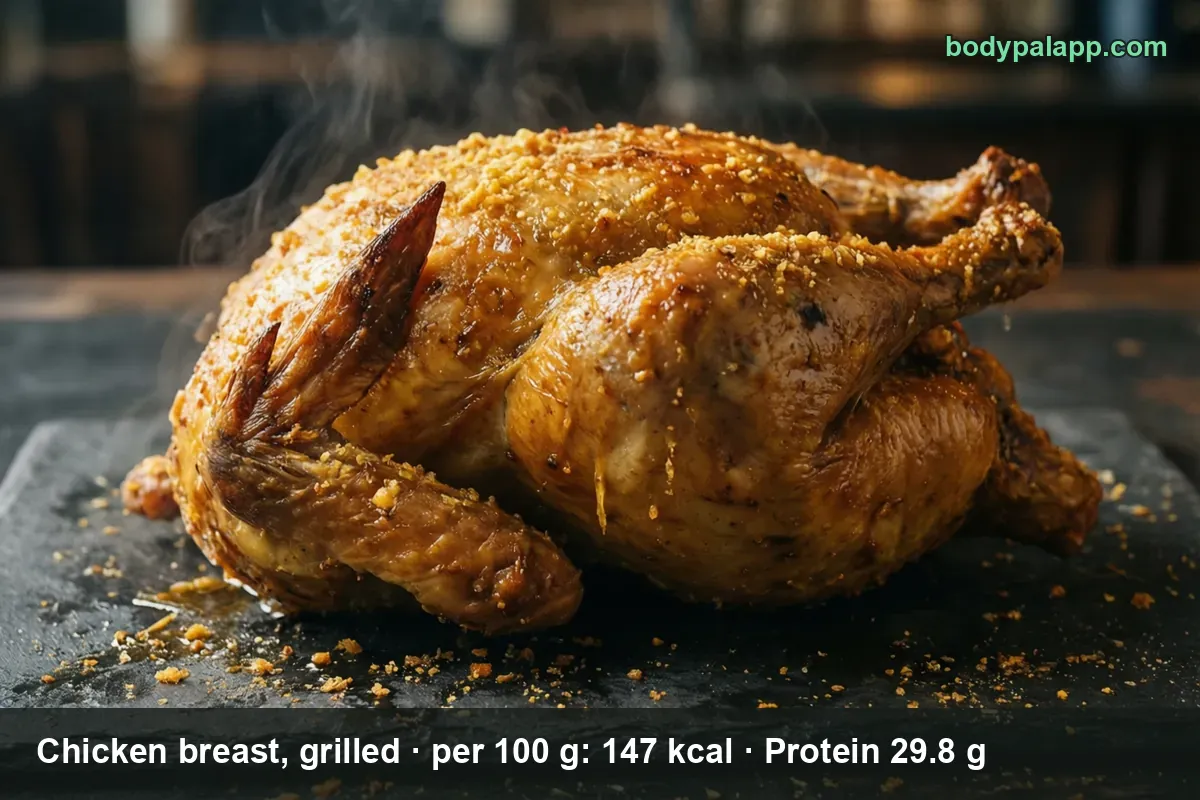
The calories in chicken breast come to 147 per 100 g grilled, so a typical ~130 g fillet lands at 191. Strip the skin off before cooking and the figure barely moves: 148. The gap people fear is one calorie, and the rest of the bird is where the real differences live.
On this page
- Chicken breast nutrition at a glance
- UK portions, from a drumstick to a roast plate
- The skin myth: 147 with, 148 without
- Thigh, leg and wing: the dark-meat premium
- A whole chicken, raw and roasted
- Nuggets are a different food
- How does chicken breast compare?
- Most popular chicken brands
- FAQ
Chicken breast nutrition at a glance
| Nutrient | Per 100 g, grilled | Per ~130 g fillet | %RI* per fillet |
|---|---|---|---|
| Energy | 147 kcal / 615 kJ | 191 kcal / 799 kJ | 10% |
| Protein | 29.8 g | 38.7 g | 77% |
| Carbohydrate | 0 g | 0 g | 0% |
| of which sugars | 0 g | 0 g | 0% |
| Fat | 3.1 g | 4.0 g | 6% |
| Fibre | 0 g | 0 g | – |
| Salt | 0.15 g | 0.20 g | 3% |
*%RI = percentage of the reference intake for an average adult (2,000 kcal; 70 g fat, 260 g carbohydrate, 90 g sugars, 50 g protein, 6 g salt).
Verified nutrition data
Numbers on this page come from CoFID, the UK government’s Composition of Foods Integrated Dataset, and from manufacturer labels where a branded product is named. Last verified August 2026. How we verify our data →
One fillet covers 77% of an adult's daily protein reference intake for a tenth of the day's energy. That ratio is the whole reason this cut sits in every meal-prep container in the country.
Saturated fat is 0.9 g per 100 g, and the salt is 0.15 g before you touch the grinder. Seasoning, marinades and shop-bought coatings are what move chicken up the NHS salt arithmetic, not the meat.
UK portions, from a drumstick to a roast plate
| Portion | Weight | Calories |
|---|---|---|
| Grilled breast fillet | ~130 g cooked | 191 kcal |
| Skinless grilled fillet | ~130 g cooked | 192 kcal |
| Casseroled thigh, meat and skin | ~85 g cooked | 198 kcal |
| Roast drumstick, meat only | ~55 g meat | 84 kcal |
| Roast chicken serving, meat only | ~140 g | 248 kcal |
The fillet and the thigh sit ten calories apart on the plate, which surprises people who think of thigh as the indulgent cut. It is, per gram. A thigh simply weighs less than a fillet, so the portion maths forgives it.
The roast serving is worth reading twice: 140 g of mixed roast meat is 248 kcal on its own, before the potatoes, stuffing or anything from our full English breakfast school of plate-building arrives alongside it.
The skin myth: 147 with, 148 without
Here is the line that breaks most diet folklore. Chicken breast grilled with the skin on, skin then left on the plate, is 147 kcal per 100 g. The same breast grilled without any skin is 148.
Higher, without the skin. The reason is water. Cooking bare meat drives off more moisture, so every 100 g of skinless breast is slightly more concentrated: 32 g of protein against 29.8, and 2.2 g of fat against 3.1. The skin acts as a lid during cooking, and its fat mostly stays in the skin.
Eating the skin is the actual decision. Breast with the skin eaten is 173 kcal per 100 g, which turns a 130 g fillet from 191 into roughly 225. That is a 34-calorie choice, not a catastrophe, and crisp skin is arguably the best thing the bird produces. Log it honestly and have it when it is worth it.
Thigh, leg and wing: the dark-meat premium
| Cut | kcal per 100 g | Protein | Fat |
|---|---|---|---|
| Breast, grilled | 147 | 29.8 g | 3.1 g |
| Drumstick, roasted, meat only | 152 | 26.6 g | 5.1 g |
| Roast meat, average | 177 | 27.3 g | 7.5 g |
| Wing quarter, raw, meat and skin | 193 | 20.3 g | 12.4 g |
| Leg quarter, raw, meat and skin | 193 | 18.3 g | 13.3 g |
| Thigh, casseroled, meat and skin | 233 | 21.5 g | 16.3 g |
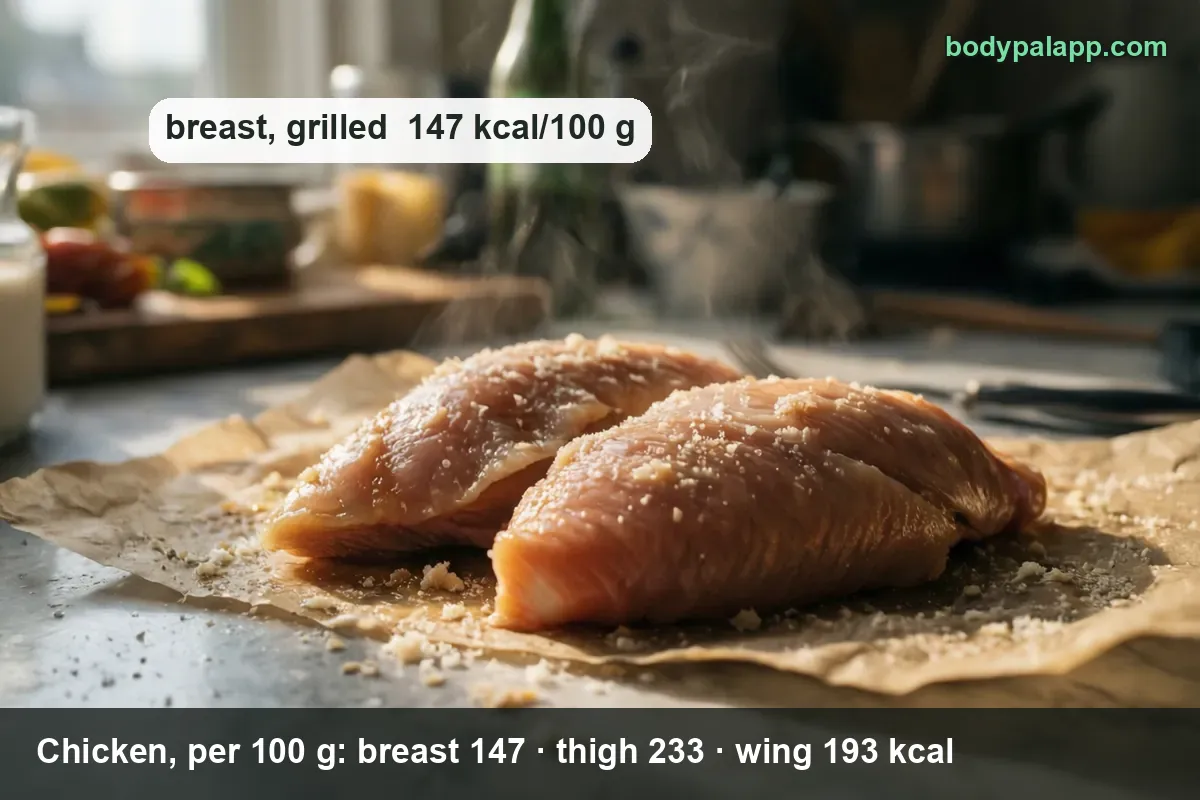
The pattern is fat, and it runs top to bottom. Dark meat carries more of it than breast, and the skin carries more than the meat, so the cuts that keep both, thigh, leg and wing, cost 30 to 60% more per 100 g than the fillet.
Drumstick meat on its own is the quiet exception at 152. Most of a drumstick's reputation comes from what clings to it: the skin, and whatever glaze it was roasted in.
Wings deserve their own caution. At 193 kcal per 100 g raw, meat and skin, they start close to thigh territory, and almost nothing served as a wing arrives without a coating or a sauce. The same logic applies to takeaway spits: the numbers on our doner kebab page show what stacked, fat-basted meat does to a portion.
A whole chicken, raw and roasted
Chicken meat averages 108 kcal per 100 g raw and 177 per 100 g roasted. Nothing was added in the oven. Roughly a third of the water cooked off, so the same protein and fat now sit in fewer grams.
That is why raw and cooked weights cannot share a diary entry. Weigh the meat after cooking and use the cooked figure, or weigh it raw and use 108; mixing the two overstates a portion by a third. For a whole bird, the total depends entirely on its weight, so weigh the meat you actually carve rather than guessing from the label on the bag.
One kitchen habit worth dropping: the Food Standards Agency advises against washing raw chicken, since splashing spreads bacteria around the sink. It does nothing to the calories either.
Nuggets are a different food
Chicken nuggets average 307 kcal per 100 g, with 15.9 g of protein, 14.9 g of carbohydrate and 20.4 g of fat. Set that against the fillet's 147 and the label "chicken" is doing a lot of work: the coating and the frying oil contribute roughly half the energy, and the protein density drops by half.
Nuggets belong in the same mental folder as any other coated, fried food. If the goal is chicken's protein at chicken's price, the fillet, the drumstick and the roast bird are the versions that deliver it.
How does chicken breast compare?
| Food | Portion | kcal per portion | kcal per 100 g | P / C / F per 100 g |
|---|---|---|---|---|
| Chicken breast, grilled | ~130 g fillet | 191 | 147 | 29.8 / 0 / 3.1 |
| Turkey breast, grilled | ~125 g fillet | 194 | 155 | 35.0 / 0 / 1.7 |
| Chicken thigh, casseroled | ~85 g | 198 | 233 | 21.5 / 0 / 16.3 |
| Boiled egg | medium, ~50 g | 72 | 143 | 14.1 / 0 / 9.6 |
The verdict: chicken breast keeps the lowest per-100 g figure on the table, but turkey delivers more protein for almost the same energy, 35 g against 29.8, and less fat. If protein per calorie is the game, turkey edges it; the full head-to-head is in our chicken vs turkey comparison. Eggs win on cost per unit and lose on protein density.
Most popular chicken brands in the United Kingdom
Ranked by how widely each product appears among foods sold in the United Kingdom, from the BodyPal food database of over 3.3 million products. Calories are the figures printed on each label. These are ready-to-eat cooked slices; the grilled breast figures above are for plain meat.
| Product | Calories (per 100 g) |
|---|---|
| Glensallagh Cooked Chicken Slices (Lidl) | 103 kcal |
| J. James British Cooked Chicken Slices | 105 kcal |
| Butchers Choice Cooked Chicken Slices | 115 kcal |
Brand popularity: BodyPal food database. Nutrition: manufacturer labels.
How long does it take to burn off chicken breast?
100 g grilled breast is 147 kcal. Enter your weight and the amount you ate to see how long it takes you to burn that off:
lb
| Activity | Time to burn 147 kcal |
|---|---|
| Walking, brisk | 29 min |
| Cycling, moderate | 18 min |
| Swimming, moderate | 21 min |
| Jogging | 17 min |
| Weight training, moderate | 33 min |
Times are for a 154 lb (11 st) adult at a steady pace; change the weight to see yours. The amount is set to the portion in the text (100 g); change it to what you actually ate. BodyPal works this out from your steps automatically.
Burning it off is one side of it. The other is knowing your number: work out how many calories you need a day, with macros and a goal date.
Frequently asked questions
How many calories are in a chicken breast?
A typical grilled chicken breast fillet of ~130 g is 191 kcal, at 147 kcal per 100 g. It carries 38.7 g of protein, around 77% of an adult's daily reference intake, with 4 g of fat and no carbohydrate. Bigger fillets scale in a straight line from the per-100 g figure.
How many calories are in a skinless chicken breast?
Grilled skinless breast is 148 kcal per 100 g, one calorie more than skin-on at 147, because bare meat loses more water in cooking and ends up denser. The trade is favourable anyway: 32 g of protein per 100 g against 29.8, and 2.2 g of fat against 3.1.
How many calories are in a whole chicken?
Chicken meat averages 108 kcal per 100 g raw and 177 per 100 g roasted, so a whole bird's total depends on its weight rather than a single number. The practical method is to weigh the meat you carve and log it at the roasted figure.
How many calories are in a chicken leg?
A leg quarter runs at 193 kcal per 100 g raw with meat and skin, reflecting the fattier dark meat. A roasted drumstick eaten without skin is far lighter: 152 kcal per 100 g, which is about 84 kcal for the ~55 g of meat on a typical drumstick.
How many calories are in a chicken wing?
Wing quarter with skin is 193 kcal per 100 g raw, with 20.3 g of protein and 12.4 g of fat. Served wings almost always add a coating, glaze or sauce on top of that, so the plate figure depends more on the recipe than on the wing itself.
Chicken breast vs thigh: what is the difference?
Grilled breast is 147 kcal per 100 g; casseroled thigh with skin is 233. The 86-calorie gap is fat, 16.3 g against 3.1. On the plate the gap shrinks, since a thigh weighs less than a fillet: roughly 198 kcal against 191 for typical portions.
How many calories are in chicken nuggets?
Chicken nuggets average 307 kcal per 100 g, more than double a grilled fillet's 147. The coating and frying add carbohydrate and fat while halving the protein density to 15.9 g per 100 g. Count them as a fried food that contains chicken, not as chicken.
Is chicken breast good for weight loss?
At 147 kcal per 100 g with 29.8 g of protein, a fillet delivers most of a day's protein reference intake for about 10% of a 2,000 kcal day, which suits a deficit well. The number to watch is the cooking method: coatings and frying can double the figure.
Why does cooked chicken have more calories than raw?
Raw chicken meat averages 108 kcal per 100 g and roasted meat 177 because roughly a third of the water evaporates in the oven. The energy stays the same while the weight falls. Always match the figure to the state you weighed: raw with raw, cooked with cooked.
Similar foods
- Chicken chow mein — 588 kcal a takeaway box
- Chinese takeaway — 147 kcal per 100 g chow mein
- Indian takeaway — 145 kcal per 100 g chicken curry
- Spaghetti bolognese — ~680 kcal a plate
- Turkey — 155 kcal per 100 g breast
- Chicken tikka masala — ~546 kcal the curry alone
Count it without the maths
Snap the plate and BodyPal logs the fillet, the roast slices and whatever came with them from one photo, so the cut-by-cut arithmetic stays out of your head.

