
Calories in an Indian Takeaway: Curry, Bread, Rice and Sides
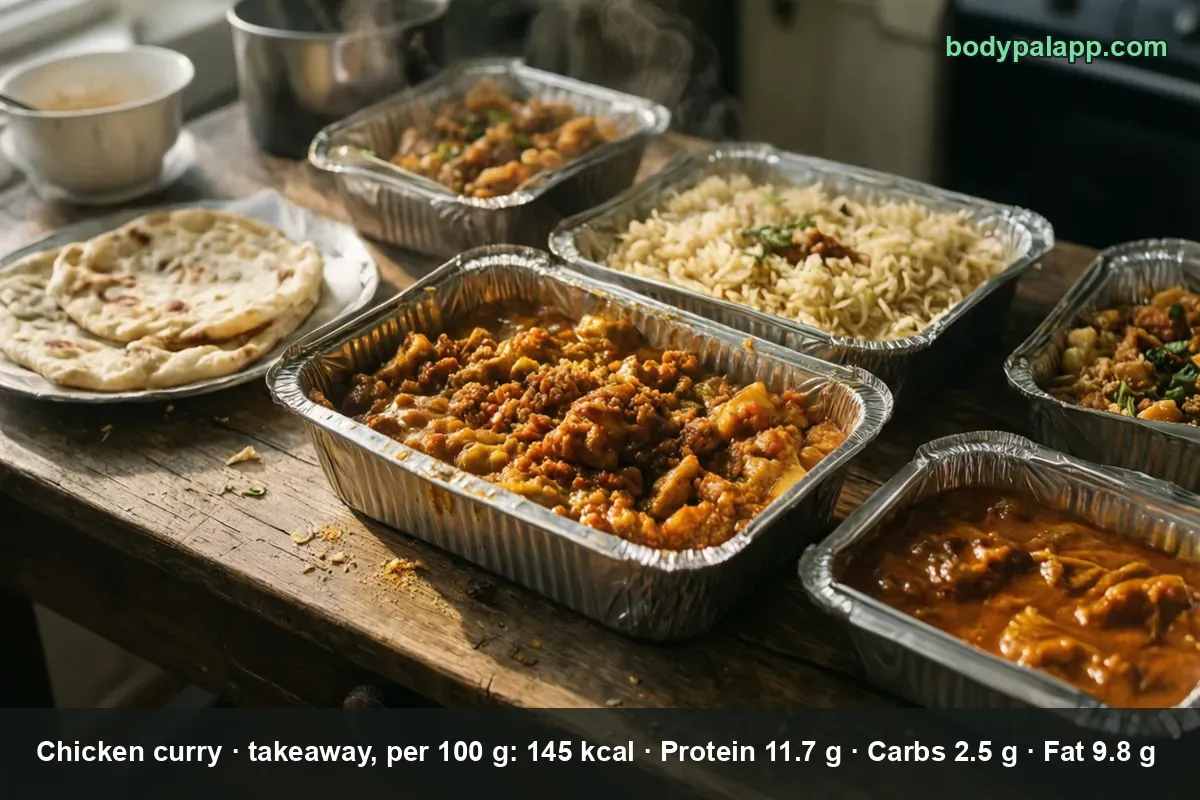
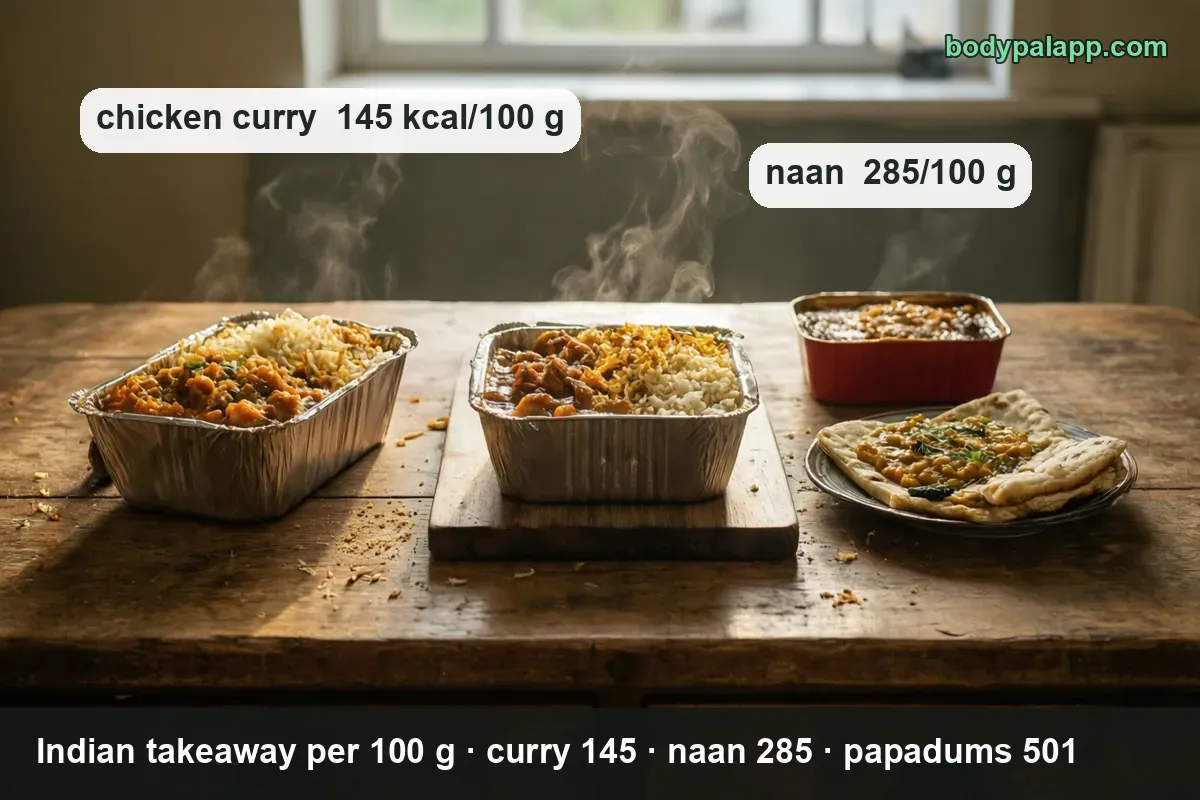
Chicken curry is 145 calories per 100 g. Naan is 285 and poppadoms are 501. Almost everyone counting the calories in an Indian takeaway keeps an eye on the curry and none at all on the bread, and the numbers say that instinct is precisely backwards. The sauce is the light part of the meal.
On this page
- Chicken curry nutrition
- The bread is the expensive part
- Curry by curry
- The peshwari paradox
- Starters and sides
- Rice, and the one dish with no salt in it
- Jar sauce against the restaurant
- Building the lighter order
- Most popular Indian takeaway brands in the United Kingdom
- FAQ
Chicken curry nutrition
The reference figure comes from an average of fifty takeaway samples covering korma, tikka masala, dhansak, jalfrezi and dopiaza. One number for the category, rather than a guess at which one you ordered.
| Nutrient | Per 100 g | RI%* |
|---|---|---|
| Energy | 145 kcal / 607 kJ | 7% |
| Protein | 11.7 g | 23% |
| Carbohydrates | 2.5 g | 1% |
| – of which sugars | 1.2 g | 1% |
| Fat | 9.8 g | 14% |
| – of which saturates | 2.87 g | 14% |
| Fibre | 2.2 g | – |
| Salt | 0.89 g | 15% |
*RI% = share of an adult's daily reference intake per 100 g, based on 2,000 kcal.
Verified nutrition data
Numbers on this page come from CoFID, the UK government’s Composition of Foods Integrated Dataset, and from manufacturer labels where a branded product is named. Last verified September 2026. How we verify our data →
Look at the carbohydrate row. Two and a half grams per 100 g, which is nothing. A curry is meat, onion, oil and spice, and it delivers 11.7 g of protein for 145 kcal, which is a better protein-to-calorie ratio than most things served in a foil container in this country. The 2.2 g of fibre comes from the onions and the pulses that thicken the sauce.
The fat is real at 9.8 g per 100 g, and roughly a third of it is saturated. But nothing in this table explains why an Indian takeaway has a reputation as the heaviest meal of the British week. That explanation is on the side plate.
The bread is the expensive part
Three items arrive alongside the curry and none of them is counted by anybody.
| Bread and crisps, per 100 g | Calories | Protein | Carbs | Fat | Saturates | Fibre |
|---|---|---|---|---|---|---|
| Poppadoms, takeaway | 501 kcal | 11.5 g | 28.3 g | 38.8 g | 7.95 g | 6.3 g |
| Naan, retail | 285 kcal | 7.8 g | 50.2 g | 7.3 g | 0.97 g | 2.9 g |
| Peshwari naan | 251 kcal | 7.6 g | 39.8 g | 7.9 g | 3.13 g | 5.6 g |
Poppadoms are 501 kcal per 100 g, three and a half times the density of the curry they accompany, and 38.8 g of that hundred grams is fat. They are lentil flour that has been deep-fried until it is mostly air and oil, which is why a stack of six weighs so little and costs so much.
Naan is the other one. At 285 kcal per 100 g it is denser than any curry on the menu, and a naan is not a small object. The bread is also where a large share of the meal's carbohydrate lives: 50.2 g per 100 g against 2.5 g in the curry.
The pattern holds across the whole table. In an Indian takeaway the protein dishes are light and the flour dishes are heavy, and the flour dishes are the ones nobody logs because they feel like cutlery.
Curry by curry
Four curries, measured the same way. The spread between the lightest and the heaviest is 45 kcal per 100 g, which is narrower than most people expect from a menu that ranges from korma to madras.
| Dish, per 100 g | Calories | Protein | Fat | Saturates | Salt |
|---|---|---|---|---|---|
| Chicken biryani, takeaway | 163 kcal | 8.5 g | 7.4 g | 2.01 g | 0.657 g |
| Chicken tikka masala, retail | 156 kcal | 12.4 g | 9.8 g | 3.30 g | 0.55 g |
| Chicken curry, takeaway average | 145 kcal | 11.7 g | 9.8 g | 2.87 g | 0.89 g |
| Prawn curry, takeaway | 118 kcal | 8.2 g | 8.5 g | 1.40 g | 0.777 g |
Prawn curry is the light choice at 118 kcal per 100 g, 27 below the chicken average, and it halves the saturated fat while it is at it. Within the prawn category a bhuna runs 120 and a madras 115, so the style of the sauce moves the number by five calories per 100 g. The protein does the moving, not the spice.
Biryani sits at the top of the table, and it is worth understanding why. It is the only dish in the group with the rice already in it, so the 163 kcal per 100 g is a complete plate rather than a sauce. Compared like for like against curry plus rice, biryani is not the heavy option at all.
Our take: order the prawn curry if you want the lightest bowl on the menu and the chicken if you want the most protein per calorie. Both decisions matter less than what you put next to them.
The peshwari paradox
Peshwari naan is 251 kcal per 100 g. Plain naan is 285. The sweet one, stuffed with coconut and dried fruit, is 34 kcal per 100 g lighter than the plain one.
This runs against every instinct about sweet bread, and the mechanism is simple. Coconut and sultanas take up space that would otherwise be occupied by flour and the oil brushed onto it. Displace enough flour and the total falls, even though the filling itself tastes richer.
The trade-off shows up in two other rows. Peshwari carries 3.13 g of saturated fat per 100 g against 0.97 g in plain naan, because coconut fat is heavily saturated. It also carries 5.6 g of fibre against 2.9 g, which is close to double.
So the sweet naan is lighter, more fibrous and more saturated all at once. If the thing you are managing is total calories, it is the better bread. If it is saturated fat, plain naan wins comfortably.
Starters and sides
Samosas divide sharply depending on what is inside them.
Meat samosas from a takeaway are 272 kcal per 100 g with 17.3 g of fat and 11.4 g of protein. Retail vegetable samosas are 217 kcal per 100 g with 9.3 g of fat, but only 5.1 g of protein and 30 g of carbohydrate. The vegetable version is lighter and emptier; the meat version is heavier and does more.
Salt is where the starters get expensive. Meat samosas carry 1.022 g per 100 g and vegetable samosas 0.975 g, both higher than any curry in the previous table, against the 6 g daily maximum the NHS sets for adults. Starters at an Indian restaurant tend to be the saltiest course, not the main.
Poppadoms are the outlier again, and their 6.3 g of fibre per 100 g is the highest figure on this page. Fibre does not rescue a food that is 38.8 g of fat per 100 g. It just means the fat arrives with company.
Rice, and the one dish with no salt in it
Plain pilau rice is 134 kcal per 100 g, with 24.3 g of carbohydrate, 3.7 g of fat and 2.5 g of protein.
It is also the only item on this entire menu with essentially no salt: 0.003 g per 100 g. Every other dish here is between 0.55 g and 1.022 g. If you are trying to keep an Indian meal inside a sensible salt budget, the rice is the free component and everything else is a negotiation.
At 134 kcal per 100 g pilau is also lighter than any bread on the menu by more than 100 kcal per 100 g. Trading the naan for a second spoon of rice is one of the few swaps here that changes the total meaningfully rather than symbolically.
Fibre is the weak point at 0.6 g per 100 g, the lowest number on this page. Rice is fuel, not roughage.
Jar sauce against the restaurant
Cook-in sauces for korma and tikka masala are 133 kcal per 100 g. That looks like a win against 145 for a takeaway curry, until you notice what the two numbers describe.
The takeaway figure is a finished dish with the chicken already in it. The jar figure is sauce alone, before a single gram of meat has been added. Compare the saturates and the picture sharpens: 4.41 g per 100 g in the jar against 2.87 g in the completed restaurant curry, because coconut cream and palm oil do the thickening.
Sugar tells the same story. The jar carries 7.4 g per 100 g, which is 8% of the daily sugars reference intake, against 1.2 g in the takeaway version. Six times as much, from a product bought because it seemed like the sensible option.
Cooking at home still lets you control the portion, which is the larger lever. Just do not assume the jar is the lighter starting point, because on saturated fat and sugar it is not.
Building the lighter order
Prawn curry with plain pilau rice is the lightest complete meal this menu offers: 118 kcal per 100 g of curry, 134 for the rice, 1.40 g of saturates and almost no salt from the rice half of the plate.
The single most effective change is not swapping the curry. It is skipping the poppadoms before the food arrives, because at 501 kcal per 100 g they are the densest thing on the table and they are eaten during the part of the evening when nobody is paying attention.
After that, the naan. Then the starters. The curry itself, at 145 kcal per 100 g with 11.7 g of protein, is closer to a chicken dish than to a treat, and it is the last thing on this menu worth economising on.
Most popular Indian ready meal brands in the United Kingdom
Ranked by how widely each product appears among foods sold in the United Kingdom, from the BodyPal food database of over 3.3 million products. Calories are the figures printed on each label.
| Product | Calories (per 100 g) |
|---|---|
| Waitrose Peshwari Naan | 278 kcal |
| Tesco Plain Naan | 258 kcal |
| Tesco Onion Bhaji | 251 kcal |
| M&S Vegetable Samosa | 239 kcal |
| M&S Chicken Tikka Masala | 152 kcal |
| Vitasia Chicken Tikka Masala (Lidl) | 140 kcal |
Brand popularity: BodyPal food database. Nutrition: manufacturer labels.
Indian takeaway FAQs
How many calories in a curry?
An average takeaway chicken curry is 145 kcal per 100 g, based on fifty samples across korma, tikka masala, dhansak, jalfrezi and dopiaza. It carries 11.7 g of protein, 9.8 g of fat and only 2.5 g of carbohydrate. Prawn curry is lighter at 118 kcal per 100 g.
How many calories in chicken tikka masala?
A retail chicken tikka masala reheated at home is 156 kcal per 100 g, with 12.4 g of protein, 9.8 g of fat and 3.30 g of saturates. That is 11 kcal per 100 g above the average takeaway curry, and its salt is lower at 0.55 g against 0.89 g.
How many calories in naan bread?
285 kcal per 100 g for plain naan, with 50.2 g of carbohydrate and 7.3 g of fat. That makes it denser than any curry on the menu. Peshwari naan is lighter at 251 kcal per 100 g, because coconut and dried fruit displace some of the flour.
How many calories in a poppadom?
Takeaway poppadoms are 501 kcal per 100 g, of which 38.8 g is fat and 7.95 g saturated. They are the densest item on an Indian menu by a wide margin. They also weigh very little each, which is exactly why a shared stack disappears uncounted before the food arrives.
How many calories in pilau rice?
Plain pilau rice is 134 kcal per 100 g, with 24.3 g of carbohydrate, 3.7 g of fat and 2.5 g of protein. It is also the only dish on the menu with effectively no salt, at 0.003 g per 100 g, so it is the free component in a salt-conscious order.
How many calories in a samosa?
Meat samosas from a takeaway are 272 kcal per 100 g with 17.3 g of fat and 11.4 g of protein. Retail vegetable samosas are 217 kcal per 100 g but drop to 5.1 g of protein. Both carry around 1 g of salt per 100 g, more than any curry on the menu.
Korma or madras: which has fewer calories?
Within the prawn curries, madras is 115 kcal per 100 g and bhuna 120, a five-calorie gap. Both sit inside the 145 kcal average that covers korma, tikka masala, dhansak, jalfrezi and dopiaza. Heat level barely moves the calories; the protein in the pot does.
What is the healthiest Indian takeaway?
Prawn curry with plain pilau rice: 118 kcal per 100 g for the curry with 1.40 g of saturates, and 134 kcal for the rice with almost no salt. Skipping the poppadoms at 501 kcal per 100 g saves more than any change to the main dish will.
Similar foods
- Chicken breast — 147 kcal per 100 g grilled
- Chicken chow mein — 588 kcal a takeaway box
- Chinese takeaway — 147 kcal per 100 g chow mein
- Spaghetti bolognese — ~680 kcal a plate
- Instant noodles — 135 kcal per 100 g made up
- Turkey — 155 kcal per 100 g breast
Log the table, not just the curry
Photograph everything before the lids come off and BodyPal counts the curry, the rice, the bread and the poppadoms in one go.


How long does it take to burn off an Indian takeaway?
100 g of chicken curry is 145 kcal. Enter your weight and the amount you ate to see how long it takes you to burn that off:
lb
| Activity | Time to burn 145 kcal |
|---|---|
| Walking, brisk | 29 min |
| Cycling, moderate | 18 min |
| Swimming, moderate | 21 min |
| Jogging | 17 min |
| Weight training, moderate | 32 min |
Times are for a 154 lb (11 st) adult at a steady pace; change the weight to see yours. The amount is set to the portion in the text (100 g); change it to what you actually ate. BodyPal works this out from your steps automatically.
Burning it off is one side of it. The other is knowing your number: work out how many calories you need a day, with macros and a goal date.