
How Many Calories in Chicken Tikka Masala?
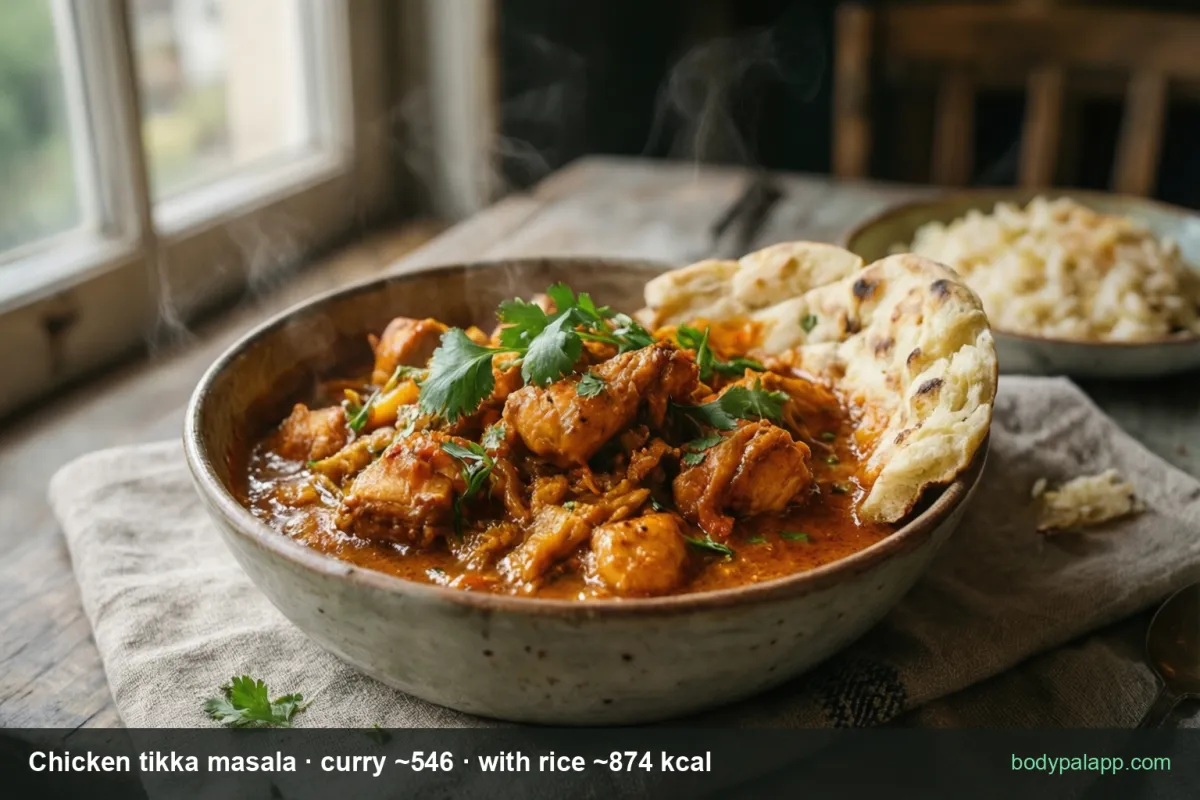
The question of how many calories in chicken tikka masala has a two-part answer: 546 for the takeaway curry itself (156 kcal per 100 g), and about 874 once pilau rice joins it. Add a naan and Friday night's favourite order clears four figures.
On this page
- Quick facts
- From container to full plate
- Tikka, tandoori and korma
- How does chicken tikka masala compare?
- The curry-is-the-damage myth
- Most popular tikka masala brands
- Chicken tikka masala FAQs
Quick facts
| Per 100 g | Amount | RI%* |
|---|---|---|
| Calories | 156 kcal (653 kJ) | 8% |
| Protein | 12.4 g | 25% |
| Carbohydrates | 4.9 g | 2% |
| Fat | 9.8 g | 14% |
| — of which saturates | 3.3 g | 17% |
| Fibre | 1.4 g | — |
| Sugar | 3.6 g | 4% |
| Salt | 0.55 g | 9% |
*RI = reference intake of an average adult (8,400 kJ / 2,000 kcal).
Verified nutrition data
Numbers on this page come from CoFID, the UK government’s Composition of Foods Integrated Dataset, and from manufacturer labels where a branded product is named. Last verified August 2026. How we verify our data →
Two numbers define this dish. Protein first: 12.4 g per 100 g is serious — a full portion delivers around 43 g, most of a day's 50 g reference intake, courtesy of the marinated chicken that gives the dish its name.
Then fat: 9.8 g per 100 g, a third of it saturated. That is the cream and butter in the masala sauce doing what cream and butter do. Carbs, by contrast, barely register at 4.9 g — the curry itself is a low-carb food. What lands beside it is another matter entirely.
From container to full plate
Nobody eats tikka masala by the 100 grams. Here is how a real order stacks up, layer by layer.
| What's on the plate | Amount | Calories | Running total |
|---|---|---|---|
| Chicken tikka masala | takeaway container, ~350 g | 546 kcal | 546 |
| Pilau rice | ~250 g cooked | +328 kcal | ~874 |
| Naan bread | 1 | +300 or more | past 1,100 |
The container alone is a reasonable dinner: 546 kcal with 43 g of protein, 17 g of carbs and 34 g of fat. The rice — 328 kcal for a typical 250 g serving at 131 kcal per 100 g — adds 60% on top. The naan turns dinner into a banquet.
Salt tells a similar story. The curry carries about 1.9 g per container, a third of the NHS 6 g daily maximum, before the rice and bread contribute their share.
None of this is an argument against the full spread. It is an argument for knowing which part costs what. If you trim one thing on an ordinary weeknight, trim the naan — it is the most expensive item on the table and the only one that is pure extra.
Portion drift is the other trap. Takeaway containers are not calibrated instruments: one curry house's "portion" can run well past 350 g, and the sauce is the part that gets ladled generously. When the container looks unusually full, it probably is — and every extra 100 g of masala is another 156 kcal, most of it from the cream.
Tikka, tandoori and korma
Chicken tikka masala was famously described as a true British national dish, and its sauce is what separates it from its relatives on the menu.
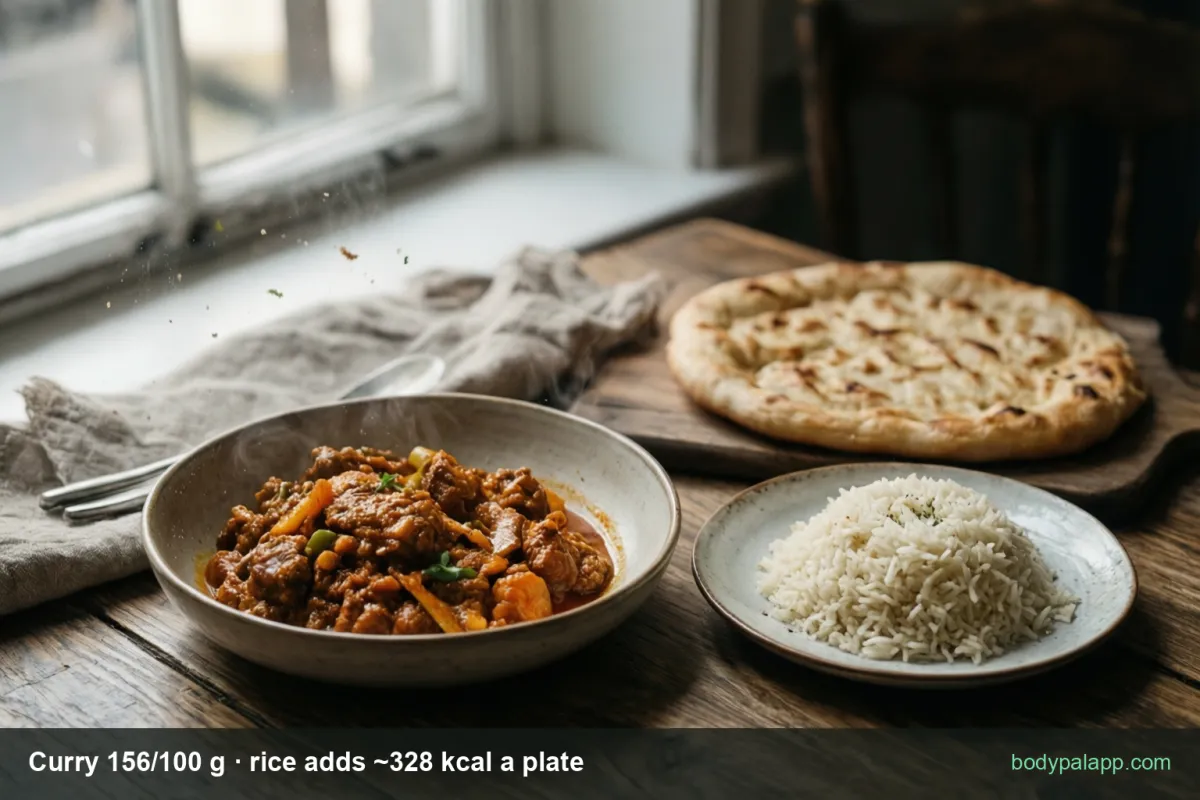
Order chicken tandoori and you get the same idea minus the sauce: marinated chicken from the dry heat of the oven, with roughly 4 g of fat per 100 g against the masala's 10. The grilled meat was never the indulgence. The cream was.
Slide the other way and you reach korma. We have no verified figure to print for it, but the direction is not in doubt: korma builds its sauce on more cream plus ground nuts, so it sits above tikka masala on any menu's calorie list.
Homemade is where you take back control. The takeaway figure of 156 kcal per 100 g reflects restaurant quantities of cream and ghee; a home version that swaps cream for yoghurt and measures the oil lands meaningfully lighter, with the protein untouched. Same flavour family, friendlier maths.
How does chicken tikka masala compare?
Against the rest of the takeaway landscape, tikka masala is middleweight — denser than Chinese, far lighter than the kebab van.
| Food | Per 100 g | Typical serving |
|---|---|---|
| Chicken tikka masala | 156 kcal | 546 kcal (container) |
| Chicken chow mein | 147 kcal | — |
| Doner kebab | 377 kcal | — |
| Lasagne | — | ~630 kcal (portion) |
| Rice | — | 236 kcal (portion) |
The verdict: for the lightest takeaway night, chicken chow mein edges it at 147 kcal per 100 g with the noodles already included — tikka masala's 156 is only the start of its plate. For protein per calorie, though, the curry is the strongest order on this table, and everything on it embarrasses the doner.
The curry-is-the-damage myth
Curry gets the blame for the calorie count of curry night, and it is largely innocent. The masala itself is 546 kcal — a normal dinner. It is the supporting cast that doubles the bill: 328 kcal of rice, 300-plus of naan, and whatever poppadoms and mango chutney did before the mains arrived.
The practical fix is not to abandon the dish but to pick its entourage deliberately. Curry plus rice, or curry plus half a naan, is a filling meal in the 800s. Curry plus rice plus a whole naan plus starters is a four-figure evening — cheerfully worth it sometimes, just worth knowing.
Most popular tikka masala brands in the United Kingdom
Ranked by how widely each product appears among foods sold in the United Kingdom, from the BodyPal food database of over 3.3 million products. Calories are the figures printed on each label. Jars and ready meals sit under the takeaway figure — less cream, more sauce.
| Product | Calories (per 100 g) |
|---|---|
| Vitasia Chicken Tikka Masala (Lidl) | 140 kcal |
| The Spice Tailor Original Tikka Masala | 130 kcal |
| Sharwood's Tikka Masala Sauce | 108 kcal |
Brand popularity: BodyPal food database. Nutrition: manufacturer labels.
Chicken tikka masala FAQs
How many calories in chicken tikka masala with rice?
About 874 kcal: 546 for a 350 g takeaway container of curry plus 328 for a 250 g serving of pilau rice. That is a substantial but not outrageous dinner. It is the naan on top of both that pushes a standard order past 1,100 kcal.
Takeaway vs homemade — how big is the gap?
The takeaway benchmark is 156 kcal per 100 g, and restaurant kitchens earn it with cream, butter and free-poured oil. A home version using yoghurt in place of cream and a measured spoon of oil comes in noticeably lighter with the same 12 g-plus protein. The sauce is where the difference lives.
Is chicken tikka masala healthy?
A container brings 546 kcal, an excellent 43 g of protein, and the catch: around 12 g of saturated fat — over half the daily reference intake — plus 1.9 g of salt. As a regular order, pair it with rice rather than naan and it holds up fine. As a daily habit, the saturates add up.
Tikka masala vs korma — which is lighter?
Tikka masala, at 156 kcal per 100 g. Korma stacks extra cream and ground nuts into its sauce, which places it above masala on the calorie ladder at any curry house. If you are ordering with the calories in mind, masala is the milder-mannered of the two creamy classics.
How much protein is in chicken tikka masala?
About 43 g in a takeaway container, from 12.4 g per 100 g. That approaches the full 50 g daily reference intake in one meal, which is why the dish satisfies the way it does. Few takeaway orders deliver more protein per calorie.
How many calories without the rice?
546 kcal for the standard 350 g container of curry on its own. Skipping the rice is the single simplest way to keep curry night in ordinary-dinner territory — you keep all 43 g of protein and drop 328 kcal from the plate.
How many calories in the naan?
Plan for 300 kcal or more — naan is a large, oil-brushed bread and it is the most calorific single addition on the table. Half a naan shared across the table buys the ritual for a fraction of the cost. The poppadoms before it are not free either.
How many carbs in chicken tikka masala?
Only about 17 g per container (4.9 g per 100 g) — the curry itself is close to low-carb. The carbs on curry night come almost entirely from the rice and naan alongside, which between them can add well over 60 g. Order accordingly if carbs are what you count.
How much salt is in chicken tikka masala?
About 1.9 g per takeaway container (0.55 g per 100 g) — roughly a third of the NHS 6 g daily maximum before the sides join in. If you are watching salt, it is the accumulation across curry, rice, naan and chutneys that deserves the attention, not any single component.
Tikka vs tikka masala — what is the difference in calories?
The sauce. Masala runs about 10 g of fat per 100 g because of the cream; plain tandoori-style tikka, grilled without the sauce, carries roughly 4. Same marinated chicken, very different bill. If you love the flavour but not the fat, chicken tikka is the order.
Similar foods
- Turkey — 155 kcal per 100 g breast
- Full English breakfast — about 1,093 kcal the works
- Sunday roast — ~946 kcal a typical plate
- Sushi — 148–170 kcal per 100 g
- Spaghetti bolognese — ~680 kcal a plate
- Ham sandwich — 277 kcal whole
Curry night, counted
Snap the plate before you start and BodyPal logs the curry, the rice and the torn-off naan as they actually appear — no menu guesswork, no maths between poppadoms.


How long does it take to burn off chicken tikka masala?
A takeaway container (~350 g) is 546 kcal. Enter your weight and the amount you ate to see how long it takes you to burn that off:
lb
| Activity | Time to burn 546 kcal |
|---|---|
| Walking, brisk | 1 hr 49 min |
| Cycling, moderate | 1 hr 8 min |
| Swimming, moderate | 1 hr 18 min |
| Jogging | 1 hr 4 min |
| Weight training, moderate | 2 hr 1 min |
Times are for a 154 lb (11 st) adult at a steady pace; change the weight to see yours. The amount is set to the portion in the text (350 g); change it to what you actually ate. BodyPal works this out from your steps automatically.
One food is easy to picture; a whole day is harder. See how many calories you need a day and what a deficit actually looks like.