
Calories in Rice per 100 g: Which 100 g Are We Talking About?
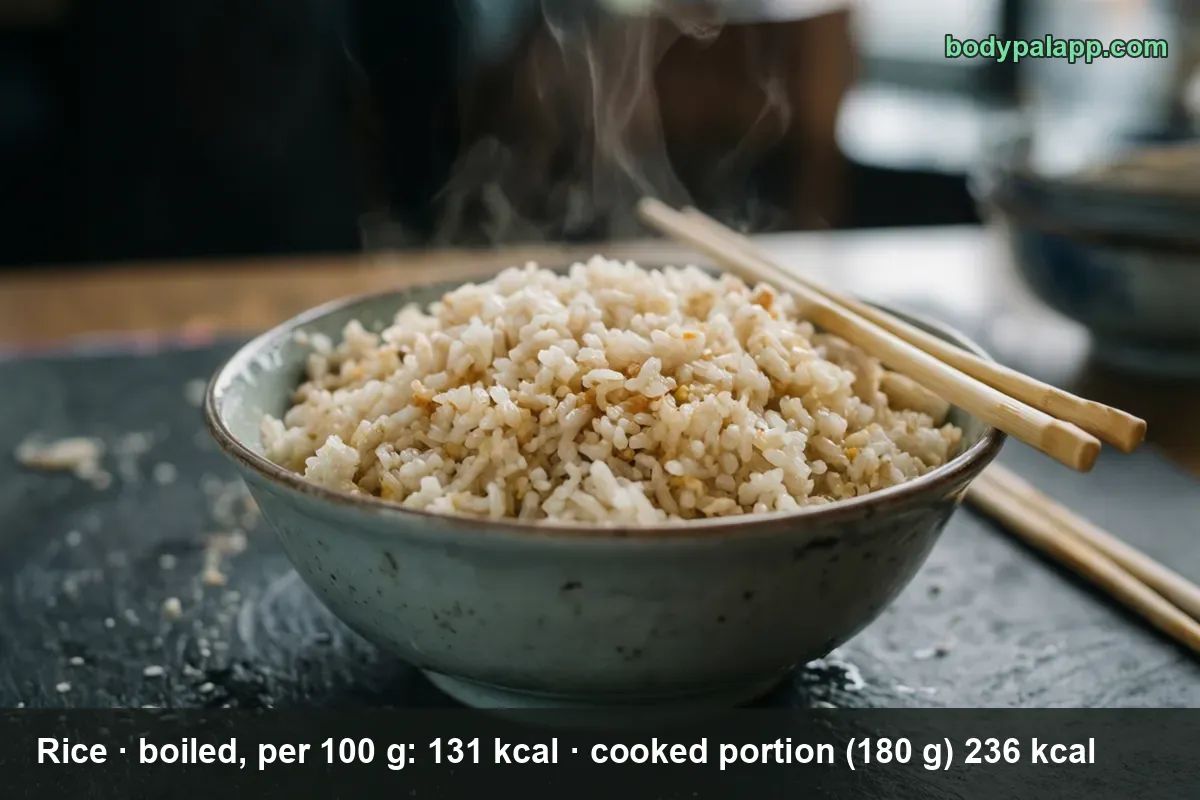
The calories in rice per 100 g depend entirely on when you weigh it: 131 kcal for white rice boiled, 370 kcal for the same rice straight from the bag. Both answers are correct. The packet prints the dry figure, your plate holds the boiled one, and the gap between them is nothing but water.
On this page
- Rice nutrition at a glance
- Portions, from a side to the takeaway tub
- Basmati, brown, jasmine and the pouch problem
- Weighing it dry against weighing it cooked
- Rice against quinoa, potato and bread
- The brown rice myth
- Most popular rice brands
- FAQ
Rice nutrition at a glance
Figures are for white long grain rice, boiled in unsalted water, the standard plate rice in the UK.
| Nutrient | Per 100 g boiled | Per 180 g portion | %RI* per portion |
|---|---|---|---|
| Energy | 131 kcal / 548 kJ | 236 kcal / 987 kJ | 12% |
| Protein | 2.8 g | 5.0 g | 10% |
| Carbohydrate | 31.1 g | 56.0 g | 22% |
| of which sugars | 0 g | 0 g | 0% |
| Fat | 0.4 g | 0.7 g | 1% |
| Fibre | 0.5 g | 0.9 g | – |
| Salt | 0.03 g | 0.05 g | 1% |
*%RI = percentage of the reference intake for an average adult (2,000 kcal; 70 g fat, 260 g carbohydrate, 90 g sugars, 50 g protein, 6 g salt).
Verified nutrition data
Numbers on this page come from CoFID, the UK government’s Composition of Foods Integrated Dataset, and from manufacturer labels where a branded product is named. Last verified August 2026. How we verify our data →
Two lines deserve a second look. Sugars sit at zero: rice is starch almost entirely, which is why it tastes of nothing until something lands on it. And fat is 0.4 g per 100 g, which makes plain boiled rice one of the leanest ways to put carbohydrate on a plate. The NHS Eatwell guidance on starchy foods puts rice in the same base-of-the-meal group as potatoes and bread.
What rice does not bring is fibre. At 0.5 g per 100 g boiled, a full portion moves you 0.9 g towards the 30 g a day the NHS suggests. Brown rice roughly doubles that, and more on it below.
Portions, from a side to the takeaway tub
| Portion | Weight (cooked) | Calories |
|---|---|---|
| Small side | ~125 g | 164 kcal |
| Standard portion | ~180 g | 236 kcal |
| Takeaway container | ~300 g | 393 kcal |
| Basmati, standard portion | ~180 g | 211 kcal |
The takeaway tub is the row that matters. Filled level, it holds roughly 300 g of cooked rice at 393 kcal, and that is before the curry touches it. People log the curry conscientiously and wave the rice through, when the rice is often the larger number of the two.
If you cook from dry, 75 g of uncooked rice comes out at roughly 190 to 210 g cooked, depending on the grain and how long it simmers. The calories do not change in the pan; only the water does. That one fact does most of the work in the next two sections.
Basmati, brown, jasmine and the pouch problem
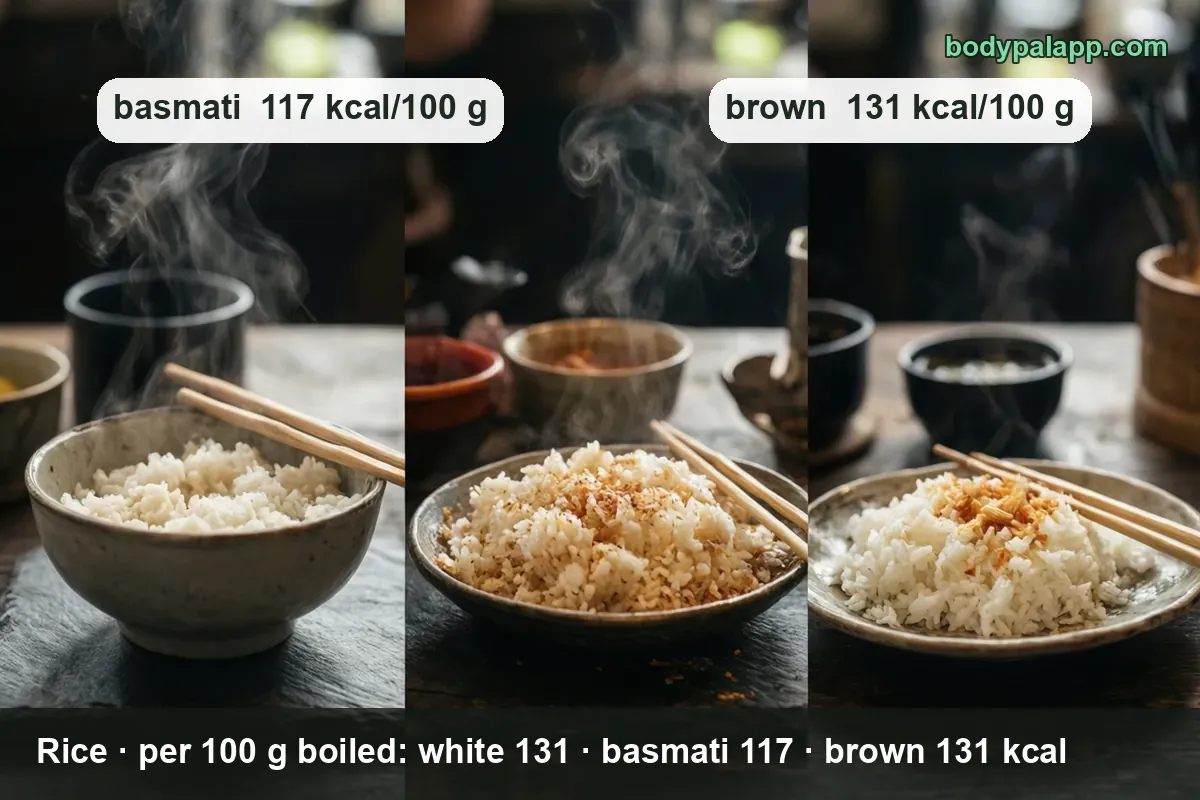
Basmati is the lightest of the everyday choices at 117 kcal per 100 g boiled, with 26.5 g of carbohydrate. Swap it in for long grain and a 180 g portion drops from 236 to 211 kcal. Not dramatic, but it is the only rice swap that saves calories without shrinking the plate.
Brown rice boils to 131 kcal per 100 g, matching white long grain to the calorie. What changes is underneath: 1.2 g of fibre against 0.5 g, plus slightly more protein at 3.3 g. Choose it for those, never for the energy figure.
Jasmine and the steamed pouches are where labels surprise people. A Tilda steamed jasmine pouch declares 175 kcal per 100 g cooked, some 44 above plain boiled rice. The pouch rice is not a different plant; it carries a little added oil to keep the grains separate, and the oil is what you are reading. Plainer microwave basmati pouches average 132 kcal per 100 g across supermarket labels, essentially the boiled figure with convenience built in.
Rice pudding answers a different question people also ask: canned rice pudding is 85 kcal per 100 g, with 16.1 g of carbohydrate and 1.3 g of fat. Milk and sugar dilute the rice, which is why the tin undercuts the plate.
Weighing it dry against weighing it cooked
Uncooked white rice is 370 kcal per 100 g, with 81.7 g of carbohydrate and 6.8 g of protein. Boiled, the same rice reads 131. Nothing was lost; each grain simply took on around two and a half times its weight in water.
This is the single biggest source of rice-logging errors. Weigh 100 g dry, log it as 131, and you have missed 239 calories. The safe habit is to pick one moment and stay with it: either weigh dry and log the dry figure, or weigh the cooked plate and log the cooked one. Mixing the two is how a careful diary quietly drifts.
Rice against quinoa, potato and bread
| Food, cooked | Per 100 g | Typical serving |
|---|---|---|
| Jacket potato | 97 kcal | 277 kcal (medium) |
| Quinoa | ~111 kcal | 139 kcal (125 g side) |
| White rice, boiled | 131 kcal | 236 kcal (180 g) |
| White bread | 236 kcal | 85 kcal (slice) |
The verdict: for the fullest plate per calorie, the potato wins at 97 kcal per 100 g, with quinoa just behind carrying far more protein. Rice sits in the middle, and bread is the densest of the four per 100 g while being the smallest per unit, because a slice weighs only 36 g. If the choice is rice or quinoa, rice is cheaper and blander; quinoa is 20 kcal lighter per 100 g and brings twice the protein.
Pair rice with a grilled chicken breast and the whole plate lands around 430 kcal, which is why the combination has been the default training meal for decades: mostly carbohydrate and protein, almost no fat, and every number easy to check.
The brown rice myth
"Brown rice is much lower in calories." It is not lower at all: 131 kcal per 100 g boiled for both brown and white long grain. The wholegrain's case rests on fibre, 1.2 g against 0.5 g, and a slower, steadier digestion. Both are good reasons. Neither is a calorie saving, so switching for weight loss alone changes the flavour and not the arithmetic.
One safety note that belongs on any rice page: cooked rice kept warm or left out can grow Bacillus cereus, so the NHS advises cooling leftovers quickly and reheating rice only once.
Most popular rice brands in the United Kingdom
Ranked by how widely each product appears among foods sold in the United Kingdom, from the BodyPal food database of over 3.3 million products. Calories are the figures printed on each label. Dry rice and ready-cooked pouches are different bases, which is why the two groups sit so far apart.
| Product | Calories (per 100 g) |
|---|---|
| Laila Basmati Rice (dry) | 375 kcal |
| Tilda Basmati Rice (dry) | 351 kcal |
| Ben's Original Spicy Mexican (cooked pouch) | 167 kcal |
| Veetee Basmati Rice (cooked pouch) | 139 kcal |
| Sainsbury’s Basmati Rice (cooked pouch) | 137 kcal |
Brand popularity: BodyPal food database. Nutrition: manufacturer labels.
How long does it take to burn off rice?
100 g boiled white rice is 131 kcal. Enter your weight and the amount you ate to see how long it takes you to burn that off:
lb
| Activity | Time to burn 131 kcal |
|---|---|
| Walking, brisk | 26 min |
| Cycling, moderate | 16 min |
| Swimming, moderate | 19 min |
| Jogging | 15 min |
| Weight training, moderate | 29 min |
Times are for a 154 lb (11 st) adult at a steady pace; change the weight to see yours. The amount is set to the portion in the text (100 g); change it to what you actually ate. BodyPal works this out from your steps automatically.
One food is easy to picture; a whole day is harder. See how many calories you need a day and what a deficit actually looks like.
Frequently asked questions
How many calories are in 100 g of rice?
Boiled white rice is 131 kcal per 100 g; uncooked it is 370 kcal per 100 g. The difference is water, not energy, so decide whether you are weighing dry or cooked before you log anything. Basmati boils to 117 kcal per 100 g, and brown rice matches white at 131.
How many calories are in uncooked rice?
370 kcal per 100 g dry, with 81.7 g of carbohydrate. A typical 75 g dry serving is around 278 kcal and swells to roughly 190 to 210 g once boiled. If you weigh rice dry, log the dry figure and ignore the cooked weight entirely.
How many calories are in a portion of boiled rice?
A standard 180 g cooked portion of white rice is 236 kcal; a smaller 125 g side is 164 kcal. A takeaway container holds nearer 300 g, which is 393 kcal before any sauce. Swapping to basmati brings the 180 g portion down to 211 kcal.
How many calories are in microwave rice?
Plain microwave basmati averages 132 kcal per 100 g across supermarket labels, so half a 250 g pouch is around 165 kcal. Flavoured and jasmine pouches run higher, up to 175 kcal per 100 g, because a little oil is added to keep the grains loose. The label on the pouch settles it.
Is basmati rice lower in calories than jasmine?
Boiled basmati is 117 kcal per 100 g, the lightest common rice. Jasmine from a steamed pouch declares 175 kcal per 100 g, though much of that gap is the pouch's added oil rather than the grain itself. Cooked plainly, the two sit far closer together.
Brown rice vs white rice: which has fewer calories?
Neither. Both boil to 131 kcal per 100 g. Brown rice carries 1.2 g of fibre per 100 g against 0.5 g in white, plus a touch more protein, which is the genuine difference. Pick it for the fibre; the calorie line will not move.
How many calories are in rice pudding?
Canned rice pudding is 85 kcal per 100 g, lower than boiled rice because milk dilutes the grain. Half a 400 g tin is around 170 kcal, with 16.1 g of carbohydrate per 100 g. Homemade versions vary with the milk and sugar used, so treat 85 as the canned baseline.
How many calories are in chicken and rice?
Around 430 kcal for the classic plate: a 180 g portion of boiled rice at 236 kcal plus a grilled chicken breast at roughly 191 kcal. It carries close to 35 g of protein and almost no fat, which is why the pairing survives every diet trend intact.
Is rice good for weight loss?
It can be, at 131 kcal per 100 g cooked with zero sugars and almost no fat; the risk is portion drift, since rice is eaten by the scoop. Weighing the cooked portion once a week keeps the estimate honest, and basmati at 117 kcal per 100 g buys a small extra margin.
Similar foods
- Tofu — 102 kcal per 70 g quarter block
- Quinoa — ~111 kcal per 100 g cooked
- Olives — 4 kcal each
- Pasta — 304 kcal per cooked portion
- Couscous — 267 kcal per 150 g cooked side
- Baked beans — 168 kcal per half tin
Count it without the maths
BodyPal reads the plate from one photo and logs the rice at its cooked weight, so the dry-or-boiled question stops costing you 239 calories a guess.

