
Calories in Pasta: 304 per Cooked Portion (169 per 100 g)
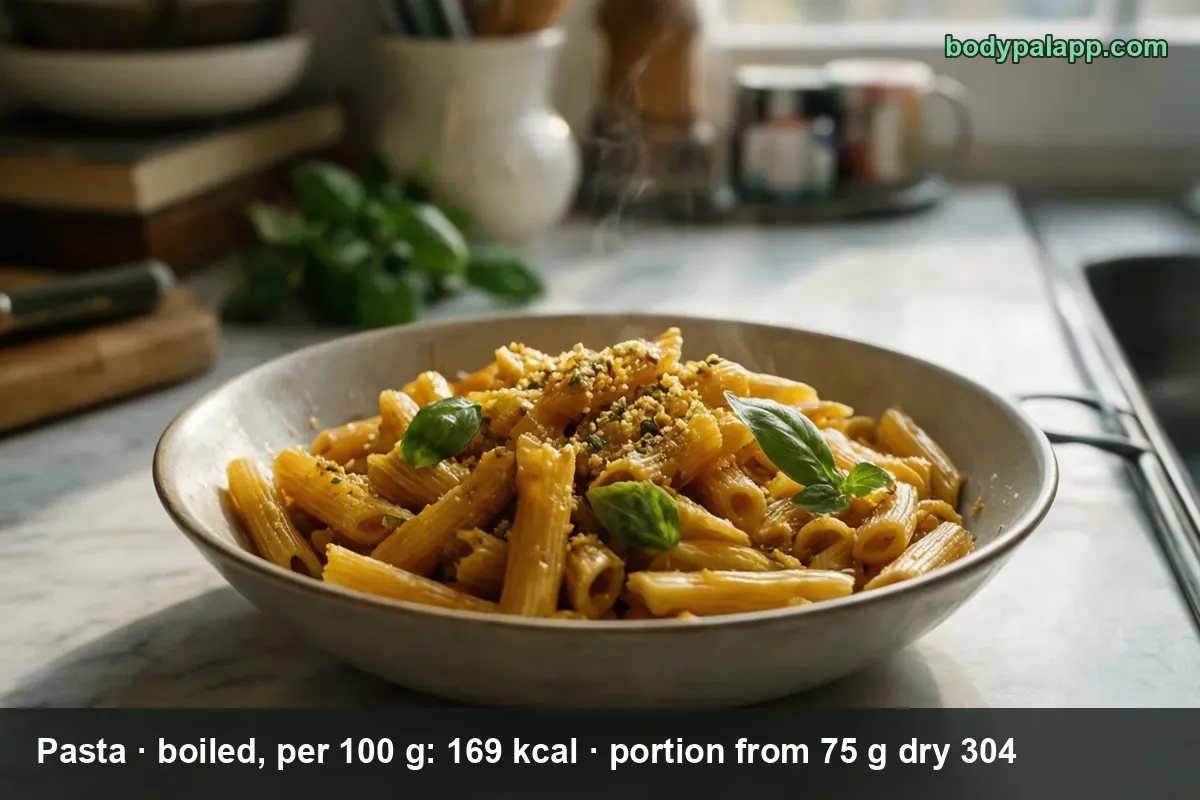
A typical cooked portion of white pasta — about 180 g on the plate, boiled from 75 g dry — has 304 calories, which works out at 169 kcal per 100 g cooked (707 kJ). Nearly every tracking mistake with the calories in pasta comes from mixing up dry and cooked weights, so let's settle that first.
On this page
- Quick facts
- Dry weight vs cooked weight
- Spaghetti and fresh pasta
- How does it compare?
- The "pasta is fattening" myth
- Most popular pasta brands
- FAQ
Quick facts
Figures are for white dried pasta, boiled in unsalted water. The portion column is the classic 75-g-dry serving, which weighs roughly 180 g once cooked.
| Nutrient | Per 100 g cooked | Per portion (180 g cooked) | % RI (portion)* |
|---|---|---|---|
| Energy | 169 kcal (707 kJ) | 304 kcal (1,272 kJ) | 15% |
| Protein | 5.5 g | 9.9 g | 20% |
| Carbohydrates | 37.2 g | 67.0 g | 26% |
| Fat | 0.8 g | 1.4 g | 2% |
| Fibre | 2.5 g | 4.5 g | — |
| Sugar | 1.1 g | 2.0 g | 2% |
| Salt | 0.003 g | 0.01 g | <1% |
*Reference intake for an average adult, calculated for the 180 g cooked portion.
Verified nutrition data
Numbers on this page come from CoFID, the UK government’s Composition of Foods Integrated Dataset, and from manufacturer labels where a branded product is named. Last verified August 2026. How we verify our data →
Plain boiled pasta is a remarkably clean label: 1.1 g of sugar and 0.003 g of salt per 100 g are close to nothing, and even the fat barely registers. A full portion also carries 9.9 g of protein — a fifth of the daily reference intake before any sauce arrives.
That cleanliness is precisely why pasta dishes vary so wildly in practice. The pasta is the predictable part; the salt and the calories live in the sauce, the oil and the cheese.
Dry weight vs cooked weight: the trap
Dry pasta swells to roughly two and a half times its weight in the pan: 75 g of dry shapes becomes about 180 g of cooked pasta. Both describe the same 304 calories, but they belong to different columns in any food database. Log 180 g against a per-100-g-dry figure and you nearly double your number; log 75 g against the cooked figure and you record half a portion you didn't eat.
| Portion | On the plate | Calories |
|---|---|---|
| Standard portion (75 g dry) | ~180 g cooked | 304 kcal |
| Half plate | 90 g cooked | 152 kcal |
The reliable habit: weigh dry when you cook at home (it is exact and takes two seconds), and use cooked weight — 169 kcal per 100 g — when you serve yourself from a shared pot or eat out.
Spaghetti and fresh pasta: not quite the same number
"Pasta" is one word covering several different figures once boiled:
| Type (boiled) | kcal per 100 g | Protein | Carbs | Fat | Fibre | Sugar | Salt |
|---|---|---|---|---|---|---|---|
| White, dried | 169 | 5.5 g | 37.2 g | 0.8 g | 2.5 g | 1.1 g | 0.003 g |
| White spaghetti, dried | 141 | 4.4 g | 31.5 g | 0.6 g | 1.7 g | 1.0 g | 0.007 g |
| Plain fresh pasta | 159 | 6.6 g | 31.8 g | 1.5 g | – | 0.6 g | 0.04 g |
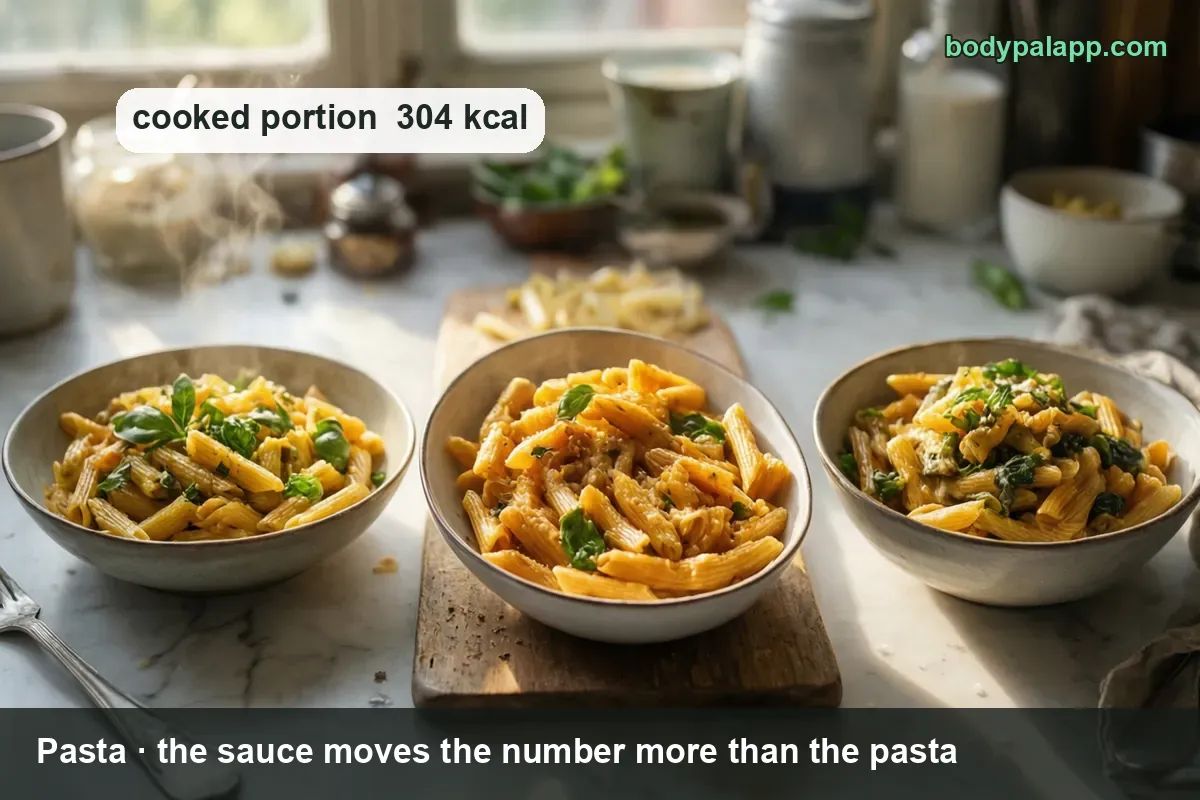
Boiled spaghetti comes out lighter per 100 g than boiled shapes — 141 kcal against 169 — mostly because long strands take up more water in the pot. Same shelf, same flour, a different number on the plate.
Fresh pasta sits in between at 159 kcal per 100 g cooked, with more protein (6.6 g) and fat (1.5 g) from the egg in the dough. None of these gaps will make or break a day, but if you eat pasta several times a week, logging the right variant keeps your totals honest rather than approximately hopeful.
How does it compare?
All figures per 100 g, cooked:
| Carbohydrate side | kcal per 100 g |
|---|---|
| Pasta (white, boiled) | 169 |
| Rice | 131 |
| Quinoa | 111 |
| Potato (boiled) | 74 |
The verdict: gram for cooked gram, pasta is the heaviest starchy base of the four, and boiled potato does the same job on the plate for well under half the calories. If you want to shrink a dinner without shrinking the pile of food, swapping part of the pasta for potato or quinoa is the easiest move available.
The "pasta is fattening" myth
Pasta has spent decades as the villain of low-carb folklore, yet the plain product is 169 kcal per 100 g cooked with almost no fat, sugar or salt. A half-plate of 90 g cooked is 152 calories — less than many cereal bars. The Eatwell Guide puts starchy carbohydrates like pasta at the base of everyday meals, not on a warning list.
What earns pasta its reputation is everything around it: creamy sauces, generous oil, a snowfall of cheese, and portions that creep from 75 g dry towards double that. If you are watching your weight, measure the dry weight and be a little cynical about the sauce; the pasta itself is the most predictable thing in the bowl. Aim for the fibre too — a standard portion already contributes 4.5 g.
Most popular pasta brands in the United Kingdom
Ranked by how widely each product appears among foods sold in the United Kingdom, from the BodyPal food database of over 3.3 million products. Calories are the figures printed on each label. Dry pasta roughly halves in calories per 100 g once boiled, as the tables above show.
| Product | Calories (per 100 g (dry)) |
|---|---|
| Barilla Spaghetti | 359 kcal |
| Garofalo Spaghetti | 351 kcal |
| De Cecco Spaghetti | 351 kcal |
Brand popularity: BodyPal food database. Nutrition: manufacturer labels.
Pasta questions, answered
How many calories are in pasta?
Cooked white pasta has 169 calories per 100 g, and a standard portion boiled from 75 g dry — about 180 g on the plate — comes to 304 kcal. Boiled spaghetti is lower at 141 kcal per 100 g, and plain fresh pasta sits between them at 159.
How many calories in 100g of pasta?
100 g of boiled white pasta is 169 calories; the same weight of boiled spaghetti is 141. Watch which state your source describes: packet labels usually quote dry weight, and 75 g of dry pasta swells to roughly 180 g cooked, so per-100-g figures for dry pasta run far higher.
How many calories in cooked pasta?
Cooked and drained, white pasta comes to 169 kcal per 100 g, spaghetti to 141, and fresh egg pasta to 159. A standard cooked portion of around 180 g is 304 calories, and a modest half-plate of 90 g is 152 — all before any sauce, oil or cheese is added.
How many calories in pasta salad?
The pasta base contributes 169 kcal per 100 g cooked; what varies is the dressing. Mayonnaise- or pesto-based salads add substantial fat on top of that base, while a light vinaigrette adds far less. There is no single honest figure, so log the pasta and the dressing separately.
Is pasta healthy?
Plain boiled pasta at 169 kcal per 100 g is a clean starchy staple: 0.8 g fat, 1.1 g sugar and 0.003 g salt, with 5.5 g of protein. The NHS Eatwell Guide places starchy carbohydrates at the base of meals, and pasta fits that role as well as any of them.
Is pasta unhealthy?
Not by its own numbers — 169 kcal per 100 g cooked with negligible fat, sugar and salt. Pasta dishes become heavy through sauces, oil, cheese and portion creep, and a 304-kcal standard portion can quietly double once those join in. Judge the whole bowl, not the pasta.
Is pasta good for weight loss?
A 90 g half-plate of cooked pasta is 152 calories, and a full 180 g portion is 304 with 9.9 g of protein — workable in most calorie budgets if the sauce stays sensible. If you are cutting, weighing the dry pasta at 75 g per person is the single most useful habit.
Is pasta good for you?
A standard portion delivers 9.9 g of protein and 4.5 g of fibre for 304 calories, with almost no sugar or salt — a solid base for a balanced plate. Where pasta meals go wrong nutritionally is rarely the pasta; it is what gets stirred through it.
Similar foods
- Couscous — 267 kcal per 150 g cooked side
- Tofu — 102 kcal per 70 g quarter block
- Rice — 236 kcal per cooked portion
- Quinoa — ~111 kcal per 100 g cooked
- Olives — 4 kcal each
- Feta — 75 kcal per 30 g portion
Count it without the maths
One photo of the finished plate and BodyPal untangles pasta, sauce and parmesan into calories and macros for you.


How long does it take to burn off pasta?
A 180 g cooked portion (from 75 g dry) is 304 kcal. Enter your weight and the amount you ate to see how long it takes you to burn that off:
lb
| Activity | Time to burn 304 kcal |
|---|---|
| Walking, brisk | 1 hr 1 min |
| Cycling, moderate | 38 min |
| Swimming, moderate | 43 min |
| Jogging | 36 min |
| Weight training, moderate | 1 hr 8 min |
Times are for a 154 lb (11 st) adult at a steady pace; change the weight to see yours. The amount is set to the portion in the text (180 g); change it to what you actually ate. BodyPal works this out from your steps automatically.
Burning it off is one side of it. The other is knowing your number: work out how many calories you need a day, with macros and a goal date.