
How Many Calories in Feta?
Feta is 250 calories per 100 g, which makes the 30 g portion printed on UK packs — two or three cubes over a salad — 75 kcal. Half a block is 250 and a whole 200 g block is 500. Calories are not the interesting number here. Salt is: 2.50 g per 100 g, 42% of an adult's day.
On this page
- Is it feta, or is it salad cheese?
- Feta quick facts
- Why your label says 278 and the database says 250
- Cube, half block, whole block
- The salt is 42% of your day
- Feta against the rest of the cheese counter
- Brands on the UK shelf
- FAQ
Is it feta, or is it salad cheese?
Start here, because it changes which number applies to the block in your fridge.
Feta is a protected name. To be sold as feta it has to be made in defined regions of Greece, from sheep's milk, with up to 30% goat's milk allowed. The white brined cheese sitting next to it in the same chiller, made from cow's milk, is not permitted to use the word — so it goes out as "salad cheese" or "Greek-style salad cheese" in slightly smaller type.
The two look identical in a bowl of tomatoes. They are not the same product, and their labels do not carry the same figures. So the first move with any white brined cheese is to read the front of the pack for the word "feta" and the PDO mark, then read the panel on the back rather than assuming this page's 250 applies to it.
Everything below describes real feta: sheep's and goat's milk, brined, drained.
Feta quick facts
| Nutrient | Per 100 g | 30 g portion | RI%* |
|---|---|---|---|
| Energy | 250 kcal / 1,046 kJ | 75 kcal / 314 kJ | 4% |
| Protein | 15.6 g | 4.7 g | 9% |
| Carbohydrates | 1.5 g | 0.5 g | <1% |
| – of which sugars | 1.5 g | 0.5 g | <1% |
| Fat | 20.2 g | 6.1 g | 9% |
| – of which saturates | 13.7 g | 4.1 g | 21% |
| Fibre | 0 g | 0 g | – |
| Salt | 2.50 g | 0.75 g | 13% |
Verified nutrition data
Numbers on this page come from CoFID, the UK government’s Composition of Foods Integrated Dataset, and from manufacturer labels where a branded product is named. Last verified September 2026. How we verify our data →
*RI% = one 30 g portion's share of an adult's daily reference intake, based on 2,000 kcal.
Look along the 30 g row and the shape of feta appears. It costs 4% of the day's calories and 21% of the day's saturated fat. Those two percentages are five times apart, and that ratio, not the calorie count, is what feta actually is.
Where do 250 calories come from? Fat contributes 182 of them (73%), protein 62 (25%) and carbohydrate 6 (2%). Feta is fat with a useful amount of protein attached.
Why your label says 278 and the database says 250
Take the UK shelf as it stands. Dodoni reads 257 per 100 g, Melis 275, Lidl's Eridanous 276, Sainsbury's Greek PDO 276.7, Asda 278, Tesco 279, Aldi 281, Gazi 286, Apetina 300, Morrisons 303, and Marks & Spencer's runs 298 to 317. The middle of that spread is around 278.
The UK government's food composition dataset gives 250, from 18 samples of sheep's and goat's milk feta.
Neither is wrong. The dataset is describing feta as a category, sampled across producers; a supermarket label is describing one recipe from one dairy, and the richer Greek blocks aimed at the British market sit at the fattier end. The gap is about 10%, which on a 30 g portion is roughly eight calories.
Use 250 for a rough log. Use the panel on your own pack when it is in front of you — that is the only figure that describes the block you are actually eating.
Cube, half block, whole block
The standard UK pack is a 200 g block, and almost every brand prints its serving as 30 g. Co-op is the exception at 50 g, and Lidl sells a 570 g bucket for people who have stopped pretending.
| Portion | Calories | Protein | Saturates | Salt |
|---|---|---|---|---|
| 30 g, cubed into a salad | 75 kcal | 4.7 g | 4.1 g | 0.75 g |
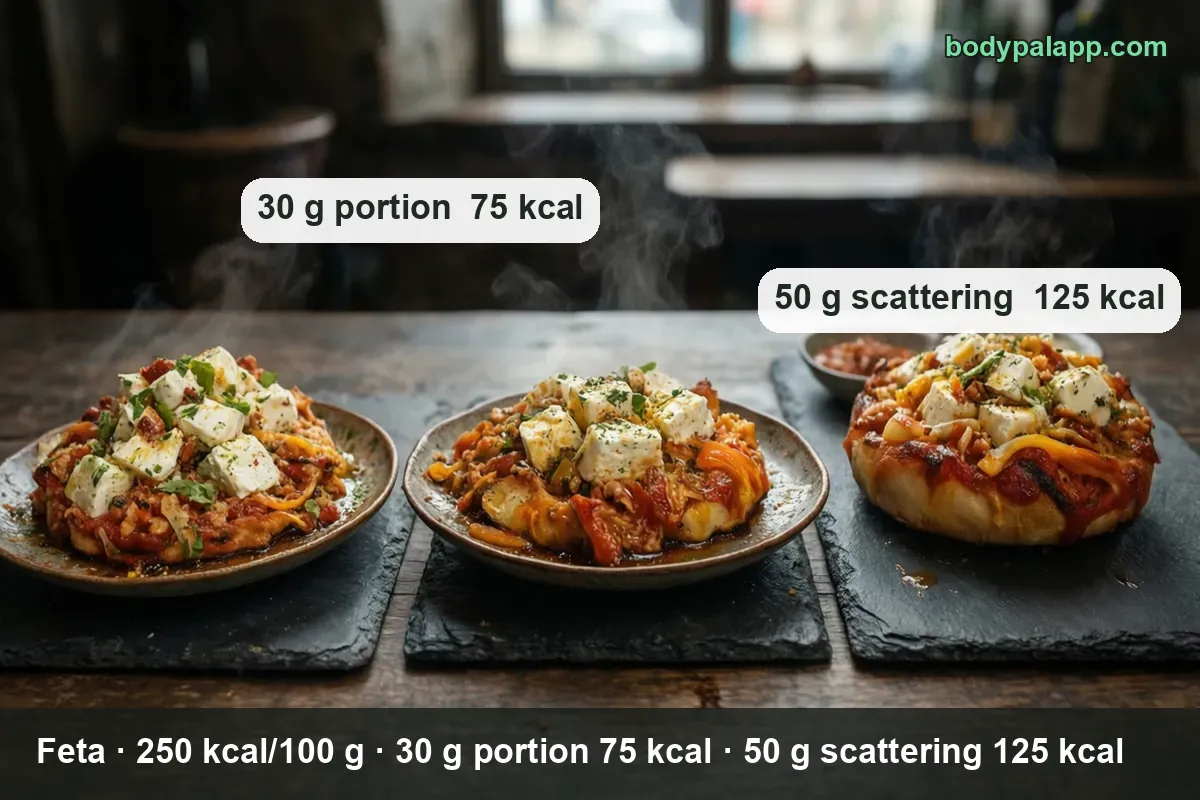
| 50 g, a generous scattering | 125 kcal | 7.8 g | 6.9 g | 1.25 g |
| 100 g, half a block | 250 kcal | 15.6 g | 13.7 g | 2.50 g |
| 200 g, the whole block | 500 kcal | 31.2 g | 27.4 g | 5.00 g |
A Greek salad settles the portion question better than any label does. The government's recipe for one — feta, olives, tomato, cucumber, olive oil — comes out at 131 kcal per 100 g, so a 200 g bowl is 262 kcal and 1.04 g of salt. Work backwards from that and the bowl contains something like 40 to 50 g of feta, not the half block people picture. A restaurant slab on top of a salad is a different animal.
The salt is 42% of your day
Cheese is a salty food in general, which the NHS covers in its notes on milk and dairy. Feta is at the far end of it.
- 30 g: 0.75 g of salt, 13% of the daily maximum
- 50 g: 1.25 g, 21%
- 100 g: 2.50 g, 42%
- 200 g block: 5.00 g, 83%
The adult limit is 6 g of salt a day, about a level teaspoon. Half a block of feta uses more than two fifths of it, and that is before the olives arrive — brined olives carry 3.33 g per 100 g, more than the cheese does.
Two practical points. First, brand choice barely helps: UK labels range from 2.0 to 2.5 g per 100 g, a spread of about 20%, while doubling your portion moves the salt by 100%. Second, rinsing the block does less than people hope. The salt is inside the curd, not only in the brine, and the government figure of 1,000 mg of sodium per 100 g is measured on drained cheese.
For scale, 30 g of feta carries the same salt as a 41 g piece of cheddar, while carrying fewer calories than that piece would.
Saturated fat is the other line worth reading. Feta holds 13.7 g per 100 g, so half a block covers 68% of the 20 g daily reference and one 30 g cube covers 21%. NHS advice on cutting saturated fat is aimed at exactly this kind of food — small, dense, easy to keep adding to a plate.
Feta against the rest of the cheese counter
| Cheese | Per 100 g | Salt per 100 g | 30 g piece |
|---|---|---|---|
| Feta | 250 kcal | 2.50 g | 75 kcal |
| Cheddar | 416 kcal | 1.81 g | 125 kcal |
| Mozzarella | 257 kcal | 0.99 g | 77 kcal |
| Halloumi | 313 kcal | 3.00 g | 94 kcal |
| Danish blue | 342 kcal | 3.05 g | 103 kcal |
| Cottage cheese, plain | 103 kcal | 0.62 g | 31 kcal |
| Greek yogurt | 133 kcal | 0.17 g | 40 kcal |
Feta is the lightest firm cheese on a British counter. At 250 kcal per 100 g it undercuts English cheddar by 40% per gram, which is the whole reason it turned up in so many lunchbox salads in the first place.
Our take: for calories alone, feta beats every other block cheese and only mozzarella comes close — and mozzarella wins on salt by a mile, at 0.99 g against 2.50. If salt is the number you are managing, mozzarella or Greek yogurt are the swaps that actually change something. If you want the flavour, feta earns its place at 30 g and stops earning it fast at 100.
A light version exists too. Salakis feta light runs 161 kcal per 100 g with 19.0 g of protein and 9.0 g of fat — fewer calories than standard feta and more protein, which is an unusually clean trade for a reduced-fat cheese.
Popular feta brands in the BodyPal food database
Ranked by how widely each product appears among foods sold in the United Kingdom, from the BodyPal food database of over 3.3 million products. Calories are the figures printed on each label. The last one is salad cheese, not feta — cow’s milk, and legally a different product.
| Product | Calories (per 100 g) |
|---|---|
| Dodoni Feta | 257 kcal |
| Omiros Feta | 276 kcal |
| Milbona Feta (Lidl) | 276 kcal |
| Zeus Feta | 276 kcal |
| Eridanous Salad Cheese (Lidl) | 259 kcal |
Brand popularity: BodyPal food database. Nutrition: manufacturer labels.
Feta FAQs
How many calories are in feta?
250 kcal per 100 g, which makes a 30 g portion 75 kcal and a whole 200 g block 500 kcal. That figure is the UK government's, based on 18 samples of sheep's and goat's milk feta. Supermarket labels usually read a little higher, around 278.
How many calories in 30 g of feta?
75 kcal, with 4.7 g of protein, 6.1 g of fat and 0.75 g of salt. Thirty grams is the portion printed on almost every UK pack and works out at two or three cubes. It costs 4% of a day's calories and 21% of a day's saturated fat.
Is feta lower in calories than cheddar?
Considerably. Feta is 250 kcal per 100 g against 416 for English cheddar, so it is 40% lighter per gram. Compare like for like and a 30 g piece is 75 kcal against 125. Cheddar returns the favour on salt, at 1.81 g per 100 g against feta's 2.50.
How much salt is in feta?
2.50 g per 100 g, which is 42% of the 6 g the NHS sets as an adult's daily maximum. A 30 g portion carries 0.75 g and the full 200 g block carries 5.00 g. UK brands vary between about 2.0 and 2.5 g, so portion size moves the number far more than brand does.
Why does my feta pack say 278 when charts say 250?
Because they describe different things. The 250 is a category average across 18 sampled fetas; your pack describes one dairy's recipe, and the Greek blocks sold in British supermarkets sit at the fattier end, mostly 257 to 303. On a 30 g portion the difference is about eight calories.
How much protein is in feta?
15.6 g per 100 g, or 4.7 g in a 30 g portion. That is 25% of feta's calories, with fat supplying 73%. Cheddar carries more protein per gram at 25.4 g, but also 66% more calories, so feta gives you more protein per calorie than most hard cheeses.
How many calories in a Greek salad with feta?
About 262 kcal for a 200 g bowl, from the government's recipe figure of 131 kcal per 100 g, along with 1.04 g of salt. That bowl contains roughly 40 to 50 g of feta rather than the half block people imagine. Most of the remaining calories are the olive oil and the olives.
Is light feta worth buying?
The numbers say yes. Salakis feta light is 161 kcal per 100 g with 19.0 g of protein and 9.0 g of fat, against 250 kcal and 15.6 g of protein for standard feta. Fewer calories and more protein is a rare combination in a reduced-fat cheese, though the salt still needs watching.
Similar foods
- Mozzarella — 159 kcal per half ball
- Maple syrup — 54 kcal per tablespoon
- Honey — 20 kcal a teaspoon
- Hummus — 92 kcal per 30 g
- Couscous — 267 kcal per 150 g cooked side
- Pasta — 304 kcal per cooked portion
Count it without the maths
Point the camera at the salad bowl and BodyPal logs the feta and the salt in one go, without weighing the block first.


How long does it take to burn off feta?
A 30 g portion is 75 kcal. Enter your weight and the amount you ate to see how long it takes you to burn that off:
lb
| Activity | Time to burn 75 kcal |
|---|---|
| Walking, brisk | 15 min |
| Cycling, moderate | 9 min |
| Swimming, moderate | 11 min |
| Jogging | 9 min |
| Weight training, moderate | 17 min |
Times are for a 154 lb (11 st) adult at a steady pace; change the weight to see yours. The amount is set to the portion in the text (30 g); change it to what you actually ate. BodyPal works this out from your steps automatically.
This table assumes you know your daily total. If you do not, the daily calorie calculator works it out from five numbers.