
How Many Calories in Maple Syrup?
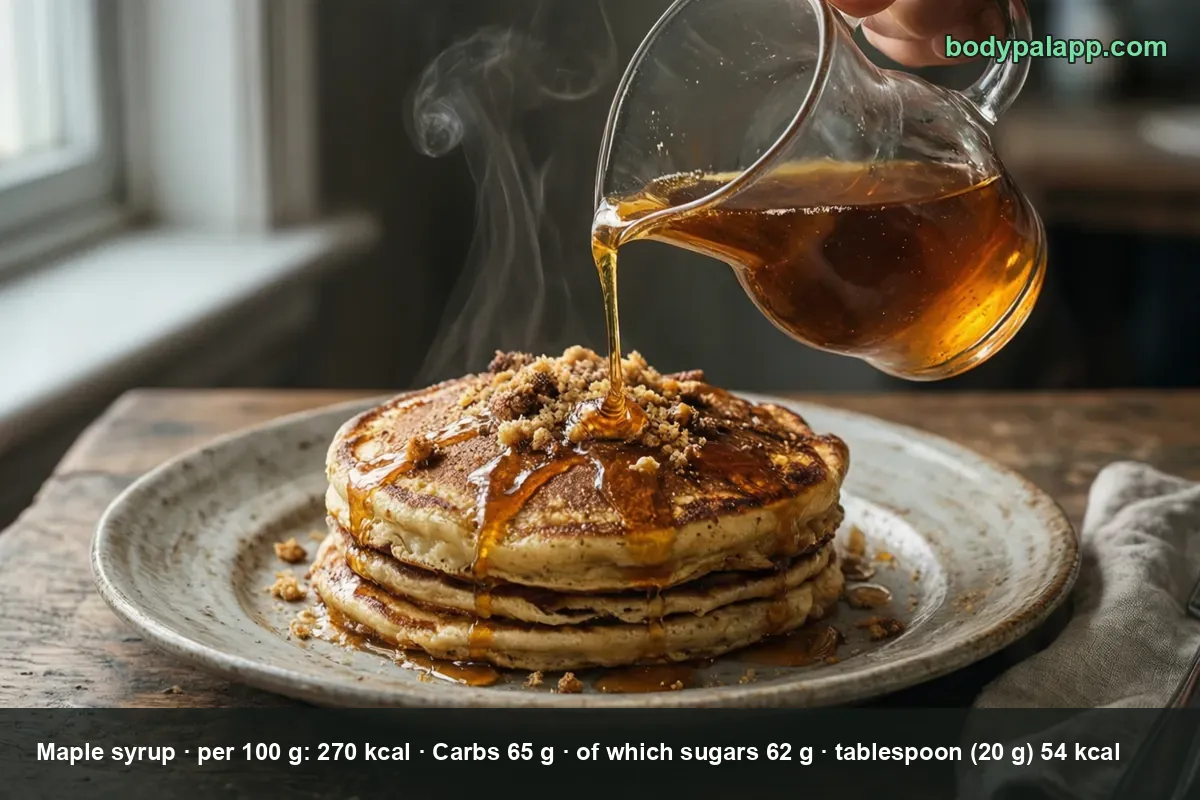
A tablespoon of maple syrup is 54 calories — 15 ml of it, which weighs 20 g, at 270 kcal per 100 g. A teaspoon is 19 kcal. Pour two tablespoons over pancakes and you have added 108 kcal and 24.8 g of sugars, which is where the real cost of this bottle sits.
On this page
- Maple syrup quick facts
- Why the same bottle says 270 and 359
- What a tablespoon actually weighs
- UK portions, spoon by spoon
- The sugar number, not the calorie number
- Maple syrup, honey or golden syrup
- Grade, brand and price change nothing
- Popular maple syrup brands
- FAQ
Maple syrup quick facts
Britain's national food composition table lists golden syrup and dark corn syrup. It has no row for maple syrup at all. So the honest reference is the shelf itself: 47 UK labels for pure maple syrup, running from 253 to 281 kcal per 100 g, with a median of 270.
| Nutrient | Per 100 g | 1 tbsp (20 g) | RI%* |
|---|---|---|---|
| Energy | 270 kcal / 1,130 kJ | 54 kcal / 226 kJ | 3% |
| Protein | 0.1 g | 0.02 g | 0% |
| Carbohydrates | 65 g | 13.0 g | 5% |
| – of which sugars | 62 g | 12.4 g | 14% |
| Fat | 0.1 g | 0.02 g | 0% |
| Fibre | 0 g | 0 g | – |
| Salt | 0.02 g | 0.004 g | 0% |
*RI% = one tablespoon's share of an adult's daily reference intake, based on 2,000 kcal.
Verified nutrition data
Numbers on this page come from CoFID, the UK government’s Composition of Foods Integrated Dataset, and from manufacturer labels where a branded product is named. Last verified September 2026. How we verify our data →
Read that table across and one row is doing everything. There is no fat, no protein, no fibre and effectively no salt. Maple syrup is 95% sugars by carbohydrate, and the 14% sugars figure is the only number on the label that should make you pause.
Why the same bottle says 270 and 359
Search for this number and you will find two answers, roughly 90 kcal apart. Both are correct. Neither site tells you why.
The UK labels split into two clean groups. One group sits between 253 and 281 kcal, median 270. The other sits between 333 and 366, median 359. The ratio between them is 359 ÷ 270 = 1.33 — which happens to be the density of maple syrup in grams per millilitre.
That is the whole explanation. The first group declares its figures per 100 grams. The second declares them per 100 millilitres, and 100 ml of syrup weighs 133 g.
The proof is inside the data. Clarks appears twice in the UK label set: once at 269 and once at 356. Same brand, same product. 269 × 1.32 = 356. Every label in the higher group that prints a serving size prints it in millilitres; every label in the lower group prints it in grams.
| Declared as | Typical range | Median | Carbohydrates |
|---|---|---|---|
| Per 100 g | 253–281 kcal | 270 kcal | 58–69 g |
| Per 100 ml | 333–366 kcal | 359 kcal | 79–89 g |
So when an Aldi bottle reads 359 and a Tesco bottle reads 261, nothing has changed except the unit at the top of the panel. Divide any per-100-ml maple figure by 1.33 and you land back on the per-100-g number. We use per 100 g throughout this page, because that is what a kitchen scale measures and what a food diary expects.
What a tablespoon actually weighs
The unit problem does not stop at the bottle. It follows the spoon.
A British tablespoon holds 15 ml. At a density of 1.33, those 15 ml weigh 20 g — not 15. Which is why UK labels disagree with each other about their own serving:
- Waitrose and Sainsbury's Taste the Difference print a serving of 15 g → 41 kcal
- Aldi prints a serving of 15 ml → the same 20 g of syrup → 54 kcal
- Co-op prints 25 g → 68 kcal
One movement of the wrist, three declared answers, a 32% spread between the smallest and the largest. If you are logging by eye rather than by scale, 54 kcal is the figure to use for a tablespoon: it is the spoonful, not the weight some marketing department chose to print.
UK portions, spoon by spoon
| Portion | Weight | Calories | Sugars |
|---|---|---|---|
| One teaspoon (5 ml) | 7 g | 19 kcal | 4.3 g |
| Label serving, Waitrose | 15 g | 41 kcal | 9.3 g |
| One tablespoon (15 ml) | 20 g | 54 kcal | 12.4 g |
| Label serving, Co-op | 25 g | 68 kcal | 15.5 g |
| A generous pour | 30 g | 81 kcal | 18.6 g |
| Two tablespoons over pancakes | 40 g | 108 kcal | 24.8 g |
Two arithmetic results worth keeping. One pancake at 187 kcal with two tablespoons of syrup is 295 kcal for the plate. A bowl of porridge made with semi-skimmed milk is 168 kcal, and one tablespoon takes it to 222 kcal — a third more breakfast for one spoon.
Neither of those is alarming. The spoon is small and the syrup is light. Which is exactly why the calorie count is the wrong thing to watch here.
The sugar number, not the calorie number
Fifty-four calories is nothing. Twelve grams of sugars is not.
Maple syrup is free sugars in the technical sense the NHS uses: sugar outside the cell walls of a whole food, in a form your body meets all at once. The adult cap is 30 g of free sugars a day.
- One tablespoon, 12.4 g → 41% of the daily cap
- Two tablespoons on pancakes, 24.8 g → 83%
- A generous pour, 18.6 g → 62%
Two tablespoons and you have spent the day's allowance on breakfast, having consumed 108 calories. That mismatch is the reason "it's only 54 calories" is a bad way to think about syrup. Against the 2,000 kcal reference intake a tablespoon barely registers at 3%. Against the sugar guideline it is nearly half the day.
The practical move is not switching syrups. It is the smaller spoon: a teaspoon carries 4.3 g of sugars, a third of a tablespoon, and on porridge you will struggle to tell the difference.
Maple syrup, honey or golden syrup
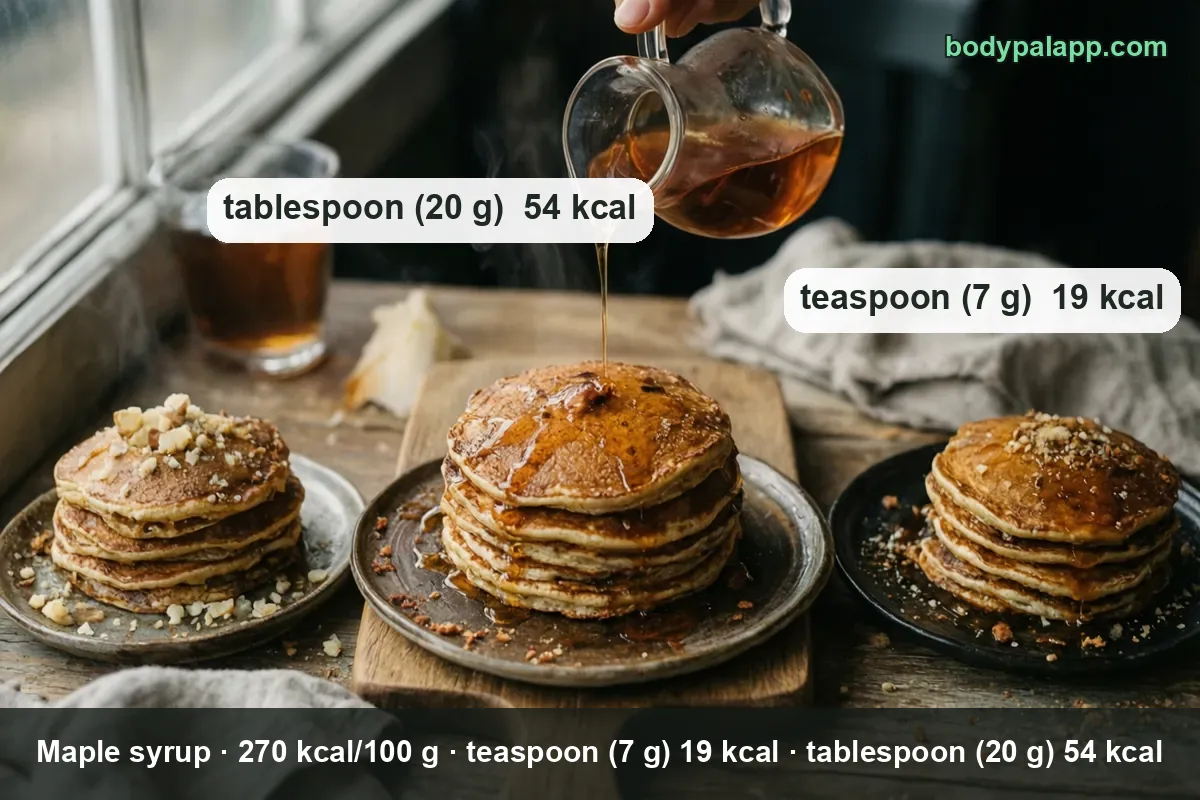
| Syrup | Per 100 g | 1 tsp (7 g) | 1 tbsp (20 g) | Salt per 100 g |
|---|---|---|---|---|
| Maple syrup | 270 kcal | 19 kcal | 54 kcal | 0.02 g |
| Honey | 288 kcal | 20 kcal | 58 kcal | 0.03 g |
| Golden syrup | 298 kcal | 21 kcal | 60 kcal | 0.68 g |
| Dark corn syrup | 282 kcal | 20 kcal | 56 kcal | 0.40 g |
| Granulated sugar | 394 kcal | 16 kcal | — | 0 g |
Maple syrup is the lightest of the four syrups per 100 g. Per spoon the whole argument collapses: 54 against 58 against 60. Swapping honey for maple saves you four calories on a teaspoon — you cannot measure that, and it will not show up anywhere.
Our take: if you are choosing between these for calorie reasons, stop. Choose on taste and move on. The one genuine difference in the table is the last column — golden syrup carries 0.68 g of salt per 100 g, thirty-four times the maple figure, which is enough that it registers against the 6 g daily salt limit if you bake with it in quantity. Sugar itself is the odd one out for a different reason: a level tablespoon of sugar is 50 kcal, lower than a tablespoon of syrup, because dry sugar packs less weight into the same spoon than liquid does.
Grade, brand and price change nothing
The amber-versus-dark question comes up constantly, and the labels answer it flatly. Tesco Finest amber and Tesco Finest dark are 261 kcal each — identical to the decimal. At Waitrose the two grades differ by 20 kcal per 100 g, which is 4 kcal on a tablespoon.
Across all 47 UK labels the full spread is 253 to 281 kcal per 100 g. Converted to what you eat, that is 51 to 56 kcal a tablespoon. The £7 bottle and the £3 bottle are, energetically, the same bottle.
Two things do change the number. Blends are one: a product sold as maple-flavoured or maple-and-honey is a different food with a different panel, so read it rather than assuming. The other is the sugar-free bottle — one UK brand, Skinny Food Co, sells a zero-calorie maple syrup at 0 kcal and 0 g of carbohydrate, with 0.03 g of salt per 100 g. That is the only version of this product where the calorie choice is real: 54 against 0 on a spoon.
There is no middle path, mind. Maple syrup has no fat, no protein and no fibre, so there is nothing to improve. You are choosing between the spoon and a smaller spoon.
Popular maple syrup brands in the BodyPal food database
Ranked by how widely each product appears among foods sold in the United Kingdom, from the BodyPal food database of over 3.3 million products. Calories are the figures printed on each label. Labels from Lidl and Aldi read 355–359, but those are per 100 ml — the same syrup at a density of 1.33.
| Product | Calories (per 100 g) |
|---|---|
| Maple Joe Maple Syrup | 266 kcal |
| Canadian Maple Syrup (M&S) | 273 kcal |
| Canadian Maple Syrup (Waitrose) | 273 kcal |
Brand popularity: BodyPal food database. Nutrition: manufacturer labels.
Maple syrup FAQs
How many calories in maple syrup?
270 kcal per 100 g, which makes one tablespoon 54 kcal and one teaspoon 19 kcal. That figure is the median of 47 UK labels for pure maple syrup, which run from 253 to 281 kcal per 100 g. Two tablespoons over pancakes come to 108 kcal.
How many calories in a tablespoon of maple syrup?
54 kcal. A British tablespoon holds 15 ml, and because maple syrup has a density of 1.33 g per ml, that spoonful weighs 20 g rather than 15. It carries 12.4 g of sugars and 13.0 g of carbohydrate.
How many calories in a teaspoon of maple syrup?
19 kcal for a 5 ml teaspoon, which weighs 7 g. It brings 4.3 g of sugars, a third of what a tablespoon delivers. On porridge or yoghurt the smaller spoon is the easiest saving available, since the syrup itself cannot be made lighter.
Why do some labels say 359 calories per 100?
Because they are declaring per 100 ml, not per 100 g. Maple syrup weighs 1.33 g per ml, so 100 ml is 133 g of syrup. Divide 359 by 1.33 and you get 270, the per-100-g figure. Clarks appears in UK data at both 269 and 356 for the same product.
Maple syrup or honey: which has fewer calories?
Maple syrup, by 18 kcal per 100 g: 270 against 288. Per spoon the gap is four calories, 54 against 58, which is too small to matter. Honey carries more sugars per 100 g at 76.4 against roughly 62, so maple is marginally the lighter pour.
Is maple syrup better than sugar?
It is lighter by weight — 270 kcal per 100 g against 394 for granulated sugar — because roughly a third of the bottle is water. Both count as free sugars, and a tablespoon of syrup at 12.4 g of sugars uses 41% of the 30 g daily cap.
How much sugar is in maple syrup?
About 62 g per 100 g, out of 65 g of total carbohydrate — so roughly 95% of the carbohydrate is sugars. A tablespoon holds 12.4 g, which is 14% of the reference intake for sugars and 41% of the NHS 30 g free-sugars cap.
Does the grade of maple syrup change the calories?
Barely. Tesco Finest amber and dark are both 261 kcal per 100 g. The widest gap between two grades on a UK shelf is 20 kcal per 100 g, which works out at 4 kcal on a tablespoon. Across 47 UK labels the whole range is 51 to 56 kcal a spoon.
Similar foods
- Mozzarella — 159 kcal per half ball
- Honey — 20 kcal a teaspoon
- Feta — 75 kcal per 30 g portion
- Hummus — 92 kcal per 30 g
- Brie — 103 kcal per 30 g wedge
- Couscous — 267 kcal per 150 g cooked side
Count it without the maths
Point the camera at the jug and BodyPal logs the spoonful and its sugars without you converting anything.


How long does it take to burn off maple syrup?
A tablespoon (20 g) is 54 kcal. Enter your weight and the amount you ate to see how long it takes you to burn that off:
lb
| Activity | Time to burn 54 kcal |
|---|---|
| Walking, brisk | 11 min |
| Cycling, moderate | 7 min |
| Swimming, moderate | 8 min |
| Jogging | 6 min |
| Weight training, moderate | 12 min |
Times are for a 154 lb (11 st) adult at a steady pace; change the weight to see yours. The amount is set to the portion in the text (20 g); change it to what you actually ate. BodyPal works this out from your steps automatically.
Burning it off is one side of it. The other is knowing your number: work out how many calories you need a day, with macros and a goal date.