
How Many Calories in a Spoon of Olive Oil?
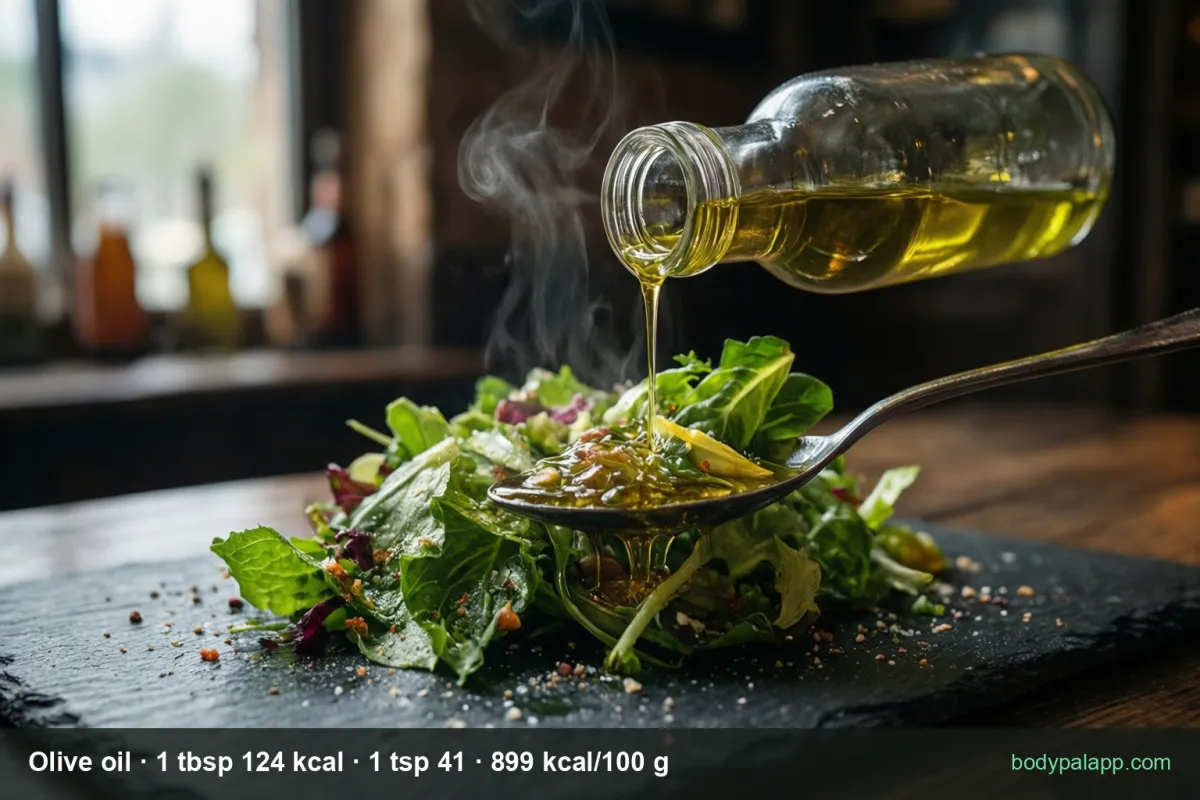
It vanishes into the pan but never from the day: how many calories in a spoon of olive oil comes to 124 kcal for a tablespoon and 41 for a teaspoon, from an oil that runs 899 kcal per 100 g. There are no carbs, no sugar and no protein in it. Olive oil is fat, 99.9 g per 100 g, which makes it the most energy-dense thing in your kitchen.
On this page
- Quick facts
- Extra virgin, light and spray oils
- The light olive oil myth
- A teaspoon, a tablespoon, a glug
- How does olive oil compare?
- Most popular olive oil brands
- FAQ
Quick facts
| Nutrient | Per tablespoon (15 ml / ~14 g) | Per 100 g | RI% (tbsp) |
|---|---|---|---|
| Energy | 124 kcal / 519 kJ | 899 kcal / 3,761 kJ | 6% |
| Protein | trace | trace | 0% |
| Carbohydrates | 0 g | 0 g | 0% |
| Fat | 14 g | 99.9 g | 20% |
| of which saturates | 2.0 g | 14.3 g | 10% |
| Fibre | 0 g | 0 g | – |
| Sugar | 0 g | 0 g | 0% |
| Salt | trace | trace | 0% |
RI = reference intake for an average adult (2,000 kcal a day). One tablespoon covers a fifth of the day's fat allowance on its own.
Verified nutrition data
Numbers on this page come from CoFID, the UK government’s Composition of Foods Integrated Dataset, and from manufacturer labels where a branded product is named. Last verified August 2026. How we verify our data →
Extra virgin, light and spray oils
Here is the part most labels are quiet about: the grade makes no difference to the calories. Extra virgin, refined, "light", even rapeseed and other cooking oils all sit at roughly the same 899 kcal per 100 g, because pure fat is 9 kcal per gram wherever it comes from. CoFID, the UK government's food composition dataset, lists culinary oils within a whisker of each other.
What extra virgin buys you is flavour and less processing, not a lighter number. Pick the bottle by taste and price, and manage calories with the spoon.
Spray bottles are the one genuine exception in practice. Each spray delivers well under a gram of oil, and at 9 kcal per gram that keeps a misted pan in single figures. The oil is identical; the dose is what changes.
The light olive oil myth
"Light" olive oil is lighter in colour and flavour, nothing more. It is a refined oil with the same 899 kcal per 100 g as the greenest extra virgin, and a tablespoon of it is the same 124 kcal.
The word survives on labels because it sells. If a lower number is the goal, use less oil or switch to a spray; there is no bottle on the shelf that gets you there by itself.
A teaspoon, a tablespoon, a glug
| Measure | Oil | kcal |
|---|---|---|
| 1 teaspoon (5 ml) | ~4.6 g | 41 |
| 1 tablespoon (15 ml) | ~14 g | 124 |
| A generous glug (2 tbsp) | ~28 g | 248 |
| 100 ml | ~92 g | 827 |
The glug is where honest tracking goes to die. Two tablespoons is a perfectly normal pour for a frying pan or a salad, and it costs 248 kcal, more than many of the things being cooked in it. Measured against the bottle, 100 ml works out at 827 kcal.
None of that makes olive oil a problem food. The NHS guidance on fats favours unsaturated fats, which olive oil mostly is, over saturated ones; the Eatwell Guide simply says to use oils in small amounts. Small amounts, measured, is the entire game.
How does olive oil compare?
| Fat | Typical serving | kcal | Per 100 g |
|---|---|---|---|
| Olive oil | 1 tablespoon | 124 | 899 kcal |
| Ghee | 1 tablespoon | 117 | 898 kcal |
| Butter | thin spread | 52 | 744 kcal |
| Margarine | thin spread (~7 g) | 48 | 688 kcal |
Per 100 g, olive oil tops this table, which surprises people who think of butter as the heavy one. Butter and margarine carry water, so gram for gram they are actually lighter than any pure oil.
The verdict: swapping butter for olive oil is a fat-quality choice, not a calorie cut, and the NHS backs it on those grounds. For the calorie line itself, the measuring spoon beats the brand of bottle every time.
Most popular olive oil brands in the United Kingdom
Ranked by how widely each product appears among foods sold in the United Kingdom, from the BodyPal food database of over 3.3 million products. Calories are the figures printed on each label. The spread comes from labels quoting per 100 ml or per 100 g — every olive oil is 9 kcal per gram.
| Product | Calories (per 100 ml/g) |
|---|---|
| Filippo Berio Extra Virgin | 822 kcal |
| Tesco Extra Virgin Olive Oil | 900 kcal |
| Borges Extra Virgin | 900 kcal |
Brand popularity: BodyPal food database. Nutrition: manufacturer labels.
FAQ
How many calories in a tablespoon of olive oil?
124 calories per 15 ml tablespoon, which holds about 14 g of oil. That is a fifth of an adult's daily fat reference intake in one spoon. Two tablespoons, a normal pour for a pan or a salad, come to 248 kcal.
How many calories in a teaspoon of olive oil?
41 calories per 5 ml teaspoon, roughly 4.6 g of oil. It is the most useful measure for tracking, because a teaspoon is often all a non-stick pan needs. Three teaspoons make a tablespoon's 124 kcal, so the small spoon keeps the arithmetic honest.
How many calories in 100ml of olive oil?
About 827 calories. Olive oil is lighter than water at roughly 0.92 g per ml, so 100 ml weighs about 92 g, and at 899 kcal per 100 g that pours out at 827. A quarter of a small bottle used across a week of cooking is a meaningful line in the week's total.
Is olive oil healthy?
It is mostly unsaturated fat, the kind NHS guidance says to favour over saturated fat, with only 2 g of saturates in a 14 g tablespoon. Healthy does not mean light, though: at 899 kcal per 100 g it is as energy-dense as food gets, so the advice is quality fat, small amounts.
Which has more calories, olive oil or butter?
Olive oil, per 100 g: 899 kcal against butter's 744, because butter contains water and pure oil does not. Per serving the picture flips, since a thin spread of butter is 52 kcal while a tablespoon of oil is 124. The serving size decides, not the ingredient.
Is light olive oil lower in calories?
No. Light olive oil is around the same 899 kcal per 100 g as every other olive oil; the word refers to a milder flavour and paler colour, not less energy. A tablespoon still costs 124 kcal. The only lower-calorie option in the oil aisle is using less.
How many calories in olive oil spray?
Each spray delivers well under a gram of oil, and fat runs 9 kcal per gram, so a spray stays in single figures. That dosing is exactly why sprays help: the oil itself is unchanged, but you physically cannot pour a 248 kcal glug from a mister.
How many calories in two tablespoons of olive oil?
248 calories, from about 28 g of oil. That is the realistic amount in a dressed salad for two or a shallow fry, and it is worth logging as its own item. Halving the pour to one tablespoon saves 124 kcal without changing what is on the plate.
Similar foods
- Ghee — 117 kcal per tablespoon
- Butter — 52 kcal per thin scrape
- Margarine — 48 kcal per scrape
- Mayonnaise — 103 kcal a tablespoon
- Almond butter — 103 kcal per tablespoon
- Peanut butter — 97 kcal per tablespoon
Log the glug, not the guess
Snap the pan or the salad and BodyPal logs the oil along with everything else on the plate, teaspoon or tablespoon.


How long does it take to burn off a spoon of Olive oil?
A tablespoon (15 ml) is 124 kcal. Enter your weight and the amount you ate to see how long it takes you to burn that off:
lb ml
| Activity | Time to burn 124 kcal |
|---|---|
| Walking, brisk | 25 min |
| Cycling, moderate | 16 min |
| Swimming, moderate | 18 min |
| Jogging | 15 min |
| Weight training, moderate | 28 min |
Times are for a 154 lb (11 st) adult at a steady pace; change the weight to see yours. The amount is set to the portion in the text (15 ml); change it to what you actually drank. BodyPal works this out from your steps automatically.
Want the bigger picture? Calculate your daily calorie needs — your maintenance figure, a target for losing or gaining, and the date you get there.