
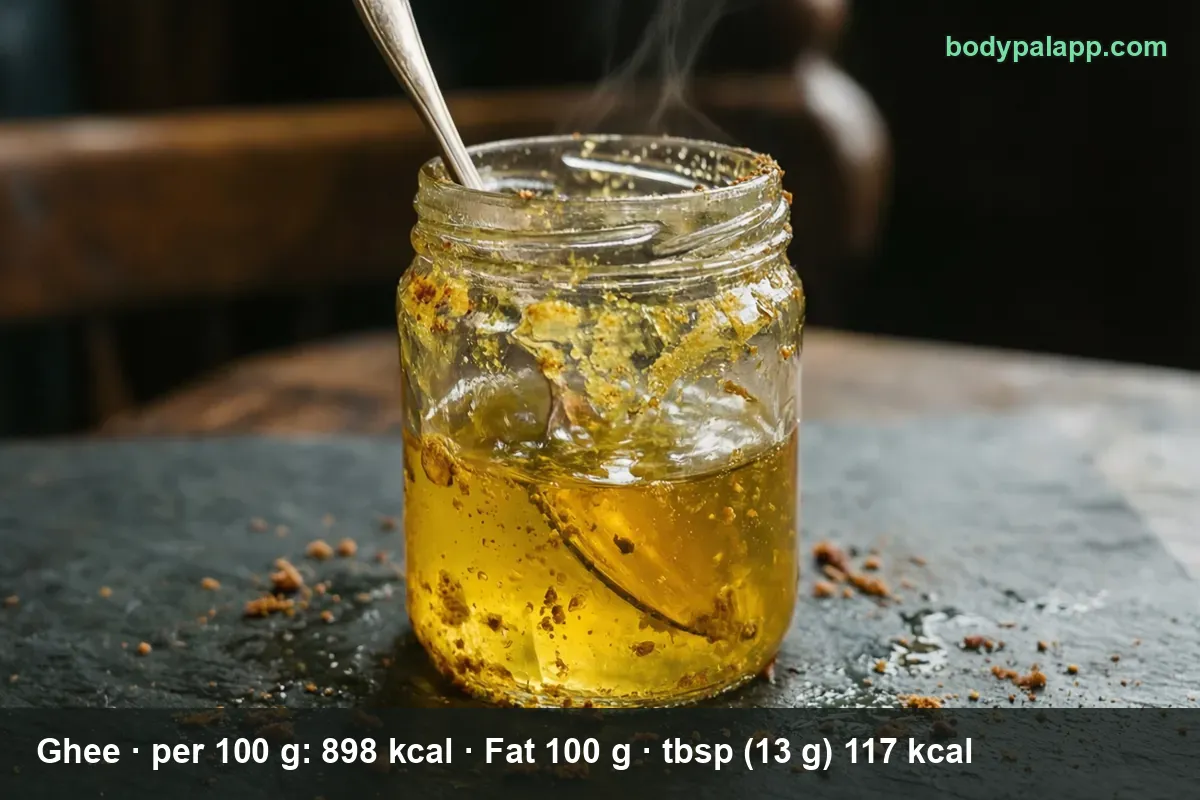
Calories in Ghee: 117 per Tablespoon, 898 per 100 g
The calories in ghee come to 117 per tablespoon and 898 per 100 g, which makes it the most energy-dense ingredient most kitchens hold. Ghee is butter with the water and milk solids cooked away, so what remains is fat and nothing else. Every gram in the jar is 9 calories.
On this page
- Ghee nutrition at a glance
- Spoonfuls, from a teaspoon to a curry base
- Why the jar says 898 and the database says 878
- Ghee against butter and margarine
- The health halo and the calorie column
- Most popular ghee brands
- FAQ
Ghee nutrition at a glance
| Nutrient | Per 100 g | Per tablespoon (~13 g) | %RI* per tablespoon |
|---|---|---|---|
| Energy | 898 kcal / 3,757 kJ | 117 kcal / 490 kJ | 6% |
| Protein | 0 g | 0 g | – |
| Carbohydrate | 0 g | 0 g | – |
| of which sugars | 0 g | 0 g | – |
| Fat | 100 g | 13 g | 19% |
| Fibre | 0 g | 0 g | – |
| Salt | 0 g | 0 g | – |
*%RI = percentage of the reference intake for an average adult (2,000 kcal; 70 g fat, 260 g carbohydrate, 90 g sugars, 50 g protein, 6 g salt).
Verified nutrition data
Numbers on this page come from CoFID, the UK government’s Composition of Foods Integrated Dataset, and from manufacturer labels where a branded product is named. Last verified August 2026. How we verify our data →
That fat row is worth a second look: 100 g of fat in 100 g of product. Butter carries 82.2 g, because roughly a sixth of butter is water and milk solids. Clarifying removes both, and the calories concentrate accordingly.
The zeros matter too. No carbohydrate, no sugar, no protein and no salt, which is rare for anything sold in a jar. Ghee is a single macronutrient with a flavour.
Spoonfuls, from a teaspoon to a curry base
| Portion | Weight | Calories |
|---|---|---|
| Teaspoon | ~4 g | 36 kcal |
| Tablespoon | ~13 g | 117 kcal |
| Curry base, 2 tablespoons | ~26 g | 233 kcal |
The teaspoon is the honest unit for ghee, because recipes rarely stop at one spoon. A home curry that starts with two tablespoons puts 233 calories in the pan before the onions arrive, and that fat does not evaporate; it ends up in the sauce, shared across however many portions you serve.
Fried rice, paratha, roast vegetables: the pattern repeats. Ghee goes in by the generous spoon, and at 9 calories a gram the difference between a level and a heaped tablespoon is real. Level it once against a knife and you will know what your usual scoop actually weighs.
Why the jar says 898 and the database says 878
The 898 figure on this page comes from the label of KTC Pure Butter Ghee, one of the most common jars on UK shelves. The government's CoFID database lists its own ghee entry at 878 kcal per 100 g with 97.6 g of fat. The gap is not a mystery: one describes a specific product that is fully clarified, the other an average across samples that keep a little more moisture.
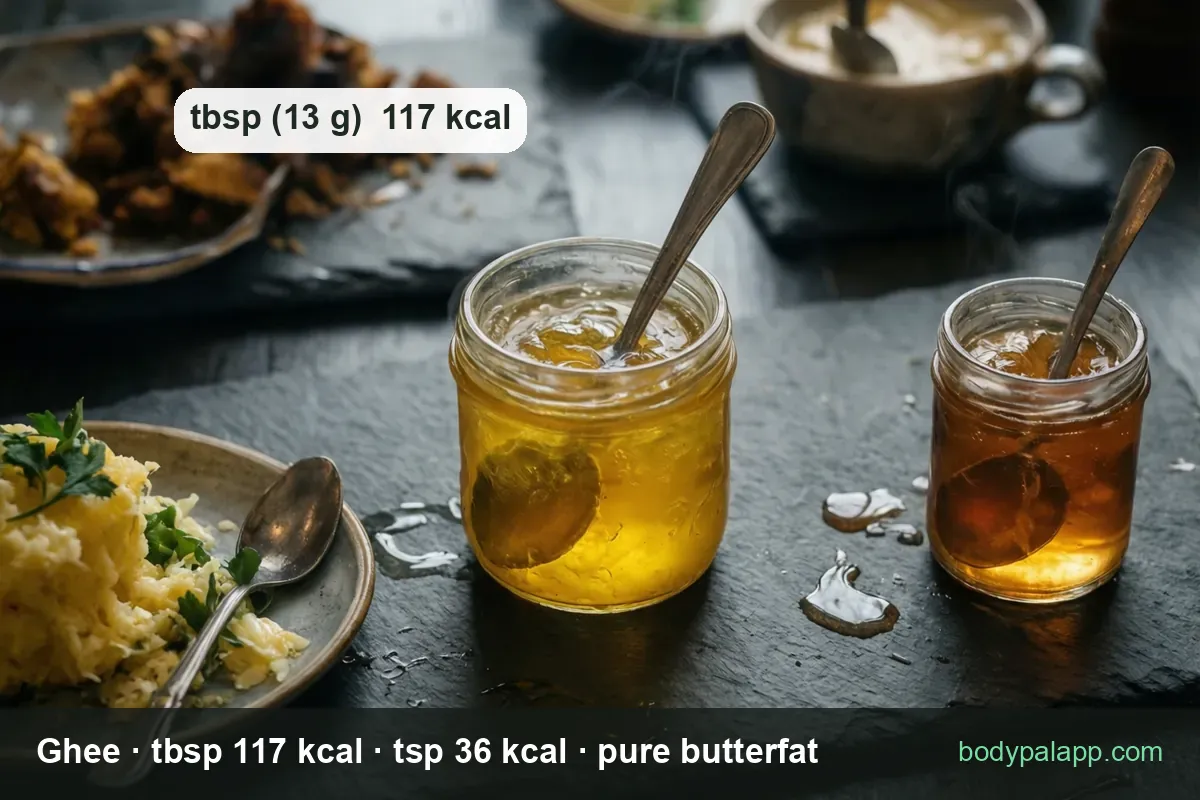
For logging purposes the difference is 20 kcal per 100 g, under 3 per tablespoon. Take whichever number matches the jar in your cupboard and move on; the spoon size will swing your total far more than the source will.
Homemade ghee sits in the same range. Simmering butter until the solids brown and straining them off leaves close to pure butterfat, so expect the finished jar to behave like the shop one, not like the butter it started as.
Ghee against butter and margarine
| Fat | Per 100 g | Per tablespoon | Fat per 100 g |
|---|---|---|---|
| Ghee | 898 kcal | 117 kcal (~13 g) | 100 g |
| Butter, salted | 744 kcal | 104 kcal (~14 g) | 82.2 g |
| Margarine, hard block | 688 kcal | 96 kcal (~14 g) | 76.4 g |
The verdict: for the fewest calories per spoon, margarine wins and ghee comes last; the gap between ghee and butter is 154 kcal per 100 g, which is the water butter carries for free. Pick ghee for the pan, not the toast: it earns its place at high heat, where butter's milk solids scorch, and nothing about that requires pretending it is light.
On saturated fat the two are closer than the marketing suggests. CoFID's ghee entry records 58.4 g of saturates per 100 g against butter's 52.1 g, so concentration went up when the water left. The NHS advises keeping saturated fat under 20 g a day for an average adult, and one tablespoon of either fat spends more than a third of that.
One genuine difference favours ghee: salt. Salted butter carries 1.8 g per 100 g, while ghee carries none, a point in its favour if you are watching sodium against the NHS 6 g daily guide. The full head-to-head lives in our butter vs ghee comparison.
The health halo and the calorie column
"Ghee is a lighter choice than butter." It is the opposite. Removing water concentrates everything, so ghee runs 154 kcal per 100 g above butter and 13 above it per spoon. Whatever draws you to ghee, flavour, heat stability, no lactose to speak of, the calorie column is not on that list.
"It's traditional, so it doesn't count like other fat." A gram of butterfat is 9 calories whether it came from a jar of ghee, a block of butter or a bottle of oil. The Eatwell Guide files all of them under the same small corner of the plate: use sparingly.
Most popular ghee brands in the United Kingdom
Ranked by how widely each product appears among foods sold in the United Kingdom, from the BodyPal food database of over 3.3 million products. Calories are the figures printed on each label.
| Product | Calories (per 100 g) |
|---|---|
| East End Pure Butter Ghee | 900 kcal |
| KTC Pure Butter Ghee | 898 kcal |
| Amul Ghee | 897 kcal |
Brand popularity: BodyPal food database. Nutrition: manufacturer labels.
How long does it take to burn off ghee?
A tablespoon (~13 g) is 117 kcal. Enter your weight and the amount you ate to see how long it takes you to burn that off:
lb
| Activity | Time to burn 117 kcal |
|---|---|
| Walking, brisk | 23 min |
| Cycling, moderate | 15 min |
| Swimming, moderate | 17 min |
| Jogging | 14 min |
| Weight training, moderate | 26 min |
Times are for a 154 lb (11 st) adult at a steady pace; change the weight to see yours. The amount is set to the portion in the text (13 g); change it to what you actually ate. BodyPal works this out from your steps automatically.
Want the bigger picture? Calculate your daily calorie needs — your maintenance figure, a target for losing or gaining, and the date you get there.
Frequently asked questions
How many calories are in a tablespoon of ghee?
A tablespoon of ghee is 117 kcal at around 13 g. It is pure fat, so the count scales exactly with weight: 9 calories per gram, wherever you spend it. A heaped spoon can easily carry half as much again, which is why levelling it matters more with ghee than with most ingredients.
Does ghee have more calories than butter?
Yes. Ghee is 898 kcal per 100 g against butter's 744, and 117 against 104 per tablespoon. Butter is roughly one-sixth water and milk solids, which carry no meaningful energy; clarifying removes them, leaving only fat. Gram for gram, ghee is the most calorific thing in the cupboard.
Why is ghee so high in calories?
Because it is 100% fat, and fat holds 9 calories per gram, more than double carbohydrate or protein. Most foods dilute their fat with water, fibre or protein. Ghee has had all of that removed on purpose, so there is nothing left in the jar that is not energy.
How many calories are in a teaspoon of ghee?
A teaspoon is 36 kcal at around 4 g. For cooking that only needs a film of fat in the pan, a teaspoon is often enough, and swapping your habitual tablespoon for it saves 81 calories per go. Across a week of daily cooking that is a meal's worth of difference.
Does ghee contain carbohydrate or sugar?
No. The label reads 0 g carbohydrate and 0 g sugar, alongside 0 g protein and 0 g salt. Every calorie of ghee's 898 per 100 g comes from fat. That makes it simple to log accurately: weigh the spoon, multiply by nine, and the number is right.
Is ghee okay to use if I'm cutting calories?
It can be, if you measure it. At 117 kcal a tablespoon there is no low-calorie way to use ghee freely, but a teaspoon at 36 kcal buys the flavour and the high-heat behaviour without wrecking a deficit. The pan does not need more; habit usually adds the rest.
Does ghee contain salt?
No, ghee carries 0 g of salt. Salted butter, by contrast, holds 1.8 g per 100 g, about 0.25 g per tablespoon. If you cook with several spoons of fat a day and are watching salt against the NHS guide of under 6 g, ghee is the quieter choice of the two.
Is there lactose in ghee?
Clarifying strains out the milk solids, which is where lactose and milk protein live, so well-made ghee contains at most a trace. Its calories are unaffected either way at 898 per 100 g. If you avoid dairy strictly, check the individual jar's label rather than assuming.
Why do different sources give ghee different calories?
Labels such as KTC's say 898 kcal per 100 g; the UK CoFID database averages ghee at 878 with 97.6 g of fat. The spread reflects how completely the water was removed. The difference is under 3 kcal per tablespoon, so either number logs a spoonful honestly.
Similar foods
- Olive oil — 124 kcal per tablespoon
- Butter — 52 kcal per thin scrape
- Margarine — 48 kcal per scrape
- Mayonnaise — 103 kcal a tablespoon
- Almond butter — 103 kcal per tablespoon
- Peanut butter — 97 kcal per tablespoon
Count it without the maths
BodyPal logs the ghee in your curry from one photo of the plate, so the spoonful that went into the pan stops going missing from your day.

