
How Many Calories in a Piece of Pizza?
Asking how many calories in a piece of pizza gets a straight answer: around 340 kcal for a typical 125 g slice from a large cheese and tomato pizza, which works out at 272 kcal per 100 g. Toppings move that number far less than most people expect. The cheese, not the pepperoni, does most of the damage.
On this page
- Quick facts
- Calories per slice and per pizza
- Toppings change the maths
- How does pizza compare?
- The thin-crust myth
- The salt problem
- Most popular pizza brands
- FAQ
Quick facts
Cheese and tomato pizza, retail, as measured for the UK government's food composition data:
| Nutrient | Per 100 g | Per slice (125 g) | % RI (per slice) |
|---|---|---|---|
| Calories | 272 kcal / 1,138 kJ | 340 kcal / 1,423 kJ | 17% |
| Protein | 12.2 g | 15.3 g | 31% |
| Carbohydrates | 36.1 g | 45.1 g | 17% |
| Fat | 9.8 g | 12.3 g | 18% |
| – of which saturates | 4.12 g | 5.2 g | 26% |
| Fibre | 2.9 g | 3.6 g | – |
| Sugar | 3.9 g | 4.9 g | 5% |
| Salt | 0.99 g | 1.2 g | 20% |
Verified nutrition data
Numbers on this page come from CoFID, the UK government’s Composition of Foods Integrated Dataset, and from manufacturer labels where a branded product is named. Last verified August 2026. How we verify our data →
RI = Reference Intake of an average adult (2,000 kcal a day). Fibre has no formal RI.
What that means on the plate: one slice carries real protein, 15 g, nearly a third of your day. It also carries a fifth of your salt allowance. Calorie-wise a slice is a snack; salt-wise it is a meal.
Calories per slice and per pizza
| Portion | Weight | Calories |
|---|---|---|
| 1 slice of a large pizza | ~125 g | 340 kcal |
| 2 slices | ~250 g | 680 kcal |
| Personal 10-inch margherita | ~300 g | 816 kcal |
Slices are not standard. A thin supermarket slice can weigh 90 g and a deep-pan takeaway wedge can pass 150 g, so the same "one slice" spans roughly 245 to 410 kcal. Weigh a slice from your usual order once. After that, your estimate is trustworthy for good.
The practical maths: two slices with a salad is a dinner in the region of 700 kcal, which is a perfectly ordinary evening meal. A whole personal margherita lands at 816 kcal before any dips or garlic bread join it. It is the sides, not the pizza, that usually push the night past 1,500.
Counting in slices also survives contact with real life better than counting in grams. Nobody weighs food at a party, but everybody remembers how many pieces they took. Fix the weight of your usual slice once, at home, and from then on "three slices" is a real number you can log from memory.
Toppings change the maths
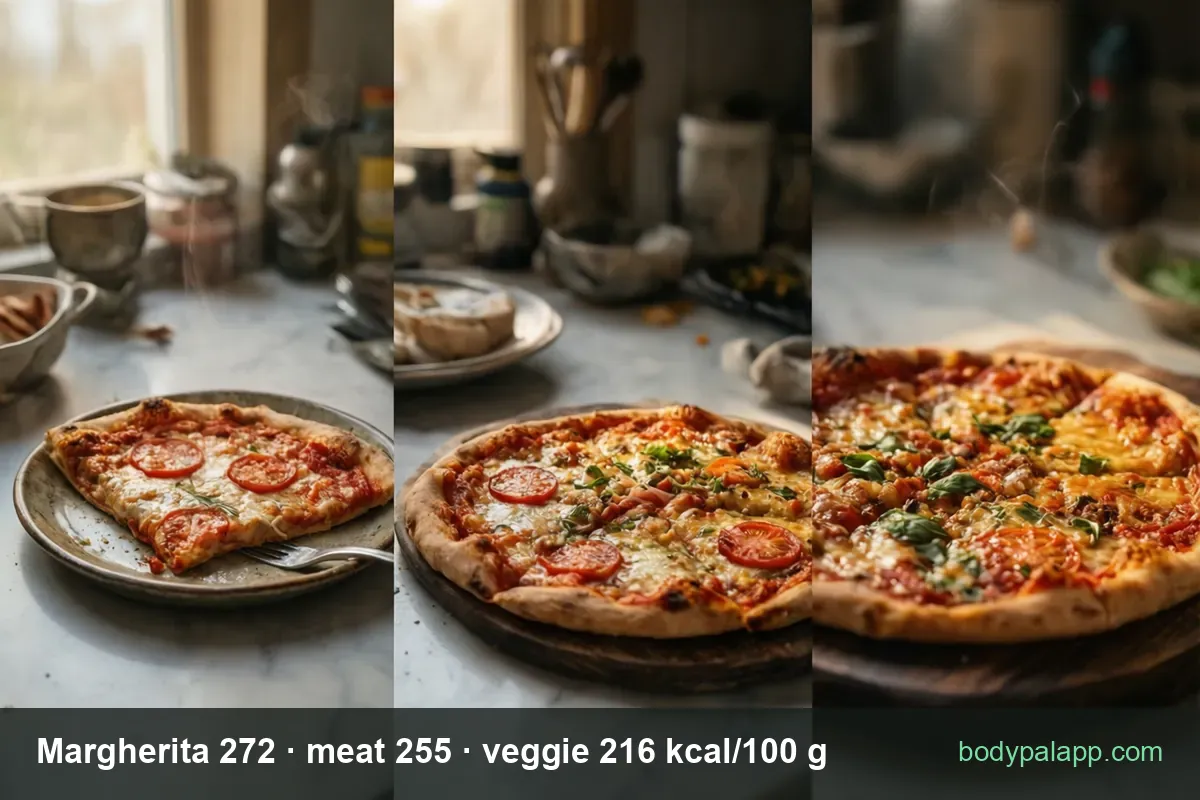
| Variant | Per 100 g | Per 125 g slice |
|---|---|---|
| Cheese and tomato, retail | 272 kcal | 340 kcal |
| Meat topped | 255 kcal | 319 kcal |
| Chicken topped | 246 kcal | 308 kcal |
| Fish topped, takeaway | 226 kcal | 283 kcal |
| Vegetarian | 216 kcal | 270 kcal |
| Homemade, tomato only (no cheese topping) | 193 kcal | 241 kcal |
Here is the counter-intuitive bit: meat pizza is lighter per 100 g than plain cheese and tomato, 255 against 272 kcal. Toppings displace cheese, and cheese is the densest thing on the base. These are measured takeaway and retail samples from CoFID, the UK government's food composition dataset, not menu estimates.
On the plate, that means ordering vegetarian saves about 70 kcal a slice, while skipping one slice saves 340. The slice count matters five times more than the topping choice. If you only change one habit, change how many pieces leave the box.
The homemade row at the bottom deserves a second look. A tomato base without a cheese topping runs 193 kcal per 100 g, nearly 30% below the retail cheese and tomato. Cheese on top is where a pizza's density lives, so going light on it at home is the single biggest lever you control, bigger than any topping swap the takeaway menu offers.
How does pizza compare?
| Food | Typical amount | Calories | Per 100 g |
|---|---|---|---|
| Pizza, cheese and tomato | 1 slice (125 g) | 340 kcal | 272 kcal |
| Burger | per 100 g | – | 288 kcal |
| Doner kebab | per 100 g | – | 377 kcal |
| Lasagne | typical portion | ~630 kcal | – |
| Fish and chips | average portion | ~1,074 kcal | – |
The verdict: pizza is the easiest takeaway to control because it arrives pre-portioned, and even three slices undercut an average fish and chips. For a lighter night, two slices of vegetarian at around 540 kcal is the best order on this table; the doner and the fish and chips are the ones that quietly write off the day.
If you are cooking at home instead, a tomato-based bowl of pasta plays the same role as the no-cheese homemade pizza above: the sauce is cheap, calorie-wise, and you decide what lands on top.
The thin-crust myth
"Thin crust is the healthy option" is half-true in a way that trips people up. Per 100 g, a thin pizza and a deep-pan pizza are much the same food: dough, sauce, cheese, in similar proportions. The thin slice wins only because it weighs less, perhaps 90 g against 150 g, which is a saving of roughly 160 kcal a slice at cheese-and-tomato density.
The catch is behavioural. Lighter slices invite an extra one, and four thin slices weigh about what three deep-pan slices do, which cancels the entire advantage. Order thin crust because you prefer it. If the goal is fewer calories, the reliable move is still one slice fewer, whatever the crust.
The salt problem
Pizza's real issue is not the calories. At 0.99 g of salt per 100 g, two slices deliver about 2.5 g, which is 40% of the 6 g daily maximum the NHS advises, before a single dip or side is counted. A whole personal margherita carries around 3 g on its own.
If you are watching salt, the homemade route is the honest fix: you control the dough, the sauce and the cheese, the three places the salt hides. Cutting the pepperoni does little; it was never the main offender.
Worth saying plainly: this is the metric where pizza genuinely differs from a home-cooked plate of similar calories. Most people track the 340 kcal and never see the 1.2 g riding along with it. If pizza is a weekly fixture rather than an occasional one, the salt line in the Quick Facts table is the one to read first.
Most popular pizza brands in the United Kingdom
Ranked by how widely each product appears among foods sold in the United Kingdom, from the BodyPal food database of over 3.3 million products. Calories are the figures printed on each label. Supermarket freezer pizzas cluster just under the CoFID retail figure of 272.
| Product | Calories (per 100 g) |
|---|---|
| Dr. Oetker Ristorante Mozzarella | 250 kcal |
| Chicago Town Four Cheese | 279 kcal |
| Goodfella's Stone Baked Thin Margherita | 243 kcal |
Brand popularity: BodyPal food database. Nutrition: manufacturer labels.
FAQ
How many calories in a slice of pizza?
About 340 kcal for a 125 g slice from a large cheese and tomato pizza. Thin-crust slices weigh less and can drop towards 250 kcal, while deep-pan slices climb past 400. Slice weight, not topping choice, is what moves the number most.
How many calories in pizza per 100 g?
272 kcal per 100 g for retail cheese and tomato pizza. Meat topped is 255, chicken 246, vegetarian 216 and a homemade tomato base without cheese topping 193. Everything sits between roughly 2 and 2.7 kcal per gram, so weight is a reliable guide.
How many calories in a margherita pizza?
816 kcal for a personal 10-inch margherita weighing about 300 g. That is a complete meal's worth in one box. At 272 kcal per 100 g, a bigger 400 g margherita would pass 1,000 kcal, so the diameter of the pizza matters more than its name.
How many calories in a Domino's slice?
There is no single honest number: chains publish their own figures and they swing widely with size, crust and topping. Check the chain's own nutrition calculator for the exact pizza, or log by weight using 272 kcal per 100 g as a cheese and tomato baseline.
How many calories in a whole pizza?
Around 816 kcal for a 300 g personal margherita. A large pizza is a weight question: at 272 kcal per 100 g, a 600 g large comes to roughly 1,630 kcal. Weigh the whole pizza once, or check the pack weight, and the total stops being a guess.
Is pizza bad for you?
Not at one or two slices: 340 kcal with 15 g of protein per slice fits into a normal day alongside the NHS Eatwell balance. The problems are dose and salt. A whole large pizza with sides can approach a full day's calories, and two slices already hold 2.5 g of salt.
How much salt is in pizza?
0.99 g of salt per 100 g, which means about 1.2 g in a single slice and 2.5 g in two, against a 6 g daily maximum. That makes pizza one of the saltiest ways to spend 680 kcal, and it is the strongest argument for stopping at two pieces.
Is vegetarian pizza lower in calories?
Yes: 216 kcal per 100 g against 272 for cheese and tomato, which is roughly 70 kcal less per slice. Vegetables displace cheese, the densest ingredient on the base. The saving is real but modest; eating one slice fewer still saves far more than switching topping.
Similar foods
- Greggs Chicken Bake — 420 kcal per bake
- Quarter Pounder — 263 kcal per 100 g with cheese
- Bacon sandwich — 314 kcal, 388 with butter
- Burger — 288 kcal per 100 g
- Cheeseburger — 254 kcal per 100 g takeaway
- Fries — 331 kcal per medium portion
Count it without the maths
One photo of the open box and BodyPal logs your slice, with the calories, the protein and the salt you cannot see, before the second piece disappears.


How long does it take to burn off a piece of pizza?
A 125 g slice of a large cheese and tomato pizza is 340 kcal. Enter your weight and the amount you ate to see how long it takes you to burn that off:
lb
| Activity | Time to burn 340 kcal |
|---|---|
| Walking, brisk | 1 hr 8 min |
| Cycling, moderate | 42 min |
| Swimming, moderate | 49 min |
| Jogging | 40 min |
| Weight training, moderate | 1 hr 16 min |
Times are for a 154 lb (11 st) adult at a steady pace; change the weight to see yours. The amount is set to the portion in the text (125 g); change it to what you actually ate. BodyPal works this out from your steps automatically.
Want the bigger picture? Calculate your daily calorie needs — your maintenance figure, a target for losing or gaining, and the date you get there.