
Calories in a Cheeseburger: What the UK Data Actually Says
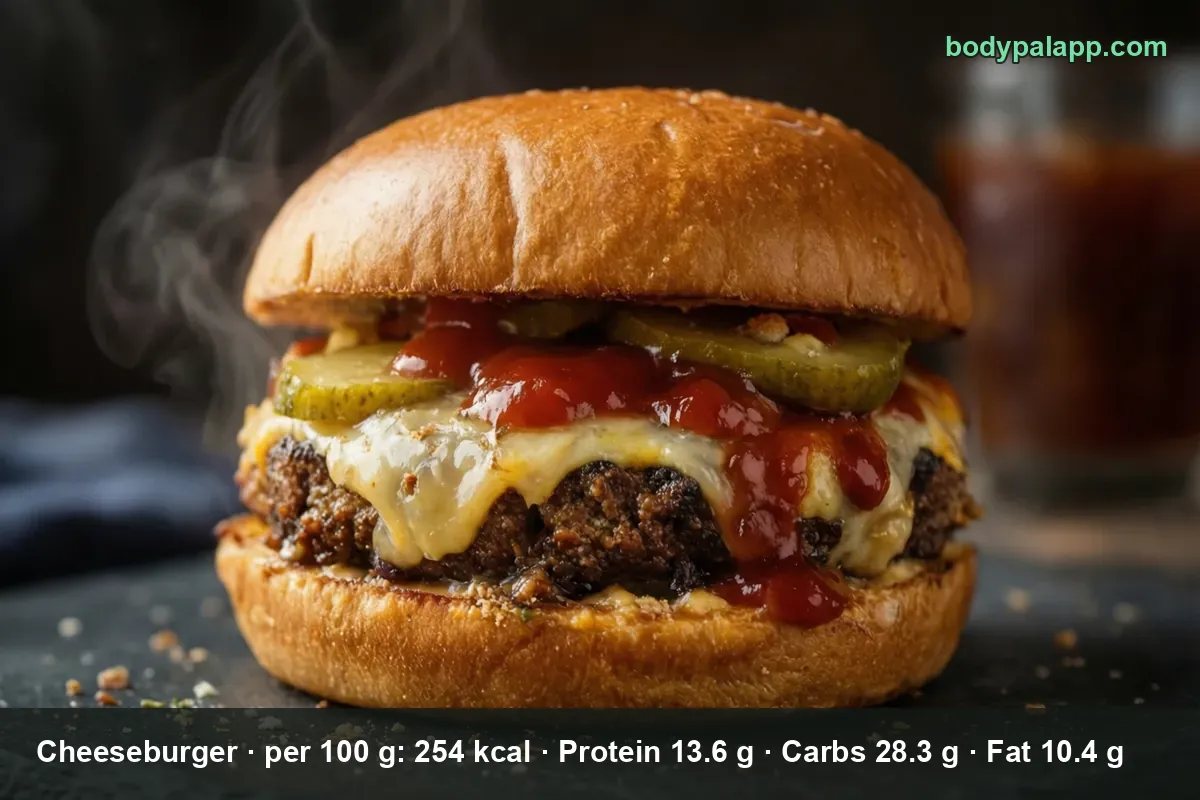
A takeaway cheeseburger carries 254 calories per 100 g. That is the figure for the whole assembled thing, beef and bun and cheese and the sauces, and it means the calories in a cheeseburger sit above both a Big Mac (232) and a Whopper (223) gram for gram. The small burger is the dense one.
On this page
- Cheeseburger nutrition at a glance
- Why the number is per 100 g and not per burger
- The takeaway burger league table
- Where the calories actually come from
- The patty without the bun
- Salt is the number that catches people out
- The bigger-burger myth
- Most popular cheeseburger brands in the United Kingdom
- FAQ
Cheeseburger nutrition at a glance
The reference here is a takeaway cheeseburger as measured by UK government analysts: a beefburger in a bun with cheese, mustard, ketchup, onions and pickles. Everything you would actually be handed, weighed together.
| Nutrient | Per 100 g | RI%* |
|---|---|---|
| Energy | 254 kcal / 1,063 kJ | 13% |
| Protein | 13.6 g | 27% |
| Carbohydrates | 28.3 g | 11% |
| – of which sugars | 5.7 g | 6% |
| Fat | 10.4 g | 15% |
| – of which saturates | 4.9 g | 25% |
| Fibre | 1.4 g | – |
| Salt | 1.4 g | 23% |
*RI% = share of an adult's daily reference intake, based on 2,000 kcal.
Verified nutrition data
Numbers on this page come from CoFID, the UK government’s Composition of Foods Integrated Dataset, and from manufacturer labels where a branded product is named. Last verified September 2026. How we verify our data →
Two rows do most of the work. Protein at 13.6 g per 100 g is genuinely respectable, better than most things sold through a hatch. Salt at 1.4 g is the row nobody reads, and it is the one that decides whether a burger fits into a normal day.
Why the number is per 100 g and not per burger
Chains publish per item. Government analysts publish per 100 g. Neither is wrong, but they answer different questions, and mixing them is how people end up logging the same burger twice.
The per-100 g figure describes the recipe. It tells you how concentrated the food is, which is why it can rank a cheeseburger above a Big Mac even though a Big Mac is obviously the larger meal. The per-item figure describes the portion, and portions vary by chain, by country and by year.
To turn 254 kcal per 100 g into a per-burger total you need the serving weight the chain prints on its own allergen and nutrition sheet, because chains publish per item and governments publish per 100 g. Take the weight in grams from that sheet and multiply by 2.54 and you have the calorie count for the burger in front of you. Guessing the weight is where most calorie apps quietly go wrong, because a burger looks like about 100 g and is rarely that light.
If you are logging at home, weigh the finished burger once. The ratio holds afterwards.
The takeaway burger league table
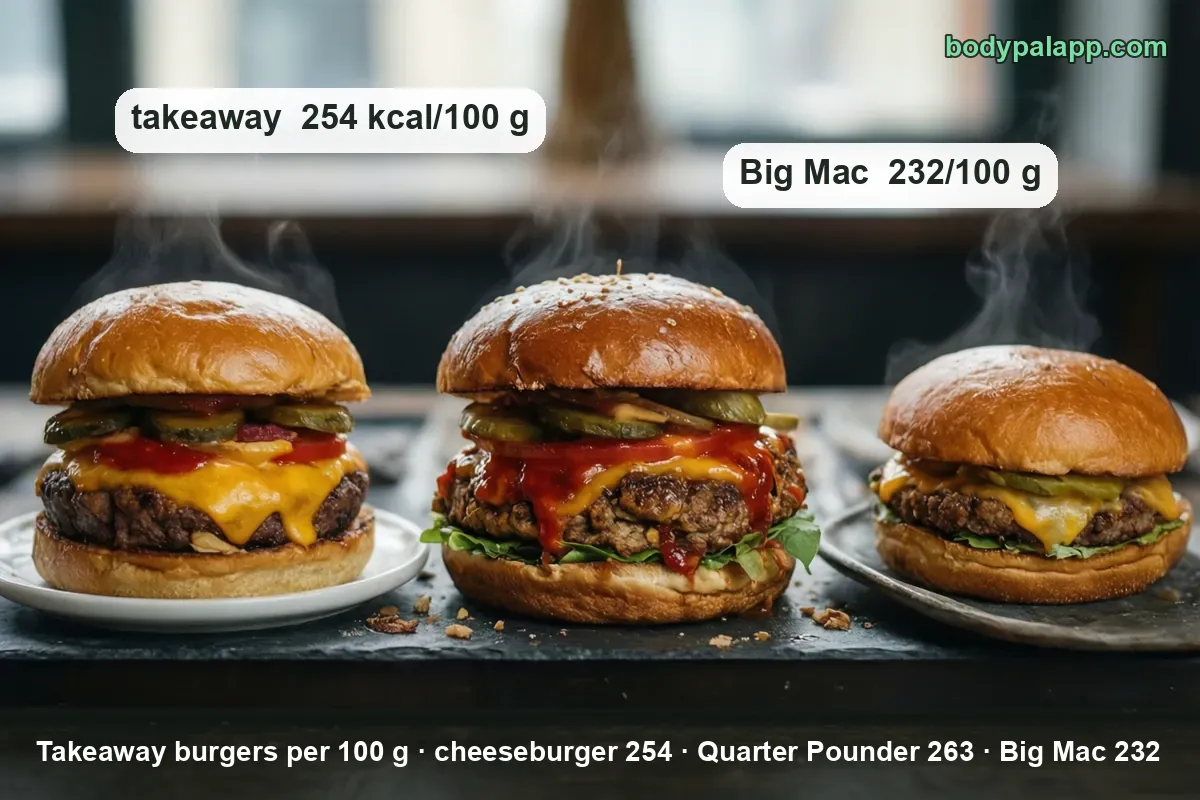
Six takeaway burgers, measured the same way, per 100 g. Sorted by energy density rather than by size, which reshuffles the order people expect.
| Burger (takeaway) | Calories / 100 g | Protein | Fat | Saturates | Sugars | Salt |
|---|---|---|---|---|---|---|
| Quarter Pounder with cheese | 263 kcal | 16.3 g | 13.2 g | 6.8 g | 5.5 g | 1.157 g |
| Cheeseburger | 254 kcal | 13.6 g | 10.4 g | 4.9 g | 5.7 g | 1.4 g |
| Hamburger | 246 kcal | 13.5 g | 8.3 g | 3.5 g | 6.6 g | 1.2 g |
| Chicken burger | 235 kcal | 12.5 g | 10.8 g | – | – | 1.4 g |
| Big Mac | 232 kcal | 13.1 g | 11.2 g | 4.7 g | 3.9 g | 0.975 g |
| Whopper | 223 kcal | 10.4 g | 12.1 g | 3.3 g | 4.2 g | 0.892 g |
The result runs against instinct. A Big Mac and a Whopper are built with a second bun layer, more shredded lettuce and more sauce, and all of that is either water or air. Dilution is the whole trick. Stack more onto a burger and the density falls even as the total climbs.
Our take: for protein per calorie the Quarter Pounder with cheese row wins outright at 16.3 g, and for the lowest salt in the group it is the Whopper at 0.892 g. The plain cheeseburger sits in the middle of both rankings, which is exactly why it survives as the default order.
One row deserves a warning label. The chicken burger at 235 kcal per 100 g looks like the lighter choice and carries the joint-highest salt in the table at 1.4 g, alongside more fat than a hamburger. Breaded chicken in a bun is not a lean swap. It is a burger with a different animal in it.
Where the calories actually come from
Multiply the fat by nine and you can see how much of each burger is oil rather than food.
| Burger | Calories / 100 g | Fat | Calories from fat | Share of energy |
|---|---|---|---|---|
| Whopper | 223 kcal | 12.1 g | 109 kcal | 49% |
| Quarter Pounder with cheese | 263 kcal | 13.2 g | 119 kcal | 45% |
| Big Mac | 232 kcal | 11.2 g | 101 kcal | 43% |
| Chicken burger | 235 kcal | 10.8 g | 97 kcal | 41% |
| Cheeseburger | 254 kcal | 10.4 g | 94 kcal | 37% |
| Hamburger | 246 kcal | 8.3 g | 75 kcal | 30% |
Now the cheeseburger looks different again. It is the second-densest burger in the table and the second-least fatty. Its calories are disproportionately carbohydrate: 28.3 g per 100 g, more than any other row, because a single small burger is mostly bun.
That matters if you are choosing on macros rather than on totals. The Whopper spends half its energy budget on fat. The cheeseburger spends just over a third, and hands you 13.6 g of protein for the trouble.
The patty without the bun
Strip the bread away and the numbers reorganise completely.
| Beef patty, grilled, no bun | Calories / 100 g | Protein | Fat | Saturates | Salt |
|---|---|---|---|---|---|
| 98–99% beef | 326 kcal | 26.5 g | 24.4 g | 10.9 g | 1.0 g |
| 62–85% beef | 229 kcal | 18.3 g | 13.8 g | 5.22 g | 1.1 g |
The premium patty is the heavier one. Ninety-nine per cent beef means 326 kcal and 24.4 g of fat per 100 g, against 229 kcal for the cheaper 62–85% mince, which is bulked out with rusk and water. That is a 97 kcal gap per 100 g in favour of the burger most people would describe as worse.
Fat is where the difference lives, and so is flavour. The lean-mince patty gives up 8.2 g of protein per 100 g in exchange, so it is not a free saving either.
Ditching the bun does not make a cheeseburger a light meal. It makes it a more concentrated one. Per 100 g eaten you go from 254 kcal to 326, and the cheese slice stays exactly where it was.
Salt is the number that catches people out
A cheeseburger is 1.4 g of salt per 100 g. The NHS daily maximum for adults is 6 g, so every 100 g of burger takes roughly a quarter of it.
Add chips and a sauce and the salt total for one counter meal starts competing with the day's entire allowance, without a shaker being involved. Salt in fast food arrives pre-installed: in the bun, in the cheese slice, in the pickles, in the seasoned patty and in the ketchup.
The spread across the league table is wider than the calorie spread. Whopper 0.892 g, Big Mac 0.975 g, Quarter Pounder 1.157 g, hamburger 1.2 g, cheeseburger and chicken burger both 1.4 g. Gram for gram the smallest burgers are the saltiest, because the seasoning is concentrated at the surfaces and small burgers are almost all surface.
If salt is the thing you are managing this week, the ranking to follow is that one, not the calorie column.
The bigger-burger myth
The belief that a Big Mac must be the "worst" burger is the most common error on this subject, and it comes from confusing a total with a rate.
Per 100 g the Big Mac is one of the lighter builds in the table at 232 kcal, below both a cheeseburger and a hamburger. It carries less salt than either. What makes a Big Mac a bigger meal is that there is simply more of it, which is a portion question and not a recipe question.
The second myth is that a burger is a protein food. At 13.6 g per 100 g it is a decent contributor, but the same weight of grilled beef patty gives 26.5 g. Roughly half the protein in a cheeseburger has been replaced by bread, and that bread is doing most of the carbohydrate work too. A doner kebab or a chicken kebab is worth comparing here if protein per calorie is what you are shopping for.
Most popular beef burger brands in the United Kingdom
Ranked by how widely each product appears among foods sold in the United Kingdom, from the BodyPal food database of over 3.3 million products. Calories are the figures printed on each label. These are chiller-cabinet patties, not an assembled takeaway burger.
| Product | Calories (per 100 g) |
|---|---|
| Tesco Finest Beef Burgers | 230 kcal |
| Lidl Next Level Burger | 218 kcal |
| Aldi Aberdeen Angus Beef Burger | 204 kcal |
| Aldi Specially Selected Irish Black Angus Beef Burgers | 171 kcal |
Brand popularity: BodyPal food database. Nutrition: manufacturer labels.
Cheeseburger FAQs
How many calories in a McDonald's cheeseburger?
UK composition data puts a takeaway cheeseburger at 254 kcal per 100 g, including bun, cheese, ketchup, mustard, onions and pickles. To convert that into a per-burger number you need the chain’s own printed serving weight, which appears on its allergen and nutrition sheet. Multiply that weight in grams by 2.54.
How many calories in a double cheeseburger?
A double swaps bread for a second beef patty, so its density climbs towards the patty figure of 326 kcal per 100 g rather than staying at 254. The item total depends on the chain’s serving weight, so take that from the printed sheet and apply the higher density. Expect more protein and noticeably more saturated fat than the single.
Cheeseburger or Big Mac: which has fewer calories?
Per 100 g the Big Mac is the lighter recipe at 232 kcal against 254 for a cheeseburger, and it carries less salt too, 0.975 g against 1.4 g. The Big Mac is still the larger meal overall because there is more of it on the tray. Density and total are two different questions.
How much protein is in a cheeseburger?
13.6 g per 100 g, which is 27% of an adult's daily reference intake for every 100 g eaten. The Quarter Pounder with cheese does better at 16.3 g per 100 g. A grilled 98–99% beef patty on its own reaches 26.5 g, so about half the protein density is lost to the bun.
How many calories in a cheeseburger without the bun?
A grilled 98–99% beef patty is 326 kcal per 100 g with 26.5 g of protein and 24.4 g of fat. A cheaper 62–85% beef patty is 229 kcal per 100 g. Removing the bun raises the calories per 100 g eaten while cutting the carbohydrate to almost nothing, and the cheese slice is unaffected.
How much salt is in a cheeseburger?
1.4 g per 100 g, close to a quarter of the 6 g daily maximum the NHS sets for adults. That is the joint-highest figure among common takeaway burgers, level with a chicken burger and above a Whopper at 0.892 g. Small burgers are saltier per gram because seasoning sits on the surfaces.
Is a cheeseburger healthy?
It is a moderate-protein, high-salt food: 13.6 g of protein and 1.4 g of salt per 100 g, with 4.9 g of saturates. It sits comfortably in a normal week and awkwardly in a normal day if you eat it alongside chips and a sauce. If you are watching saturated fat, the hamburger row at 3.5 g per 100 g is the cheaper swap.
How many calories in a homemade cheeseburger?
Start with the patty: 326 kcal per 100 g for 98–99% beef, or 229 kcal for a 62–85% mince, then add your bun and cheese. Switching to the leaner mince saves 97 kcal per 100 g of patty and costs 8.2 g of protein. Weigh the raw patty once and the arithmetic is settled for good.
Similar foods
- Happy Meal — 172-660 kcal depending on the build
- Quarter Pounder — 263 kcal per 100 g with cheese
- Cheese toastie — ~440 kcal whole
- Scotch egg — 272 kcal each
- Salmon — 287 kcal per grilled fillet
- Chicken leg — 236 kcal per 100 g roasted
Skip the maths at the counter
Photograph the tray and BodyPal reads the burger, the chips and the sauce in one go, calories, protein and salt included.


How long does it take to burn off a cheeseburger?
100 g of takeaway cheeseburger is 254 kcal. Enter your weight and the amount you ate to see how long it takes you to burn that off:
lb
| Activity | Time to burn 254 kcal |
|---|---|
| Walking, brisk | 51 min |
| Cycling, moderate | 32 min |
| Swimming, moderate | 36 min |
| Jogging | 30 min |
| Weight training, moderate | 56 min |
Times are for a 154 lb (11 st) adult at a steady pace; change the weight to see yours. The amount is set to the portion in the text (100 g); change it to what you actually ate. BodyPal works this out from your steps automatically.
One food is easy to picture; a whole day is harder. See how many calories you need a day and what a deficit actually looks like.