
Calories in Salmon Fillet: 287 kcal [57 Minutes of Walking]
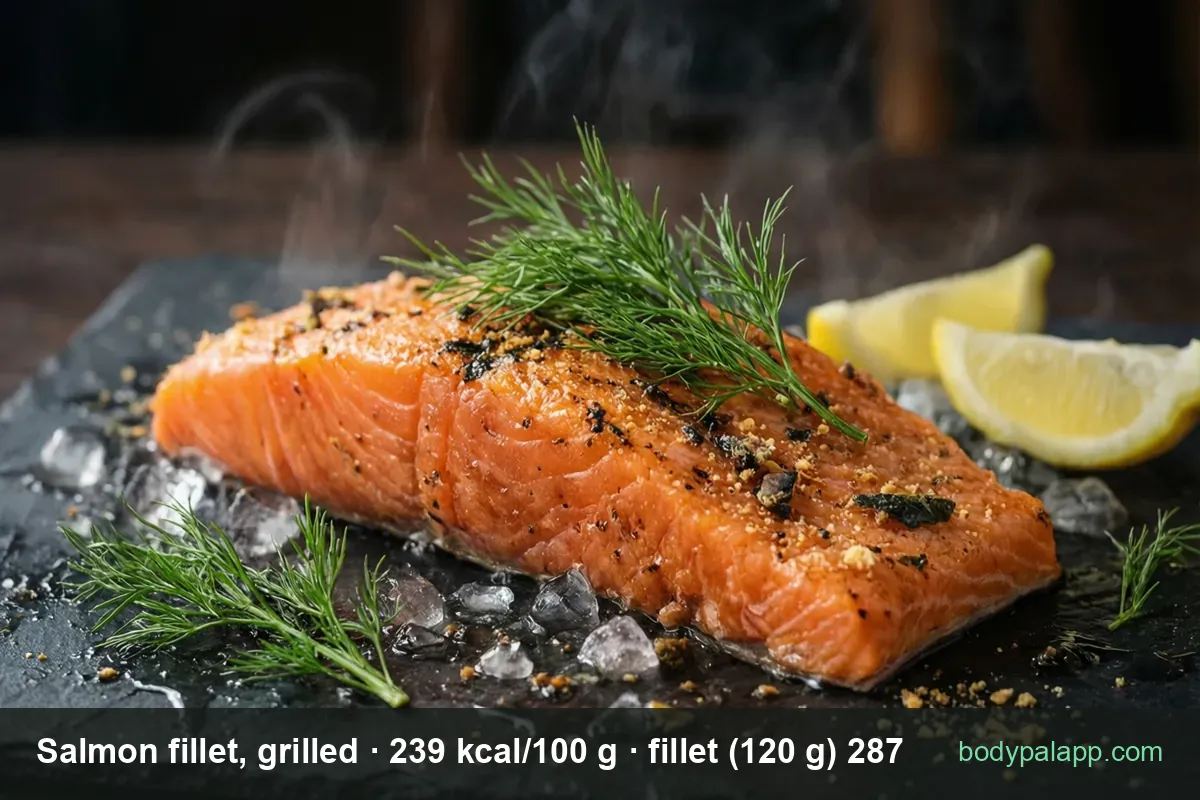
Grill a typical 120 g salmon fillet and you sit down to 287 calories. Per 100 g, farmed grilled salmon runs 239 kcal, with 24.6 g of protein doing the heavy lifting. The calories in salmon fillet come from fat and protein, nothing else — there isn't a single carb on the plate.
 (alt: "Salmon fillet on a plate - 287 calories per grilled fillet")
On this page
- Salmon quick facts
- Salmon portions in calories
- Smoked, wild, canned and en croute
- How does salmon compare?
- The smoked salmon trap
- Most popular smoked salmon brands
- FAQ
Salmon quick facts
The reference here is farmed salmon, grilled, flesh only — which is what nearly every fillet in a UK supermarket becomes.
| Nutrient | Per 100 g grilled | Typical fillet (~120 g) | RI%* |
|---|---|---|---|
| Energy | 239 kcal / 1,000 kJ | 287 kcal / 1,201 kJ | 14% |
| Protein | 24.6 g | 29.5 g | 59% |
| Carbohydrates | 0 g | 0 g | 0% |
| – of which sugars | 0 g | 0 g | 0% |
| Fat | 15.6 g | 18.7 g | 27% |
| – of which saturates | 2.95 g | 3.5 g | 18% |
| Fibre | 0 g | 0 g | – |
| Salt | 0.12 g | 0.14 g | 2% |
*RI% = the fillet's share of an adult's daily reference intake, based on 2,000 kcal.
Verified nutrition data
Numbers on this page come from CoFID, the UK government’s Composition of Foods Integrated Dataset, and from manufacturer labels where a branded product is named. Last verified August 2026. How we verify our data →
That protein row is the headline: one fillet covers 59% of the daily reference intake. And notice what the fat is not — of the 18.7 g in a fillet, only 3.5 g is saturated. Salmon is an oily fish, the category the NHS says to eat one portion of each week, and the oil is the point, not the problem.
Salmon portions in calories
- Typical fillet, cooked (~120 g): 287 kcal. The standard supermarket single portion.
- Smoked salmon, pack serving (50 g): 92 kcal. Two or three slices over a bagel or scrambled eggs.
Fillets vary less than vegetables do, but they still vary. A thin tail-end piece can be well under 120 g; a thick centre cut can push past it. The per-100 g figure — 239 kcal grilled — turns any kitchen scale reading into an answer in one multiplication.
Worth knowing when you plan the week: the fillet's 287 kcal buys you a main-course protein hit that very few foods match at that price. It's the rest of the plate that decides whether dinner lands at 450 or 900.
(alt: "BodyPal app scanning salmon fillet showing calories and macros")
Smoked, wild, canned and en croute
 (alt: "Salmon variants calories comparison")
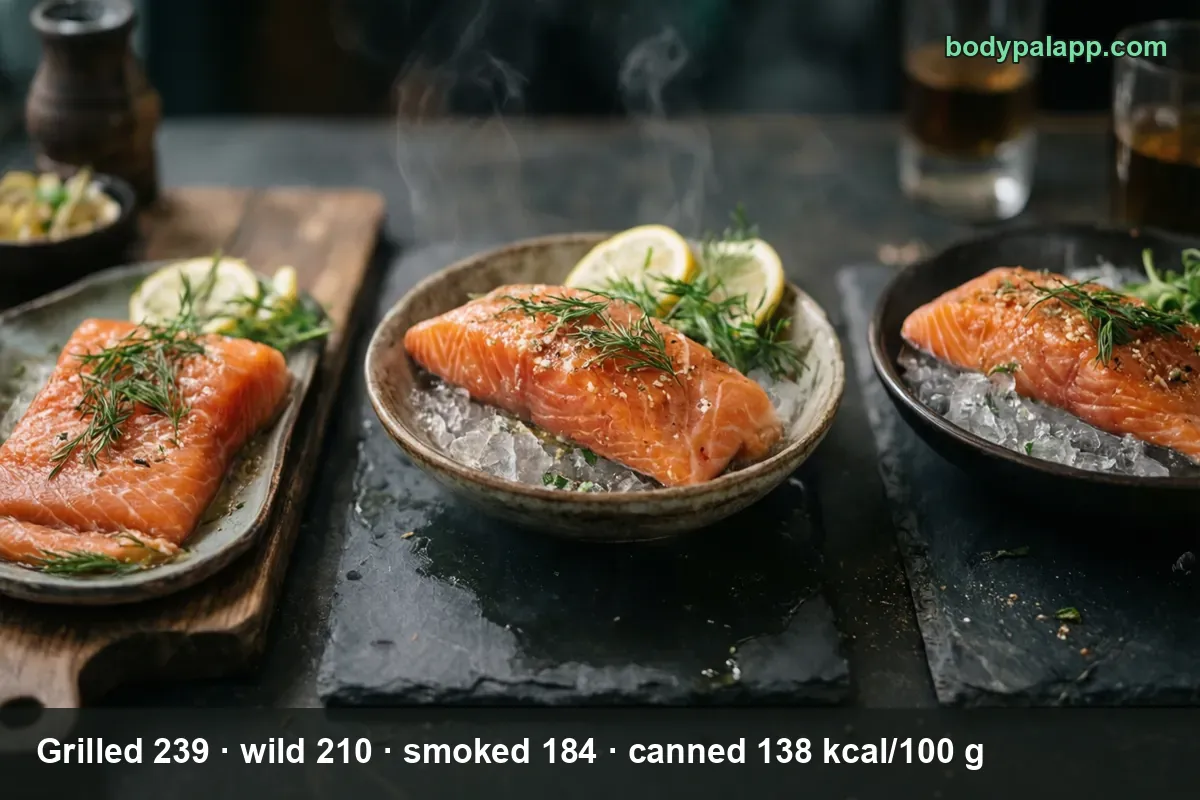
- Grilled, farmed: 239 kcal per 100 g. The benchmark.
- Baked, farmed: 232 kcal per 100 g. Practically the same fish, practically the same number.
- Raw: 217 kcal per 100 g — the sashimi figure; cooking drives off water and nudges the density up.
- Wild, grilled: 210 kcal per 100 g (25.9 g protein, 11.8 g fat). Wild fish work harder and carry less fat.
- Cold-smoked: 184 kcal per 100 g — but 2.96 g of salt per 100 g. Hold that thought.
- Canned pink, in brine, drained: 138 kcal per 100 g (23.6 g protein, 4.8 g fat, 0.88 g salt). The lean-budget option.
- En croute, retail: 288 kcal per 100 g. Pastry and butter sauce turn a fish into a pie.
Two useful patterns. First, how you cook a fresh fillet barely matters — grilled and baked sit 7 kcal apart. Second, the farmed-versus-wild gap is entirely fat: 15.6 g against 11.8 g. Farmed salmon is fed richer and swims less; the protein is nearly identical either way.
Canned pink deserves a word. At 138 kcal per 100 g with 23.6 g of protein, it delivers most of the fillet's protein for barely half the calories — drained and mashed into anything, it's the cheapest salmon there is, in both senses.
The raw figure earns its place too. At 217 kcal per 100 g, raw salmon is what you're logging at the sushi counter or in a poke bowl, before rice enters the picture — and rice always enters the picture, which is why a salmon sushi box reads so differently from a fillet. En croute sits at the other extreme: at 288 kcal per 100 g it's the only version here that outweighs the grilled fillet, and it manages that by wrapping the fish in butter pastry. Same salmon, opposite direction.
How does salmon compare?
(alt: "Salmon vs chicken, turkey, egg and sushi calories comparison")
| Food | Per 100 g |
|---|---|
| Salmon, grilled (farmed) | 239 kcal |
| Chicken, grilled breast | 147 kcal |
| Turkey | 155 kcal |
| Egg | 143 kcal (72 per egg) |
| Sushi | 148–170 kcal |
If pure calorie-cutting is the goal, chicken breast wins — 92 kcal per 100 g cheaper, with protein to match. But that reading misses what you're paying for: salmon is the only food in this table that covers the NHS oily fish recommendation. Our take: chicken for the everyday default, salmon deliberately once or twice a week, and let Greek yogurt and eggs handle protein the rest of the time.
The smoked salmon trap
Smoked salmon looks like the light choice — 184 kcal per 100 g against 239 for grilled. On the calorie line, it genuinely is.
The catch is printed further down the label: 2.96 g of salt per 100 g, roughly twenty-five times what a fresh fillet carries. A modest 50 g serving delivers 1.5 g of salt — a quarter of the NHS daily maximum of 6 g — before you've buttered the bagel. Cold-smoking is curing, and curing is salt.
None of this makes smoked salmon a bad food. It makes it a garnish with a budget: brilliant at 50 g on eggs, less brilliant eaten from the pack like ham. If you're watching salt, the fresh fillet is the better daily habit and the smoked pack is the weekend treat.
Most popular smoked salmon brands in the United Kingdom
Ranked by how widely each product appears among foods sold in the United Kingdom, from the BodyPal food database of over 3.3 million products. Calories are the figures printed on each label. Fresh fillets are sold unbranded at the counter; smoked packs carry the labels.
| Product | Calories (per 100 g) |
|---|---|
| Tesco Smoked Salmon Slices | 176 kcal |
| Nautica Norwegian Smoked Salmon (Lidl) | 174 kcal |
| Ocean Sea Smoked Salmon (Lidl) | 174 kcal |
Brand popularity: BodyPal food database. Nutrition: manufacturer labels.
Salmon FAQ
How many calories in 100 g of salmon?
239 kcal per 100 g for grilled farmed salmon, the standard UK supermarket fillet. Baked is 232, raw is 217 and wild grilled salmon comes in at 210. Whichever version you eat, carbs are zero — the energy is all protein and fish oil.
How many calories in a salmon fillet?
287 kcal for a typical cooked fillet of about 120 g. Thin tail pieces come in under that; thick centre cuts go over. At 239 kcal per 100 g grilled, a quick weigh converts any fillet to an exact figure in one step.
How many calories in smoked salmon?
92 kcal for a 50 g pack serving, or 184 kcal per 100 g. The number to actually watch is salt: 2.96 g per 100 g, so that same 50 g serving carries 1.5 g — a quarter of the NHS daily 6 g maximum.
Is salmon healthy?
At 239 kcal per 100 g it's richer than white fish, and that richness is the reason it counts as oily fish — the category the NHS advises eating a portion of every week. With 24.6 g of protein and only 2.95 g of saturated fat per 100 g, the profile backs the reputation.
Is salmon high in protein?
Yes — 24.6 g per 100 g grilled, which puts a 120 g fillet at 29.5 g of protein, or 59% of the daily reference intake in one food. Wild salmon edges slightly higher still at 25.9 g per 100 g. Few everyday foods are more protein-dense.
How many calories in salmon skin?
The 239 kcal per 100 g figure is for flesh only — there's no separate verified UK number for the skin. The skin holds a share of the fish's fat, so a skin-on fillet eaten crispy will land somewhat above the flesh-only count. Log a little high rather than a little low.
Is salmon good for weight loss?
A 287 kcal fillet carrying 29.5 g of protein is the kind of maths a calorie deficit likes — protein-heavy meals hold hunger off longer. Chicken breast beats it on pure calories at 147 per 100 g, so many people rotate the two. The pastry version, en croute at 288 per 100 g, is the one to save for occasions.
How many calories in canned salmon?
138 kcal per 100 g for pink salmon in brine, drained — with 23.6 g of protein and just 4.8 g of fat. It's the leanest way to eat salmon, though the brine leaves 0.88 g of salt per 100 g behind, several times the fresh fillet's 0.12 g.
Similar foods
- Scotch egg — 272 kcal each
- Chicken leg — 236 kcal per 100 g roasted
- Cheese toastie — ~440 kcal whole
- Falafel — 185 kcal for four falafel
- Cheeseburger — 254 kcal per 100 g takeaway
- Fish and chips — about 1,074 kcal a regular order
Log it from one photo
Plate up the fillet and BodyPal takes it from there — one photo and the calories, protein and fat are in your diary before the fork moves.


How long does it take to burn off salmon fillet?
A grilled 120 g fillet is 287 kcal. Enter your weight and the amount you ate to see how long it takes you to burn that off:
lb
| Activity | Time to burn 287 kcal |
|---|---|
| Walking, brisk | 57 min |
| Cycling, moderate | 36 min |
| Swimming, moderate | 41 min |
| Jogging | 34 min |
| Weight training, moderate | 1 hr 4 min |
Times are for a 154 lb (11 st) adult at a steady pace; change the weight to see yours. The amount is set to the portion in the text (120 g); change it to what you actually ate. BodyPal works this out from your steps automatically.
One food is easy to picture; a whole day is harder. See how many calories you need a day and what a deficit actually looks like.