
How Many Calories in a Scotch Egg?
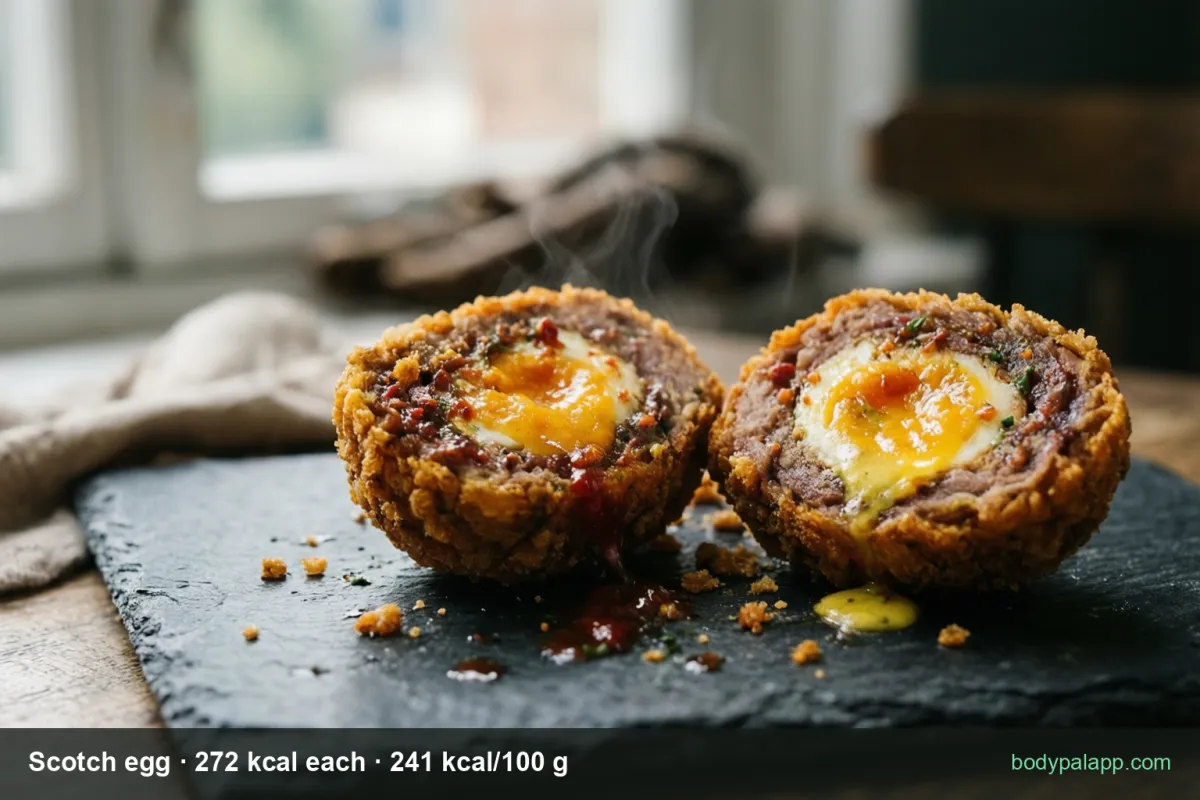
The calories in a scotch egg split unevenly: 272 in total for a standard 113 g egg (241 kcal per 100 g), of which just 72 come from the egg itself. The sausage-and-crumb coating carries the other 200. A mini scotch egg is 68 kcal.
On this page
- Quick facts
- Portion sizes
- Egg vs coating
- How does a scotch egg compare?
- The mostly-egg myth
- Most popular scotch egg brands
- Scotch egg FAQs
Quick facts
| Per 100 g | Amount | RI%* |
|---|---|---|
| Calories | 241 kcal (1,008 kJ) | 12% |
| Protein | 12.0 g | 24% |
| Carbohydrates | 13.1 g | 5% |
| Fat | 16.0 g | 23% |
| — of which saturates | 4.3 g | 22% |
| Fibre | 1.7 g | — |
| Sugar | Tr | 0% |
| Salt | 0.82 g | 14% |
*RI = reference intake of an average adult (8,400 kJ / 2,000 kcal).
Verified nutrition data
Numbers on this page come from CoFID, the UK government’s Composition of Foods Integrated Dataset, and from manufacturer labels where a branded product is named. Last verified August 2026. How we verify our data →
Two things stand out. First, protein: at 12 g per 100 g, a scotch egg is genuinely protein-dense for something sold next to the crisps. Second, fat does most of the calorie work — 16 g per 100 g, nearly a quarter of the daily reference intake before you have left the forecourt.
Sugar, at least, is a non-issue. There is essentially none.
Portion sizes
The petrol-station classic comes in two sizes, and the gap between them is bigger than people think.
| Portion | Weight | Calories |
|---|---|---|
| Standard scotch egg | ~113 g | 272 kcal |
| Mini scotch egg | ~28 g | 68 kcal |
A standard egg also delivers about 13.5 g of protein, 18 g of fat and 0.9 g of salt. That protein figure is the redeeming feature: it is the difference between a snack that holds you until dinner and one that does not.
Four minis add up to exactly one standard egg — 272 kcal — which is worth knowing, because minis are engineered to disappear from a picnic spread without anyone counting.
Egg vs coating
Slice a scotch egg in half and you are looking at two different foods. The boiled egg in the middle is 72 kcal. Everything wrapped around it — sausage meat, breadcrumbs and the fat they are fried in — adds roughly 200 more.
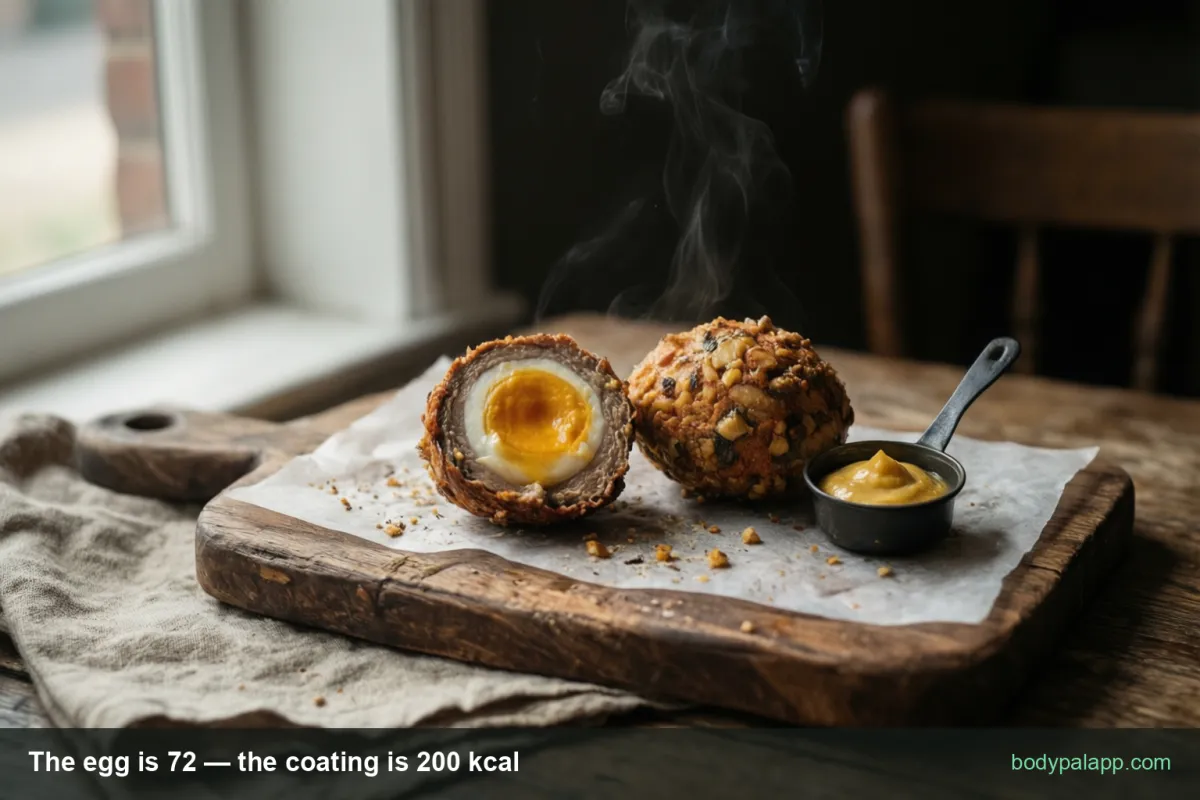
That means three-quarters of the calories sit in the coating. It is the same pattern you see across breaded and wrapped foods: the filling is rarely the problem, the jacket is. A pork chop makes an interesting side-by-side here — plain grilled meat and egg without the crumb shell tells you what the wrapper really costs.
None of this makes the coating pointless. The sausage layer is where much of the protein lives too. But if you have ever wondered why something egg-sized carries burger-adjacent calories, the crumb shell is your answer.
How does a scotch egg compare?
Put it up against the other grab-and-go savouries and the scotch egg holds its own.
| Food | Serving | Calories |
|---|---|---|
| Scotch egg | 1 standard (~113 g) | 272 kcal |
| Boiled egg | 1 medium | 72 kcal |
| Sausage roll | 1 Greggs | 348 kcal |
| Bacon sandwich | 1 sandwich | 314 kcal |
The verdict: among the meat-counter snacks, the scotch egg is the best trade — fewer calories than a sausage roll or a bacon sandwich, with a proper hit of protein. If you only want fuel and not a meal, though, nothing beats the plain boiled egg at 72.
The mostly-egg myth
The name does the marketing: "scotch egg" sounds like an egg with a bit of decoration. In calorie terms it is the reverse — a sausage product with an egg inside. The egg is 26% of the calories; the coating is 74%.
The myth matters because it flips the comparison. People treat a scotch egg as "basically a boiled egg, so about 70-odd calories" and log it accordingly. The real figure is nearly four times that. Log the wrapper, not the name.
Most popular scotch egg brands in the United Kingdom
Ranked by how widely each product appears among foods sold in the United Kingdom, from the BodyPal food database of over 3.3 million products. Calories are the figures printed on each label.
| Product | Calories (per 100 g) |
|---|---|
| Asda Scotch Egg | 267 kcal |
| Quorn Scotch Egg | 250 kcal |
| Wall's Scotch Egg | 226 kcal |
| Ginsters Scotch Egg Bar | 300 kcal |
Brand popularity: BodyPal food database. Nutrition: manufacturer labels.
Scotch egg FAQs
How many calories in a mini scotch egg?
About 68 kcal for a typical 28 g mini. That makes them one of the more forgiving party foods — but they rarely travel alone. Four minis match a full-size scotch egg at 272 kcal, so count the handful, not the unit.
How many calories in a picnic egg?
Around 68 kcal each — picnic eggs are simply mini scotch eggs under a friendlier name, usually about 28 g apiece. Branded packs vary a little either side, so glance at the label, but the mini figure is the right mental anchor.
How much protein is in a scotch egg?
About 13.5 g in a standard egg, from 12 g per 100 g. The egg and the sausage layer both contribute, which is why a scotch egg keeps you fuller than crisps carrying the same calories. It is one of the higher-protein snacks in the meal deal chiller.
Are scotch eggs healthy?
At 272 kcal with 13.5 g protein, one scotch egg is a reasonable snack — but 18 g of fat and 0.9 g of salt per egg mean it should not be a daily habit. The NHS Eatwell Guide would file it under "sometimes", not "staple".
How many calories in an M&S scotch egg?
Budget around 272 kcal for any standard 113 g scotch egg, whichever shop sells it. Branded and premium versions move with their weight and recipe — a posher, bigger egg costs more calories — so the shelf label is the final word for a specific product.
How many calories are in the coating?
Roughly 200 of the 272 kcal — the sausage meat, breadcrumbs and frying fat around a 72 kcal boiled egg. That is three-quarters of the total. If you have ever peeled one apart and eaten just the egg, you skipped most of the snack's calories.
Scotch egg or sausage roll — which is lighter?
The scotch egg, by 76 kcal: 272 against 348 for a Greggs sausage roll. It also brings more protein for the spend. If you are picking one savoury treat at the counter and calories are the tiebreaker, the egg wins.
How many carbs in a scotch egg?
About 15 g per standard egg (13.1 g per 100 g), nearly all from the breadcrumb coating. That rules it out of strict low-carb days but hardly registers against the 260 g daily reference intake. The egg and sausage inside are close to carb-free.
How much fat is in a scotch egg?
About 18 g per standard egg, of which around 4.9 g is saturated — a quarter of the saturated fat reference intake in one snack. If you are watching saturates, the plain boiled egg at 72 kcal is the kinder pick from the same shelf.
Similar foods
- Salmon — 287 kcal per grilled fillet
- Cheese toastie — ~440 kcal whole
- Chicken leg — 236 kcal per 100 g roasted
- Falafel — 185 kcal for four falafel
- Cheeseburger — 254 kcal per 100 g takeaway
- Happy Meal — 172-660 kcal depending on the build
Snack maths, done for you
Point BodyPal at a scotch egg — full-size, mini or half-demolished — and one photo logs the calories, protein and salt without you doing the wrapper arithmetic.


How long does it take to burn off a scotch egg?
A standard 113 g scotch egg is 272 kcal. Enter your weight and the amount you ate to see how long it takes you to burn that off:
lb
| Activity | Time to burn 272 kcal |
|---|---|
| Walking, brisk | 54 min |
| Cycling, moderate | 34 min |
| Swimming, moderate | 39 min |
| Jogging | 32 min |
| Weight training, moderate | 1 hr |
Times are for a 154 lb (11 st) adult at a steady pace; change the weight to see yours. The amount is set to the portion in the text (113 g); change it to what you actually ate. BodyPal works this out from your steps automatically.
Want the bigger picture? Calculate your daily calorie needs — your maintenance figure, a target for losing or gaining, and the date you get there.