
How Many Calories in Falafel?
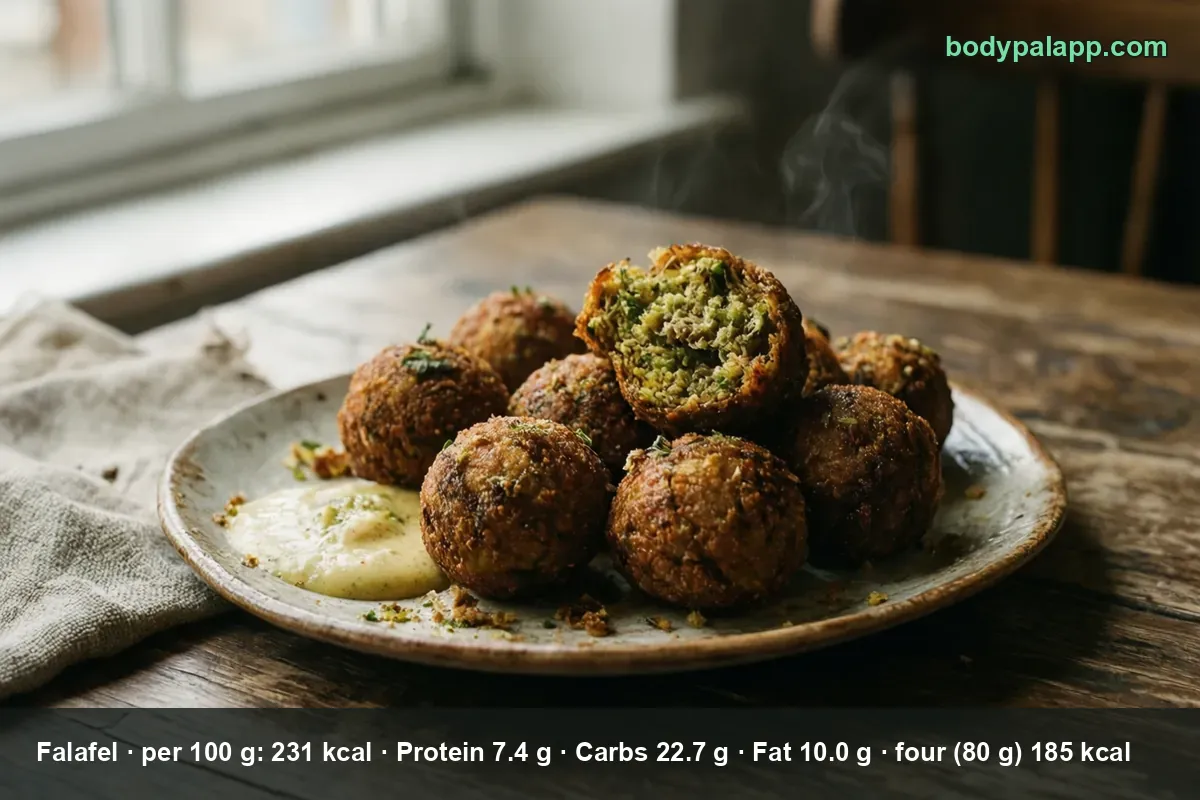
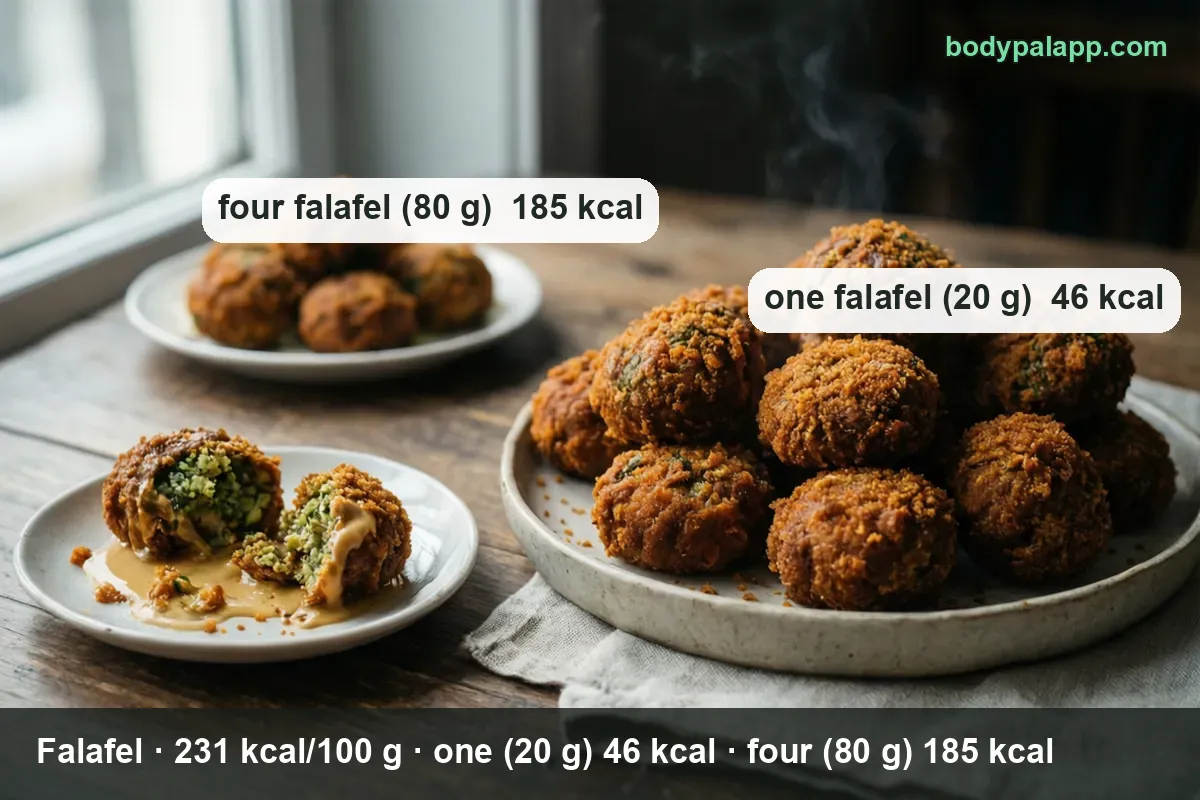
One falafel ball is 46 calories, and the four-ball portion most people eat is 185 kcal. That works off 231 kcal per 100 g, the median of 116 UK labels. Stuff four into a pitta with houmous and salad and the finished sandwich is 435 kcal.
On this page
- Falafel quick facts
- Why the chilled aisle beats the recipe book
- One ball is 20 g, not 25
- The stuffed pitta, line by line
- Beetroot, sweet potato and the 66% spread
- Falafel next to the rest of the mezze
- Popular falafel brands
- FAQ
Falafel quick facts
The reference below is supermarket falafel: the chilled tub from Tesco, Sainsbury's, Cauldron or Gosh!, not a deep-fried batch from a home kitchen. A portion is four balls, 80 g.
| Nutrient | Per 100 g | Four falafel (80 g) | RI%* |
|---|---|---|---|
| Energy | 231 kcal / 966 kJ | 185 kcal / 774 kJ | 9% |
| Protein | 7.4 g | 5.9 g | 12% |
| Carbohydrates | 22.7 g | 18.2 g | 7% |
| – of which sugars | 3.4 g | 2.7 g | 3% |
| Fat | 10.0 g | 8.0 g | 11% |
| – of which saturates | 0.9 g | 0.7 g | 4% |
| Fibre | 6.0 g | 4.8 g | 16% |
| Salt | 0.98 g | 0.78 g | 13% |
*RI% = a four-ball portion's share of an adult's daily reference intake, based on 2,000 kcal.
Verified nutrition data
Numbers on this page come from CoFID, the UK government’s Composition of Foods Integrated Dataset, and from manufacturer labels where a branded product is named. Last verified September 2026. How we verify our data →
Two rows stand out, and they pull in opposite directions. Fibre at 4.8 g is 16% of the day from a side dish. Salt at 0.78 g is 13% of the day from four small balls.
Why the chilled aisle beats the recipe book
Search for falafel calories and the number that keeps coming back is 183 per 100 g. That figure is real, and it is also describing a food most British shoppers never eat.
The UK government's food composition table holds exactly one falafel entry, and it is a recipe: chickpea balls deep-fried in rapeseed oil, made at home. Fine for someone who mixes and fries their own. Useless for someone holding a tub from the fridge.
The chilled tub is denser. Across 116 UK falafel labels — plain falafel only, with the lunch boxes, wraps and salad bowls stripped out — the median is 231 kcal per 100 g, 26% above the homemade figure. The range runs 127 to 340.
Here is the part that surprises people: it is not the frying. Home-fried falafel carries 11.2 g of fat per 100 g; the mostly-baked shelf median carries 10.0 g. Fat is a fraction lower on the shelf. The extra calories come from compression — a machine-formed ball is packed tighter than a hand-rolled one, so 20 g of shop falafel contains more chickpea than 20 g of yours.
Log the tub at 231 if the tub is what you bought. Keep 183 for the frying pan.
| Version | Per 100 g | One ball (20 g) | Four balls (80 g) |
|---|---|---|---|
| Supermarket falafel, median of 116 labels | 231 kcal | 46 kcal | 185 kcal |
| Homemade, deep-fried in rapeseed oil | 183 kcal | 37 kcal | 146 kcal |
One ball is 20 g, not 25
Most calorie charts put a falafel ball at 25 g. Nine UK labels disagree, and they disagree in the same direction.
Sainsbury's Taste the Difference states its serving as one falafel, 18 g. Sainsbury's own-label eight-pack weighs 144 g, which is 18 g a ball. Waitrose says 18 g. Tesco's sweet potato version gives two falafel as 37.5 g. M&S sells eight in a 160 g pack, so 20 g. Goodlife and Al'fez both print 20 g.
British shelf falafel is 18–20 g a ball. Nothing in the data supports 25 g. Hand-rolled falafel in a Lebanese restaurant is a bigger object, and that is where the larger figure comes from — but it is not what comes out of a fridge pack.
The consequence matters more than the gram. A four-ball portion is 80 g, not 100 g. Anyone logging "one portion of falafel" against a per-100 g figure is adding a quarter more than they ate.
| Portion | Weight | Calories |
|---|---|---|
| One ball | 20 g | 46 kcal |
| Two balls | 40 g | 92 kcal |
| Four balls, the standard side | 80 g | 185 kcal |
| Six balls | 120 g | 277 kcal |
| Cauldron, one 50 g serving | 50 g | 111 kcal |
| Gosh! Original, one 76 g pot | 76 g | 195 kcal |
The two rows at the bottom are label servings rather than ball counts, and they show how loosely "a portion" is defined. Cauldron's 50 g is two and a half balls. Gosh!'s pot is nearly four.
The stuffed pitta, line by line
This is where falafel stops being a 185 kcal side and becomes lunch.
| Component | Weight | Calories | Salt |
|---|---|---|---|
| White pitta | 60 g | 153 kcal | 0.60 g |
| Four falafel | 80 g | 185 kcal | 0.78 g |
| Houmous | 30 g | 92 kcal | 0.31 g |
| Salad (lettuce, tomato, cucumber) | 40 g | 5 kcal | 0 g |
| Total | 210 g | 435 kcal | 1.69 g |
A 60 g pitta is the British standard — Village Bakery, Rowan Hill, M&S, ASDA and Waitrose all print 56–63 g, with Sainsbury's the outlier at 70 g. Drop the houmous and the sandwich falls to 343 kcal. Add chilli sauce or tahini and put 15 to 35 back on.
At 435 kcal with 13.6 g of protein and 8.1 g of fibre, that is a proper lunch rather than a snack, and the fibre alone is 27% of the 30 g most adults are told to aim for. The NHS guidance on fibre is worth reading next to that figure, because very few 435 kcal lunches get anywhere near it.
Salt is the number to argue with. 1.69 g in one pitta is 28% of the 6 g daily limit, and it arrives in something almost everyone files under "the healthy option". The falafel supplies 0.78 g, the bread 0.60 g, the houmous 0.31 g. No single part is the culprit; they simply stack.
One more figure that rarely appears anywhere. Chickpeas bring iron: 2.89 mg per 100 g, so a four-ball portion delivers 2.3 mg, or 17% of the reference intake for iron. That comes from the pulse, not the coating.
Beetroot, sweet potato and the 66% spread
With most freezer and chiller foods the brand barely moves the number. Falafel is the exception.
| Product | Per 100 g | One ball (20 g) |
|---|---|---|
| Gosh! Beetroot with Red Pepper & Chilli | 188 kcal | 38 kcal |
| M&S Fresh Herb Aromatic | 205 kcal | 41 kcal |
| Cauldron Middle Eastern | 221 kcal | 44 kcal |
| Tesco Sweet Potato | 224 kcal | 45 kcal |
| Gosh! Mediterranean | 261 kcal | 52 kcal |
| Waitrose Spinach | 312 kcal | 62 kcal |
Bottom to top that is a 66% spread on the label, and 38 kcal a ball against 62 on the plate. Pick badly twice a week and the difference is a meal.
The trap is assuming a vegetable in the name means fewer calories. Beetroot falafel genuinely is the lightest thing on the shelf. Sweet potato falafel from Waitrose runs 284 kcal per 100 g, above the plain median, and Tesco's green pea version reaches 291. Spinach falafel at 312 is the heaviest of the lot, which is not where anyone would put their money.
Fibre swings just as hard, and in a useful direction. Cauldron prints 11 g per 100 g and Goodlife 12 g, roughly double the shelf median. Those two are the most fibre-dense items in the entire chilled aisle.
Falafel next to the rest of the mezze
| Item | Per 100 g | Typical portion | Calories |
|---|---|---|---|
| Falafel | 231 kcal | four balls, 80 g | 185 kcal |
| Houmous | 307 kcal | 30 g | 92 kcal |
| Chicken kebab | 166 kcal | 100 g shish | 166 kcal |
| Wrap | 306 kcal | one large | 196 kcal |
| Samosa | 217 kcal | one | 152 kcal |
| Chips | 214 kcal | small chippy portion | 535 kcal |
Per 100 g falafel sits mid-table, heavier than a shish kebab and lighter than houmous. Per portion it is one of the smaller items, because four balls weigh less than almost anything else on this list.
Our take: for protein per calorie the chicken kebab wins outright and it is not close — 166 kcal for a full 100 g of grilled meat. Falafel wins on fibre, and that is what makes it hold. If the choice is falafel or chips alongside a kebab, the falafel costs a third of the calories and adds 4.8 g of fibre instead of none. Where falafel loses is the vegetarian halo: 185 kcal is the side, and the pitta, houmous and sauce that usually come with it are the other 250.
Popular falafel brands in the BodyPal food database
Ranked by how widely each product appears among foods sold in the United Kingdom, from the BodyPal food database of over 3.3 million products. Calories are the figures printed on each label.
| Product | Calories (per 100 g) |
|---|---|
| Gosh! Moroccan Spiced Falafel | 239 kcal |
| Gosh! Mediterranean Falafel | 239 kcal |
| Cauldron Middle Eastern Falafel | 222 kcal |
| Gosh! Falafel | 261 kcal |
| Cauldron Moroccan Falafel | 239 kcal |
Brand popularity: BodyPal food database. Nutrition: manufacturer labels.
Falafel FAQs
How many calories in falafel?
231 kcal per 100 g for supermarket falafel, which is 46 kcal for a single 20 g ball and 185 kcal for the usual four-ball portion. Homemade falafel deep-fried in rapeseed oil is lighter at 183 kcal per 100 g, because shop-made balls are pressed denser.
How many calories in one falafel ball?
46 kcal. A British shelf falafel weighs 18 to 20 g, confirmed by nine supermarket labels including Sainsbury's, Waitrose, Tesco, M&S and Goodlife. The widely quoted 25 g ball is a restaurant size, and using it overstates a four-ball portion by about a quarter.
How many calories in a falafel pitta?
435 kcal for a 60 g white pitta with four falafel, 30 g of houmous and salad. Without the houmous it drops to 343 kcal. The full sandwich carries 1.69 g of salt, 28% of the 6 g adult daily limit, and 8.1 g of fibre.
How many calories in a falafel wrap?
Around 478 kcal for a large wrap with four falafel, houmous and salad. Shop-bought versions come in lower — Tesco's falafel and houmous wrap is 444 kcal for the 192 g pack — because a ready-made wrap holds less falafel than most people build in themselves.
Is falafel high in protein?
Moderately. A four-ball portion gives 5.9 g of protein, 12% of the daily reference intake, against 185 kcal. That is 3.2 g of protein per 100 kcal, well behind grilled chicken but ahead of most bread. Fibre is the stronger card at 4.8 g a portion.
Is baked falafel lower in calories than fried?
Barely, and the gap runs the wrong way. Home-fried falafel is 183 kcal per 100 g against 231 for the mostly-baked supermarket median. Fat is almost identical, 11.2 g fried against 10.0 g on the shelf. Density decides this, not the oil.
How much salt is in falafel?
0.98 g per 100 g, so a four-ball portion carries 0.78 g — 13% of the 6 g daily limit. Built into a pitta with houmous the total reaches 1.69 g, or 28% of the day. Salt varies from 0.14 g to 1.36 g per 100 g between brands.
How many calories in Cauldron falafel?
221 kcal per 100 g, so the 50 g serving printed on the pack is 111 kcal with 0.65 g of salt. Cauldron is also one of the two most fibre-dense options on the chilled shelf at 11 g per 100 g, against a category median of 6 g.
Similar foods
- Chicken leg — 236 kcal per 100 g roasted
- Fish and chips — about 1,074 kcal a regular order
- Salmon — 287 kcal per grilled fillet
- Scotch egg — 272 kcal each
- Cheese toastie — ~440 kcal whole
- Samosa — 152 kcal each
Count it without the maths
Photograph the tub and BodyPal works out the balls, the pitta and the salt together.


How long does it take to burn off falafel?
One 20 g falafel ball is 46 kcal. Enter your weight and the amount you ate to see how long it takes you to burn that off:
lb
| Activity | Time to burn 46 kcal |
|---|---|
| Walking, brisk | 9 min |
| Cycling, moderate | 6 min |
| Swimming, moderate | 7 min |
| Jogging | 5 min |
| Weight training, moderate | 10 min |
Times are for a 154 lb (11 st) adult at a steady pace; change the weight to see yours. The amount is set to the portion in the text (20 g); change it to what you actually ate. BodyPal works this out from your steps automatically.
Burning it off is one side of it. The other is knowing your number: work out how many calories you need a day, with macros and a goal date.