
How Many Calories in Chips?
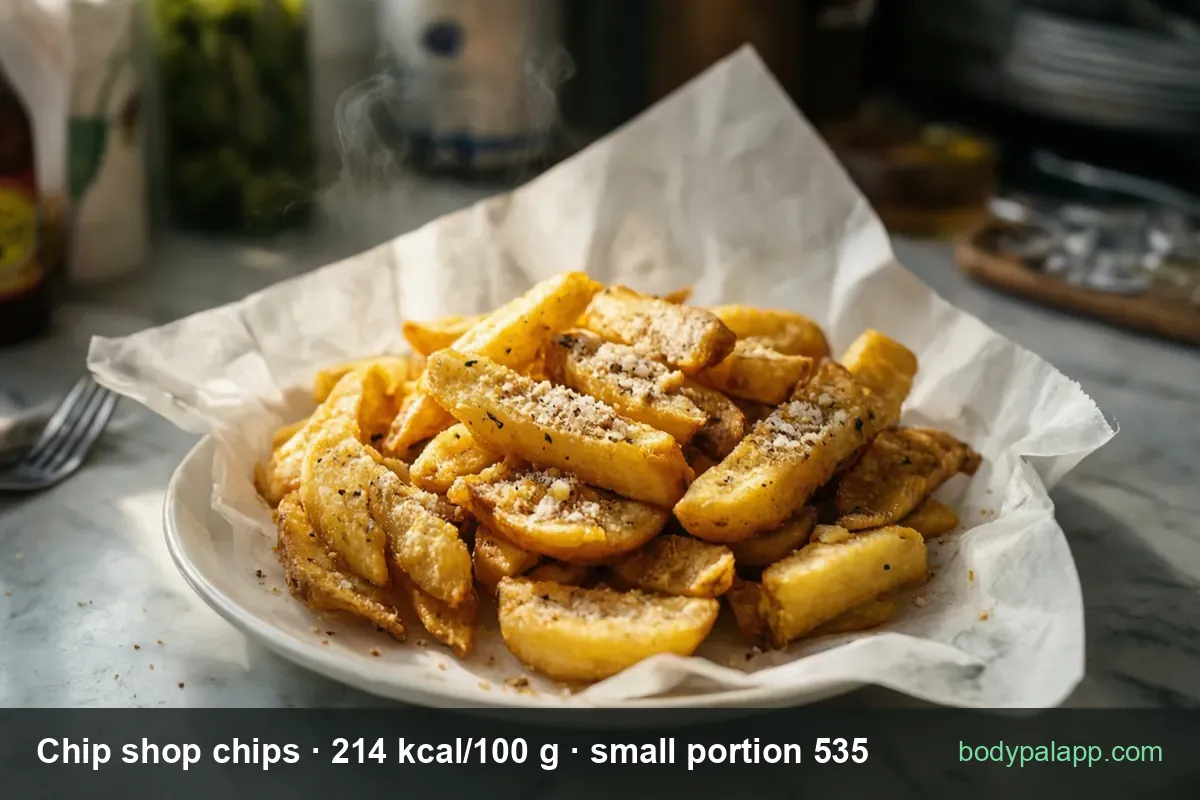
How many calories in chips is decided by the knife, not the potato: chip shop chips run 214 kcal per 100 g, which makes a small tray about 535 calories and a large one 856. Cut the same potato thin, fast-food style, and it jumps to 290 kcal per 100 g.
On this page
- Quick facts
- What a portion of chips really weighs
- Oven, frozen, thin cut: the fryer league table
- How do chips compare?
- The oven chip illusion
- Most popular chip brands
- Chips FAQs
Quick facts
Figures are for takeaway chip shop chips, fried, per 100 g.
| Per 100 g | Amount | % RI* |
|---|---|---|
| Energy | 214 kcal (895 kJ) | 11% |
| Protein | 3.5 g | 7% |
| Carbohydrate | 33.2 g | 13% |
| Fat | 8.4 g | 12% |
| – of which saturates | 4.29 g | 21% |
| Fibre | 3.2 g | – |
| Sugar | 0.6 g | 1% |
| Salt | 0.04 g | 1% |
*RI = reference intake of an average adult (2,000 kcal).
Verified nutrition data
Numbers on this page come from CoFID, the UK government’s Composition of Foods Integrated Dataset, and from manufacturer labels where a branded product is named. Last verified August 2026. How we verify our data →
Two things jump out. First, the salt: 0.04 g per 100 g is almost nothing, because that figure is for unsalted chips straight from the fryer. The salt on your chips comes from the shaker at the counter, which puts the amount entirely in your hands. The NHS ceiling is 6 g a day, and its salt guidance is worth a look if you have a heavy wrist. Second, the fibre: 3.2 g per 100 g is real fibre, from potatoes cooked in their own starch. Chips are junk food's most defensible member.
What a portion of chips really weighs
Nobody weighs chips at the counter, so here is what the scoop actually delivers:
- Small chippy portion (~250 g): ~535 kcal
- Large chippy portion (~400 g): ~856 kcal
That is the whole story of chip calories in two lines. Per 100 g, chips are mid-table. Per portion, they are a meal, because a "small" already weighs a quarter kilo. A large tray on its own carries more energy than many full dinners, before the fish, the curry sauce or the buttered roll turn up.
The practical move on the plate: order small, and treat the large as a sharing bag with someone who owes you a favour. Splitting a large two ways lands each of you at 428 kcal, less than eating a small alone plus "just a few" of someone else's.
Oven, frozen, thin cut: the fryer league table
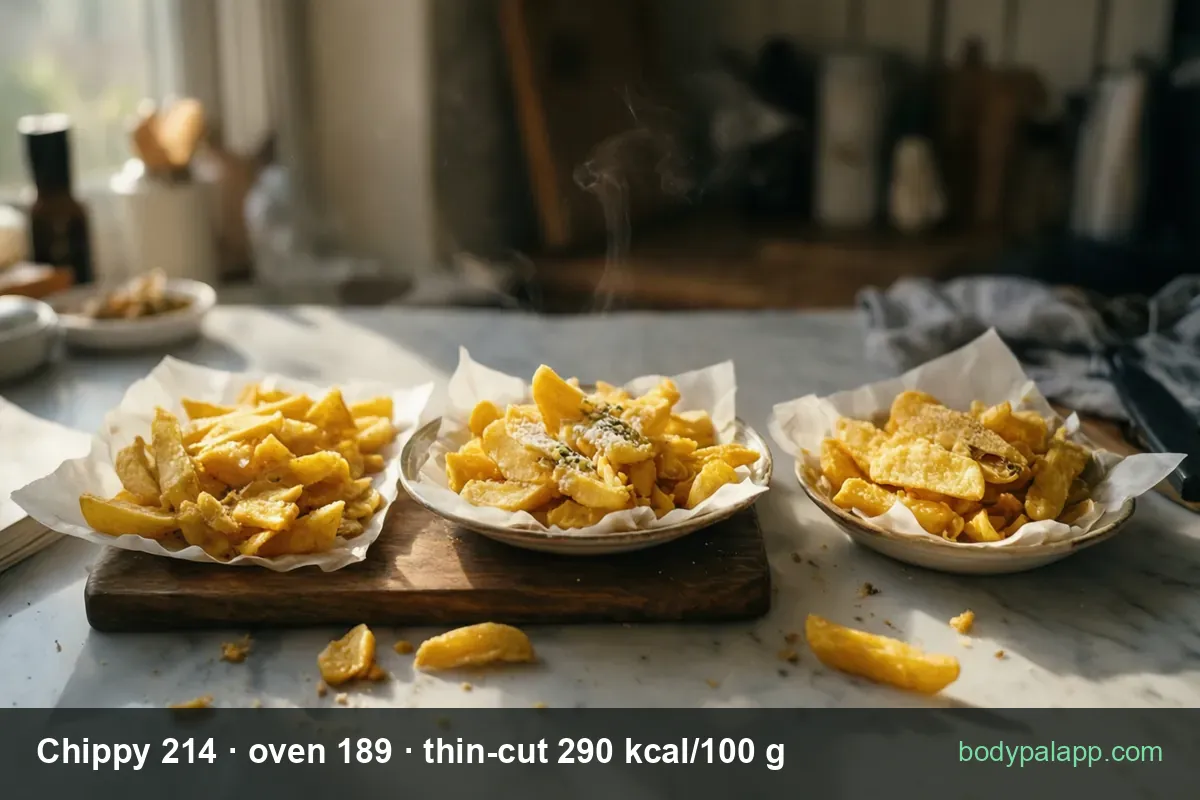
All per 100 g, ranked from lightest to heaviest:
| Type of chips | Per 100 g |
|---|---|
| Oven chips, baked | 189 kcal |
| Homemade, fried | 197 kcal |
| Chip shop, fried | 214 kcal |
| Microwave chips | 221 kcal |
| Frozen straight cut, fried | 273 kcal |
| Fine cut (fast-food style), fried | 290 kcal |
The pattern is pure geometry. Thin chips have far more surface area per gram, and surface is where the oil lives, so fine-cut fries carry 36% more calories per gram than the fat chip shop wedge-like cut. It is the rare case in nutrition where the "greasy spoon" option is the lighter one: thick chippy chips at 214 beat a portion of skinny fries at 290, gram for gram.
If you cook at home, the ranking rewards laziness. Oven chips at 189 kcal per 100 g are the lightest of the lot, homemade fried are respectable at 197, and the worst offender in the freezer aisle is the thin frozen chip that drinks oil twice, once in the factory and once in your pan.
Chips also remain, at heart, a starchy food, the base of the plate in the NHS starchy foods guidance, just cooked in the most calorie-expensive way available. The potato is not the problem. The oil economy around it is.
How do chips compare?
| Food | Typical serving | Per 100 g |
|---|---|---|
| Chips (chip shop) | 535 kcal (small portion) | 214 kcal |
| Fish and chips | ~1,074 kcal (full portion) | – |
| Jacket potato | 277 kcal (medium) | – |
| Sweet potato (wedges) | – | 139 kcal |
| Burger | – | 288 kcal |
For weight loss, the jacket potato is the runaway winner: a whole medium jacket costs half of a small tray of chips. But note the quiet upset in the last row: gram for gram, chips at 214 kcal undercut a burger at 288. On a takeaway night, it is usually what sits next to the chips, the battered fish, the burger, the sauce, that decides the damage, not the chips themselves.
The oven chip illusion
Oven chips get sold as the diet option, and the number does not really back it up. Baked at 189 kcal per 100 g against 214 for the chippy version, the saving is about 12%, roughly 60 kcal across a whole 250 g plateful. Nice, not transformative.
The lever that actually moves the total is weight, not cooking method. A 250 g portion versus a 400 g portion is a 321 kcal difference, five times what switching to oven chips saves you. Choose the smaller portion first and the cooking method second.
Most popular chip brands in the United Kingdom
Ranked by how widely each product appears among foods sold in the United Kingdom, from the BodyPal food database of over 3.3 million products. Calories are the figures printed on each label. Freezer chips bake below the chip-shop figure of 214.
| Product | Calories (per 100 g, oven-baked) |
|---|---|
| McCain Naked Oven Chips | 135 kcal |
| McCain Original Oven Chips | 158 kcal |
| McCain Crinkle Cut Oven Chips | 162 kcal |
Brand popularity: BodyPal food database. Nutrition: manufacturer labels.
Chips FAQs
How many calories in chip shop chips?
About 535 kcal for a small portion (~250 g) and 856 kcal for a large (~400 g), at 214 kcal per 100 g. Chip shops cut thick, which works in your favour: thick chips hold less oil per gram than any thin-cut fry.
How many calories in oven chips?
Oven chips baked come to 189 kcal per 100 g, the lightest chip in the table. A generous 250 g plateful is about 473 kcal. The saving over fried chip shop chips is modest, around 12%, so portion size still matters more than the oven.
Are McDonald's fries the same as chip shop chips?
No, and the difference is the cut. Thin fast-food-style fries run about 290 kcal per 100 g in UK composition data, against 214 for thick chippy chips. Chains publish their own nutrition figures for exact portions, so check theirs, but the rule holds: thinner means more oil per gram.
Are chips bad for you?
A small portion at 535 kcal is a hefty but honest side: real potato, 3.2 g of fibre per 100 g and almost no salt until you shake it on. The trouble is the large portion (856 kcal) and the company chips keep. As an occasional meal with something green, they are fine.
What about air fryer chips?
Expect them at the oven-chip end of the table, around the 189 kcal per 100 g mark rather than the fried 214–290 range, since an air fryer is a small fast oven using a spray of oil. The exact number depends on how much oil you add, so weigh the oil, not just the potato.
Why do thin chips have more calories than thick ones?
Surface area. Fine-cut fries are 290 kcal per 100 g against 214 for thick chip shop chips, a 36% jump, because oil clings to the outside of a chip and thin chips are nearly all outside. Same potato, same fryer, different geometry.
How many calories in half a portion of chips?
About 268 kcal for half a small chippy portion (~125 g at 214 kcal per 100 g). Sharing a small tray turns chips into a reasonable side dish, roughly the territory of a medium jacket potato, and it is the cheapest calorie cut on the menu.
How much salt is in chips?
Just 0.04 g per 100 g before the shaker comes out, effectively unsalted. What lands on top at the counter is the real source, and it is invisible in any table because it is up to you. With the NHS daily limit at 6 g, ask for salt on the side or skip the second shake.
Chips or jacket potato – which is better for weight loss?
The jacket potato, at 277 kcal for a whole medium spud versus 535 kcal for a small portion of chips. Same vegetable, no fryer. If chips are non-negotiable, a shared small portion plus a jacket-style topping mentality gets you most of the pleasure for half the bill.
Similar foods
- Samosa — 152 kcal each
- Fish and chips — about 1,074 kcal a regular order
- Falafel — 185 kcal for four falafel
- Yorkshire pudding — 108 kcal each
- Pork chop — 233 kcal grilled lean
- Chicken leg — 236 kcal per 100 g roasted
Skip the mental maths
Snap the tray before you dig in and BodyPal logs the chips and everything alongside them, calories and macros included.


How long does it take to burn off chips?
A small chip shop portion (~250 g) is 535 kcal. Enter your weight and the amount you ate to see how long it takes you to burn that off:
lb
| Activity | Time to burn 535 kcal |
|---|---|
| Walking, brisk | 1 hr 47 min |
| Cycling, moderate | 1 hr 7 min |
| Swimming, moderate | 1 hr 16 min |
| Jogging | 1 hr 3 min |
| Weight training, moderate | 1 hr 59 min |
Times are for a 154 lb (11 st) adult at a steady pace; change the weight to see yours. The amount is set to the portion in the text (250 g); change it to what you actually ate. BodyPal works this out from your steps automatically.
Want the bigger picture? Calculate your daily calorie needs — your maintenance figure, a target for losing or gaining, and the date you get there.