
How Many Calories in a Sweet Potato?
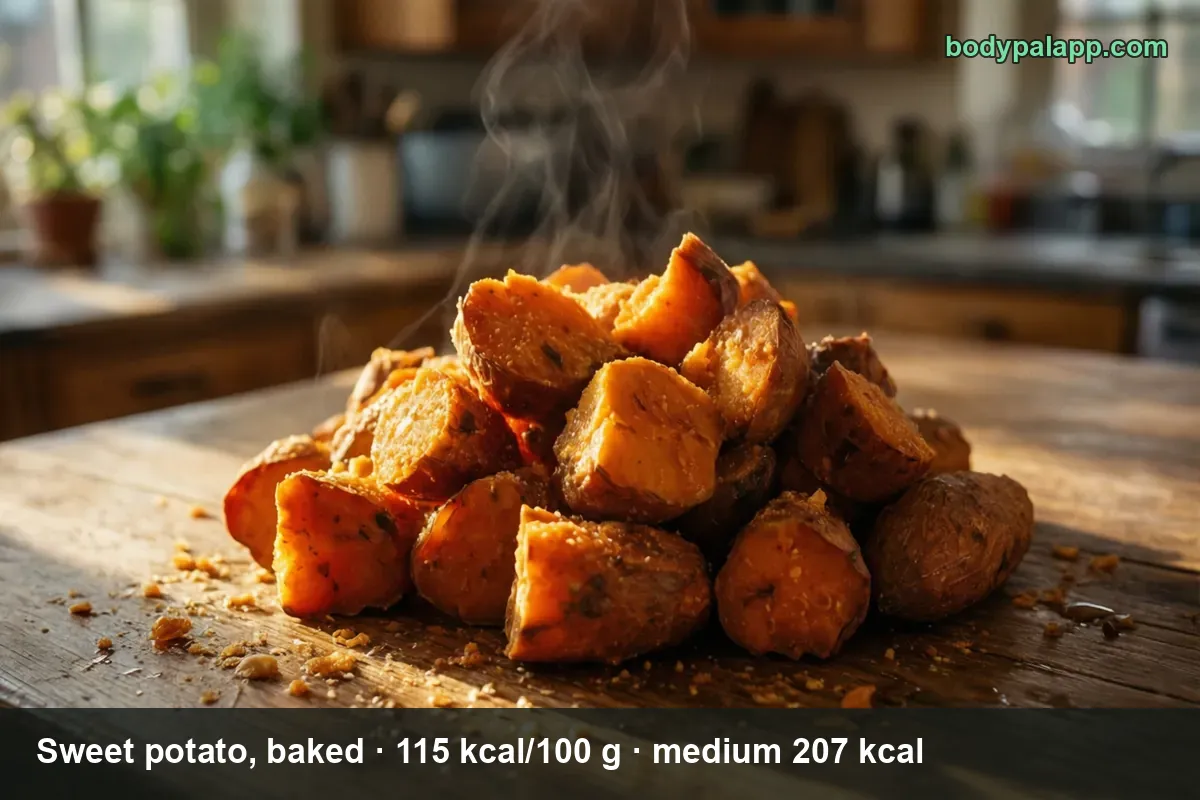
207 calories. That's a medium baked sweet potato, skin on, at roughly 180 g. Boil it instead and 100 g of flesh costs just 58 kcal. If you're checking how many calories in a sweet potato, the cooking method matters most: baked, it sits at 115 kcal per 100 g.
 (alt: "Sweet potato on a plate - 207 calories per medium baked potato")
On this page
- Sweet potato quick facts
- Portions that match real plates
- Boiled, steamed, raw and wedges
- How does sweet potato compare?
- The baking myth
- Most popular sweet potato brands
- FAQ
Sweet potato quick facts
These figures are for sweet potato baked in its skin, the way most UK kitchens serve it.
| Nutrient | Per 100 g baked | Medium potato (~180 g) | RI%* |
|---|---|---|---|
| Energy | 115 kcal / 481 kJ | 207 kcal / 866 kJ | 10% |
| Protein | 1.6 g | 2.9 g | 6% |
| Carbohydrates | 27.9 g | 50.2 g | 19% |
| – of which sugars | 14.5 g | 26.1 g | 29% |
| Fat | 0.4 g | 0.7 g | 1% |
| – of which saturates | 0.20 g | 0.4 g | 2% |
| Fibre | 5.2 g | 9.4 g | – |
| Salt | 0.13 g | 0.23 g | 4% |
*RI% = the medium potato's share of an adult's daily reference intake, based on 2,000 kcal.
Verified nutrition data
Numbers on this page come from CoFID, the UK government’s Composition of Foods Integrated Dataset, and from manufacturer labels where a branded product is named. Last verified August 2026. How we verify our data →
Two rows deserve a pause. Fibre first: 9.4 g from one potato is a serious contribution to your day. Then sugar: 26.1 g, nearly a third of the daily reference figure. The "sweet" in the name is not marketing — baked sweet potato carries 14.5 g of sugar per 100 g, ten times what a white potato manages. If sugar is on your radar, the NHS guide to sugar in food puts that number in context.
Portions that match real plates
- Medium baked sweet potato, skin on (~180 g): 207 kcal. The whole-potato lunch.
- Boiled flesh, side-dish portion (100 g): 58 kcal. A mash-sized serving next to a main.
Supermarket sweet potatoes swing wildly in size, and many are well over the 180 g "medium". Weigh one once and you'll know your shop's version; per 100 g baked, the maths is 115 kcal, so a hefty 250 g specimen is closer to 288.
At 58 kcal per 100 g, the boiled version is one of the cheapest starchy sides you can put on a plate. It also counts towards your 5 A Day — unlike white potatoes, which the NHS classes as a starchy food instead.
(alt: "BodyPal app scanning sweet potato showing calories and macros")
Boiled, steamed, raw and wedges
 (alt: "Sweet potato variants calories comparison")
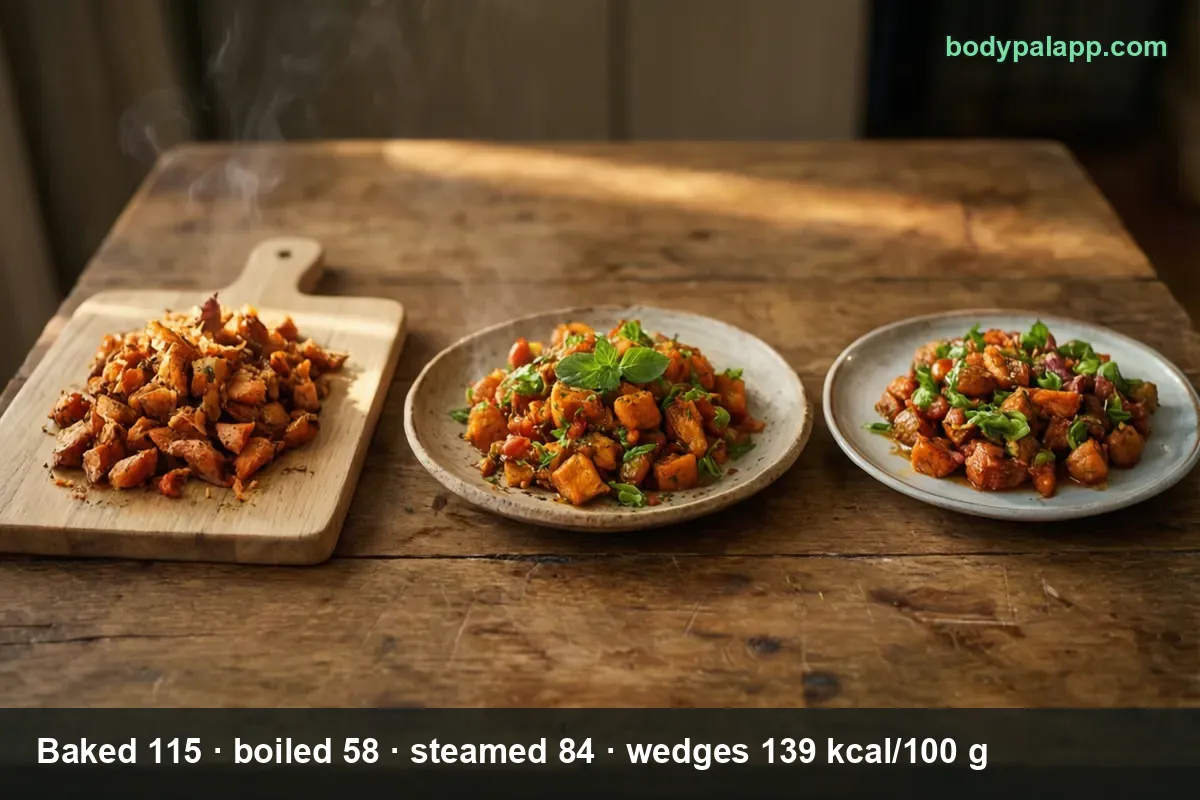
- Boiled, flesh only: 58 kcal per 100 g (1.7 g protein, 13 g carbs, 0.2 g fat, 2.7 g fibre, 9.4 g sugar)
- Steamed: 84 kcal per 100 g
- Raw flesh: 87 kcal per 100 g
- Baked, flesh and skin: 115 kcal per 100 g
- Wedges baked in rapeseed oil: 139 kcal per 100 g (5.2 g fibre, 18.8 g sugar)
The order tells the story. Boiling keeps the water in, so every 100 g carries less actual potato. Steaming holds a middle line. Baking drives water off and concentrates everything that's left. And wedges add the one thing sweet potato doesn't have on its own — oil.
Wedges are still the most reasonable of the "chip-shaped" options, mind. At 139 kcal per 100 g with the fibre intact, a home-baked tray is a different proposition from anything that's been through a deep-fat fryer.
A word on the skin, because it splits opinion at the table. The baked figure of 115 kcal per 100 g already includes it, and the skin is where a decent share of that 5.2 g of fibre lives — peeling a baked sweet potato throws away the best part of the deal for no calorie saving worth naming.
Mash follows the boiled numbers, with one condition. Boiled flesh crushed with a fork is still 58 kcal per 100 g; it's the butter and milk that traditional mash recipes stir in that move the figure, and they can move it a long way. If the orange side dish needs to stay light, mash it dry and season hard. For an even lighter orange option on the same plate, carrot plays the supporting role for a fraction of the cost.
How does sweet potato compare?
(alt: "Sweet potato vs white potato, rice and quinoa calories comparison")
| Food | Per 100 g cooked |
|---|---|
| Sweet potato, baked | 115 kcal |
| Sweet potato, boiled | 58 kcal |
| White potato, baked | 97 kcal |
| White potato, boiled | 74 kcal |
| Rice, cooked | 131 kcal |
| Quinoa, cooked | 111 kcal |
Here's the twist most comparisons miss: the answer flips with the pan. Baked, white potato is lighter (97 vs 115). Boiled, sweet potato wins (58 vs 74). Either boiled potato undercuts rice and quinoa comfortably — and if the choice is between the two potatoes, boiled sweet potato takes it: fewest calories on the table, more fibre, and a 5 A Day tick that white can't offer. For the fully loaded version of the white option, see our jacket potato page.
The baking myth
"Baking adds calories." It doesn't — no oil goes in, nothing changes but water. The same potato leaves the oven with the same energy it went in with; it just weighs less, so each 100 g reads higher. That's the entire explanation for 115 baked vs 58 boiled.
The practical rule: compare cooking methods per potato, not per 100 g. A 180 g raw-weight potato is the same food at 207-ish kcal however you cook it (minus a little if peeled, plus a lot if oiled). Per-100 g tables are for portioning, not for judging cooking methods — mixing up those two jobs is how sweet potato got its confusing reputation.
Most popular sweet potato brands in the United Kingdom
Ranked by how widely each product appears among foods sold in the United Kingdom, from the BodyPal food database of over 3.3 million products. Calories are the figures printed on each label. These are fried or oven products — a plain baked sweet potato stays at 115 kcal per 100 g.
| Product | Calories (per 100 g, prepared) |
|---|---|
| Aviko Sweet Potato Fries | 170 kcal |
| Strong Roots Sweet Potato Fries | 156 kcal |
| Harvest Basket Sweet Potato Fries (Aldi) | 145 kcal |
Brand popularity: BodyPal food database. Nutrition: manufacturer labels.
Sweet potato FAQ
Sweet potato vs potato — which has more calories?
Baked, sweet potato has more: 115 kcal per 100 g against 97 for white. Boiled, it flips — 58 for sweet against 74 for white. The gap is small either way; choose on fibre (5.2 g per 100 g baked, in sweet potato's favour) rather than on calories alone.
How many calories in a boiled sweet potato?
58 kcal per 100 g of boiled flesh — the lightest way to eat it, because boiling keeps the water in. A typical side-dish portion of about 100 g is therefore 58 kcal, with 13 g of carbs and almost no fat at 0.2 g.
How many calories in a baked sweet potato?
207 kcal for a medium one, about 180 g with the skin on. Per 100 g, baked sweet potato is 115 kcal. Bigger specimens are common in UK supermarkets, so a large potato around 250 g lands closer to 288 kcal — worth a one-off weigh.
Is sweet potato a carb?
Yes — 27.9 g of carbohydrate per 100 g baked, of which 14.5 g is sugar. It's a starchy root by any nutritional measure. Oddly, it still counts towards your 5 A Day in the UK, a status the NHS doesn't grant white potatoes.
Is sweet potato good for weight loss?
Boiled at 58 kcal per 100 g, it's among the cheapest starchy sides available, and the fibre helps meals keep you full. Baked whole at 207 kcal, it makes a sensible plate anchor. The versions to watch are the oiled ones — wedges at 139 kcal per 100 g and anything fried.
Is sweet potato better than potato?
For calories, it's nearly a draw — 115 vs 97 baked, 58 vs 74 boiled. Sweet potato brings 5.2 g of fibre per 100 g and a 5 A Day tick; white brings a slightly cheaper jacket. Our call: boiled sweet potato takes the round on fibre-per-calorie.
How many calories in sweet potato fries?
139 kcal per 100 g for wedges baked in rapeseed oil, the closest measured UK figure. Restaurant and takeaway fries run higher because deep-frying soaks in more oil than a brushed home tray ever will. Portion size decides the damage either way.
Does sweet potato count towards your 5 a day?
Yes — an 80 g portion counts once, per NHS guidance, because sweet potato is usually eaten alongside a starchy food rather than as one. White potatoes never count. It's one of the few genuine nutritional perks it holds over its paler cousin.
Similar foods
- Mashed potato — 102 kcal per 100 g with butter
- Corn on the cob — 84 kcal a cob
- Avocado — 128 kcal per half
- Onions — 53 kcal per medium onion
- Carrot — 27 kcal per medium carrot
- Cauliflower — 23 kcal per 80 g portion
Skip the spreadsheet
Point your camera at the plate and BodyPal logs the sweet potato — baked, boiled or in wedges — with calories and macros counted from a single photo.


How long does it take to burn off a sweet potato?
A medium baked sweet potato, skin on (~180 g) is 207 kcal. Enter your weight and the amount you ate to see how long it takes you to burn that off:
lb
| Activity | Time to burn 207 kcal |
|---|---|
| Walking, brisk | 41 min |
| Cycling, moderate | 26 min |
| Swimming, moderate | 30 min |
| Jogging | 24 min |
| Weight training, moderate | 46 min |
Times are for a 154 lb (11 st) adult at a steady pace; change the weight to see yours. The amount is set to the portion in the text (180 g); change it to what you actually ate. BodyPal works this out from your steps automatically.
Burning it off is one side of it. The other is knowing your number: work out how many calories you need a day, with macros and a goal date.