
Calories in Mashed Potato: What the Butter Actually Costs
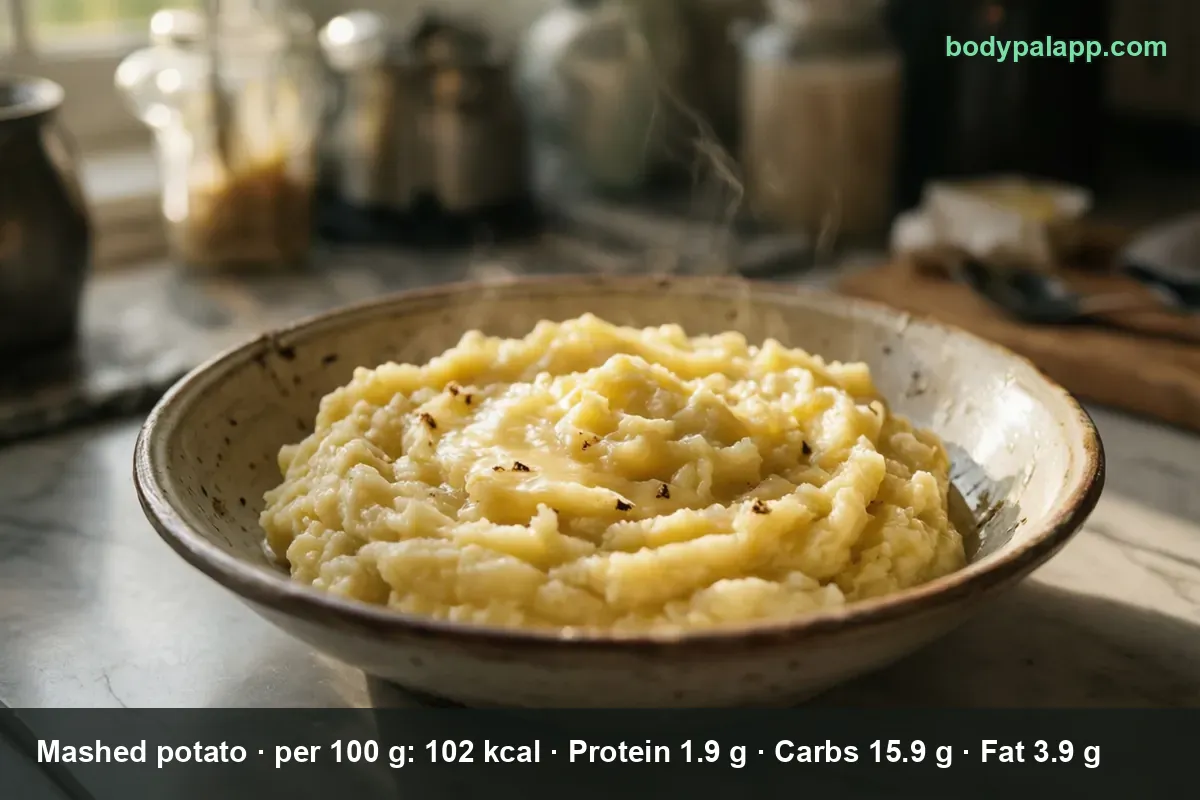
Mashed potato made the usual British way is 102 kcal per 100 g, which puts a 200 g plate at 204. The potato underneath it is only 74. Everything above that number is butter and milk, so the calories in mashed potato are almost entirely a decision about how creamy you want it.
On this page
- Mashed potato quick facts
- How much is on your plate
- The 28 calorie gap
- Butter against reduced fat spread
- The fibre you lose when you peel
- Mash against the other ways to cook a potato
- Most popular mashed potato brands in the United Kingdom
- Mashed potato FAQs
Mashed potato quick facts
The reference here is the standard UK recipe recorded in the government's composition tables: 100 g of boiled potato mashed with 5 g of butter and 7 g of milk. That is a normal domestic mash, not a restaurant one.
| Nutrient | Per 100 g | Per 200 g plate | RI%* |
|---|---|---|---|
| Energy | 102 kcal / 427 kJ | 204 kcal / 854 kJ | 10% |
| Protein | 1.9 g | 3.8 g | 8% |
| Carbohydrates | 15.9 g | 31.8 g | 12% |
| – of which sugars | 1.0 g | 2.0 g | 2% |
| Fat | 3.9 g | 7.8 g | 11% |
| – of which saturates | 2.42 g | 4.84 g | 24% |
| Fibre | 1.4 g | 2.8 g | – |
| Salt | 0.09 g | 0.18 g | 3% |
*RI% shows what the 200 g plate contributes to an average adult's daily reference intake, based on 2,000 kcal.
Verified nutrition data
Numbers on this page come from CoFID, the UK government’s Composition of Foods Integrated Dataset, and from manufacturer labels where a branded product is named. Last verified September 2026. How we verify our data →
Two rows carry the story. Fat is 3.9 g in a food that starts life with 0.1 g, and saturates take a quarter of the day's allowance from one side dish. Salt, by contrast, is almost nothing at 0.09 g, because the recipe seasons with dairy rather than with a shaker.
How much is on your plate
Mash is served with a spoon, not counted in units, which is why people log it badly. Weigh it once and the arithmetic looks after itself.
| Served weight | Made with butter | Made with reduced-fat spread |
|---|---|---|
| 100 g | 102 kcal | 93 kcal |
| 150 g | 153 kcal | 140 kcal |
| 200 g | 204 kcal | 186 kcal |
| 250 g | 255 kcal | 233 kcal |
| 300 g | 306 kcal | 279 kcal |
A pub plate of sausage and mash sits nearer the bottom of that table than the top. A child's portion sits nearer the top. There is no published national standard for a single scoop, which is the honest answer to a question people ask constantly. The spoon in your hand is the measurement, and a set of scales will settle it in ten seconds.
The good news is that mash is unusually forgiving of estimation error. At roughly one calorie per gram, being 30 g out costs you 30 calories, which is less than most people's margin on a splash of gravy.
The 28 calorie gap
Boiled potato, flesh only, is 74 kcal per 100 g. Mash is 102. The difference is 28 calories, and every one of them comes from the 5 g of butter and 7 g of milk stirred through it.
Scale that up and it stops being trivial. On a 200 g plate you are paying 56 calories for the texture. Across a Sunday dinner for four, that is a fifth of a meal's worth of energy spent purely on making the potato smooth.
Whether that is worth it is a genuine question rather than a rhetorical one. Mash is the reason children eat vegetables and the reason a plate of stew feels finished. Fifty-six calories is a cheap price for either. It is only a problem when nobody knows they are paying it.
There is one more line worth noticing. Boiling potatoes in salted water lifts them from 0.003 g of salt per 100 g to 0.16 g, because the salt in the water clings to the surface. That means a plain boiled potato cooked the way most kitchens cook it carries almost twice the salt of finished mash, which arrives at 0.09 g. Salting the water is the single change that moves the salt line here, not the butter.
Butter against reduced fat spread
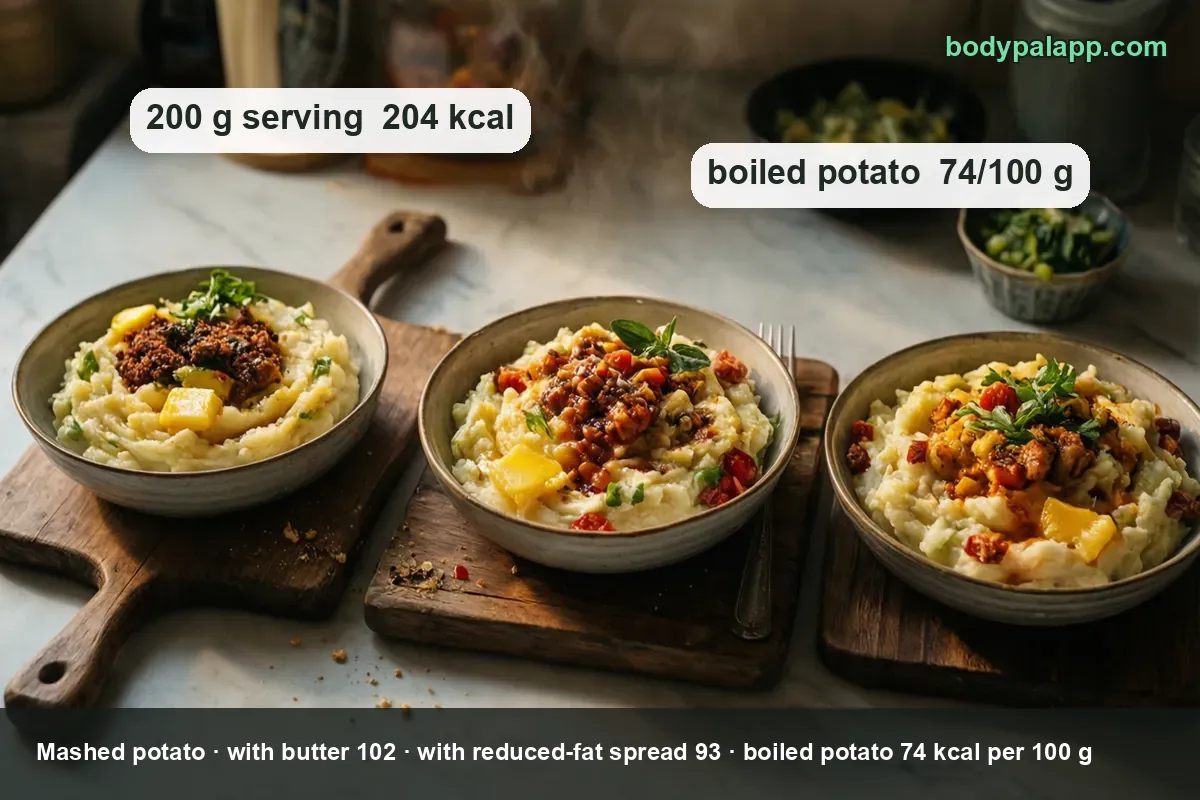
Swap the butter for a reduced-fat spread and the mash lands at 93 kcal per 100 g instead of 102. Nine calories per 100 g is not a headline. What happens underneath it is.
| Per 100 g | Made with butter | Made with reduced-fat spread |
|---|---|---|
| Energy | 102 kcal | 93 kcal |
| Fat | 3.9 g | 2.8 g |
| Saturates | 2.42 g | 0.68 g |
| Protein | 1.9 g | 1.8 g |
| Carbohydrates | 15.9 g | 15.9 g |
| Fibre | 1.4 g | 1.4 g |
| Salt | 0.09 g | 0.075 g |
Saturates fall from 2.42 g to 0.68 g, a drop of about seventy per cent. On a 200 g plate that is 4.84 g against 1.36 g, or a quarter of the daily reference intake against under a tenth. The calorie saving is minor; the saturated fat saving is the largest single change you can make to this dish without changing what it is.
Our position: if you are cutting calories, mash is not where the win is. If you are watching saturated fat, the spread version is worth making the default, and most people cannot tell from the plate.
Adding more butter runs the same maths in reverse. Restaurant mash is smooth because it holds far more fat than the domestic recipe measured here, so any figure you log for mash eaten out should be treated as a floor rather than an estimate.
The fibre you lose when you peel
Mash is 1.4 g of fibre per 100 g. A baked potato eaten with its skin is 2.6 g. Peeling is what costs you, because roughly half the fibre in a potato sits in and just under the skin, and mash by definition starts with a peeled potato.
That single line reframes the usual comparison. Mash at 102 kcal per 100 g and a jacket potato at 97 are, for calorie purposes, the same food. They are not the same meal. The jacket potato delivers nearly twice the fibre and 2.5 g of protein against 1.9 g, which is why it holds you longer for the same energy.
If you want mash and you want the fibre, mash the skins in. It is not traditional and the texture is coarser, but the nutrition follows the skin, not the recipe card. Starchy foods with the skin left on are the NHS's own suggestion for exactly this reason.
Mash against the other ways to cook a potato
Same vegetable, six treatments, and a spread of more than fourfold from top to bottom.
| Per 100 g | Calories | Protein | Fat | Fibre | Salt |
|---|---|---|---|---|---|
| Boiled, flesh only | 74 kcal | 1.8 g | 0.1 g | 1.6 g | 0.003 g |
| Mashed with reduced-fat spread | 93 kcal | 1.8 g | 2.8 g | 1.4 g | 0.075 g |
| Baked, flesh and skin | 97 kcal | 2.5 g | 0.2 g | 2.6 g | 0.005 g |
| Mashed with butter | 102 kcal | 1.9 g | 3.9 g | 1.4 g | 0.09 g |
| Roasted in sunflower oil | 161 kcal | 2.6 g | 5.7 g | 2.7 g | – |
| Chips, fine cut, fast food | 290 kcal | 3.5 g | 14.2 g | 3.8 g | 0.482 g |
The verdict: for weight loss the baked potato with its skin wins, because it costs five calories less than mash per 100 g and returns nearly double the fibre. For a small plate that has to feel like a proper dinner, especially for children, mash made with a reduced-fat spread is the better pick at 93 kcal per 100 g with saturates under 1 g.
Roast potatoes deserve their reputation. At 161 kcal per 100 g they are 58 per cent heavier than butter mash, and a roast tray tends to hold far more than 200 g per person. Chips from a fast food outlet are almost triple, which is the number to remember on the nights when mash felt like the boring option.
Mash also plays well with what goes on top. A pour of gravy costs very little; another knob of butter does not. If you are building a Sunday roast, the potato is rarely the line that decides the total.
Most popular mashed potato brands in the United Kingdom
Ranked by how widely each product appears among foods sold in the United Kingdom, from the BodyPal food database of over 3.3 million products. Calories are the figures printed on each label. The instant figure is the made-up dish, not the dry powder in the packet.
| Product | Calories (per 100 g) |
|---|---|
| Aunt Bessie’s Mashed Potato | 113 kcal |
| Aldi Buttery Mashed Potato | 94 kcal |
| M&S Food Mashed Potato | 89 kcal |
| Tesco Mashed Potato | 84 kcal |
| Tesco Instant Mashed Potato | 80 kcal |
Brand popularity: BodyPal food database. Nutrition: manufacturer labels.
Mashed potato FAQs
How many calories are in mashed potato?
102 kcal per 100 g for mash made with butter and milk, so a 200 g plate is 204 kcal. Made with a reduced-fat spread instead, the same mash is 93 kcal per 100 g and 186 kcal for the plate. The boiled potato underneath is 74 kcal per 100 g.
How many calories in mashed potato with butter?
102 kcal per 100 g, using the standard recipe of 5 g of butter and 7 g of milk per 100 g of boiled potato. That is 28 kcal more than plain boiled potato, and it brings 3.9 g of fat and 2.42 g of saturates with it. Restaurant mash usually holds more butter than this, so treat 102 as a floor when you eat out.
How many calories in mashed potato without butter?
Mash made with no added fat is effectively boiled potato at 74 kcal per 100 g, or 148 kcal for a 200 g plate. Using a reduced-fat spread instead of butter gives you 93 kcal per 100 g and keeps the texture, with saturates at 0.68 g rather than 2.42 g.
Is mashed potato good for weight loss?
At 102 kcal per 100 g it is a moderate side, and the reduced-fat version at 93 is better again. The catch is fibre: mash carries 1.4 g per 100 g against 2.6 g in a baked potato with the skin on, so it satisfies less for the same calories. Portion size matters more than recipe here, since mash is served by spoon rather than by unit.
Mashed potato or jacket potato?
Almost identical on calories, 102 against 97 per 100 g, and not close on anything else. The baked potato brings 2.6 g of fibre and 2.5 g of protein per 100 g against 1.4 g and 1.9 g for mash. Pick the jacket when you want the meal to hold you, and mash when it is a side dish to something else.
How many carbs are in mashed potato?
15.9 g of carbohydrate per 100 g, of which 1.0 g is sugar, so a 200 g plate is 31.8 g. That is lower than plain boiled potato at 17.5 g per 100 g, because the butter and milk take up part of the weight. Fibre adds a further 1.4 g per 100 g.
How many calories in a scoop of mashed potato?
It depends entirely on the scoop, and mash is not sold in standard units. Work from 102 kcal per 100 g: 150 g is 153 kcal and 250 g is 255 kcal.
How many calories in instant mash?
British government composition tables carry no row for instant mash, but supermarket labels do, and made-up instant mash from the large British retailers reads between 63 and 80 kcal per 100 g. Made up with water alone it will sit below the 102 kcal per 100 g of butter mash, and made up with butter and milk as the packet suggests it will sit close to it. Check the label for the made-up figure rather than the dry powder figure, which is several times higher.
Similar foods
- Sweet potato — 207 kcal per medium baked
- Corn on the cob — 84 kcal a cob
- Onions — 53 kcal per medium onion
- Carrot — 27 kcal per medium carrot
- Avocado — 128 kcal per half
- Cauliflower — 23 kcal per 80 g portion
Log the plate, not the spoon
Photograph the mash, the gravy and everything beside it, and BodyPal works out the weights so you do not have to guess at a scoop.


How long does it take to burn off mashed potato?
100 g of mash made with butter is 102 kcal. Enter your weight and the amount you ate to see how long it takes you to burn that off:
lb
| Activity | Time to burn 102 kcal |
|---|---|
| Walking, brisk | 20 min |
| Cycling, moderate | 13 min |
| Swimming, moderate | 15 min |
| Jogging | 12 min |
| Weight training, moderate | 23 min |
Times are for a 154 lb (11 st) adult at a steady pace; change the weight to see yours. The amount is set to the portion in the text (100 g); change it to what you actually ate. BodyPal works this out from your steps automatically.
One food is easy to picture; a whole day is harder. See how many calories you need a day and what a deficit actually looks like.