
Calories in Fish and Chips: 1,074, and the Fish Is the Light Half
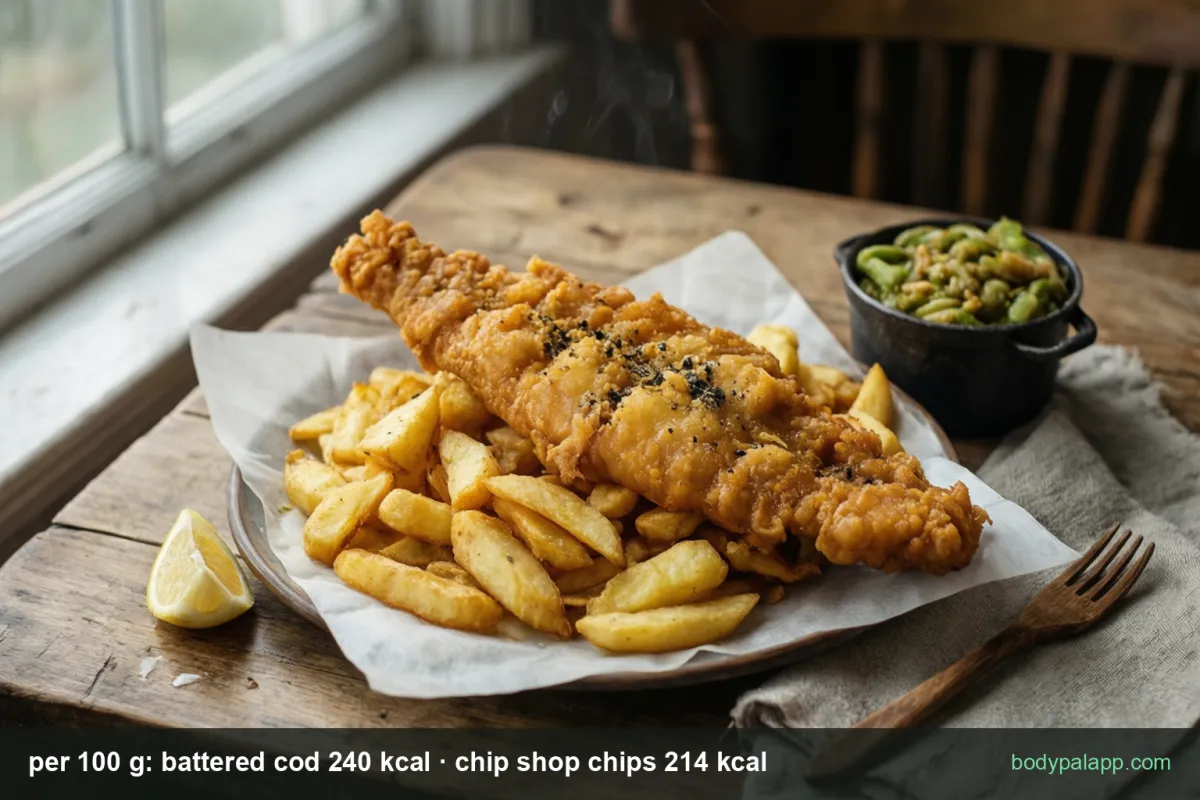
A regular fish and chips from the chippy comes to about 1,074 kcal: 432 for a 180 g battered cod and 642 for a 300 g portion of chips. Which means the calories in fish and chips are mostly the chips, not the fish. That surprises almost everyone who orders it.
On this page
- Fish and chips at a glance
- Where the 1,074 actually sits
- What the batter costs
- UK portions and what they weigh
- How does a fish supper compare?
- Is a chippy tea a problem?
- Most popular frozen fish and chips brands
- FAQ
Fish and chips at a glance
A regular order: one 180 g battered cod and 300 g of chips, 480 g on the plate.
| Nutrient | Per 100 g of plate | Per regular order (480 g) | %RI* |
|---|---|---|---|
| Energy | 224 kcal / 936 kJ | 1,074 kcal / 4,494 kJ | 54% |
| Protein | 8.5 g | 40.7 g | 81% |
| Carbohydrate | 24.8 g | 118.9 g | 46% |
| Fat | 10.8 g | 51.7 g | 74% |
| Fibre | 2.2 g | 10.5 g | 35%† |
| Salt | 0.19 g | 0.91 g | 15% |
*%RI = percentage of the reference intake for an average adult (2,000 kcal; 70 g fat, 260 g carbohydrate, 90 g sugars, 50 g protein, 6 g salt). †The UK sets no reference intake for fibre, so this is measured against the 30 g a day the NHS suggests.
Verified nutrition data
Numbers on this page come from CoFID, the UK government’s Composition of Foods Integrated Dataset, and from manufacturer labels where a branded product is named. Last verified August 2026. How we verify our data →
Watch the salt row. Chips leave the fryer at 0.04 g per 100 g, so 0.91 g is what the plate holds unsalted, and the shaker at the counter can double it. The NHS advises adults to stay under 6 g a day.
Where the 1,074 actually sits
Split the order in two and the reputation falls apart. The cod is 432 kcal, the chips 642. The chips are 60% of the plate, and they are the half nobody thinks twice about.
Per 100 g the two are close: 240 kcal for battered cod against 214 for chips. The difference is weight, since a regular scoop is nearly twice the fish by mass. Chips win one line, though: 9.6 g of fibre against 0.9 g.
What the batter costs
Battered fried cod is 240 kcal per 100 g, with 14.7 g of fat and 10.7 g of carbohydrate. Cod has no carbohydrate of its own. Every gram of that 10.7 is flour, and most of the fat arrived with the fryer.
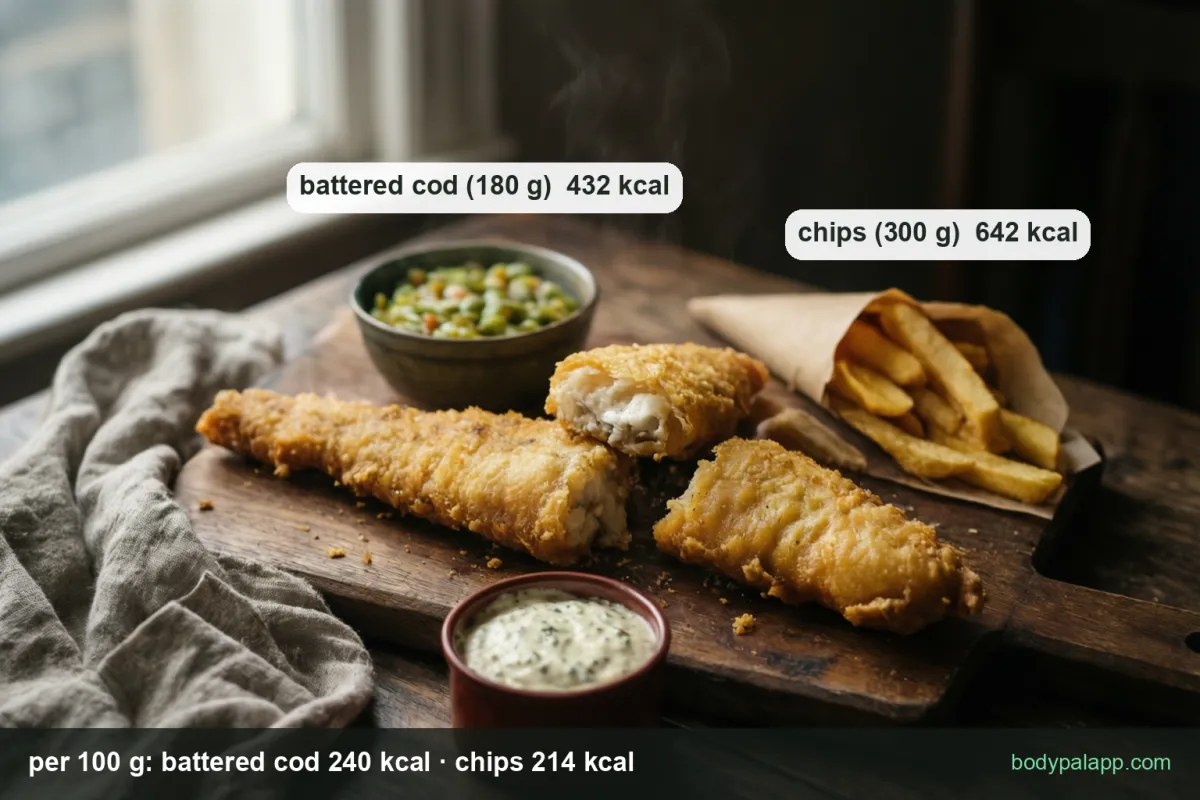
Portion size moves the total more than anything else on the menu.
UK portions and what they weigh
| Portion | Weight | Calories |
|---|---|---|
| Battered cod, one fillet | 180 g | 432 kcal |
| Small chips | 200 g | 428 kcal |
| Regular chips | 300 g | 642 kcal |
| Cod + small chips | 380 g | 860 kcal |
| Cod + regular chips | 480 g | 1,074 kcal |
Chip shops weigh nothing, so treat these as the middle of a wide range.
How does a fish supper compare?
| Food | Per 100 g | Typical UK portion | Per portion | P / C / F per 100 g |
|---|---|---|---|---|
| Regular fish supper | 224 kcal | cod + regular chips, 480 g | 1,074 kcal | 8.5 / 24.8 / 10.8 |
| Battered cod, fried | 240 kcal | 1 fillet, 180 g | 432 kcal | 16.8 / 10.7 / 14.7 |
| Chip shop chips | 214 kcal | regular, 300 g | 642 kcal | 3.5 / 33.2 / 8.4 |
| Jacket potato | 97 kcal | medium, 285 g | 277 kcal | 2.5 / 22.6 / 0.2 |
The verdict: if you are cutting calories, the fish stays and the chips go. A medium jacket potato in place of a regular chips saves 365 kcal and puts a bigger object on the plate, because the same potato is 97 kcal per 100 g baked and 214 once it is cut up and fried. For protein per calorie the cod wins outright, at nearly five times what the chips manage.
The NHS suggests at least two portions of fish a week, and a battered cod counts towards that. It also brings 26.5 g of fat a grilled fillet wouldn't.
Is a chippy tea a problem?
Our position, plainly: a 1,000 kcal meal once a week is a choice, not a catastrophe. Spread over seven days it is roughly 150 kcal a day, a biscuit and a half. What causes trouble is not knowing the number, because people log a chippy tea at 600 and then wonder why the week didn't add up.
The thing people get wrong: "the fish is the fattening bit." It isn't. The cod is 432 kcal of a 1,074 kcal plate, and it carries the protein that makes the meal hold. Take your 200 calories off the chips instead.
Most popular frozen fish and chips brands in the United Kingdom
Ranked by how widely each product appears among foods sold in the United Kingdom, from the BodyPal food database of over 3.3 million products. Calories are the figures printed on each label. These are supermarket freezer versions, so the numbers sit below the chip-shop plate.
| Product | Calories (per 100 g) |
|---|---|
| Birds Eye Battered Haddock | 234 kcal |
| Findus Fish and Chips | 207 kcal |
| McCain Beer Battered Fish & Chips | 128 kcal |
Brand popularity: BodyPal food database. Nutrition: manufacturer labels.
How long does it take to burn off fish and chips?
A regular chippy order (cod and regular chips, 480 g) is 1,074 kcal. Enter your weight and the amount you ate to see how long it takes you to burn that off:
lb
| Activity | Time to burn 1,074 kcal |
|---|---|
| Walking, brisk | 3 hr 35 min |
| Cycling, moderate | 2 hr 14 min |
| Swimming, moderate | 2 hr 33 min |
| Jogging | 2 hr 6 min |
| Weight training, moderate | 3 hr 59 min |
Times are for a 154 lb (11 st) adult at a steady pace; change the weight to see yours. The amount is set to the portion in the text (480 g); change it to what you actually ate. BodyPal works this out from your steps automatically.
This table assumes you know your daily total. If you do not, the daily calorie calculator works it out from five numbers.
Frequently asked questions
How many calories are in fish and chips?
A regular chip-shop order is about 1,074 kcal: 432 for a 180 g battered cod and 642 for 300 g of chips. Per 100 g the plate averages 224 kcal. Portions vary widely between shops, so treat this as the middle of the range.
How many calories are in a battered cod?
A 180 g battered fried cod is 432 kcal, from 240 kcal per 100 g. It brings 30.2 g of protein, 26.5 g of fat and 19.3 g of carbohydrate, and all of that carbohydrate is batter rather than fish.
How many calories are in chip shop chips?
Chip-shop chips are 214 kcal per 100 g, so a regular 300 g portion is 642 kcal and a small 200 g one is 428. They are the biggest single item in a fish supper, and they carry the fibre: 9.6 g against 0.9 g from the fish.
How many calories are in a small fish and chips?
A cod with a small 200 g chips is about 860 kcal, or 214 fewer than the regular. Leaving roughly half the batter takes the same order down to around 650 to 700 kcal. That is the cheapest saving on offer, and it needs no negotiation at the counter.
Is fish and chips healthy?
One regular order is 54% of a 2,000 kcal day and 74% of the fat reference intake, so it is a large meal. It is not an empty one: 40.7 g of protein, 10.5 g of fibre, and cod counts towards the two portions of fish a week the NHS suggests.
Does taking the batter off save many calories?
Leaving about half the batter takes a cod-and-small-chips order from roughly 860 kcal down to 650 to 700. The batter holds the fried fat and all 10.7 g of carbohydrate per 100 g, since cod itself has none. A little protein goes with it.
How much salt is in fish and chips?
A regular order holds about 0.91 g of salt before it is salted: 0.79 g from the cod and 0.12 g from the chips, which are only 0.04 g per 100 g on their own. The shaker moves that number, and the NHS advises adults to stay under 6 g a day.
Can you eat fish and chips while losing weight?
A 1,074 kcal meal once a week averages about 150 kcal a day across the week, so it fits a deficit if the other days are planned. Ordering a small chips instead of a regular saves 214 kcal. The trap is under-logging it, not eating it.
Similar foods
- Jacket potato — the 365 kcal swap
- White bread
- Wrap
- Bagel
- Crumpet
Similar foods
- Falafel — 185 kcal for four falafel
- Samosa — 152 kcal each
- Chips — 535 kcal a small chippy portion
- Chicken leg — 236 kcal per 100 g roasted
- Salmon — 287 kcal per grilled fillet
- Scotch egg — 272 kcal each
Count it without the maths
BodyPal reads the fish and the chips separately from one photo, so the half of the plate carrying 642 calories doesn't get logged as a side.

