
How Many Calories in a Burger? From Patty to Bun
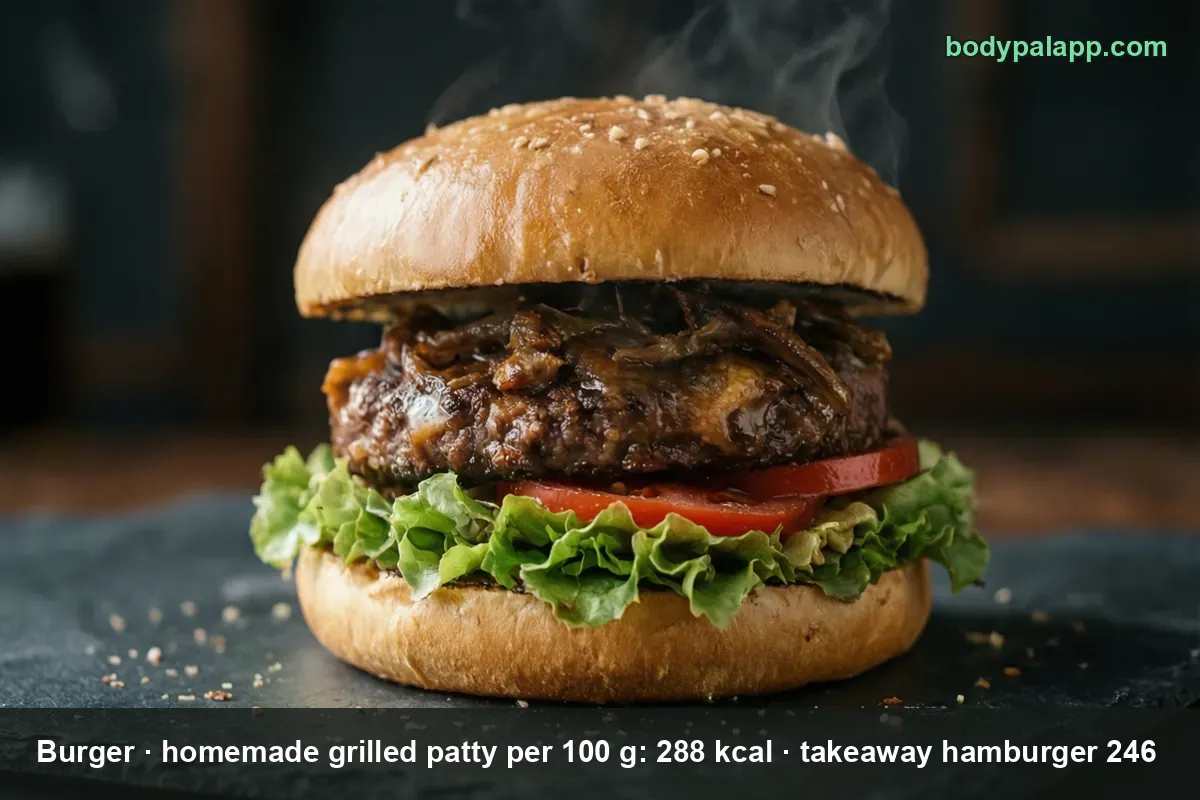
There are 259 calories in a grilled homemade burger patty of about 90 g, which is 288 kcal per 100 g, and a whole homemade burger in a bun comes to roughly 623. Here is the part nobody expects: gram for gram, the takeaway version is lighter than yours.
On this page
- Burger nutrition at a glance
- UK portions, patty to full stack
- Why takeaway burgers read lighter
- The salt is in the assembled burger
- How does a burger compare?
- Most popular burger brands
- FAQ
Burger nutrition at a glance
| Nutrient | Per 100 g | Per grilled patty (~90 g) | %RI* per patty |
|---|---|---|---|
| Energy | 288 kcal / 1,205 kJ | 259 kcal / 1,084 kJ | 13% |
| Protein | 25.0 g | 22.5 g | 45% |
| Carbohydrate | 1.1 g | 1.0 g | 0% |
| of which sugars | 0.9 g | 0.8 g | 1% |
| Fat | 20.3 g | 18.3 g | 26% |
| of which saturates | 8.5 g | 7.7 g | 39% |
| Fibre | 0.3 g | 0.3 g | – |
| Salt | 0.29 g | 0.26 g | 4% |
*%RI = percentage of the reference intake for an average adult (2,000 kcal; 70 g fat, 20 g saturates, 260 g carbohydrate, 90 g sugars, 50 g protein, 6 g salt).
Verified nutrition data
Numbers on this page come from CoFID, the UK government’s Composition of Foods Integrated Dataset, and from manufacturer labels where a branded product is named. Last verified August 2026. How we verify our data →
The figures are for a plain grilled homemade patty, CoFID's benchmark row. Two lines carry the story: 22.5 g of protein, close to half the daily reference intake, and 18.3 g of fat, which is where most of the calories live. The carbohydrate line is near zero, because a patty is meat.
Put it in a bun and the composition flips. CoFID's homemade burger with bun runs 283 kcal per 100 g with 10.3 g of carbohydrate, and the salt roughly doubles to 0.50 g per 100 g. Bread brings both.
UK portions, patty to full stack
| Portion | Weight | Calories |
|---|---|---|
| Grilled homemade patty | ~90 g | 259 kcal |
| Homemade burger in a bun | ~220 g | 623 kcal |
A homemade burger is a proper meal on the calorie ledger: 623 kcal is close to a third of a 2,000 kcal day in one item, before chips join the plate. That is not an argument against it. A patty's 25 g of protein per 100 g does more to hold you to the next meal than most 600-calorie plates manage.
The honest comparison with a night out is a doner kebab or a portion of fish and chips, and the burger usually enters that contest as the smaller number. Size, not recipe, decides it.
Why takeaway burgers read lighter
Per 100 g, the famous names undercut your kitchen. CoFID's takeaway rows: a plain hamburger is 246 kcal per 100 g, a cheeseburger 254, a Big Mac 232, a Quarter Pounder with cheese 263, a Whopper 223, and a chicken burger 235.
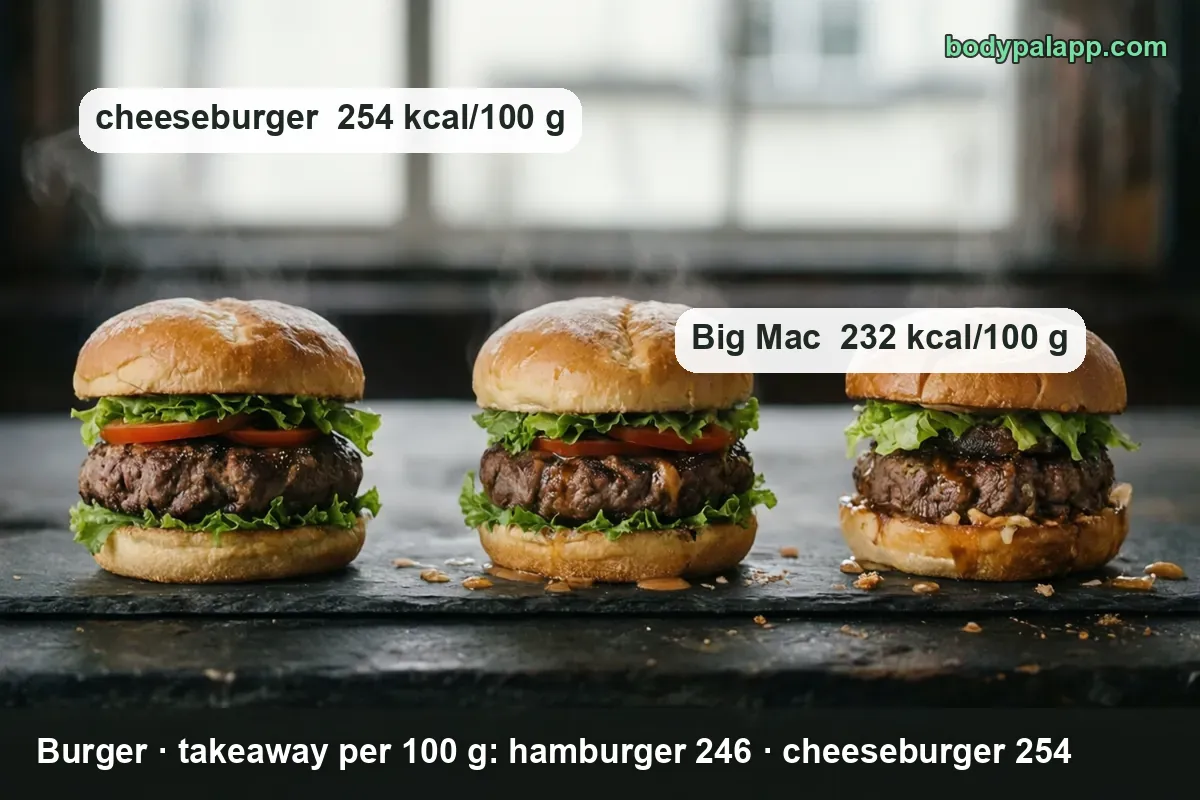
Your homemade patty beats all of them at 288. The reason is what surrounds the meat. A takeaway burger is a stack of bun, sauce, lettuce, gherkin and onion, and bread with salad is less calorie-dense than beef. More burger, proportionally less meat.
The catch is that nobody eats 100 g of a Big Mac. The chains sell items, not weights, and their menus publish the per-item figures, so the number on the board is the one to log. The per-100 g rows are still worth knowing for one reason: they show that a takeaway burger is not some uniquely engineered calorie bomb. It is bread and mince. The bomb, when there is one, is the meal deal around it.
One quiet standout in that list: the chicken burger at 235 kcal per 100 g is no lighter than the beef hamburger at 246 in any way that matters. Coated and fried chicken gives back everything the leaner meat saved. Grilled chicken breast is a different food at 147 kcal per 100 g, and the coating is the whole difference.
The salt is in the assembled burger
A plain homemade patty carries just 0.26 g of salt. Assemble it into a bun and the homemade figure hits 0.50 g per 100 g; buy it assembled and it climbs further, with the takeaway hamburger at 1.2 g and the cheeseburger at 1.4 g per 100 g.
Across a 250 g takeaway cheeseburger-sized serving, that pace reaches over half of the 6 g daily limit the NHS advises. Bread, cheese and sauce are the carriers, which is why the burger you season yourself at home starts with a fraction of it. If you are watching salt, the patty is innocent; the assembly is not.
How does a burger compare?
| Food | Per 100 g | Protein per 100 g |
|---|---|---|
| Homemade grilled patty | 288 kcal | 25.0 g |
| Homemade burger in a bun | 283 kcal | 21.9 g |
| Takeaway cheeseburger | 254 kcal | 13.6 g |
| Lasagne, homemade | 180 kcal | 9.6 g |
| Chicken breast, grilled | 147 kcal | 29.8 g |
The verdict: for protein per calorie, grilled chicken breast wins and it is not close. But among the comfort options, a homemade burger is the strongest of its class: nearly double a cheeseburger's protein concentration, with salt at a fifth of the takeaway level. Pick the takeaway version for the occasion; build it at home when it is a weekly habit.
Most popular burger brands in the United Kingdom
Ranked by how widely each product appears among foods sold in the United Kingdom, from the BodyPal food database of over 3.3 million products. Calories are the figures printed on each label.
| Product | Calories (per 100 g) |
|---|---|
| Rustlers Southern Fried Chicken Burger | 289 kcal |
| Birds Eye Chicken Burger | 243 kcal |
| Tesco Finest Beef Burgers | 230 kcal |
| Aldi Aberdeen Angus Beef Burger | 204 kcal |
Brand popularity: BodyPal food database. Nutrition: manufacturer labels.
How long does it take to burn off a burger?
A grilled homemade patty (~90 g) is 259 kcal. Enter your weight and the amount you ate to see how long it takes you to burn that off:
lb
| Activity | Time to burn 259 kcal |
|---|---|
| Walking, brisk | 52 min |
| Cycling, moderate | 32 min |
| Swimming, moderate | 37 min |
| Jogging | 30 min |
| Weight training, moderate | 58 min |
Times are for a 154 lb (11 st) adult at a steady pace; change the weight to see yours. The amount is set to the portion in the text (90 g); change it to what you actually ate. BodyPal works this out from your steps automatically.
One food is easy to picture; a whole day is harder. See how many calories you need a day and what a deficit actually looks like.
Frequently asked questions
How many calories are in a homemade burger?
A grilled homemade patty of about 90 g is 259 kcal, and the full burger in a bun lands around 623 kcal at a typical 220 g. Per 100 g the patty is 288 kcal, with 25 g of protein, which is the strongest protein line of any burger format.
How many calories does the burger bun add?
CoFID measures the assembled burger rather than the bun alone: with the bun the burger runs 283 kcal per 100 g against 288 for pure patty. The bun barely changes the density, but it adds bulk, so the total climbs from 259 to roughly 623 kcal. It also doubles the salt concentration.
How many calories are in a chicken burger?
A takeaway chicken burger is 235 kcal per 100 g, almost level with a beef hamburger at 246. The coating and frying cancel the leaner meat. A grilled chicken breast without the coating is 147 kcal per 100 g, so the format, not the bird, sets the number.
How many calories are in a Big Mac?
Per 100 g, a Big Mac measures 232 kcal in the CoFID takeaway data, which is lighter than a homemade patty's 288. The chains publish exact per-item calories on their menus, and that printed figure is the one to log, since item weights vary between burgers and countries.
Why is a takeaway burger lower in calories per 100 g than homemade?
Because it is proportionally less meat. A takeaway stack is bun, sauce and salad around a thin patty, at 223 to 263 kcal per 100 g, while a homemade burger is mostly beef at 288. Per whole item the takeaway can still win on size.
How much salt is in a burger?
A plain homemade patty holds just 0.26 g of salt, but a takeaway hamburger runs 1.2 g and a cheeseburger 1.4 g per 100 g. One assembled takeaway burger can carry over half the NHS daily guide of 6 g. Bread, cheese and sauce are where it hides.
Is a burger high in protein?
Yes, when the beef leads: a grilled patty delivers 25 g of protein per 100 g, so one patty covers 45% of an adult's daily reference intake for 259 kcal. Takeaway versions dilute that to around 13-14 g per 100 g once the bun and toppings join in.
Can I eat a burger and still lose weight?
A 623 kcal homemade burger fits a day comfortably if the rest of the plate stays modest; its 45 g-plus of total protein does real work on fullness. The arithmetic usually breaks at the sides, since chips and a sugary drink can double the meal.
Similar foods
- Bacon sandwich — 314 kcal, 388 with butter
- Fries — 331 kcal per medium portion
- Greggs Chicken Bake — 420 kcal per bake
- Cheese on toast — 336 kcal for two slices
- Pizza — 340 kcal per slice
- Cheese and onion pasty — 436 kcal a Greggs bake
Count it without the maths
BodyPal logs the whole stack from one photo, patty, bun and sauce included, so the difference between a burger and a burger meal stays visible.

