
How Many Calories Are in Fries?
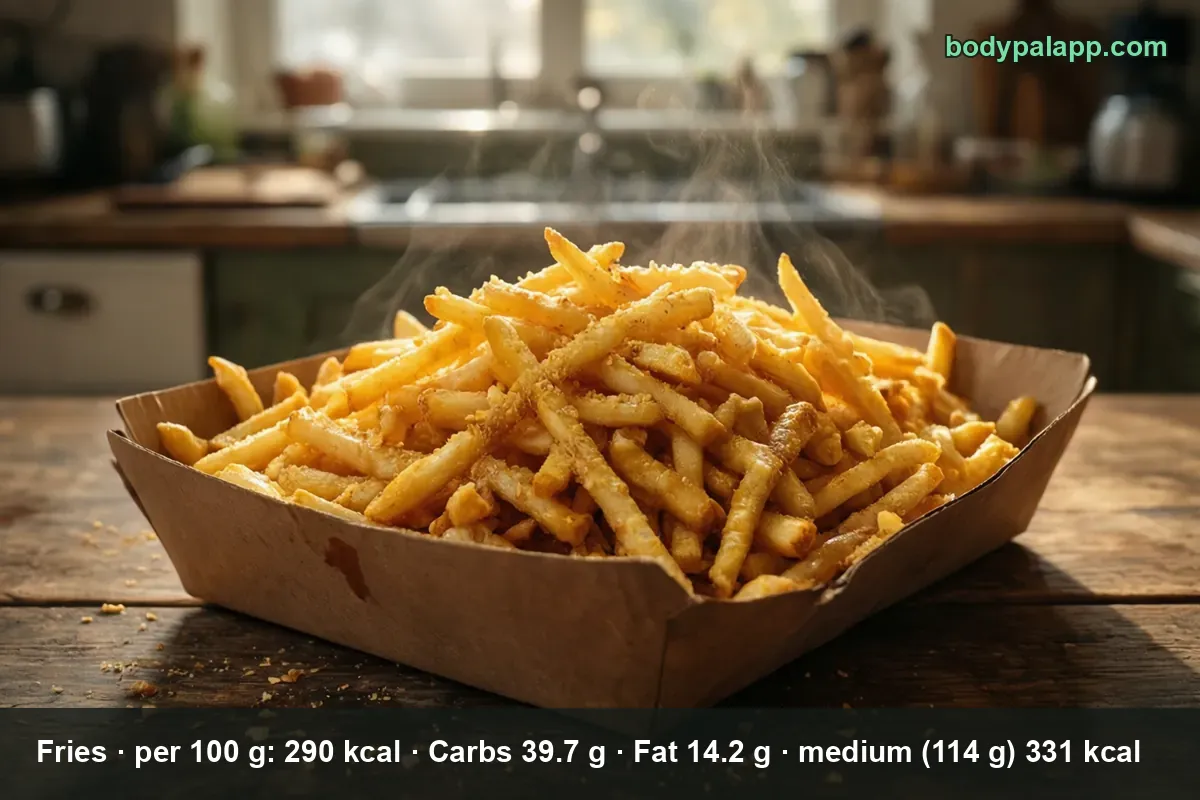
Fries are 290 calories per 100 g, so a medium 114 g portion comes to 331 kcal. Oven-baked ones out of a freezer bag are 189 kcal per 100 g. Thin fries deep-fried in your own kitchen reach 364. Same potato, same oil, three very different answers, and the cut explains most of it.
On this page
- Fries quick facts
- Fries and chips are not the same food
- UK portions, small to large
- Oven, pan or fryer
- Your kitchen fries harder than the drive-through
- Where the calories actually come from
- Fries against the rest of the potato aisle
- Popular oven chip and fry brands
- FAQ
Fries quick facts
The reference row here is the one the UK composition table builds from five samples taken at fast food outlets, McDonald's, Burger King, Wimpy and KFC among them. Thin cut, cooked, salted, ready to eat. That is what "fries" means in British usage, and it is the food this page is about.
| Nutrient | Per 100 g | Medium portion (114 g) | RI%* |
|---|---|---|---|
| Energy | 290 kcal / 1,219 kJ | 331 kcal / 1,385 kJ | 17% |
| Protein | 3.5 g | 4.0 g | 8% |
| Carbohydrates | 39.7 g | 45.3 g | 17% |
| – of which sugars | 0.3 g | 0.3 g | 0% |
| Fat | 14.2 g | 16.2 g | 23% |
| – of which saturates | 2.5 g | 2.9 g | 15% |
| Fibre | 3.8 g | 4.3 g | 14% |
| Salt | 0.48 g | 0.55 g | 9% |
Verified nutrition data
Numbers on this page come from CoFID, the UK government’s Composition of Foods Integrated Dataset, and from manufacturer labels where a branded product is named. Last verified September 2026. How we verify our data →
*RI% = one medium portion's share of an adult's daily reference intake, based on 2,000 kcal.
The fat row is the one to watch: 16.2 g in a medium portion, 23% of the day, from a side dish. The fibre row is the pleasant surprise at 4.3 g, because the skin and the potato itself are still in there.
Fries and chips are not the same food
Everywhere else in the world this is a vocabulary quibble. In Britain it is worth 76 calories per 100 g.
Chip-shop chips — thick, cut on the premises, fried once in a big vat — run 214 kcal per 100 g. Fast-food fries, thin and blanched and fried hard, run 290. Order the same 250 g of each and you get 535 kcal of chips against 725 kcal of fries.
The thin one is the heavier one. That trips people up, because thin reads as light.
It comes down to geometry. A thin baton has far more surface per gram than a thick one, and oil clings to surfaces. The composition table shows it cleanly, with the same potatoes and the same corn oil at every thickness:
| Cut | Per 100 g | Fat |
|---|---|---|
| Fine cut, frozen, deep-fried | 364 kcal | 21.3 g |
| Crinkle cut, frozen, deep-fried | 290 kcal | 16.7 g |
| Straight cut, frozen, deep-fried | 273 kcal | 13.5 g |
| Thick cut, frozen, deep-fried | 234 kcal | 10.2 g |
From fine to thick is 130 kcal per 100 g, and the potato never changed. Nothing else you can do to a chip — the oil, the brand, the variety — moves the number that far.
UK portions, small to large
| Portion | Weight | Calories | Fat | Salt |
|---|---|---|---|---|
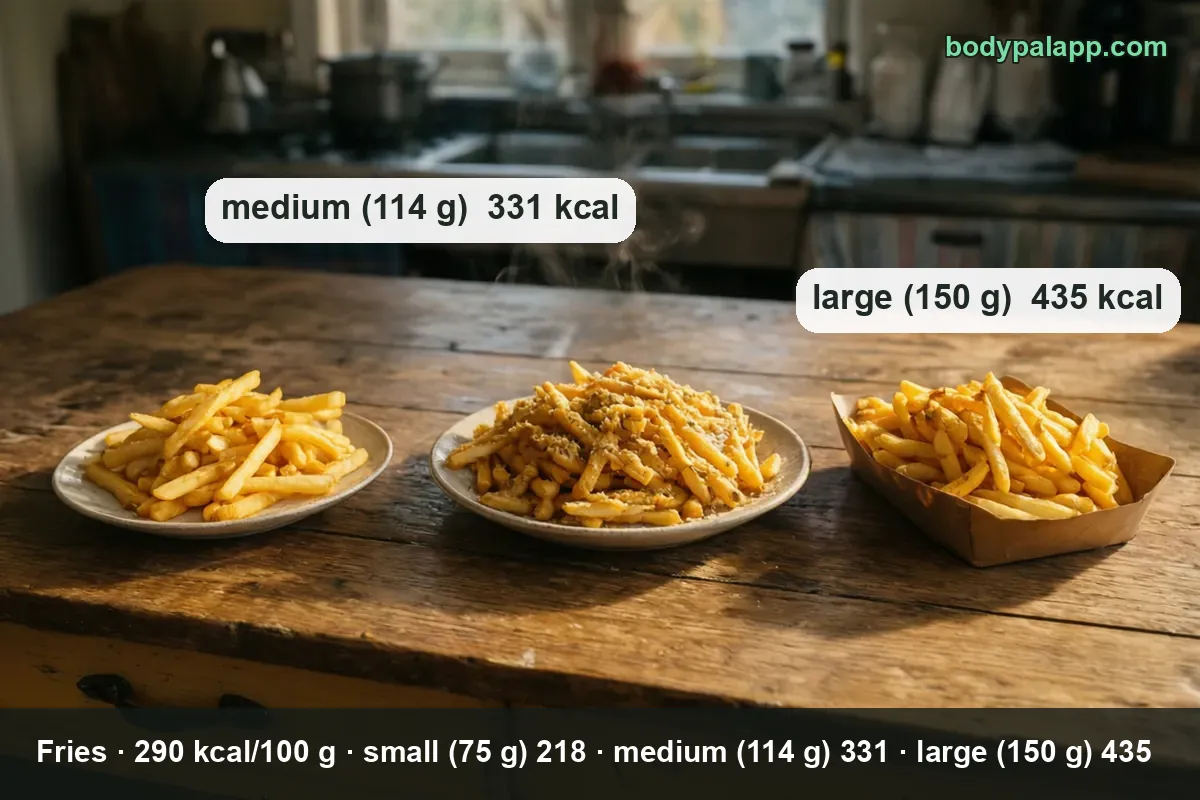
| Small | 75 g | 218 kcal | 10.7 g | 0.36 g |
| Standard label serving | 100 g | 290 kcal | 14.2 g | 0.48 g |
| Medium, fast-food size | 114 g | 331 kcal | 16.2 g | 0.55 g |
| Large | 150 g | 435 kcal | 21.3 g | 0.72 g |
The 114 g figure is not a guess. It is the serving weight printed on a medium UK fast-food portion, and it is the most useful anchor available, since the composition table gives no piece weights. Supermarket bags of French fries print servings of 100 g to 140 g, so a home portion sits in the same territory.
Small to large is 217 kcal. If you eat fries once a week and always take the large, dropping to the small over a year is the sort of change that happens without any willpower at all — you just say small.
Oven, pan or fryer
The cooking method is worth more than the cut, and it is the only lever most people have at home.
| Method | Per 100 g | Fat |
|---|---|---|
| Oven-baked, no batter | 189 kcal | 4.9 g |
| Homemade, shallow-fried | 197 kcal | 6.7 g |
| Oven-baked, battered | 202 kcal | 6.1 g |
| Chip-shop, thick | 214 kcal | 8.4 g |
| Microwave | 221 kcal | 9.6 g |
| Fast food, thin | 290 kcal | 14.2 g |
| Frozen thin, deep-fried at home | 364 kcal | 21.3 g |
Oven against deep fryer is 175 kcal per 100 g, the largest single saving anywhere in the potato section. On a 150 g plate that is 262 calories, for one decision about which appliance to switch on.
The battered oven varieties — the crispy-coated kind sold by McCain and Aunt Bessie's — cost 13 kcal per 100 g over the plain ones. That is a rounding error, and the coating is what makes an oven chip taste like a fried one. Take the batter.
Your kitchen fries harder than the drive-through
Here is the result nobody expects. Thin fries deep-fried at home, straight from a freezer bag, land at 364 kcal per 100 g. The fast-food version of the same shape is 290.
Your chip pan puts a quarter more calories into the potato than a commercial fryer does.
The mechanism is temperature. A commercial fryer holds its oil hot and steady and cooks the batch in one to four minutes; the water inside the potato flashes to steam and pushes outwards, which keeps oil out. A domestic pan drops in temperature the moment cold chips hit it, the steam pressure fades, and oil moves in to fill the space. Cooler oil means oilier chips, every time.
So "I make them myself, so they must be lighter" is only true if you bake them. Fry them and you have made the heavier version.
Where the calories actually come from
Break the 100 g row into its parts and it stops being abstract. 39.7 g of carbohydrate is about 159 kcal. 14.2 g of fat is about 128 kcal. Protein contributes roughly 14.
Around 44% of what you are eating is oil, not potato. A boiled potato sits near 74 kcal per 100 g; nothing about a potato gets it to 290 on its own. The gap is the fryer.
Salt behaves in a way that surprises people too. The fast-food row carries 0.48 g of salt per 100 g — the salting happens at the fryer, before the portion is scooped. Chip-shop chips carry 0.04 g, twelve times less, because the shop hands you the salt shaker and lets you decide. A medium portion of fries is 0.55 g of salt, 9% of the 6 g adult daily limit, which is modest for something that tastes as salty as it does.
On the fat side, the saturated fraction depends entirely on what the batch was cooked in. Frozen thin chips fried in corn oil carry 4.0 g of saturates per 100 g; the identical chips fried in beef dripping carry 11.8 g. Same calories, same everything else, nearly three times the saturated fat.
Fries against the rest of the potato aisle
| Item | Per 100 g | Typical portion | Calories |
|---|---|---|---|
| Fries, fast-food thin | 290 kcal | 114 g medium | 331 kcal |
| Chips | 214 kcal | small chip-shop | 535 kcal |
| Hash brown | 217 kcal | one | 127 kcal |
| Sweet potato | 115 kcal | one baked | 207 kcal |
| Jacket potato | 97 kcal | medium | 277 kcal |
| Fish and chips | 224 kcal | one order | 1,074 kcal |
Our take: per 100 g, fries are the densest thing on this list, but per portion they are mid-table, because a fries portion is small and a chip-shop portion is enormous. If you want the potato that fills you up for the fewest calories, the jacket potato wins outright — 277 kcal for 285 g of food, and it keeps the starch with almost none of the oil. If you want fries and you want them lighter, the answer is not sweet potato fries or skinny fries. It is the oven, and a smaller portion.
Popular oven chip and fry brands in the BodyPal food database
Ranked by how widely each product appears among foods sold in the United Kingdom, from the BodyPal food database of over 3.3 million products. Calories are the figures printed on each label. These are frozen, as sold — the figure rises once they are cooked and lose water.
| Product | Calories (per 100 g) |
|---|---|
| McCain French Fries | 231 kcal |
| McCain 1-2-3 Crinkle Fries | 151 kcal |
| McCain Naked Oven Chips | 135 kcal |
| Crinkle Cut Chips (Sainsbury's) | 166 kcal |
| Aunt Bessie's Crinkle Cut Chips | 201 kcal |
Brand popularity: BodyPal food database. Nutrition: manufacturer labels.
Fries FAQs
How many calories are in fries?
290 kcal per 100 g for thin fast-food fries, which makes a medium 114 g portion 331 kcal. A small 75 g portion is 218 kcal and a large 150 g portion is 435 kcal. Oven-baked fries from a freezer bag are much lower, at 189 kcal per 100 g.
How many calories in a large fries?
About 435 kcal for a 150 g large portion, with 21.3 g of fat and 0.72 g of salt. That is 217 kcal more than a 75 g small portion, which comes to 218 kcal. The step from large to small is the single biggest saving available at the counter.
Are oven fries healthier than deep-fried?
They carry far less fat. Oven-baked chips with no batter are 189 kcal and 4.9 g of fat per 100 g, against 364 kcal and 21.3 g for the same thin chips deep-fried at home. That is a saving of 175 kcal per 100 g, the largest in the whole potato category.
French fries or chips: which has fewer calories?
Chips, by a clear margin per 100 g: chip-shop chips are 214 kcal against 290 for thin fries. Portion sizes reverse the picture, since a small chip-shop portion is around 250 g and comes to 535 kcal, well above a 331 kcal medium fries.
Why are thin fries higher in calories than thick chips?
Surface area. A thin baton has more crust per gram, and crust is where oil is absorbed. With the same potato and the same oil, fine cut comes to 364 kcal per 100 g and thick cut to 234 — a 130 kcal gap created purely by the shape of the cut.
How much salt is in fries?
0.48 g per 100 g, so 0.55 g in a medium 114 g portion, which is 9% of the 6 g adult daily limit. Chip-shop chips carry only 0.04 g per 100 g because they are salted at the table rather than in the fryer, a twelve-fold difference.
How much of a portion of fries is oil?
Roughly 44% of the calories. Per 100 g, 14.2 g of fat supplies about 128 kcal while 39.7 g of carbohydrate supplies about 159. A boiled potato is near 74 kcal per 100 g, so almost everything above that figure arrived in the fryer.
Do fries have any fibre?
More than most people assume: 3.8 g per 100 g, or 4.3 g in a medium portion, which is 14% of the 30 g daily reference. The potato is still a potato, skin included, and the frying does not remove the fibre it started with.
Similar foods
- Burger — 288 kcal per 100 g
- Bacon sandwich — 314 kcal, 388 with butter
- Cheese on toast — 336 kcal for two slices
- Greggs Chicken Bake — 420 kcal per bake
- Cheese and onion pasty — 436 kcal a Greggs bake
- Pizza — 340 kcal per slice
Count it without the maths
Point the camera at the tray and BodyPal works out the portion, the fat and the salt in one go.


How long does it take to burn off fries?
A medium 114 g portion is 331 kcal. Enter your weight and the amount you ate to see how long it takes you to burn that off:
lb
| Activity | Time to burn 331 kcal |
|---|---|
| Walking, brisk | 1 hr 6 min |
| Cycling, moderate | 41 min |
| Swimming, moderate | 47 min |
| Jogging | 39 min |
| Weight training, moderate | 1 hr 14 min |
Times are for a 154 lb (11 st) adult at a steady pace; change the weight to see yours. The amount is set to the portion in the text (114 g); change it to what you actually ate. BodyPal works this out from your steps automatically.
Burning it off is one side of it. The other is knowing your number: work out how many calories you need a day, with macros and a goal date.