
Calories in a Quarter Pounder with Cheese
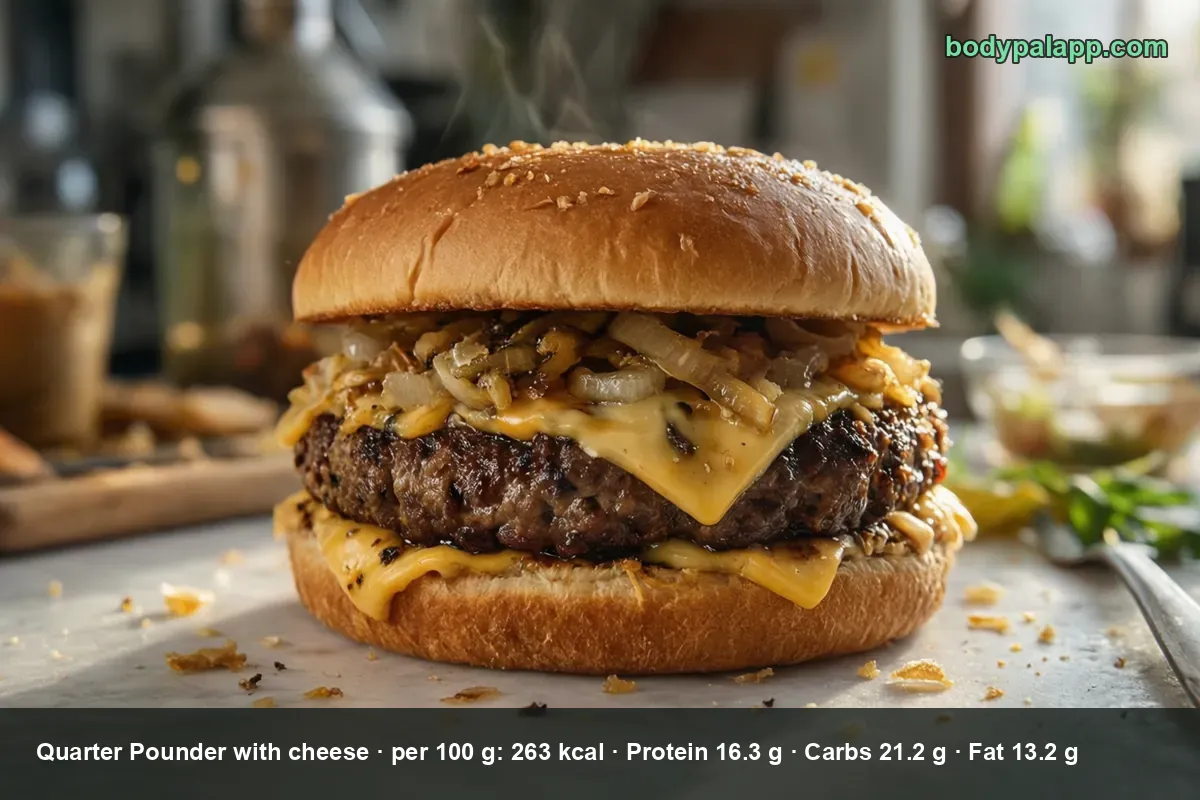
263 calories per 100 g. That is the calories in a quarter pounder with cheese as UK government analysts weigh it, and it makes this the densest of the common takeaway burgers. The name is both the clue and the trap: a quarter pound is 113 g of raw beef, weighed before it ever touches a grill.
On this page
- What a quarter pound actually weighs
- Quarter Pounder with cheese nutrition
- The patty is the heaviest thing on the menu
- Protein per calorie: this burger wins
- Saturated fat is the row to watch
- Doubles, and taking the cheese off
- Most popular Quarter Pounder brands in the United Kingdom
- FAQ
What a quarter pound actually weighs
A quarter of a pound is 113 g. Raw.
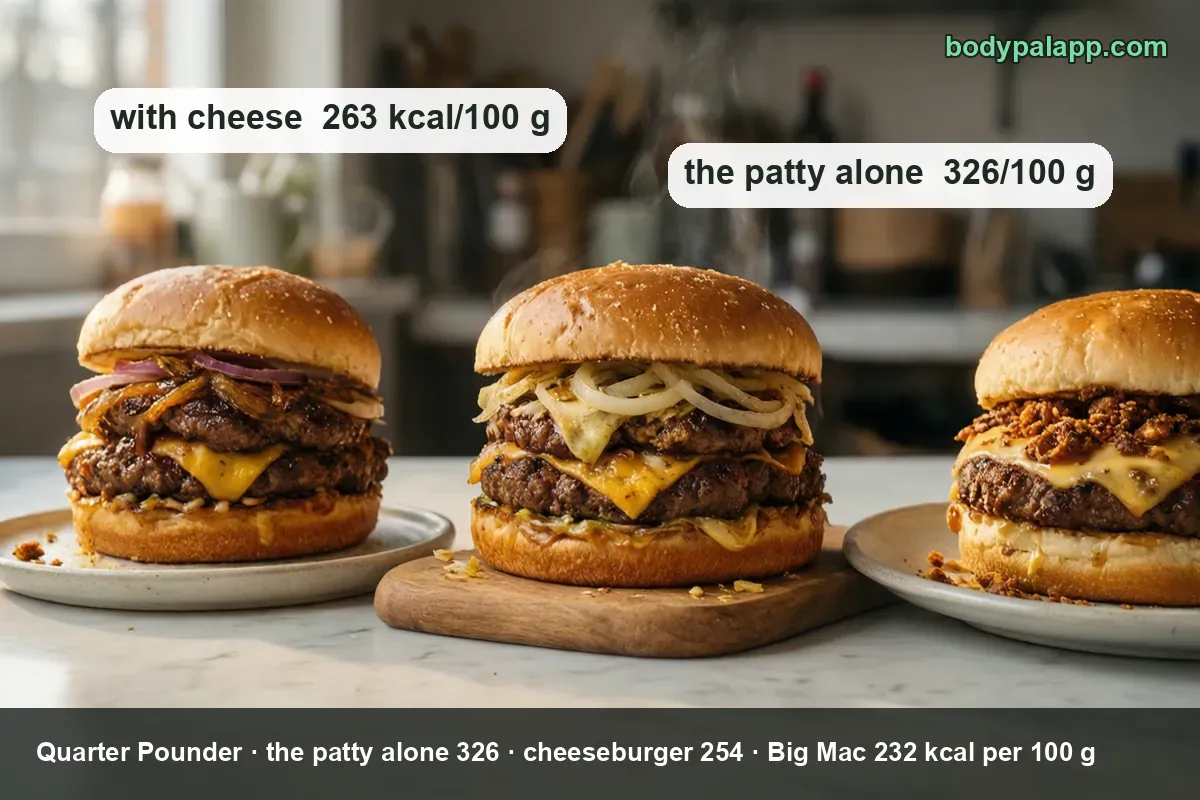
Beef on a grill sheds water and some fat, so what lands in the bun weighs meaningfully less than 113 g. This single fact explains the strangest number on this page, which is that the patty alone is 326 kcal per 100 g while the finished burger is only 263. Cooking concentrates the meat, then the bun and the salad dilute it again.
Which means the honest way to log this burger is by the chain's own printed serving weight, not by the name on the menu board. Take the serving weight in grams from the chain’s allergen and nutrition sheet, multiply by 2.63, and you have your number.
Nobody should be estimating this by eye. A quarter pounder in the hand looks like roughly 150 g and is usually rather more, because the bun, the cheese slice, the onions and the sauces are all weight that the name never mentions.
Quarter Pounder with cheese nutrition
The reference is the assembled takeaway burger: quarter pound beefburger, cheese, ketchup, mustard and onions in a bun.
| Nutrient | Per 100 g | RI%* |
|---|---|---|
| Energy | 263 kcal / 1,100 kJ | 13% |
| Protein | 16.3 g | 33% |
| Carbohydrates | 21.2 g | 8% |
| – of which sugars | 5.5 g | 6% |
| Fat | 13.2 g | 19% |
| – of which saturates | 6.8 g | 34% |
| Fibre | 1.6 g | – |
| Salt | 1.157 g | 19% |
*RI% = share of an adult's daily reference intake, based on 2,000 kcal.
Verified nutrition data
Numbers on this page come from CoFID, the UK government’s Composition of Foods Integrated Dataset, and from manufacturer labels where a branded product is named. Last verified September 2026. How we verify our data →
Read that table across and a shape appears. The protein column is the best on the fast-food counter. The saturates column is the worst. Everything else is unremarkable, including the salt, which at 1.157 g per 100 g is lower than a plain cheeseburger's 1.4 g.
The patty is the heaviest thing on the menu
Grilled 98–99% beef comes in at 326 kcal per 100 g, with 26.5 g of protein, 24.4 g of fat and 10.9 g of saturates. Carbohydrate is 0.1 g, which is to say none.
That is a denser food than any assembled burger sold through a window. It is also, in macro terms, an excellent one: a quarter of its weight is protein. The burger built around it lands at 263 kcal per 100 g because a bun is mostly starch and air, and starch and air weigh something.
A leaner patty changes the picture without improving it as much as you would hope. A 62–85% beef burger drops to 229 kcal per 100 g, but protein falls to 18.3 g and 8.5 g of carbohydrate appear, because the missing beef has been replaced by rusk and water. You save calories and buy filler.
For anyone building this at home, the patty is the only component worth weighing precisely. The bun and the cheese slice are fixed quantities. The beef is not.
Protein per calorie: this burger wins
Divide protein by calories and the ranking of takeaway burgers changes completely. This is grams of protein bought per 100 kcal spent.
| Item, per 100 g | Calories | Protein | Protein per 100 kcal |
|---|---|---|---|
| Beef patty alone, 98–99%, grilled | 326 kcal | 26.5 g | 8.1 g |
| Quarter Pounder with cheese | 263 kcal | 16.3 g | 6.2 g |
| Big Mac | 232 kcal | 13.1 g | 5.6 g |
| Hamburger | 246 kcal | 13.5 g | 5.5 g |
| Cheeseburger | 254 kcal | 13.6 g | 5.4 g |
| Chicken burger | 235 kcal | 12.5 g | 5.3 g |
| Whopper | 223 kcal | 10.4 g | 4.7 g |
The Quarter Pounder with cheese is the only assembled burger in UK data carrying more than 16 g of protein per 100 g, and it beats the runner-up by a full 0.6 g per 100 kcal. Against the Whopper the gap is a third.
The reason is arithmetic rather than virtue. More beef per unit of bread means more protein per calorie, and the quarter pound is simply a larger proportion of meat than the smaller burgers manage. The chicken burger, which most people assume is the protein pick, finishes second from bottom.
Our take: if the reason you are at the counter is protein, this is the order. If the reason is a lighter meal, it is the wrong one, because the same beef ratio that lifts the protein lifts the saturated fat with it.
Saturated fat is the row to watch
6.8 g of saturates per 100 g. Against the 20 g daily reference intake that is 34% of a day's worth in every 100 g of burger, and it is the highest figure among the common takeaway burgers.
| Burger, per 100 g | Saturates | Share of 20 g RI |
|---|---|---|
| Quarter Pounder with cheese | 6.8 g | 34% |
| Cheeseburger | 4.9 g | 25% |
| Big Mac | 4.7 g | 24% |
| Hamburger | 3.5 g | 18% |
| Whopper | 3.3 g | 17% |
Cheese and beef fat are both mostly saturated, and this burger has more of each than its neighbours. The NHS guidance on fats puts the adult reference at 20 g a day for saturates, which is not a lot of room once a burger has taken a third of it.
The trade is real and it is worth stating plainly. You are buying the best protein-to-calorie ratio on the menu with the worst saturates figure on the menu. A hamburger halves the saturates and costs you 2.8 g of protein per 100 g.
Adding chips or a hash brown does not move the saturates much, since those are fried in vegetable oil. It moves the total and the salt.
Doubles, and taking the cheese off
Two questions come up constantly, and only one of them has a clean answer.
Removing the cheese removes a slice of concentrated saturated fat and salt from a burger that is already high in both, and it barely touches the protein. Per 100 g the remaining burger gets slightly less dense, because you have taken away one of the fattiest components. The exact figure for the cheese-free version is not published in UK composition data, so the honest answer here is a direction rather than a number.
The double is the harder case. Adding a second patty pushes the whole burger towards the patty's own 326 kcal per 100 g and away from the 263 of the single, so the density rises rather than staying flat. Protein rises with it. So do the saturates, which were already the highest on the board. The item total needs the chain’s serving weight, which is printed on its nutrition sheet rather than derivable from the composition tables.
If you want the same beef with less bread and less cheese, a doner kebab is the closest thing on a British high street, and it plays by different rules again.
Most popular frozen and chilled burger brands in the United Kingdom
Ranked by how widely each product appears among foods sold in the United Kingdom, from the BodyPal food database of over 3.3 million products. Calories are the figures printed on each label.
| Product | Calories (per 100 g) |
|---|---|
| Birds Eye Chicken Quarter Pounders | 282 kcal |
| Birds Eye Chicken Burger | 243 kcal |
| Tesco Finest Beef Burgers | 230 kcal |
| Lidl Next Level Burger | 218 kcal |
| Aldi Aberdeen Angus Beef Burger | 204 kcal |
Brand popularity: BodyPal food database. Nutrition: manufacturer labels.
Quarter Pounder FAQs
How many calories in a Quarter Pounder with cheese?
263 kcal per 100 g in UK government composition data, for the assembled burger with beef, cheese, ketchup, mustard, onions and bun. That is the densest of the common takeaway burgers. For the per-item total you need the chain's printed serving weight, then multiply the grams by 2.63.
How much does a Quarter Pounder weigh?
A quarter pound is 113 g of raw beef, and the patty loses water and fat on the grill, so the cooked meat weighs less than that. The finished burger weighs considerably more once bun, cheese, onions and sauce are added, and the chain prints that serving weight on its own nutrition sheet.
Quarter Pounder or Big Mac: which is heavier on calories?
Per 100 g the Quarter Pounder with cheese is denser at 263 kcal against 232 for a Big Mac, and it carries 6.8 g of saturates against 4.7 g. It also carries more protein, 16.3 g against 13.1 g. The Big Mac is the bigger item; the Quarter Pounder is the richer recipe.
How much protein is in a Quarter Pounder?
16.3 g per 100 g, or 6.2 g of protein for every 100 kcal, which is the best ratio of any assembled takeaway burger in UK data. The nearest rival is the Big Mac at 5.6 g per 100 kcal. The beef patty on its own reaches 8.1 g per 100 kcal.
How many calories in a Double Quarter Pounder?
A second patty pulls the density up towards the grilled beef figure of 326 kcal per 100 g and away from the single burger's 263. Protein and saturated fat rise together. The item total depends on the chain’s serving weight, taken from its printed nutrition sheet.
How many calories in a Quarter Pounder without cheese?
Lower than 263 kcal per 100 g, because a cheese slice is one of the fattiest components in the build, but UK composition data does not publish the cheese-free version. Dropping the slice mainly cuts saturated fat and salt rather than protein.
Is a Quarter Pounder healthy?
It is the strongest protein choice on a fast-food counter and the weakest on saturated fat: 16.3 g of protein and 6.8 g of saturates per 100 g, the latter being 34% of the 20 g daily reference intake. Salt at 1.157 g per 100 g is lower than a plain cheeseburger. If saturates are your concern, a hamburger halves them.
How many calories is the beef patty on its own?
326 kcal per 100 g for a grilled 98–99% beef burger, with 26.5 g of protein, 24.4 g of fat and effectively no carbohydrate. A cheaper 62–85% beef patty is 229 kcal per 100 g with 18.3 g of protein and 8.5 g of carbohydrate from rusk and water.
Similar foods
- Cheeseburger — 254 kcal per 100 g takeaway
- Happy Meal — 172-660 kcal depending on the build
- Pizza — 340 kcal per slice
- Greggs Chicken Bake — 420 kcal per bake
- Cheese toastie — ~440 kcal whole
- Scotch egg — 272 kcal each
One photo, one number
Point the camera at the tray and BodyPal works out the burger, the sides and the sauce together, protein and saturates included.


How long does it take to burn off a quarter Pounder?
Per 100 g of the assembled burger with cheese is 263 kcal. Enter your weight and the amount you ate to see how long it takes you to burn that off:
lb
| Activity | Time to burn 263 kcal |
|---|---|
| Walking, brisk | 53 min |
| Cycling, moderate | 33 min |
| Swimming, moderate | 38 min |
| Jogging | 31 min |
| Weight training, moderate | 58 min |
Times are for a 154 lb (11 st) adult at a steady pace; change the weight to see yours. The amount is set to the portion in the text (100 g); change it to what you actually ate. BodyPal works this out from your steps automatically.
One food is easy to picture; a whole day is harder. See how many calories you need a day and what a deficit actually looks like.