
Calories in an Apple: 66 kcal [13 Minutes of Walking]
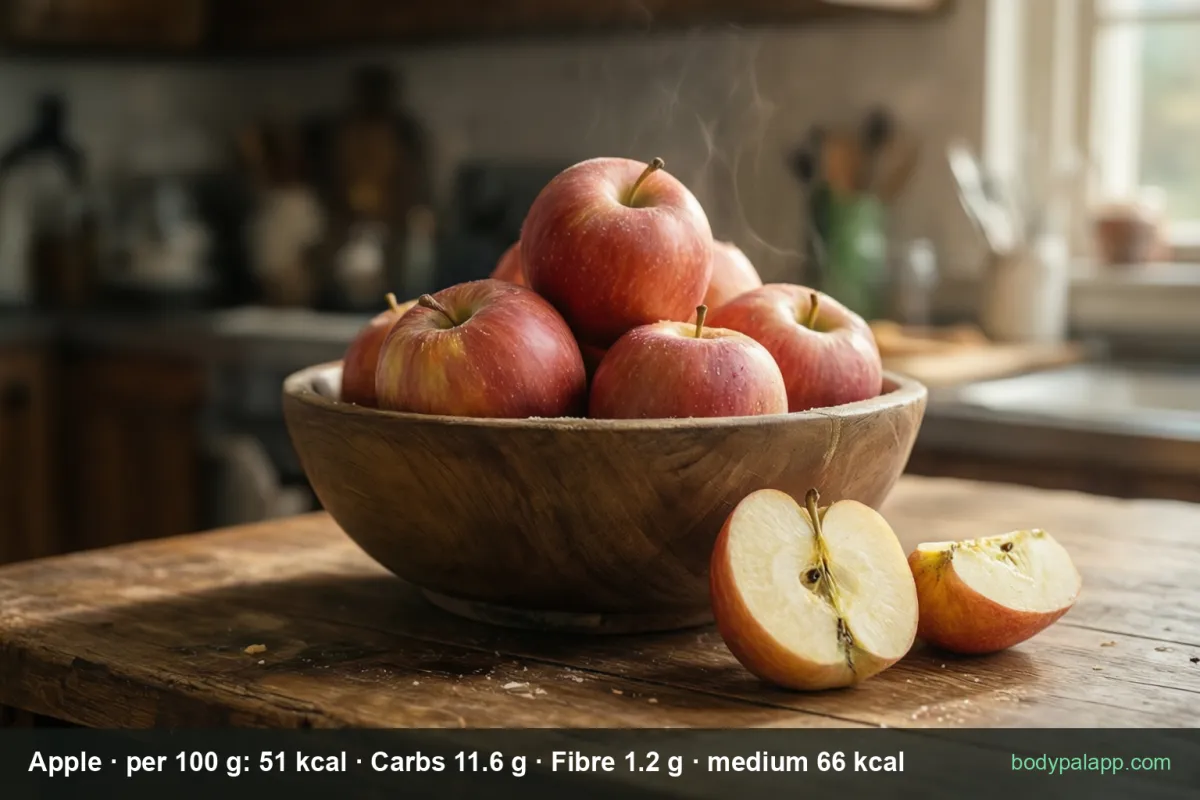
The calories in an apple come down to size: a medium one of about 130 g has 66 calories, which works out at 51 kcal per 100 g of flesh and skin. Small fruit lands at 51 kcal, large at 87. Almost all of that energy is carbohydrate, and the whole apple carries under a gram of fat.
On this page
- Apple nutrition at a glance
- Apple calories by size
- Weighed with the core vs flesh and skin
- Apple with peanut butter
- Apple with cheese
- How does an apple compare?
- Sugar in apples, and what that number means
- Most popular apple brands
- Frequently asked questions
- Similar foods
Apple nutrition at a glance
| Nutrient | Per 100 g | Per medium apple (130 g) | %RI (medium apple) |
|---|---|---|---|
| Energy | 51 kcal / 213 kJ | 66 kcal / 276 kJ | 3% |
| Protein | 0.6 g | 0.8 g | 2% |
| Carbohydrate | 11.6 g | 15.1 g | 6% |
| of which sugars | 11.6 g | 15.1 g | 17% |
| Fat | 0.5 g | 0.7 g | 1% |
| Fibre | 1.2 g | 1.6 g | no RI set |
| Salt | 0.003 g | 0.004 g | <1% |
Verified nutrition data
Numbers on this page come from CoFID, the UK government’s Composition of Foods Integrated Dataset, and from manufacturer labels where a branded product is named. Last verified August 2026. How we verify our data →
RI = Reference Intake for an average adult eating 2,000 kcal a day. Figures are for the raw fruit, flesh and skin, no core.
Two things stand out in that table. The salt is a rounding error, so an apple is one of the few snacks you can eat daily without touching the 6 g daily limit the NHS sets for adults. And every gram of carbohydrate in an apple is sugar, which sounds alarming until you look at where that sugar sits. More on that below.
The protein column is the honest weak spot. At 0.8 g in a medium fruit, an apple contributes essentially nothing to a daily protein target, and that is why it works better as part of a snack than as the whole snack. The two variant sections further down exist for exactly that reason.
Worth noting what the fibre figure covers: 1.2 g per 100 g is for flesh and skin. Peel the apple and you throw away part of it. The calorie saving from peeling is negligible, so there is no calorie-counting argument for doing it.
Apple calories by size
Supermarket apples vary far more in weight than people expect. A loose Braeburn from the bottom of the bag and a big Bramley-sized eater are not the same snack, and the gap between them is roughly a chocolate digestive.
| Portion | Weight | Calories |
|---|---|---|
| Small apple | 100 g | 51 kcal |
| Medium apple | 130 g | 66 kcal |
| Large apple | 170 g | 87 kcal |
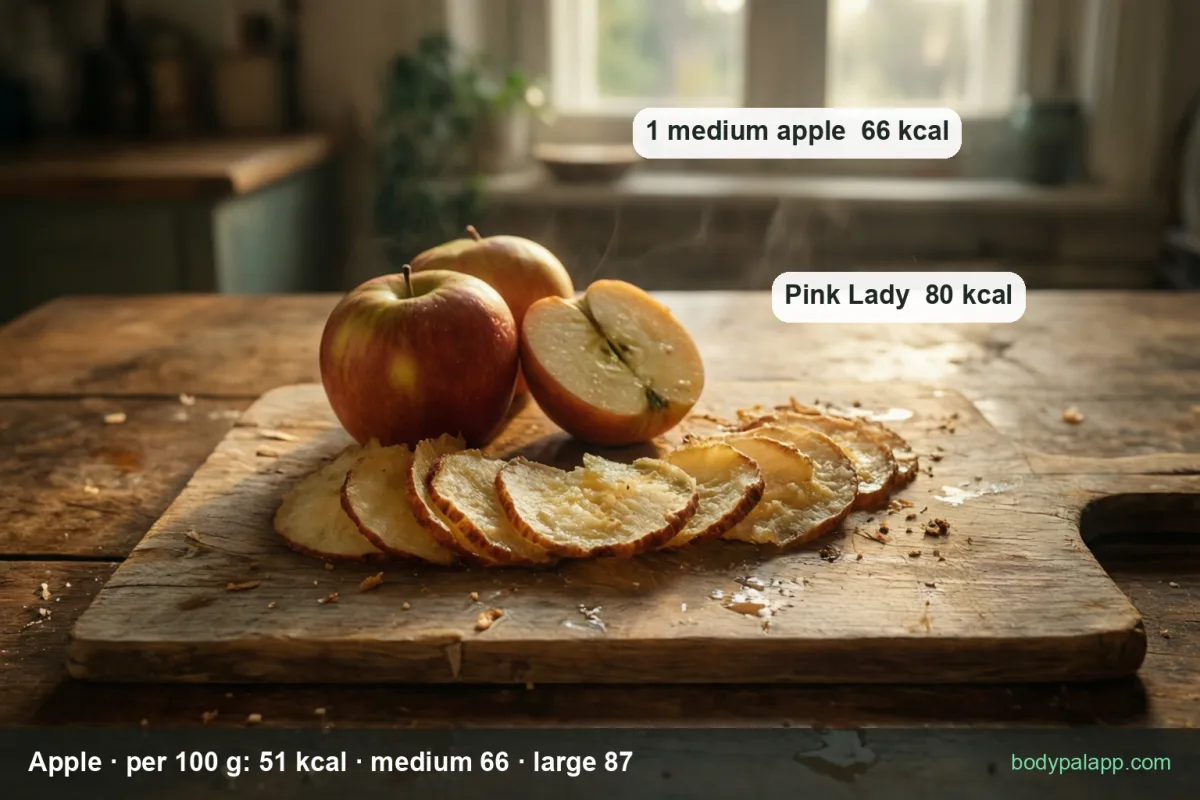
| Pink Lady, one fruit | ~143 g | ~80 kcal |
Pink Lady sits a little higher per gram than the generic figure: 56 kcal per 100 g on the label, against 51 kcal for eating apples in general. That is a difference of five calories in a typical fruit. Not worth losing sleep over, but if you eat two a day it adds up over a week.
If you never weigh fruit, log a medium. It is the closest thing to a safe default, and being 15 calories out on an apple will not move your day. Where it does start to matter is volume. Three apples across a working day is 200 kcal or so, and at that point the difference between small and large is a chunk of your afternoon snack allowance rather than a rounding error.
A useful habit if you buy the same apples every week: weigh two or three of them once, take the average, and reuse it. Loose fruit from the same crate tends to cluster tightly, so one minute with the scales gives you a number you can trust for months.
Weighed with the core vs flesh and skin
Here is the detail almost every calorie site skips. The 51 kcal figure describes 100 g of apple you actually eat. Weigh the whole fruit on a kitchen scale, core included, and the equivalent figure is 43 kcal per 100 g, because the core is roughly 15% of the weight and it ends up in the bin.
So a 130 g apple as it comes off the scale gives you about 56 kcal of edible fruit, not 66. Which number is right depends on what you put on the scale.
Weighing the whole apple before you eat it? Use the with-core figure. Logging a portion of chopped apple, or apple sliced onto porridge? Use the flesh-and-skin figure, because you have already thrown the core away. The two are ten calories apart on one fruit and a few hundred a month if you eat one daily.
Most apps and calorie sites only carry one of these two figures and never tell you which. That is the single most common reason two people log "one medium apple" and get numbers that disagree. Neither is wrong; they are measuring different things.
The same trap shows up with any fruit you do not eat whole. Bananas, oranges and mangoes all have a with-skin figure and a flesh-only figure, and the gap is much wider than it is for an apple. Getting into the habit of asking which weight a number refers to is worth more than a fortnight of careful weighing.
Apple with peanut butter
Apple slices with 25 g of smooth peanut butter come to 218 kcal: 66 from the fruit, 152 from the peanut butter.
Swap in a small apple and the same snack is 203 kcal; a large one takes it to 239. The fruit moves the total far less than the spread does.
The peanut butter is doing nearly 70% of the work here. That is not a criticism, it is the point of the combination, since the fat and protein turn a snack that empties quickly into one that holds. Just be honest with the spoon. A heaped tablespoon is closer to 30 g than 25 g, and peanut butter at 607 kcal per 100 g punishes eyeballing more than almost anything else in the cupboard.
Apple with cheese
Apple with 30 g of cheddar lands at 191 kcal, the cheese adding 125 of those.
It is the classic ploughman's pairing and it works for the same reason as peanut butter: the fruit brings volume and fibre, the cheese brings fat and protein. Thirty grams is a modest matchbox-sized piece. Cut a slab off a block without thinking and you can double it easily, which turns a 190 kcal snack into something the size of a small meal.
Between the two combinations, cheddar is the leaner option by 27 calories and it brings more protein for the money. Peanut butter wins on taste for most people and on how long it keeps you going. Choosing on numbers alone, take the cheese; choosing on how long the snack holds you, take the peanut butter.
Both also make the apple survive a lunchbox. Sliced fruit browns, and the cut surface pressed against something else browns less, which matters more for whether it gets eaten than any macro on this page.
How does an apple compare?
| Food (raw) | kcal per 100 g | P / C / F (g) | Typical UK portion |
|---|---|---|---|
| Apple, eating | 51 | 0.6 / 11.6 / 0.5 | medium 130 g = 66 kcal |
| Satsuma or tangerine | 53 | 0.8 / 13.3 / 0.3 | 1 fruit ~70 g |
| Grapes | 65 | 0.7 / 16.1 / 0.2 | handful ~80 g |
| Banana | 81 | 1.2 / 20.3 / 0.1 | 1 medium ~118 g |
For keeping calories down, apples and satsumas are effectively tied and both beat grapes and bananas per gram. For anything where the fruit is doing a job, though, such as breakfast on the go or something before the gym, a banana is the better pick: it packs 60% more energy into the same weight, so you get there without eating a bowlful.
Grapes deserve a warning that has nothing to do with their calorie count. They come loose, they need no peeling and there is no core to tell you when to stop. A punnet disappears in a way an apple never does, and at 65 kcal per 100 g that adds up faster than the per-gram figure suggests.
This is the part calorie tables cannot show you. An apple has a built-in stopping signal: it takes five to ten minutes to eat, it needs both hands, and it leaves something behind. Foods that finish themselves are the ones worth watching, whatever their number per 100 g.
For the record, all four of these count towards 5 A Day, so the choice between them is about calories and convenience rather than about ticking a box.
Sugar in apples, and what that number means
An apple is 11.6 g sugar per 100 g, so a medium fruit holds about 15 g. That is a real number and it belongs in your log.
It is not, however, the sugar the guidelines are aimed at. The NHS counts free sugars, which means sugar added to food plus the sugar in juice, honey and syrups, and it specifically excludes sugar sitting inside whole fruit. Blend that apple into juice and the same sugar changes category. Eat it whole and it comes packaged with 1.6 g of fibre and a skin that takes time to chew.
That is also why an apple counts towards 5 A Day while an equivalent amount of sugar from a biscuit does not. If you want more fibre in general, the NHS guidance on fibre is the place to start, and eating the skin rather than peeling is the free win.
One myth worth killing: green apples are not a lower-calorie choice. The composition figure for eating apples is a single 51 kcal per 100 g regardless of colour, and the only meaningful variation shows up between named varieties on a label, such as Pink Lady at 56. Choose by taste.
Most popular apple brands in the United Kingdom
Ranked by how widely each product appears among foods sold in the United Kingdom, from the BodyPal food database of over 3.3 million products. Calories are the figures printed on each label. Pink Lady and Jazz are trademarked varieties rather than growers, which is why they behave like brands on the shelf.
| Product | Calories (per 100 g) |
|---|---|
| Pink Lady (Cripps Pink) | 62 kcal |
| Tesco Pink Lady Apples | 53 kcal |
| Jazz Apple | 52 kcal |
Brand popularity: BodyPal food database. Nutrition: manufacturer labels.
How long does it take to burn off an apple?
A medium 130 g apple is 66 kcal. Enter your weight and the amount you ate to see how long it takes you to burn that off:
lb
| Activity | Time to burn 66 kcal |
|---|---|
| Walking, brisk | 13 min |
| Cycling, moderate | 8 min |
| Swimming, moderate | 9 min |
| Jogging | 8 min |
| Weight training, moderate | 15 min |
Times are for a 154 lb (11 st) adult at a steady pace; change the weight to see yours. The amount is set to the portion in the text (130 g); change it to what you actually ate. BodyPal works this out from your steps automatically.
Burning it off is one side of it. The other is knowing your number: work out how many calories you need a day, with macros and a goal date.
Frequently asked questions
How many calories are in an apple?
A medium apple of about 130 g has 66 calories. Per 100 g of flesh and skin, an eating apple is 51 kcal. Size drives the whole answer: a small 100 g fruit is 51 kcal and a large 170 g one is 87 kcal, so the realistic range for a single apple is roughly 50 to 90 calories.
How many calories are in a small apple?
A small apple of around 100 g has 51 calories. That includes 11.6 g of carbohydrate, 1.2 g of fibre and only 0.5 g of fat. It is one of the cheapest snacks you can log in calorie terms, and it comes in under the 100 kcal mark even if your apple is a bit bigger than you guessed.
How many calories are in a Pink Lady apple?
One Pink Lady of about 143 g is roughly 80 calories, based on 56 kcal per 100 g from the label. That is slightly denser than the generic eating-apple figure of 51 kcal per 100 g, so a Pink Lady runs a few calories above a same-sized Gala or Braeburn. The difference is around five calories per fruit.
How many calories are in an apple without the core?
Apple without the core is 51 kcal per 100 g, and that is the figure most people should log. If you weigh the whole fruit with the core still in, the equivalent is 43 kcal per 100 g, because the core is about 15% of the weight and you do not eat it. A 130 g whole apple therefore gives roughly 56 kcal of edible fruit.
Is an apple good for weight loss?
Yes, on the numbers it is one of the easier snacks to fit in: 66 calories for a medium fruit, with 1.6 g of fibre and skin that takes real chewing. Its strength is bulk for very little energy. Its weakness is protein, at under a gram, so an apple alone rarely holds anyone from lunch to dinner.
How much sugar is in an apple?
A medium apple has about 15 g of sugar, from 11.6 g per 100 g. All of it is naturally present in the fruit rather than added, and NHS guidance on free sugars excludes sugar inside whole fruit. Juice it and the same sugar becomes a free sugar, which is the main argument for eating apples whole.
Do green apples have fewer calories than red ones?
No. The UK composition figure for raw eating apples is 51 kcal per 100 g whatever the colour, and colour is not what drives energy density in fruit. Where you do see a difference is between branded varieties with their own labels, such as Pink Lady at 56 kcal per 100 g. Pick the one you enjoy eating.
How many calories are in an apple with peanut butter?
A medium apple with 25 g of smooth peanut butter comes to 218 calories, of which 152 are from the peanut butter at 607 kcal per 100 g. Weigh the spread rather than eyeballing it, because a generous tablespoon can easily push this snack past 250 calories without looking any different on the plate.
How many calories are in a large apple?
A large apple of about 170 g has 87 calories, with roughly 19.7 g of carbohydrate and 2 g of fibre. That is 21 calories more than a medium fruit. If you buy loose apples and they look noticeably bigger than the packaged ones, logging large rather than medium is the more honest default.
Does an apple a day actually do anything?
No single food carries that much weight, but a daily apple is a genuinely useful habit: 66 calories, 1.6 g of fibre, near-zero salt and one of your 5 A Day. Its real value is what it displaces. Swapping a mid-afternoon biscuit for an apple changes both the calorie total and the fibre total in the same move.
Similar foods
- Pomegranate — 77 kcal per 150 g bowl of seeds
- Clementine — 45 kcal per 100 g
- Pineapple — 36 kcal per 80 g portion
- Kiwi — 26 kcal per fruit
- Papaya — 62 kcal per 140 g bowl
- Pear — 66 kcal per medium fruit
Logging an apple takes one photo
BodyPal reads the fruit, the peanut butter and the cheddar from a single picture, so the maths on this page happens without you opening a calculator.

