
How Many Calories in a Pomegranate?
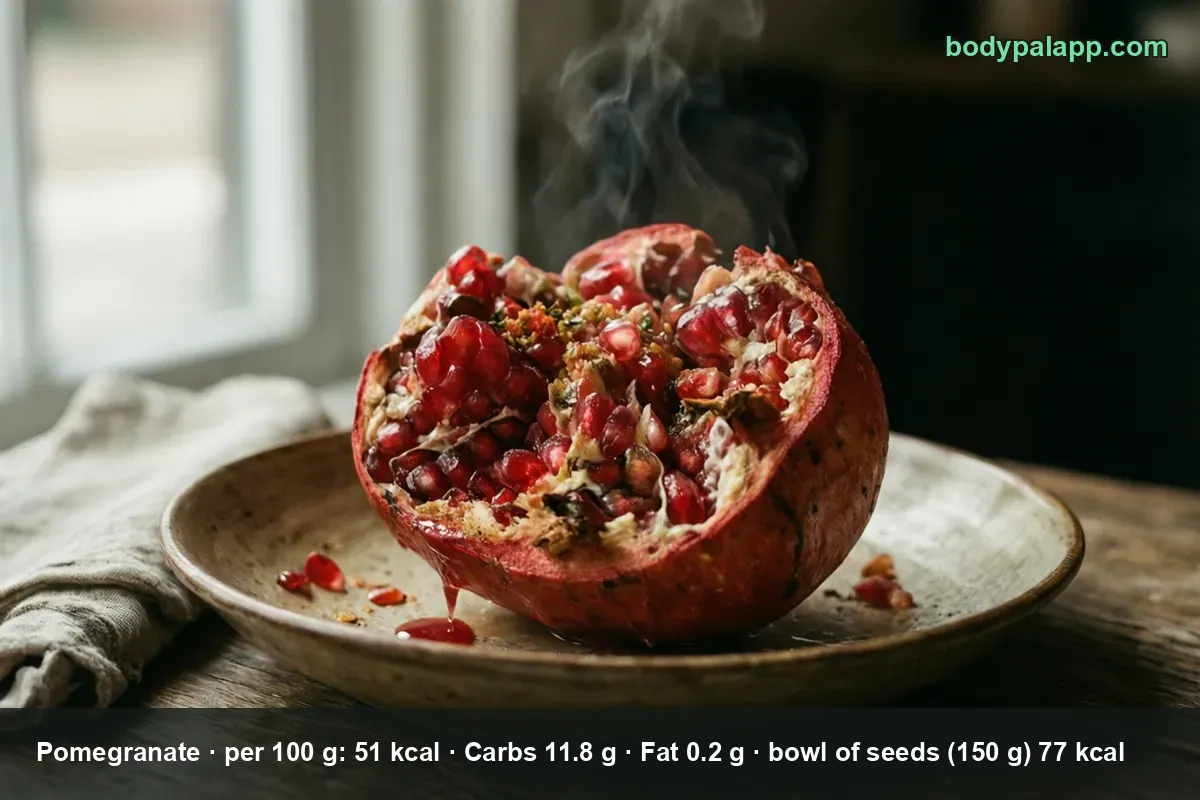
A whole pomegranate is 92 calories, and the seeds alone are 51 per 100 g. A ready-prepared 80 g pot is 41. The fruit looks like it should cost far more than that, because most of what you are holding is skin and pith, and none of it goes in the bowl.
On this page
- What a whole fruit actually costs
- Pomegranate quick facts
- Pots, halves and a bowl of seeds
- The juice is the number to watch
- Pomegranate against the fruit bowl
- All sugar, no starch
- Popular pomegranate products
- FAQ
What a whole fruit actually costs
An average pomegranate weighs about 280 g in the hand. Weighed like that, skin and all, the composition tables give 33 kcal per 100 g, so the whole fruit is 92 kcal.
Cut it open and the reason is obvious. The leathery skin, the white membranes and the pith between the chambers are all weight and no food. What is left, the seeds themselves, runs at 51 kcal per 100 g.
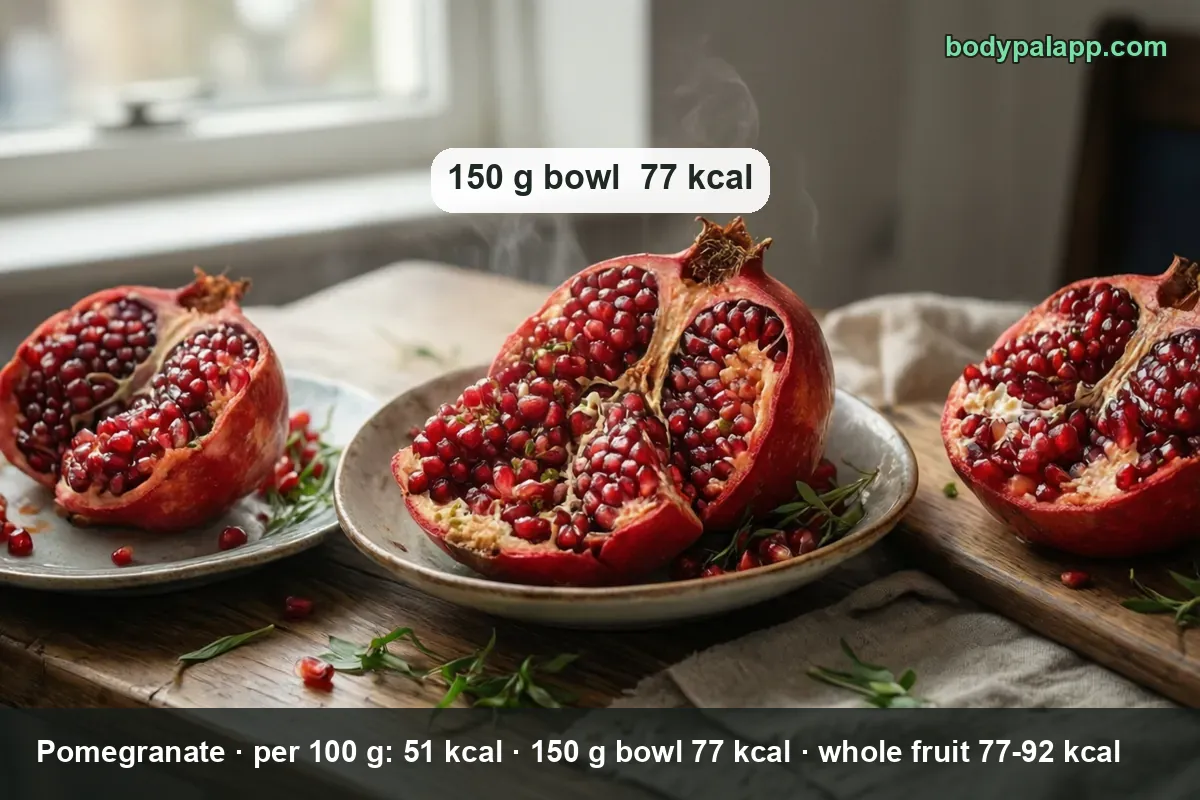
Those two routes give a slightly different answer, and it is worth knowing which one you are using. The 33 kcal per 100 g whole-fruit figure assumes a good yield of seeds. Deseed a 280 g pomegranate over a bowl at home, losing a few in the sink and leaving some clinging to the membrane, and you will typically get somewhere near 150 g out, which is 77 kcal.
So a whole pomegranate is between 77 and 92 calories depending on how thoroughly you pick it. Either number is small. Neither is the one people expect from a fruit this heavy.
Pomegranate quick facts
Seeds and flesh, raw. The middle column is a 150 g bowl, roughly what one whole fruit yields.
| Nutrient | Per 100 g | Bowl of seeds (150 g) | RI%* |
|---|---|---|---|
| Energy | 51 kcal / 213 kJ | 77 kcal / 322 kJ | 4% |
| Protein | 1.3 g | 2.0 g | 4% |
| Carbohydrates | 11.8 g | 17.7 g | 7% |
| – of which sugars | 11.8 g | 17.7 g | 20% |
| Fat | 0.2 g | 0.3 g | <1% |
| Salt | 0.005 g | 0.01 g | <1% |
*RI% = a 150 g bowl's share of an adult's daily reference intake, based on 2,000 kcal.
Verified nutrition data
Numbers on this page come from CoFID, the UK government’s Composition of Foods Integrated Dataset, and from manufacturer labels where a branded product is named. Last verified September 2026. How we verify our data →
Read the energy row against the sugars row. A bowl of seeds is 4% of a day's calories and 20% of a day's sugars. Very few foods stretch that far apart.
Pots, halves and a bowl of seeds
Most pomegranate in the UK is now bought ready-picked in a plastic pot, which makes the portion easy to pin down.
- 80 g pot of prepared seeds: 41 kcal
- Half a pomegranate (140 g of whole fruit): 46 kcal
- A 150 g bowl of seeds, roughly one whole fruit: 77 kcal
- One whole 280 g pomegranate: 92 kcal
The 80 g pot is the one to build habits around. That weight is also the size the NHS 5 A Day guidance uses as one portion of fruit, so a pot scattered over yogurt is one of your five for 41 calories.
Seeds sprinkled over a salad or a bowl of couscous are usually a much smaller amount, around 25 to 30 g, which lands near 13 to 15 kcal. At that scale pomegranate is effectively free, and it is doing a job that no dressing can do for the same money.
The juice is the number to watch
Pomegranate juice drink is 44 kcal per 100 ml with 11.6 g of sugars. A 250 ml glass is 110 kcal and 29 g of sugars.
| Nutrient | Seeds, 150 g bowl | Juice, 250 ml glass |
|---|---|---|
| Energy | 77 kcal | 110 kcal |
| Sugars | 17.7 g | 29.0 g |
| Time it takes to finish | Several minutes | Seconds |
Per 100 g the juice is actually below the seeds, 44 against 51. The problem is not the concentration, it is the serving size and the speed. Nobody drinks 100 ml, and a glass goes down in under a minute without the seeds, the membranes or the chewing that comes with the fruit.
Sugars in whole fruit sit inside the cell walls of the seed. Once the fruit is pressed, they count as free sugars, which is the category the NHS advice on cutting down on sugar puts a 30 g daily limit on. One 250 ml glass is 29 g. The 5 A Day guidance counts juice as a single portion a day at most, no matter how many glasses you have, for the same reason.
None of that makes the juice a bad drink. It makes it a different food from the fruit, and logging it as "pomegranate" understates it by 33 calories a glass and 11 g of sugar.
Pomegranate against the fruit bowl
| Fruit | Per 100 g | Per portion |
|---|---|---|
| Pomegranate seeds | 51 kcal | 41 kcal (80 g pot) |
| Apple | 51 kcal | 66 kcal (one medium) |
| Orange | 36 kcal | 43 kcal (one fruit) |
| Grapes | 65 kcal | 52 kcal (80 g) |
| Blueberries | 40 kcal | 32 kcal (80 g) |
Pomegranate and apple are identical per 100 g, at 51 kcal each, which is not what most people would guess about a fruit sold at pomegranate prices. Only grapes are denser on this list, and only because grapes are sweeter for their weight.
The verdict runs on portion size rather than density. If you are eating fruit to fill a gap between meals, an apple wins: 66 kcal that takes five minutes and leaves you holding a core. If you are adding fruit to something else, a yogurt, a salad, a plate of roast vegetables, pomegranate wins, because 41 calories of seeds spreads across a whole dish and grapes or blueberries do not. Oranges remain the cheapest whole fruit here at 43 kcal.
All sugar, no starch
Look again at the quick facts table. Carbohydrate is 11.8 g and sugars are 11.8 g. Those are the same number, and that is not a typo.
There is no starch in a pomegranate. Everything in the carbohydrate column is sugar, which is unusual even among fruits and explains the taste. It also explains why the sugars RI% climbs so much faster than the energy RI% as the bowl gets bigger.
That matters mainly for the juice. In the whole seed, the sugar arrives packed inside a firm capsule that has to be broken with your teeth, alongside the seed's own fibrous core. Pressed into a glass, the same sugar arrives loose and fast. Same fruit, same sugar, different delivery.
Protein at 1.3 g and fat at 0.2 g are both close to nothing, and salt at 0.005 g per 100 g is a rounding error, so a pomegranate is essentially water, sugar and structure.
Popular pomegranate products in the BodyPal food database
Ranked by how widely each product appears among foods sold in the United Kingdom, from the BodyPal food database of over 3.3 million products. Calories are the figures printed on each label.
| Product | Calories (per 100 g) |
|---|---|
| Pomegranate Seeds (Tesco) | 59 kcal |
| Pomegranate Seeds (M&S) | 63 kcal |
| Pomegranate Seeds (Aldi) | 61 kcal |
| Pomegranate Seeds (Asda) | 61 kcal |
| Pomegranate (Sainsbury's) | 55 kcal |
Brand popularity: BodyPal food database. Nutrition: manufacturer labels.
Pomegranate FAQs
How many calories in a whole pomegranate?
92 kcal for an average 280 g fruit weighed with the skin on, based on UK government composition data at 33 kcal per 100 g whole. If you deseed it at home and get about 150 g of seeds into the bowl, the figure is closer to 77 kcal.
How many calories in pomegranate seeds?
51 kcal per 100 g of seeds and flesh, which makes a standard 80 g pot 41 kcal and a 150 g bowl 77 kcal. A light scattering over a salad, around 25 g, costs about 13 kcal.
How many calories in pomegranate juice?
110 kcal in a 250 ml glass, from 44 kcal per 100 ml. The same glass carries 29 g of sugars, against 17.7 g in a 150 g bowl of the seeds, and it is gone in a fraction of the time.
How much sugar is in a pomegranate?
11.8 g per 100 g of seeds, or 17.7 g in a 150 g bowl, which is 20% of the daily reference intake. All of the fruit's carbohydrate is sugar, as pomegranate contains no starch.
How many calories in half a pomegranate?
46 kcal for half an average 280 g fruit. That is about 75 g of seeds once you have picked it out, which is roughly the same as a supermarket pot.
Is pomegranate high in calories?
No. At 51 kcal per 100 g the seeds match an apple exactly and sit below grapes at 65. The fruit feels expensive because it is heavy and awkward, but more than a third of that weight is skin and membrane.
Does pomegranate count towards 5 A Day?
Yes. An 80 g serving of fruit counts as one of the five under NHS guidance, and an 80 g pot of pomegranate seeds is 41 kcal. Juice counts once a day at most, however many glasses you drink.
Pomegranate or apple?
Identical per 100 g, at 51 kcal each, so it comes down to the portion. A medium apple is 66 kcal and eats as a whole snack; an 80 g pot of pomegranate is 41 kcal and works better spread across a yogurt or a salad.
Similar foods
- Apple — 66 kcal a medium apple
- Clementine — 45 kcal per 100 g
- Pineapple — 36 kcal per 80 g portion
- Kiwi — 26 kcal per fruit
- Papaya — 62 kcal per 140 g bowl
- Pear — 66 kcal per medium fruit
Count it without the maths
Point the camera at the bowl and BodyPal handles the difference between the seeds and the skin.


How long does it take to burn off a pomegranate?
A whole 280 g pomegranate is 92 kcal. Enter your weight and the amount you ate to see how long it takes you to burn that off:
lb
| Activity | Time to burn 92 kcal |
|---|---|
| Walking, brisk | 18 min |
| Cycling, moderate | 12 min |
| Swimming, moderate | 13 min |
| Jogging | 11 min |
| Weight training, moderate | 20 min |
Times are for a 154 lb (11 st) adult at a steady pace; change the weight to see yours. The amount is set to the portion in the text (280 g); change it to what you actually ate. BodyPal works this out from your steps automatically.
This table assumes you know your daily total. If you do not, the daily calorie calculator works it out from five numbers.