
Calories in a Pear: 66 per Medium Fruit
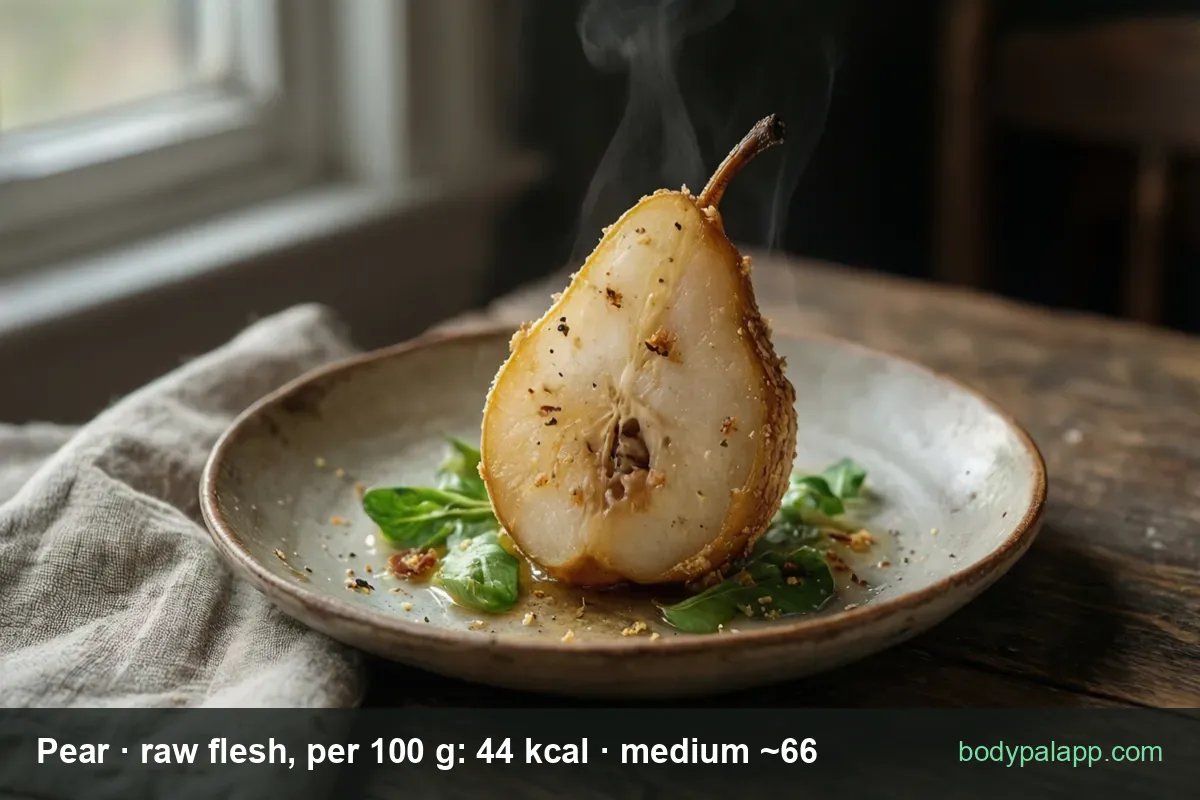
A medium pear has 66 calories (around 150 g of flesh), with pear flesh at 44 kcal per 100 g. What those numbers don't advertise is the fibre: 2.7 g per 100 g, roughly double what grapes or bananas manage. As calories in a pear go, you're buying more fullness per kcal than most of the fruit bowl.
On this page
- Quick facts
- Portion sizes
- Pear or pearl? Common mix-ups
- How does it compare?
- Most popular pear brands
- FAQ
Quick facts
Figures are for raw pear flesh — the fruit minus core and stalk. RI percentages refer to the medium fruit, not to 100 g.
| Nutrient | Per 100 g | Per medium pear (150 g flesh) | % RI (medium pear) |
|---|---|---|---|
| Energy | 44 kcal / 184 kJ | 66 kcal / 276 kJ | 3% |
| Protein | 0.3 g | 0.5 g | 1% |
| Carbohydrates | 11.3 g | 17.0 g | 7% |
| Fat | 0.1 g | 0.2 g | <1% |
| Fibre | 2.7 g | 4.1 g | — |
| Sugars | 11.3 g | 17.0 g | 19% |
| Salt | 0.003 g | 0.005 g | <1% |
Verified nutrition data
Numbers on this page come from CoFID, the UK government’s Composition of Foods Integrated Dataset, and from manufacturer labels where a branded product is named. Last verified August 2026. How we verify our data →
RI = reference intake for an average adult: 2,000 kcal, 70 g fat, 260 g carbohydrate, 90 g sugars, 50 g protein, 6 g salt. Fibre has no RI on UK labels.
The number that deserves a second look is sugars: a medium pear carries 17 g, or 19% of the daily reference. All of it is naturally occurring — this is not the free sugar the NHS asks us to cut — but a big juicy pear is genuinely one of the sweeter items in the fruit bowl, and your food diary should treat it honestly.
The counterweight is that 4.1 g of fibre, delivered for just 66 calories. Very few snacks match that trade.
Protein, on the other hand, is barely there: 0.3 g per 100 g, the lowest of any fruit on this page's comparison list. A pear is water, natural sugar and fibre, full stop. If the snack needs to hold you until dinner, pair it with something that brings protein — a bit of cheese, a few nuts, a spoon of yoghurt — and let the pear supply the sweetness.
Portion sizes
| Portion | Weight | Calories |
|---|---|---|
| Medium pear | ~150 g flesh | 66 kcal |
| NHS 5-a-day portion | 80 g | 35 kcal |
A medium pear, cored, gives you about 150 g of flesh and 66 kcal — a real snack for less than the energy in a plain biscuit. Conference and Comice pears sold loose in UK supermarkets mostly land in this range once the core is out.
The 80 g row is the official 5-a-day portion: about half a pear, for 35 calories. In practice, eat the whole fruit — you comfortably bank the portion and stay under 70 kcal.
One weighing tip: these numbers are flesh only. If you weigh the whole fruit and eat around the core, you'll log slightly high — a forgiving error, but worth knowing if you like your diary tight.
Ripeness, for the record, changes texture far more than it changes calories. A rock-hard pear and a dripping-ripe one from the same shelf log the same.
Sliced into a lunchbox, half a pear runs to about 33 kcal — a rounding error in most days, and a better sweet finish than most of what sells itself as one. The practical habit worth keeping: log the pear when you pack it, not when you remember it at 9 pm.
Pear or pearl? Common mix-ups
A surprising share of pear searches aren't about fruit at all. Two lookalikes cause most of the confusion.
Pearl barley is a grain — barley with its outer layers polished off — that turns up in soups and stews. It shares four letters with the pear and nothing else: different food group, different numbers, different job on the plate. If your recipe says pearl barley, none of the figures on this page apply.
Pearl couscous (also sold as giant couscous) is pasta in disguise: little rolled spheres of wheat. Again, a starchy carb, not a fruit.
The rule of thumb: if it needs boiling for twenty minutes, it isn't a pear. Fruit numbers live here; grain numbers need their own verified pages.
How does it compare?
On calories alone the orange edges it, but the pear is the value pick of this table: 44 kcal per 100 g with 2.7 g of fibre, against 1.2 g for the orange, 1.3 g for grapes and 1.4 g for banana. If the goal is staying full between meals rather than just spending fewer calories, the pear is the one to reach for.
That fits neatly with the Eatwell Guide's push towards more fruit, veg and fibre — a pear ticks two of those boxes in one hand.
Most popular pear brands in the United Kingdom
Ranked by how widely each product appears among foods sold in the United Kingdom, from the BodyPal food database of over 3.3 million products. Calories are the figures printed on each label.
| Product | Calories (per 100 g) |
|---|---|
| Tesco Conference Pear | 47 kcal |
| Oaklands Conference Pears (Lidl) | 43 kcal |
Brand popularity: BodyPal food database. Nutrition: manufacturer labels.
FAQ
How many calories are in a pear?
A medium pear has 66 calories, based on roughly 150 g of flesh. Per 100 g, pears are 44 kcal, and the smaller 80 g serving that counts towards your 5-a-day is 35 calories. That places pears between oranges and bananas among everyday UK fruit.
How many calories are in pear per 100 g?
Pear flesh has 44 kcal per 100 g, alongside 11.3 g of carbohydrate (all of it natural sugars), 2.7 g of fibre and almost no fat or salt. Those per-100 g figures refer to flesh only, so weigh your fruit after coring if you want your log to be precise.
How many calories are in pear fruit?
The edible flesh of a medium pear comes to 66 calories; the whole fruit weighs more, but the core and stalk go in the bin. At 44 kcal per 100 g of flesh, even a large pear stays modest — lighter, gram for gram, than grapes at 65 or bananas at 81.
How many calories are in a pear vs an apple?
Very close: a pear is 44 kcal per 100 g and an eating apple is 51, per CoFID. A medium pear at 66 kcal and a medium apple land within a few calories of each other, so pick by taste and let the pear's fibre be the tiebreaker.
Is pear good for diabetes?
A medium pear delivers 17 g of sugar, so it isn't a "free" food, but that sugar is naturally occurring and arrives with 4.1 g of fibre, which slows the ride. Whole pears are a reasonable fruit choice if you're watching blood sugar; ask your diabetes team about portions that suit you.
Is pear good for dogs?
At 66 calories for a medium fruit, a slice or two of pear is a modest treat that most dogs tolerate well. Remove the core and pips first, and factor the calories into a small dog's day — 44 kcal per 100 g adds up faster for a terrier than it does for you.
How many calories are in pearl barley?
Pearl barley shares nothing with the pear but four letters — it's a grain at 120 kcal per 100 g boiled (CoFID), nearly three times the fruit. If you were actually searching for the fruit, the pear numbers above are the ones you want.
Is pearl barley gluten free?
No — and it has nothing to do with pears at 44 kcal per 100 g. Pearl barley is barley with the outer husk polished away, and barley contains gluten, so it isn't suitable for a coeliac or gluten-free diet. The overlap with "pear" is purely in the name.
Similar foods
- Kiwi — 26 kcal per fruit
- Papaya — 62 kcal per 140 g bowl
- Clementine — 45 kcal per 100 g
- Nectarine — 60 kcal per fruit
- Pineapple — 36 kcal per 80 g portion
- Plum — 23 kcal per plum
Count it without the maths
Log a pear with one photo in BodyPal and the calories and macros are done before you've finished it.


How long does it take to burn off a pear?
A medium pear (150 g flesh) is 66 kcal. Enter your weight and the amount you ate to see how long it takes you to burn that off:
lb
| Activity | Time to burn 66 kcal |
|---|---|
| Walking, brisk | 13 min |
| Cycling, moderate | 8 min |
| Swimming, moderate | 9 min |
| Jogging | 8 min |
| Weight training, moderate | 15 min |
Times are for a 154 lb (11 st) adult at a steady pace; change the weight to see yours. The amount is set to the portion in the text (150 g); change it to what you actually ate. BodyPal works this out from your steps automatically.
This table assumes you know your daily total. If you do not, the daily calorie calculator works it out from five numbers.