
Calories in a Kiwi: 26 per Fruit
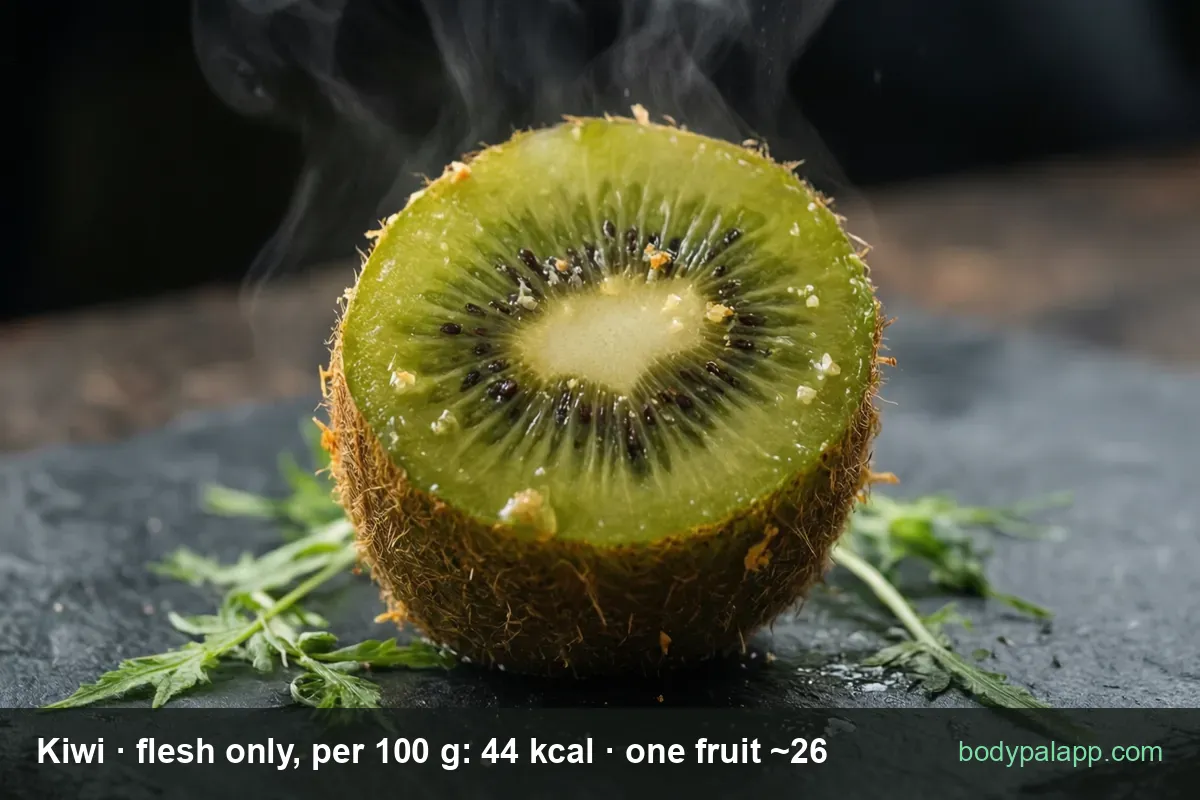
One peeled kiwi has 26 calories, with kiwi flesh at 44 kcal per 100 g — and two kiwis (120 g) tick off one of your 5-a-day for 53 calories. Weigh the fruit whole with its skin on, though, and the right figure drops to 32 kcal per 100 g. The calories in a kiwi are tiny; the weighing details are where people slip.
On this page
- Quick facts
- Portion sizes
- With skin or without: which number to use
- How does it compare?
- Most popular kiwi brands
- FAQ
Quick facts
Figures below are for raw kiwi flesh. RI percentages are for one peeled fruit.
| Nutrient | Per 100 g (flesh) | Per kiwi (~60 g flesh) | % RI (one kiwi) |
|---|---|---|---|
| Energy | 44 kcal / 184 kJ | 26 kcal / 109 kJ | 1% |
| Protein | 0.8 g | 0.5 g | 1% |
| Carbohydrates | 8.6 g | 5.2 g | 2% |
| Fat | 0.9 g | 0.5 g | 1% |
| Fibre | 2.7 g | 1.6 g | — |
| Sugars | 8.3 g | 5.0 g | 6% |
| Salt | 0.003 g | 0.002 g | <1% |
Verified nutrition data
Numbers on this page come from CoFID, the UK government’s Composition of Foods Integrated Dataset, and from manufacturer labels where a branded product is named. Last verified August 2026. How we verify our data →
RI = reference intake for an average adult: 2,000 kcal, 70 g fat, 260 g carbohydrate, 90 g sugars, 50 g protein, 6 g salt. Fibre has no RI on UK labels.
The profile is quietly excellent. For 44 kcal per 100 g you get 2.7 g of fibre — more than double an orange's — modest natural sugars, and even a whisper of fat (0.9 g), which is unusual for fruit and part of why kiwi tastes richer than its calories suggest.
One fruit barely registers against a day's intake: 1% of energy, 6% of sugars. It's hard to spend 26 calories better.
Portion sizes
| Portion | Weight | Calories |
|---|---|---|
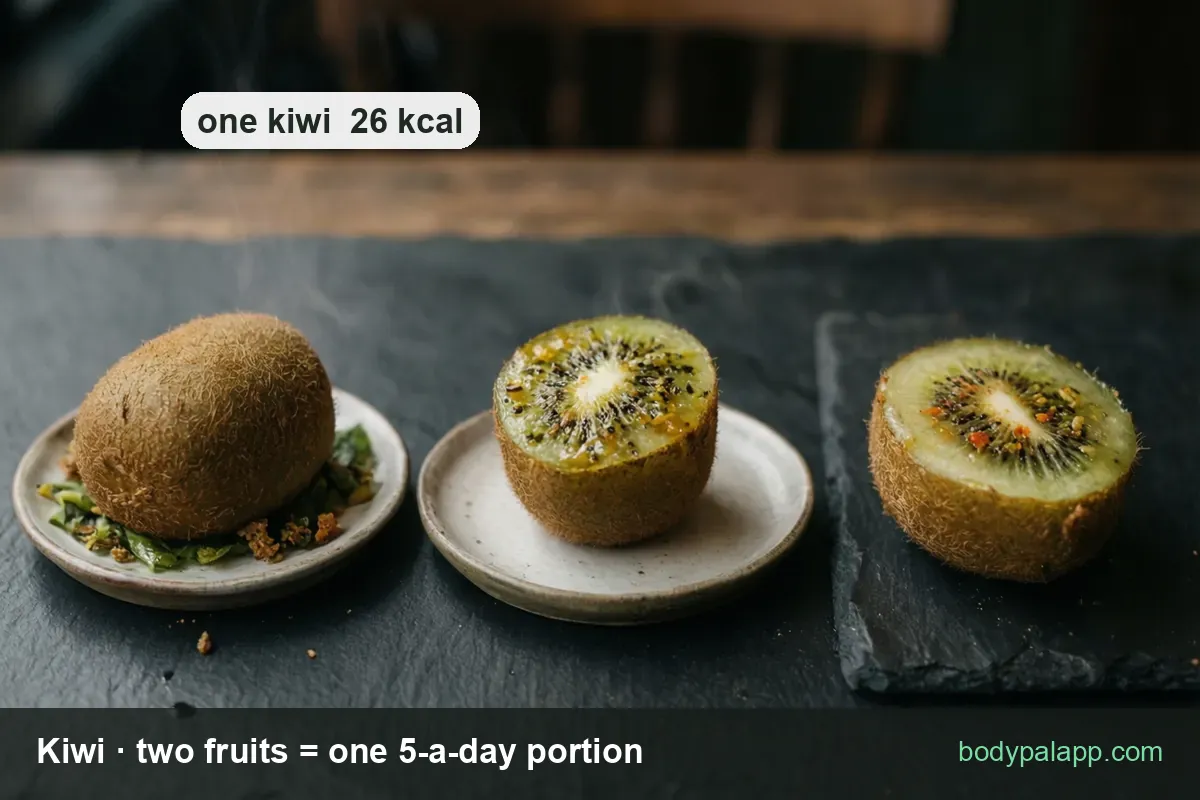
| One kiwi, peeled | ~60 g flesh | 26 kcal |
| Two kiwis — one 5-a-day portion | 120 g | 53 kcal |
A single supermarket kiwi yields about 60 g of flesh once peeled — 26 kcal, roughly a third of a medium banana's energy. The classic move is to halve it and scoop with a teaspoon, which conveniently means you only ever eat the flesh the numbers describe.
It takes two kiwis to make the 80 g-plus that counts as one of your 5-a-day; the pair comes to 53 calories. That's a full portion of fruit for less than the energy in half a slice of bread.
Kiwis are also one of the easiest fruits to log accurately: they're uniform, small, and sold loose or in packs of six, so "one kiwi = 26 kcal" holds up well without scales.
With skin or without: which number to use
This is the detail that splits kiwi logs in two, so it gets its own table.
| Per 100 g | Flesh only (peeled) | Weighed with skin |
|---|---|---|
| Energy | 44 kcal / 184 kJ | 32 kcal / 134 kJ |
| Protein | 0.8 g | 0.6 g |
| Carbohydrates | 8.6 g | 6.2 g |
| Fat | 0.9 g | 0.7 g |
| Fibre | 2.7 g | 2.0 g |
| Sugars | 8.3 g | 6.0 g |
| Salt | 0.003 g | 0.003 g |
"Weighed with skin" does not mean eating the skin. It's an accounting entry: the whole fruit sits on the scales, but only the flesh gets eaten, so each weighed gram carries fewer calories because some of that weight is peel you'll discard. CoFID, the UK's official food-composition dataset, keeps both entries for exactly this reason.
The rule is simple. Weigh the fruit whole and unpeeled: log 32 kcal per 100 g. Weigh or estimate just the flesh: log 44. Mixing them up inflates or shrinks your kiwi by about a third — harmless once, sloppy every day.
And if you actually eat the skin? It's edible on a well-washed fruit, adds fibre and saves the peeling, though neither table row describes that case exactly. For a 26-kcal fruit, the difference isn't worth losing sleep over; pick the nearest row and stay consistent.
How does it compare?
| Fruit | kcal per 100 g |
|---|---|
| Strawberry | 30 |
| Orange | 36 |
| Kiwi | 44 |
| Banana | 81 |
Kiwi sits mid-table on calories but near the top on substance: 2.7 g of fibre per 100 g beats the orange's 1.2 and the banana's 1.4, with only the strawberry (3.8 g) ahead. Our verdict: strawberries win the summer, but the kiwi is the better year-round default — denser in fibre than the citrus it replaces, and less than half a banana per gram.
Either way you're inside the fruit-and-veg segment the Eatwell Guide wants more of, at pocket-change calorie prices.
Most popular kiwi brands in the United Kingdom
Ranked by how widely each product appears among foods sold in the United Kingdom, from the BodyPal food database of over 3.3 million products. Calories are the figures printed on each label.
| Product | Calories (per 100 g) |
|---|---|
| Zespri SunGold Kiwi | 58 kcal |
| Zespri Green Kiwi | 56 kcal |
Brand popularity: BodyPal food database. Nutrition: manufacturer labels.
FAQ
How many calories are in a kiwi?
One peeled kiwi has about 26 calories, based on roughly 60 g of flesh. Two kiwis — the 120 g that counts as one of your 5-a-day — come to 53 calories. Kiwi flesh itself is 44 kcal per 100 g, a touch above an orange's 36.
How many calories are in kiwi per 100 g?
Kiwi flesh is 44 kcal per 100 g, with 8.6 g of carbohydrate, 8.3 g of natural sugars, 2.7 g of fibre and 0.9 g of fat. If you weigh the fruit whole with its skin on, use 32 kcal per 100 g instead, which accounts for the discarded peel.
How many calories are in a kiwi with skin?
Weighed with the skin on, kiwi works out at 32 kcal per 100 g. That figure doesn't mean you're eating the skin — it means the inedible peel is included in the weight, so each gram on the scales carries fewer calories. Weigh whole, log 32; weigh flesh, log 44.
How many calories are in a kiwi without skin?
Peeled kiwi flesh is 44 kcal per 100 g, and a typical fruit yields about 60 g of it, or 26 calories. That's the number to use if you halve the fruit and scoop it with a spoon, since the skin never reaches your mouth or your scales.
Is kiwi skin edible?
Yes — on a well-washed fruit the skin is edible, fuzz and all, and eating it moves you slightly off the 44 kcal per 100 g flesh figure by adding weight and fibre. If the texture puts you off, golden varieties have smoother, thinner skin that's easier to get on with.
Is kiwi skin good for you?
The flesh already provides 2.7 g of fibre per 100 g, and eating the washed skin adds more fibre for essentially no extra calories. Our verified figures cover peeled flesh and fruit weighed with skin, so skin-eaters should log the flesh row and take the bonus fibre as a freebie.
Is kiwi good for you?
For 26 calories per fruit you get 2.7 g of fibre per 100 g, natural sugars and next to no fat or salt — and two kiwis complete one of your 5-a-day for 53 calories. Among everyday fruit, few pack this much usefulness into so few calories.
Is kiwi.com legit?
Different kiwi entirely — this page covers the 26-calorie fruit, and Kiwi.com is a flight-booking website we can't assess either way. It's a common search collision, nothing more. If it's the fruit you're after, the numbers above (44 kcal per 100 g of flesh) are the ones to use.
Similar foods
- Papaya — 62 kcal per 140 g bowl
- Pear — 66 kcal per medium fruit
- Clementine — 45 kcal per 100 g
- Nectarine — 60 kcal per fruit
- Pineapple — 36 kcal per 80 g portion
- Plum — 23 kcal per plum
Count it without the maths
Halve a kiwi, grab a teaspoon, and let BodyPal log it from one photo — calories and macros in seconds.


How long does it take to burn off a kiwi?
One peeled kiwi is 26 kcal. Enter your weight to see how long it takes you to burn that off:
lb
| Activity | Time to burn 26 kcal |
|---|---|
| Walking, brisk | 5 min |
| Cycling, moderate | 3 min |
| Swimming, moderate | 4 min |
| Jogging | 3 min |
| Weight training, moderate | 6 min |
Times are for a 154 lb (11 st) adult at a steady pace; change the weight to see yours. BodyPal works this out from your steps automatically.
This table assumes you know your daily total. If you do not, the daily calorie calculator works it out from five numbers.