
How Many Calories in Papaya?
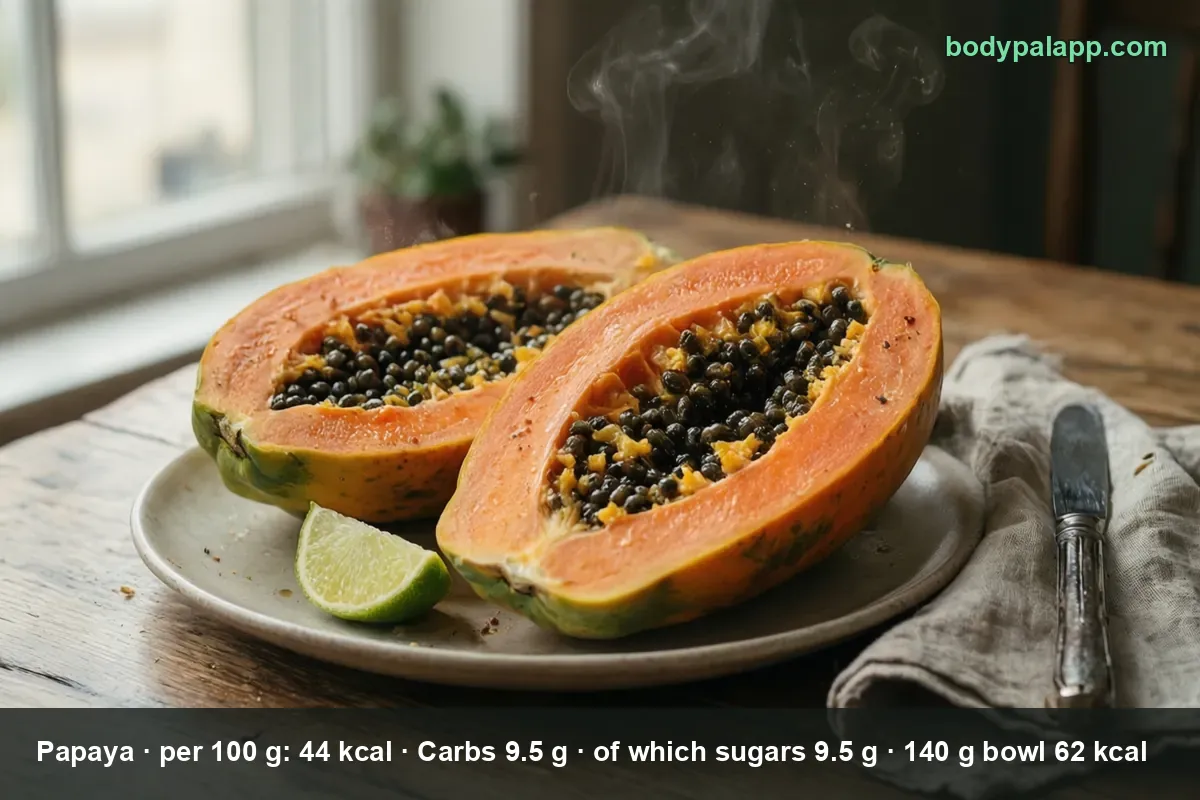
Papaya flesh is 44 calories per 100 g, so a 140 g bowl of cubes comes to 62 kcal. The same bowl carries 95 mg of vitamin C, which is 119% of a day's reference intake. Half a whole fruit is a different question, and the answer runs anywhere from 41 to 108 kcal.
On this page
- Papaya quick facts
- Vitamin C is the headline, not the calories
- Half a papaya depends on the papaya
- Green papaya and dried papaya
- Papaya against the rest of the fruit bowl
- Popular papaya products
- FAQ
Papaya quick facts
Everything below is ripe orange flesh, skin and pips removed. The portion column is a 140 g bowl of cubes, which is roughly what a breakfast bowl holds.
| Nutrient | Per 100 g | 140 g bowl of cubes | RI%* |
|---|---|---|---|
| Energy | 44 kcal / 184 kJ | 62 kcal / 259 kJ | 3% |
| Protein | 0.7 g | 1.0 g | 2% |
| Carbohydrates | 9.5 g | 13.3 g | 5% |
| – of which sugars | 9.5 g | 13.3 g | 15% |
| Fat | 0.6 g | 0.8 g | 1% |
| – of which saturates | 0.19 g | 0.27 g | 1% |
| Fibre | 1.8 g | 2.5 g | 8% |
| Salt | 0.04 g | 0.05 g | 1% |
| Vitamin C | 68 mg | 95 mg | 119%† |
*RI% = the bowl's share of an adult's daily reference intake, based on 2,000 kcal. †Vitamin C is measured against the 80 mg nutrient reference value.
Verified nutrition data
Numbers on this page come from CoFID, the UK government’s Composition of Foods Integrated Dataset, and from manufacturer labels where a branded product is named. Last verified September 2026. How we verify our data →
Read the carbohydrate rows together and something unusual appears. Carbohydrate is 9.5 g and sugar is 9.5 g. There is no starch in a ripe papaya at all — every gram of carbohydrate is fruit sugar.
That sounds worse than it is. A full bowl holds 13.3 g of sugars, 15% of the daily reference, which is less than a heaped teaspoon of honey on toast. It is also the reason the fruit tastes as sweet as it does at 44 calories.
UK supermarket labels back the figure up neatly. Tesco, Asda and Sainsbury's all print 42.2 kcal per 100 g for fresh papaya; the government table says 44. A 4% gap between a lab and a shelf is about as tight as fruit data gets, so 44 is safe to log without hedging.
Vitamin C is the headline, not the calories
Papaya is a mid-table fruit for calories and a top-table one for vitamin C, and almost nobody says so.
| Fruit | Vitamin C per 100 g |
|---|---|
| Papaya | 68 mg |
| Strawberries | 57 mg |
| Orange | 52 mg |
| Mango | 26 mg |
Papaya beats the orange by 31% and the strawberry by 19%, using the same UK dataset for all four. A 140 g bowl delivers 95 mg — 119% of the 80 mg reference value, so one breakfast covers the day with room to spare. Adults need 40 mg of vitamin C a day according to NHS guidance, which the bowl clears more than twice over.
Potassium is respectable too at 215 mg per 100 g, or 15% of the reference in a bowl. Iron and folate are negligible, so this is not a fruit to eat for those.
An 80 g serving counts as one of your 5 A Day, and 80 g of papaya is 35 kcal. That is one of the cheapest portions on the whole list.
Half a papaya depends on the papaya
Ask what a whole papaya weighs and the honest answer is that nobody publishes it. UK retailers sell them by the fruit, not the gram — the label says "1 papaya" and stops there. So a single number for half a papaya would be invented, and inventing it is how calorie charts end up wrong by a factor of two.
What is documented is the waste. Weighed as bought, with skin and pips, papaya is 27 kcal per 100 g against 44 for the flesh alone. The edible part is 61%. Buy 500 g and you eat about 305 g of it.
That ratio does the work. Halve the fruit, scoop it, and the calories follow the weight of what you brought home:
| Whole fruit as bought | Half of it | Calories | Flesh in that half |
|---|---|---|---|
| 300 g | 150 g | 41 kcal | 92 g |
| 400 g | 200 g | 54 kcal | 123 g |
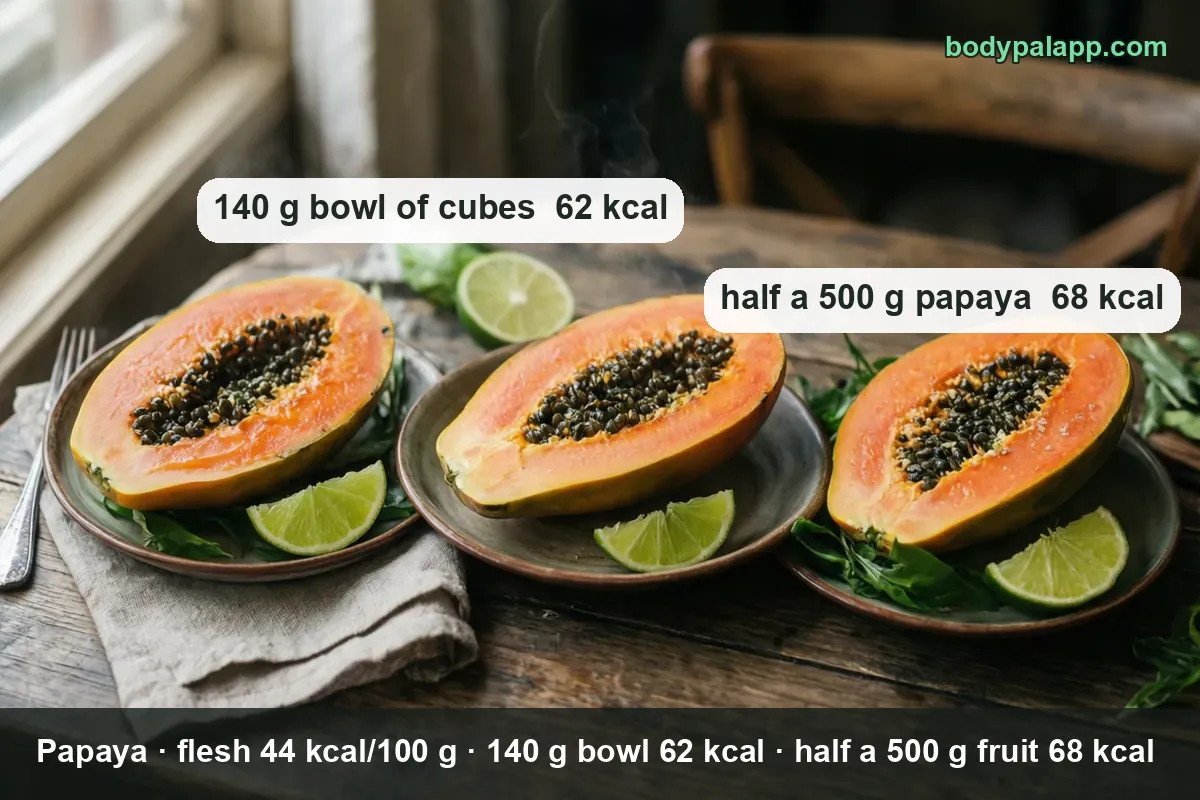
| 500 g | 250 g | 68 kcal | 153 g |
| 600 g | 300 g | 81 kcal | 184 g |
| 800 g | 400 g | 108 kcal | 246 g |
Half a papaya is somewhere between 40 and 110 calories depending on the fruit. The calories live in the flesh, and the flesh is only 61% of what the scales at the till weighed.
Other portions worth having to hand: 100 g of cubes is 44 kcal, the 5 A Day serving of 80 g is 35 kcal, and a generous 200 g bowl is 88 kcal.
Green papaya and dried papaya
Two versions of this fruit break the 44 kcal rule, one downwards and one very sharply upwards.
Green papaya — the unripe fruit shredded into Thai som tam — is 27 kcal per 100 g, 39% below the ripe version. The sugars simply have not developed yet, so 5.5 g of carbohydrate replaces 9.5 g. A large salad portion of it is still under 50 calories before the dressing arrives.
Dried papaya is the opposite, and it is the single biggest trap on this page.
| Product | Per 100 g |
|---|---|
| Fresh papaya, flesh | 44 kcal |
| Holland & Barrett Chunky Papaya Pieces | 343 kcal |
| Holland & Barrett Diced Papaya | 343 kcal |
| Grape Tree Crystallised Pineapple & Papaya | 360 kcal |
That is roughly eight times the fresh fruit, with 64 to 82 g of sugars per 100 g. Most of the jump is water leaving, but the crystallised versions have sugar added on top. A small 40 g handful from a health-food shop is 137 kcal, more than two fresh bowls of the fruit itself.
Papaya against the rest of the fruit bowl
| Fruit | Per 100 g | Typical portion | Calories |
|---|---|---|---|
| Papaya | 44 kcal | 140 g bowl | 62 kcal |
| Kiwi | 44 kcal | one fruit | 26 kcal |
| Mango | 60 kcal | 80 g portion | 48 kcal |
| Pineapple | 45 kcal | 80 g portion | 36 kcal |
| Melon | 24 kcal | 80 g slice | 19 kcal |
| Orange | 36 kcal | one medium | 43 kcal |
Papaya and kiwi are identical per 100 g, right down to the calorie. Kiwi takes the fibre round with 2.7 g against 1.8 g. Papaya takes vitamin C.
Our take: if the goal is bulk for the fewest calories, melon wins and nothing else is close at 24 kcal per 100 g. If the goal is the most nutrition per calorie, papaya wins this table — 68 mg of vitamin C at 44 calories is a ratio the mango cannot touch, and the mango costs 16 more calories per 100 g into the bargain. Worth knowing that sources disagree on mango: the UK government table puts the two fruits within a few calories of one another, while UK labels run mango higher, and our mango page follows the labels.
Mango does win one round. It carries 696 µg of carotene against papaya's 466, so the orange colour is not the same orange.
Popular papaya products in the BodyPal food database
Ranked by how widely each product appears among foods sold in the United Kingdom, from the BodyPal food database of over 3.3 million products. Calories are the figures printed on each label. All of these are dried — roughly eight times the figure of the fresh fruit on this page.
| Product | Calories (per 100 g) |
|---|---|
| SDOUKOS Dried Papaya | 354 kcal |
| Valued Naturals Dried Papaya Chunks | 350 kcal |
| Fudco Diced Papaya | 356 kcal |
Brand popularity: BodyPal food database. Nutrition: manufacturer labels.
Papaya FAQs
How many calories in papaya?
44 kcal per 100 g of flesh, which makes a 140 g bowl of cubes 62 kcal and an 80 g portion 35 kcal. UK supermarket labels print 42.2 kcal per 100 g for fresh papaya, so the two sources agree to within 4%.
How many calories in half a papaya?
Between 41 and 108 kcal, depending on the size of the fruit. Half of a 400 g papaya is 54 kcal; half of an 800 g one is 108 kcal. Weighed as bought, with skin and pips, papaya is 27 kcal per 100 g.
How much of a papaya is edible?
About 61%. Skin and pips account for the other 39%, which is why the fruit weighs 44 kcal per 100 g as flesh but only 27 kcal per 100 g as bought. Buy 500 g and roughly 305 g of it reaches the plate.
How much sugar is in papaya?
9.5 g per 100 g, and that is the entire carbohydrate content — ripe papaya contains no starch at all. A 140 g bowl holds 13.3 g of sugars, 15% of the daily reference intake, roughly a heaped teaspoon of honey's worth.
How much vitamin C is in papaya?
68 mg per 100 g, more than an orange at 52 mg or strawberries at 57 mg. A 140 g bowl gives 95 mg, which is 119% of the 80 mg nutrient reference value and more than twice the 40 mg a day NHS guidance sets for adults.
Papaya or mango — which has fewer calories?
Papaya, at 44 kcal per 100 g against 60 for mango on our page. The bigger gap is in the micronutrients: papaya carries 2.6 times the vitamin C, mango 1.5 times the carotene. Neither is a high-calorie fruit.
How many calories in dried papaya?
343 kcal per 100 g for plain dried pieces, and 360 kcal for crystallised mixes — about eight times the fresh fruit. Sugars run 64 to 82 g per 100 g. A 40 g handful comes to roughly 137 kcal, more than two fresh 140 g bowls.
How many calories in green papaya?
27 kcal per 100 g for unripe green papaya, the kind shredded into Thai som tam salad. That is 39% below ripe papaya, because the carbohydrate has not yet converted to sugar — 5.5 g against 9.5 g per 100 g.
Similar foods
- Kiwi — 26 kcal per fruit
- Pear — 66 kcal per medium fruit
- Clementine — 45 kcal per 100 g
- Nectarine — 60 kcal per fruit
- Pineapple — 36 kcal per 80 g portion
- Plum — 23 kcal per plum
Log the bowl, not the fruit
Point the camera at the cubes and BodyPal reads the weight and the calories in one go.


How long does it take to burn off papaya?
100 g of flesh is 44 kcal. Enter your weight and the amount you ate to see how long it takes you to burn that off:
lb
| Activity | Time to burn 44 kcal |
|---|---|
| Walking, brisk | 9 min |
| Cycling, moderate | 6 min |
| Swimming, moderate | 6 min |
| Jogging | 5 min |
| Weight training, moderate | 10 min |
Times are for a 154 lb (11 st) adult at a steady pace; change the weight to see yours. The amount is set to the portion in the text (100 g); change it to what you actually ate. BodyPal works this out from your steps automatically.
Burning it off is one side of it. The other is knowing your number: work out how many calories you need a day, with macros and a goal date.