
How Many Calories in a Clementine?
Clementines are 45 calories per 100 g of peeled fruit, with 9.6 g of sugar and 1.2 g of fibre. Ask how many calories in a clementine and the honest answer needs one more piece of information, which is what your clementine weighs. On fruit this small, that is not a technicality.
On this page
- Clementine quick facts
- Why nobody can tell you the calories in one fruit
- The peel you are holding
- Clementine versus orange
- Satsumas, easy peelers and tinned mandarins
- The sugar question
- Most popular clementine brands in the United Kingdom
- Clementine FAQs
Clementine quick facts
Figures are for peeled fruit, taken from British supermarket labels for clementines and easy peelers.
| Per 100 g peeled | Amount | RI%* |
|---|---|---|
| Energy | 45 kcal / 188 kJ | 2% |
| Protein | 0.7 g | 1% |
| Carbohydrates | 9.6 g | 4% |
| – of which sugars | 9.6 g | 11% |
| Fat | 0.2 g | under 1% |
| Fibre | 1.2 g | – |
| Salt | 0.01 g | under 1% |
*RI% = share of an adult's daily reference intake, based on 2,000 kcal.
Verified nutrition data
Numbers on this page come from CoFID, the UK government’s Composition of Foods Integrated Dataset, and from manufacturer labels where a branded product is named. Last verified September 2026. How we verify our data →
The carbohydrate and sugar rows are the same number, 9.6 g, which is the signature of a fruit with no starch in it. Everything a clementine gives you in carbohydrate arrives as sugar, wrapped in 1.2 g of fibre and a lot of water.
American reference data lists clementines slightly higher, at 47 kcal per 100 g with 0.8 g of protein and 12 g of carbohydrate. The gap is normal for fresh produce and mostly reflects different fruit measured in different places. British labels are the better guide for fruit bought here, so 45 is the working number on this page.
Why nobody can tell you the calories in one fruit
Every page that confidently states a single calorie figure for one clementine has invented a weight to get there. Fresh fruit is not a manufactured product, and easy peelers are graded and sold by the net rather than the piece.
The arithmetic makes the problem obvious. Take two clementines from the same bag, one 55 g of peeled flesh and one 75 g. That is 25 calories against 34, a difference of over a third, from two fruits that look the same in a bowl. Multiply the discrepancy by the three or four a day some people get through in December and the error stops being trivial.
The fix takes one afternoon and then never again. Weigh the peeled fruit once, note the number, and use it as your default for that bag. Multiply grams by 0.45 and you have the calories exactly.
British packs are labelled by the net weight of the bag, not by the fruit, which is why no single-clementine figure appears on any of them.
The peel you are holding
Citrus has an unusually high inedible fraction, and the composition data proves it. British government figures give oranges 36 kcal per 100 g of flesh and 27 kcal per 100 g when the fruit is weighed whole with peel and pips still on.
Divide one by the other and a quarter of a purchased orange goes in the bin. For a clementine the discarded share is larger, because peel thickness does not scale down as fast as fruit size does. A small fruit carries proportionally more skin.
That matters for anyone who weighs fruit before peeling it, which is a natural thing to do when the bag is in your hand and the scale is on the counter. Doing it that way inflates your logged calories by roughly a quarter on an orange and by more on an easy peeler.
Weigh after peeling. It is the single habit that makes citrus numbers reliable, and it takes no extra effort once the peel is off anyway.
Clementine versus orange
| Per 100 g | Calories | Protein | Carbs | Sugar | Fibre |
|---|---|---|---|---|---|
| Clementine, peeled (UK labels) | 45 kcal | 0.7 g | 9.6 g | 9.6 g | 1.2 g |
| Clementine (US reference data) | 47 kcal | 0.8 g | 12.0 g | – | – |
| Orange, flesh only | 36 kcal | 0.8 g | 8.2 g | 8.2 g | 1.2 g |
| Orange, weighed with peel and pips | 27 kcal | – | – | – | – |
| Mandarins, tinned in juice | 32 kcal | – | – | 7.7 g | – |
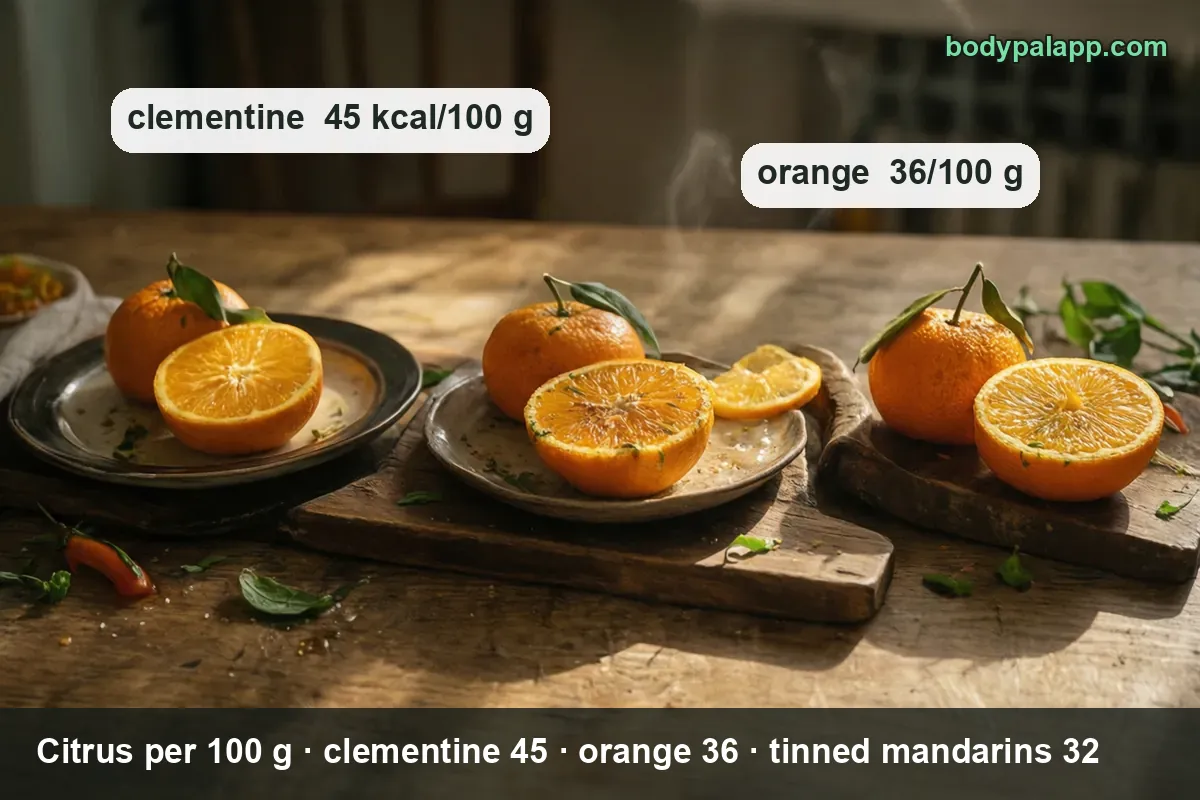
A clementine is 25% denser in calories than an orange, 45 against 36 per 100 g, and every calorie of the difference is sugar: 9.6 g against 8.2 g. That is the whole story. Protein, fat and fibre are essentially identical between the two.
It also explains the taste. Clementines are noticeably sweeter than oranges because they contain noticeably more sugar, and the popular idea that easy peelers are the lighter citrus is backwards. They are the sweeter one.
The gap is small in absolute terms, 9 calories per 100 g, and it is not a reason to change what you buy. Where it becomes visible is in quantity. Nobody eats four oranges in an evening. Four clementines in front of the television is a completely normal thing to do, and that is where the sugar column starts to add up.
Our take: for a sweet thing after lunch, a clementine is among the cheapest options on the calorie ledger and the easiest to eat without cutlery. If you are counting sugar strictly rather than calories, the orange is the better pick by 1.4 g per 100 g, and it takes longer to eat, which is its own kind of help.
Satsumas, easy peelers and tinned mandarins
British supermarkets label most of this fruit as easy peelers and shelve clementines, satsumas and mandarins together, often rotating between them through the season. The figures on this page come from labels covering that whole group, so 45 kcal per 100 g is the sensible working number for any of them.
One British easy-peeler label sold specifically as satsuma reads 41 kcal per 100 g, with 0.7 g of protein, 9.6 g of carbohydrate and 0.2 g of fat. That sits inside the ordinary spread of the group rather than outside it.
Tinned mandarins in juice go the other way and land at 32 kcal per 100 g, with 7.7 g of sugar. That is lighter than fresh clementines, which surprises people who assume tinned fruit is the indulgent version. The juice the segments sit in is more dilute than the fruit itself, so the drained-and-syrup-free total per 100 g comes out lower.
Fresh still wins on texture and on fibre. Tinned wins on convenience and, in juice rather than syrup, is a perfectly reasonable thing to log at 32 per 100 g.
If you want a change of pace at similar cost, a kiwi or a handful of grapes sit in the same territory, while a mango is a considerably richer proposition.
The sugar question
At 9.6 g per 100 g, sugar is the only row on a clementine label that reaches double figures as a percentage of the day: 11% of the 90 g reference intake.
Context matters here more than the number does. The NHS treats the sugars locked inside whole fruit differently from free sugars, the ones added to food and drink or released into juice. Eating the segments keeps the fibre and the cell structure intact; juicing them does not.
So the practical advice is dull and correct. Eat the fruit, do not drink it. Citrus counts towards your five a day, and at 45 calories per 100 g you would have to get through well over half a kilo of peeled clementine to reach 250 calories.
The one habit worth watching is the bowl. Easy peelers are engineered to be eaten in sequence, and four of them is a genuine snack rather than a piece of fruit. Even then, four clementines cost less than most single-item snacks in the same cupboard, which is why this is a good problem to have.
An apple, a pear, a peach or a nectarine all offer the same kind of afternoon fix with a different sugar-to-fibre balance, and each has its own page here.
Most popular easy peeler brands in the United Kingdom
Ranked by how widely each product appears among foods sold in the United Kingdom, from the BodyPal food database of over 3.3 million products. Calories are the figures printed on each label.
| Product | Calories (per 100 g) |
|---|---|
| Sainsbury’s Taste the Difference Easy Peelers | 50 kcal |
| Tesco Finest Sweet Easy Peelers | 47 kcal |
| Tesco Sweet Easy Peeler Clementine | 45 kcal |
| Jaffa Easy Peelers | 45 kcal |
| Sainsbury’s Easy Peeler | 44 kcal |
| Aldi Easy Peeler | 42 kcal |
Brand popularity: BodyPal food database. Nutrition: manufacturer labels.
Clementine FAQs
How many calories in a clementine?
45 calories per 100 g of peeled fruit, with 9.6 g of sugar and 1.2 g of fibre. Per fruit it depends on size: multiply the peeled weight in grams by 0.45 for an exact figure. Weighing before peeling overstates the total by around a quarter.
Clementine or satsuma: which has fewer calories?
British labels cover both under the easy peeler heading, and 45 kcal per 100 g is the working figure for either. There is no meaningful calorie difference to trade on. Choose on how easily the skin comes off and how many pips you are willing to tolerate.
Are clementines good for weight loss?
They are one of the cheapest sweet foods per gram at 45 calories per 100 g, with 1.2 g of fibre and almost no fat. You would need well over half a kilo of peeled fruit to reach 250 calories. The sugar is 9.6 g per 100 g, which the NHS treats differently from the free sugars added to processed food.
How much sugar is in a clementine?
9.6 g per 100 g of peeled fruit, which is 11% of the daily reference intake for sugars. All of the carbohydrate in a clementine is sugar, since there is no starch in citrus. An orange carries 8.2 g per 100 g, making the clementine the sweeter of the two.
How many clementines can I eat in a day?
There is no calorie reason to set a ceiling. At 45 kcal per 100 g, several across a day is a modest total, and citrus counts towards your five a day. The thing to watch is the bowl rather than the fruit: four in an evening is a snack, not a piece of fruit, though still a cheap one.
Clementine or orange: which has more calories?
The clementine, by 25%. It is 45 kcal per 100 g against 36 for orange flesh, and the entire difference is sugar, 9.6 g against 8.2 g. Protein, fat and fibre are effectively the same in both.
How many calories in easy peelers?
45 per 100 g. Easy peeler is a shelf label rather than a variety, and UK supermarkets use it for clementines, satsumas and mandarins interchangeably through the season. The figure on this page is drawn from labels across that whole group.
How many carbs are in a clementine?
9.6 g per 100 g, all of it sugar, alongside 1.2 g of fibre. American reference data lists 12 g of carbohydrate per 100 g, which is the usual spread you get between fresh produce measured in different countries. For fruit bought in Britain, use 9.6.
Similar foods
- Pineapple — 36 kcal per 80 g portion
- Kiwi — 26 kcal per fruit
- Papaya — 62 kcal per 140 g bowl
- Pear — 66 kcal per medium fruit
- Nectarine — 60 kcal per fruit
- Plum — 23 kcal per plum
One photo, no scales
Put the bowl in front of the camera and BodyPal works out how much fruit is actually there, peel excluded.


How long does it take to burn off a clementine?
Per 100 g of peeled fruit is 45 kcal. Enter your weight and the amount you ate to see how long it takes you to burn that off:
lb
| Activity | Time to burn 45 kcal |
|---|---|
| Walking, brisk | 9 min |
| Cycling, moderate | 6 min |
| Swimming, moderate | 6 min |
| Jogging | 5 min |
| Weight training, moderate | 10 min |
Times are for a 154 lb (11 st) adult at a steady pace; change the weight to see yours. The amount is set to the portion in the text (100 g); change it to what you actually ate. BodyPal works this out from your steps automatically.
Burning it off is one side of it. The other is knowing your number: work out how many calories you need a day, with macros and a goal date.