
Calories in Grapes: 65 kcal per 100 g, 52 per Handful
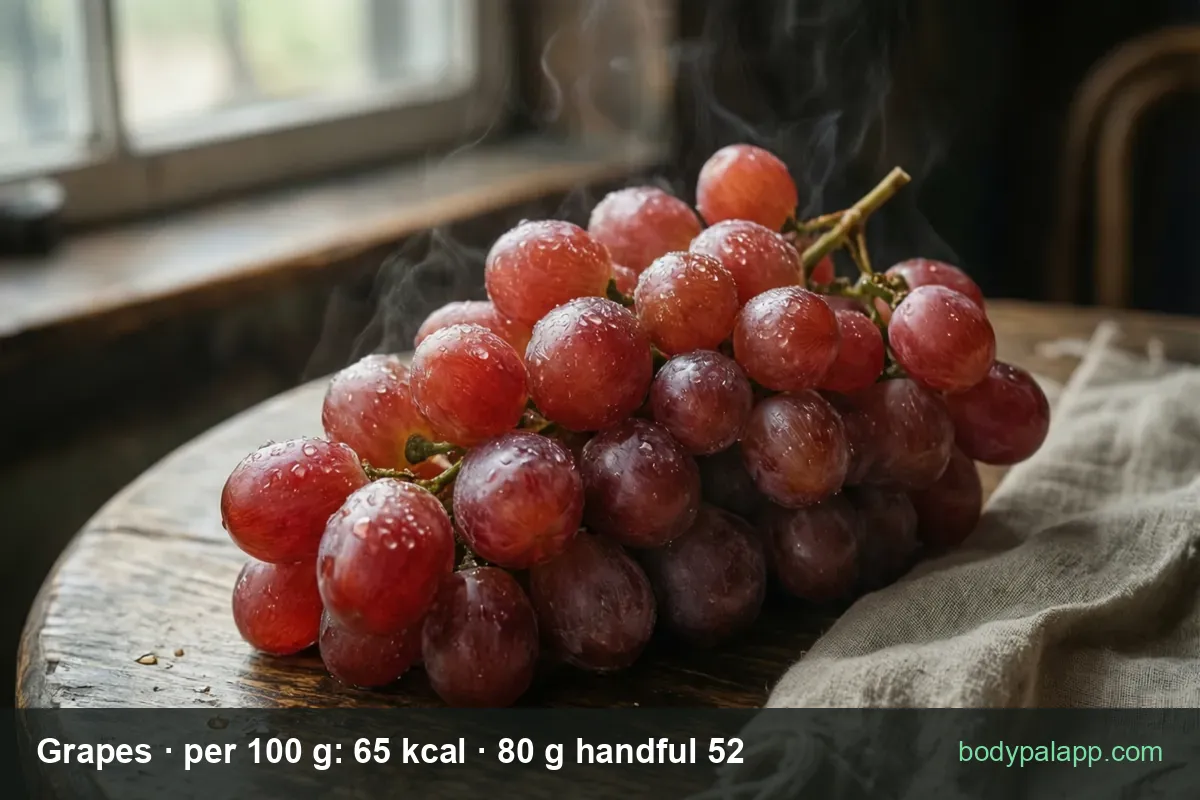
How many calories in grapes? 65 kcal per 100 g, so an 80 g handful is 52 kcal, a single grape about 3 kcal, and a 200 g snack tub 130 kcal. Red or green makes no meaningful difference — the CoFID figure is an average across both. The catch is the sugar: 16.1 g per 100 g.
On this page
Quick facts (per 100 g and per 80 g handful)
| Nutrient | Per 100 g | Per handful (80 g) | % RI (portion) |
|---|---|---|---|
| Energy | 65 kcal / 272 kJ | 52 kcal / 218 kJ | 3% |
| Protein | 0.7 g | 0.6 g | 1% |
| Carbohydrates | 16.1 g | 12.9 g | 5% |
| Fat | 0.2 g | 0.2 g | <1% |
| Fibre | 1.3 g | 1.0 g | — |
| Sugar | 16.1 g | 12.9 g | 14% |
| Salt | 0.003 g | 0.002 g | 0% |
Verified nutrition data
Numbers on this page come from CoFID, the UK government’s Composition of Foods Integrated Dataset, and from manufacturer labels where a branded product is named. Last verified August 2026. How we verify our data →
Notice that carbohydrate and sugar are identical: every gram of carbs in a grape is sugar. It's natural fruit sugar, not the free sugar the NHS targets, but at 16.1 g per 100 g grapes sit near the top of the fresh-fruit sugar table — over two and a half times sweeter than strawberries, gram for gram.
Fibre is the other side of the ledger. At 1.3 g per 100 g, grapes carry barely a third of strawberries' 3.8 g, so they do less to fill you up per calorie. That's not a reason to skip them — it's a reason to count the handful rather than graze. If you log in kilojoules, 100 g is 272 kJ and the handful 218 kJ.
Portion sizes in UK terms
Grapes are the fruit people measure worst, because nobody weighs them — they graze. Here's what realistic amounts actually cost:
| Portion | Weight | Calories |
|---|---|---|
| Single grape | ~5 g | 3 kcal |
| NHS 5-a-day handful | 80 g | 52 kcal |
| Small snack tub | 200 g | 130 kcal |
An 80 g handful counts as one of your 5-a-day for 52 kcal — perfectly reasonable. The trap is that nobody eats grapes one portion at a time. They have no peel, no prep and no natural stopping point, so a 200 g tub disappears at your desk before you've noticed: 130 kcal, and 32.2 g of sugar with it.
At 3 kcal each, the honest fix is simple. Decide the number of grapes before you start, not after the tub is empty.
Two practical notes. Frozen grapes make a slower snack — each one takes longer to eat, which quietly enforces the 3-kcal-at-a-time pace, and the numbers don't change in the freezer. And if you're feeding young children, cut grapes in half lengthways; the standard safety advice exists because whole grapes are a choking hazard, nothing to do with calories.
Red vs green grapes
Search data shows people constantly comparing the two, so let's settle it: the UK's CoFID dataset lists grapes as a single averaged entry — 65 kcal per 100 g — precisely because the colours are nutritionally so close. Pick red or green by taste, not by calories.
Seedless versus seeded changes nothing either; you're choosing convenience. What genuinely changes the numbers is processing. Drying grapes into raisins concentrates the same sugar into a fraction of the weight, and pressing them into wine or juice strips the fibre — under Eatwell Guide advice, juice is capped at one 5-a-day portion daily, while whole fruit is not.
Supermarket "cocktail" or small-berry varieties are still grapes; log them by weight and the 65 kcal per 100 g figure holds. Wine deserves its own line in your diary, though — fermentation trades the grape's sugar for alcohol, which carries more energy per gram than sugar does, so a glass will never log like a handful of its raw ingredients.
How does it compare?
Set against the fruits people actually swap them for, grapes sit firmly in the upper half of the table — closer to a banana than to a berry:
| Food (per 100 g) | Calories | Sugar |
|---|---|---|
| Banana | 81 kcal | 18.1 g |
| Grapes (this page) | 65 kcal | 16.1 g |
| Blueberries | 40 kcal | 9.1 g |
| Strawberries | 30 kcal | 6.1 g |
Verdict: grapes are the second-heaviest fruit in this line-up, with double the calories and sugar of berries but the lowest fibre of the four at 1.3 g per 100 g. They're still fruit and still a fine snack — just the one here where portion size actually deserves your attention.
One more contrast is worth making: sweets. Grapes get called "nature's sweets" with some justice — every carb gram is sugar — but unlike confectionery they arrive with water, a little fibre and a 5-a-day tick, and an 80 g handful still undercuts almost any packaged snack you'd swap it for. As a stand-in for a sweet craving, they're a clear downgrade in calories and an upgrade in everything else.
FAQ
How many calories are in grapes?
Grapes have 65 kcal per 100 g. In practical terms that's 3 kcal for a single grape, 52 kcal for an 80 g NHS 5-a-day handful and 130 kcal for a 200 g snack tub. Nearly all of that energy comes from natural sugar — 16.1 g per 100 g.
How many calories are in red grapes?
Red grapes come in at 65 kcal per 100 g — the CoFID entry is an average across grape varieties because the colours are nutritionally near-identical. A handful is 52 kcal whichever you pick, so choose red for flavour rather than for any calorie saving.
How many calories are in green grapes?
Green grapes are also 65 kcal per 100 g; UK food data doesn't split them from red because the difference is negligible. Expect around 3 kcal per grape and 52 kcal per 80 g handful, with 16.1 g sugar per 100 g regardless of colour.
How many calories are in 100g of grapes?
100 g of grapes provides 65 kcal (272 kJ), with 0.7 g protein, 16.1 g carbohydrate, 0.2 g fat, 1.3 g fibre and just 0.003 g salt. All the carbohydrate is sugar, which is why grapes taste like sweets yet still count toward your 5-a-day.
How many calories are in 1 cup of grapes?
With grapes at 65 kcal per 100 g, cup measures only muddy the water — a cup is an American volume unit and grape sizes vary. Count or weigh instead: 10 grapes is roughly 30 kcal, an 80 g handful is 52 kcal, and a 200 g tub is 130 kcal.
How many calories are in grapes per 100g in kilojoules?
272 kJ per 100 g — the same 65 kcal expressed the way UK labels print it first. For a portion, an 80 g handful is 218 kJ (52 kcal). If your tracker uses kilojoules, multiply any kcal figure on this page by 4.184.
Are grapes good for dogs?
Zero — grapes (and raisins) are toxic to dogs and can cause kidney failure, even in small amounts, so never share them. This is one of the few human foods vets flag as an emergency: if your dog eats grapes, contact a vet immediately rather than waiting for symptoms.
Are grapes good for pregnant women?
An 80 g handful of washed grapes is 52 kcal and counts toward your 5-a-day, and fresh fruit is part of standard NHS healthy-eating advice in pregnancy. Wash them well before eating, as with all fresh produce. For personal dietary guidance during pregnancy, speak to your midwife or GP.
Similar foods
- Cherries — 5 kcal per cherry
- Mango — 48 kcal per 80 g portion
- Apple — 66 kcal a medium apple
- Pomegranate — 77 kcal per 150 g bowl of seeds
- Banana — 81 kcal per medium fruit
- Clementine — 45 kcal per 100 g
Count it without the maths
Snap the tub before you open it and BodyPal logs your grapes — calories and macros in seconds.


How long does it take to burn off grapes?
100 g is 65 kcal. Enter your weight and the amount you ate to see how long it takes you to burn that off:
lb
| Activity | Time to burn 65 kcal |
|---|---|
| Walking, brisk | 13 min |
| Cycling, moderate | 8 min |
| Swimming, moderate | 9 min |
| Jogging | 8 min |
| Weight training, moderate | 14 min |
Times are for a 154 lb (11 st) adult at a steady pace; change the weight to see yours. The amount is set to the portion in the text (100 g); change it to what you actually ate. BodyPal works this out from your steps automatically.
One food is easy to picture; a whole day is harder. See how many calories you need a day and what a deficit actually looks like.