
Calories in Blueberries: 32 per Handful, 40 per 100 g
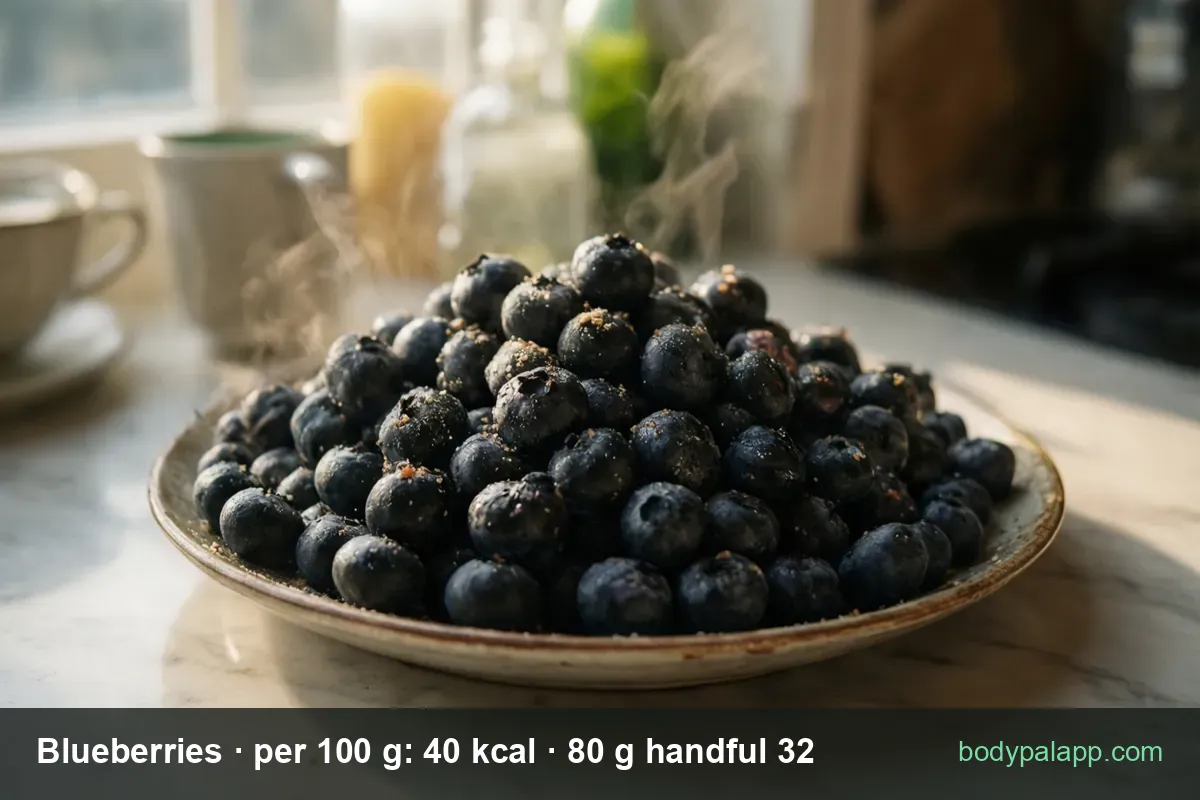
An 80 g handful of blueberries holds 32 calories, and the calories in blueberries per 100 g come to just 40. Tip an entire 150 g punnet over your breakfast and you have added only 60 kcal. Very few foods let you eat the whole pack and shrug it off like that.
On this page
- Quick facts
- UK portion sizes
- Blueberries and sugar
- How does it compare?
- Most popular blueberry brands
- FAQ
Quick facts
Everything below is for fresh, raw blueberries. The right-hand column shows what an 80 g handful contributes to an adult's daily reference intake (RI).
Verified nutrition data
Numbers on this page come from CoFID, the UK government’s Composition of Foods Integrated Dataset, and from manufacturer labels where a branded product is named. Last verified August 2026. How we verify our data →
| Nutrient | Per 100 g | Per 80 g handful | RI% (80 g handful) |
|---|---|---|---|
| Energy | 40 kcal (167 kJ) | 32 kcal (134 kJ) | 2% |
| Protein | 0.9 g | 0.7 g | 1% |
| Carbohydrates | 9.1 g | 7.3 g | 3% |
| Fat | 0.2 g | 0.2 g | <1% |
| Fibre | 1.5 g | 1.2 g | — |
| Sugar | 9.1 g | 7.3 g | 8% |
| Salt | 0.005 g | 0.004 g | <1% |
Notice that carbohydrate and sugar are the same number, 9.1 g. In a blueberry, effectively all the carbohydrate is sugar, cushioned by water, fibre and next to no fat. That is why the energy figure stays so low.
Another way to hold the number in your head: 40 kcal per 100 g works out at 0.4 kcal per gram, so a single berry costs a fraction of a calorie. Foods this dilute are hard to overeat by accident. Your hand gets tired of ferrying berries long before the calories become a problem, which is precisely what makes them such a useful snack to keep within reach.
UK portion sizes
Blueberries are one of the easiest fruits to track because supermarket punnets do the maths for you. Three portions cover almost every real situation:
| Portion | Weight | Calories |
|---|---|---|
| NHS 5 A Day handful | 80 g | 32 kcal |
| Small punnet, eaten in one go | 150 g | 60 kcal |
| Tablespoon (porridge topping) | ~10 g | 4 kcal |
The 80 g handful is the serving the NHS counts as one of your 5 A Day. A standard 150 g punnet is not quite two portions, but only one of them counts towards the five, however many you eat, since repeat servings of the same fruit count once.
The tablespoon row matters more than it looks. Scattered over porridge or yoghurt, a spoonful of berries adds 4 kcal, which is close enough to nothing that you should never let it stop you.
The swap maths is just as friendly. Trade an 80 g portion of grapes, at 65 kcal per 100 g, for the same weight of blueberries and you save calories while keeping the sweet, pop-in-your-mouth habit intact. Small substitutions like that are how a food diary improves without anyone feeling deprived, and berries are one of the easiest levers to pull.
Blueberries and sugar
The one number people worry about is the 9.1 g of sugar per 100 g. Here is the context that worry usually lacks. A realistic handful delivers 7.3 g, which is 8% of the 90 g daily reference intake, and the NHS does not count sugars in whole fruit as free sugars, the kind we are told to cut, because they arrive locked inside the fruit with its fibre.
Blend or juice the berries and that protection disappears; dried blueberries concentrate the same sugars into a fraction of the weight. If you are keeping a close eye on sugar, eat them whole and fresh, exactly the form all the numbers on this page describe.
If you are managing your blood sugar, the same logic applies with a little more force. A measured 80 g handful with its 7.3 g of sugar is a very different event from grazing through a large bowl, so portion first, then relax. Anyone with specific medical guidance should follow it; for everyone else, whole berries in sensible handfuls are about as low-stakes as sweet food gets.
How does it compare?
| Food | kcal per 100 g |
|---|---|
| Strawberry | 30 kcal |
| Blueberries (this page) | 40 kcal |
| Grape | 65 kcal |
| Porridge | 381 kcal |
Strawberries beat blueberries on both fronts: 10 kcal fewer per 100 g and 3.8 g of fibre against 1.5 g. Our verdict: strawberries are technically the better buy, but both are so light that taste should decide, and either one is a clearly smarter snack than grapes at 65 kcal. As for the porridge row, it is there for perspective: the 60 kcal punnet you sprinkle on top is a rounding error next to the bowl underneath. Never skip the berries to trim a breakfast; they were never where the calories lived in the first place.
Most popular blueberry brands in the United Kingdom
Ranked by how widely each product appears among foods sold in the United Kingdom, from the BodyPal food database of over 3.3 million products. Calories are the figures printed on each label.
| Product | Calories (per 100 g) |
|---|---|
| Driscoll’s Blueberries | 46 kcal |
Brand popularity: BodyPal food database. Nutrition: manufacturer labels.
FAQ
How many calories are in blueberries?
Blueberries have 40 kcal per 100 g. An 80 g handful, which counts as one of your 5 A Day, is 32 kcal, a 150 g punnet is 60 kcal, and a tablespoon scattered over porridge adds about 4 kcal. Fat and salt are close to zero.
How many calories are in 100 g of blueberries?
There are 40 kcal (167 kJ) in 100 g of fresh blueberries, with 0.9 g protein, 9.1 g carbohydrate, 0.2 g fat, 1.5 g fibre and 9.1 g sugar. All of the carbohydrate is naturally occurring sugar, buffered by the fruit's water and fibre.
How many calories are in 50 g of blueberries?
A 50 g serving of blueberries is 20 kcal, exactly half the 40 kcal per 100 g figure. That is roughly a small cereal-bowl topping. Even doubling it to a full 5 A Day handful of 80 g only takes you to 32 kcal.
How many calories are in blueberries per gram?
Blueberries work out at 0.4 kcal per gram, from the 40 kcal per 100 g figure. Practically, that means a single berry is a fraction of a calorie, so counting individual berries is never worth the effort. Weigh a handful once and reuse that number.
How many calories are in 1 cup of blueberries?
Stick to the 40 kcal per 100 g figure and weigh them, because a "cup" is a US volume measure that varies with berry size and how tightly you fill it. In UK terms, an 80 g handful is 32 kcal and a 150 g punnet is 60 kcal.
Are blueberries good for dogs?
A small spoonful of around 10 g adds only about 4 kcal, and blueberries are generally considered a safe occasional treat for most dogs. They are small enough to swallow whole, so scatter a few rather than a pile. Check with your vet for small breeds or dogs on restricted diets.
Are blueberries good for you?
At 32 kcal for an 80 g handful that counts as one of your 5 A Day, blueberries are among the cheapest fruit calories you can buy. They carry 1.5 g of fibre per 100 g with almost no fat or salt, and their sugars are not classed as free sugars by the NHS.
Are blueberries high in fibre?
Not especially: blueberries provide 1.5 g of fibre per 100 g, so a handful gives 1.2 g. That is modest next to strawberries at 3.8 g per 100 g. They still contribute, but if fibre is your main goal, mix your berries rather than relying on blueberries alone.
Similar foods
- Plum — 23 kcal per plum
- Nectarine — 60 kcal per fruit
- Kiwi — 26 kcal per fruit
- Orange — 43 kcal per medium fruit
- Papaya — 62 kcal per 140 g bowl
- Pear — 66 kcal per medium fruit
Count it without the maths
Point BodyPal at your breakfast bowl and the berries are logged from one photo, 32 kcal a handful, no weighing required.


How long does it take to burn off blueberries?
An 80 g handful is 32 kcal. Enter your weight and the amount you ate to see how long it takes you to burn that off:
lb
| Activity | Time to burn 32 kcal |
|---|---|
| Walking, brisk | 6 min |
| Cycling, moderate | 4 min |
| Swimming, moderate | 5 min |
| Jogging | 4 min |
| Weight training, moderate | 7 min |
Times are for a 154 lb (11 st) adult at a steady pace; change the weight to see yours. The amount is set to the portion in the text (80 g); change it to what you actually ate. BodyPal works this out from your steps automatically.
This table assumes you know your daily total. If you do not, the daily calorie calculator works it out from five numbers.