
How Many Calories in a Nectarine?
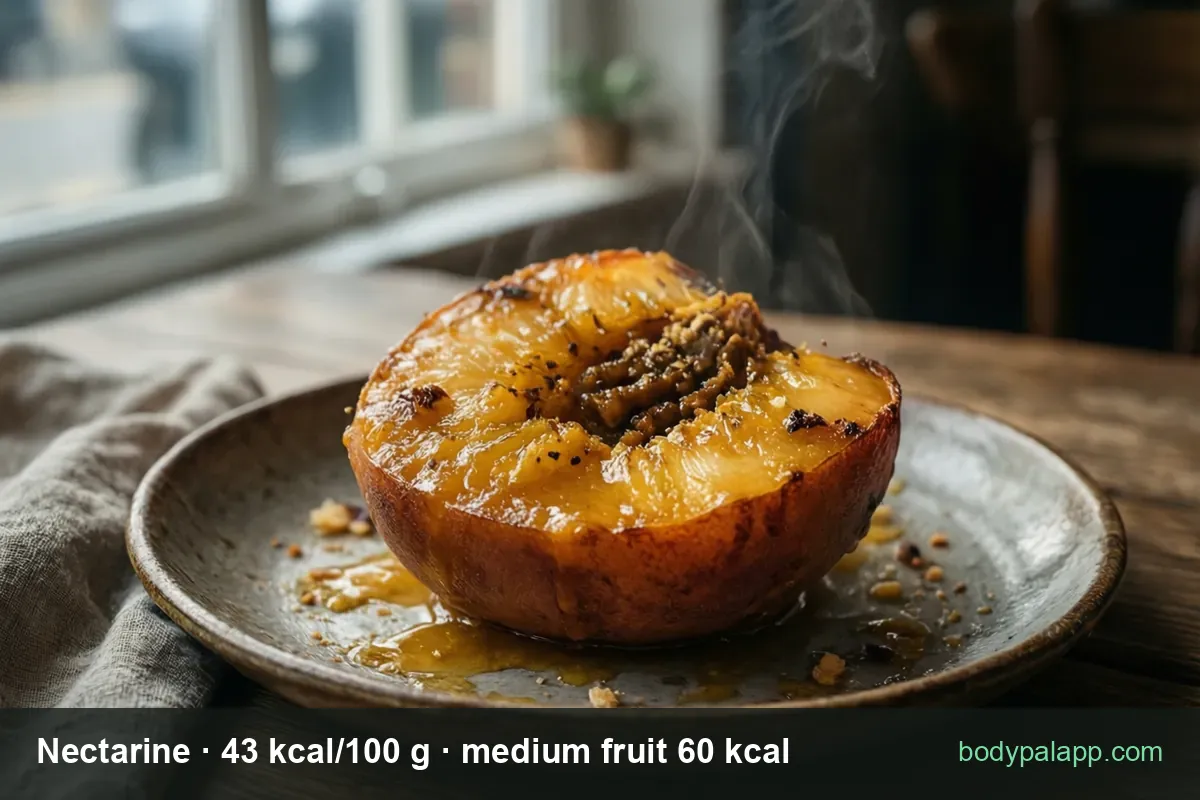
A medium nectarine has about 60 calories. Per 100 g, nectarine flesh with skin is 43 kcal, so even a large fruit stays comfortably under 100. If you searched how many calories in a nectarine expecting a catch, there isn't one: the stone does part of the weighing for you.
On this page
- Quick facts
- How big is your nectarine?
- Nectarine or peach: what changes?
- How does a nectarine compare with other fruit?
- FAQ
Quick facts
| Nutrient | Per 100 g | Per medium fruit (140 g flesh) | RI* per fruit |
|---|---|---|---|
| Energy | 43 kcal / 180 kJ | 60 kcal / 251 kJ | 3% |
| Protein | 1.0 g | 1.4 g | 3% |
| Carbohydrates | 9.8 g | 13.7 g | 5% |
| — of which sugars | 9.8 g | 13.7 g | 15% |
| Fat | 0.3 g | 0.4 g | 1% |
| Fibre | 1.3 g | 1.8 g | – |
| Salt | trace | trace | 0% |
*RI = Reference Intake of an average adult (2,000 kcal a day).
Verified nutrition data
Numbers on this page come from CoFID, the UK government’s Composition of Foods Integrated Dataset, and from manufacturer labels where a branded product is named. Last verified September 2026. How we verify our data →
How big is your nectarine?
Nectarine maths is friendly: roughly 0.4 kcal per gram of flesh, so a medium fruit with about 140 g of flesh lands on 60 calories. Weighed whole, stone and all, CoFID puts nectarines at 40 kcal per 100 g, which makes the kitchen-scale version simple too.
- Small fruit, about 120 g whole: roughly 48 kcal
- Medium fruit, about 150 g whole: about 60 kcal
- Large fruit, about 200 g whole: around 80 kcal
One nectarine also covers an 80 g five-a-day portion with room to spare, which is a decent return for 60 calories.

Nectarine or peach: what changes?
Nothing that matters on a calorie tracker. A nectarine is essentially a peach without the fuzz, and the nutrition numbers are practically identical; the smooth skin is a variety trait, not a different fruit doing different things with sugar.
The same goes for white-fleshed nectarines. They taste sweeter, and people assume the sugar content must be higher, or hope the calories are lower. Neither is true: the difference between white and yellow varieties is flavour, not the 9.8 g of sugar per 100 g in the CoFID data.
How does a nectarine compare with other fruit?
| Fruit | Typical piece | Calories |
|---|---|---|
| Plum | 1 medium | 23 kcal |
| Orange | 1 medium | 43 kcal |
| Nectarine | 1 medium | 60 kcal |
| Apple | 1 medium | 66 kcal |
| Pear | 1 medium | 66 kcal |
The whole fruit bowl sits in a 45-calorie band, so pick by appetite, not arithmetic. If you want the smallest possible bite, a plum wins at 23 kcal; for one fruit that actually fills a gap, a nectarine at 60 undercuts an apple and eats like a treat.
FAQ
How many calories are in a large nectarine?
Around 80 calories. CoFID rates a whole nectarine, stone included, at 40 kcal per 100 g, so a large fruit weighing about 200 g works out at roughly 80 kcal. Even the biggest supermarket nectarines rarely push much past that.
How many calories are in a small nectarine?
About 48 calories. A small fruit weighing around 120 g whole comes to roughly 48 kcal at 40 kcal per 100 g weighed with the stone. If you log it as 50, you are close enough for any real-world purpose.
How many calories are in 100 g of nectarine?
43 kcal per 100 g of flesh and skin, according to CoFID, the UK food composition dataset. Weighed whole with the stone, the figure drops to 40 kcal per 100 g because the stone adds weight but nothing edible.
Is a nectarine just a peach?
Effectively yes: it is a smooth-skinned variety of peach rather than a separate fruit. For calorie counting the distinction is cosmetic. The nutrition numbers are practically identical, so log either one at about 60 kcal for a medium fruit and move on.
Nectarine vs peach: which has fewer calories?
Neither, in any way you could measure at the table. The numbers are practically identical, and the difference between two individual fruits of the same type is bigger than any difference between the two species. Choose by texture, not by calories.
How much sugar is in a nectarine?
About 13.7 g in a medium fruit, from 9.8 g of sugar per 100 g. That is 15% of the 90 g daily reference intake, in the whole-fruit form the NHS specifically excludes from its free-sugars warnings.
Is a nectarine good for you?
At 43 kcal per 100 g with 1.3 g of fibre and a trace of salt, it is one of the cheaper ways to tick off a five-a-day portion. One medium fruit covers the NHS 80 g portion for 60 calories.
Do the calories include the skin?
Yes. The 43 kcal per 100 g figure is for flesh and skin together, which is how everyone eats a nectarine. There is no need to peel it for the sake of the log; the skin is also where some of the fibre sits.
Similar foods
- Kiwi — 26 kcal per fruit
- Papaya — 62 kcal per 140 g bowl
- Pear — 66 kcal per medium fruit
- Clementine — 45 kcal per 100 g
- Pineapple — 36 kcal per 80 g portion
- Plum — 23 kcal per plum
Count it without the maths
Point your camera at the fruit bowl and BodyPal logs the nectarine, its calories and its macros from one photo.


How long does it take to burn off a nectarine?
A medium nectarine is 60 kcal. Enter your weight to see how long it takes you to burn that off:
lb
| Activity | Time to burn 60 kcal |
|---|---|
| Walking, brisk | 12 min |
| Cycling, moderate | 8 min |
| Swimming, moderate | 9 min |
| Jogging | 7 min |
| Weight training, moderate | 13 min |
Times are for a 154 lb (11 st) adult at a steady pace; change the weight to see yours. BodyPal works this out from your steps automatically.
This table assumes you know your daily total. If you do not, the daily calorie calculator works it out from five numbers.