
Calories in an Orange: 43 per Medium Fruit
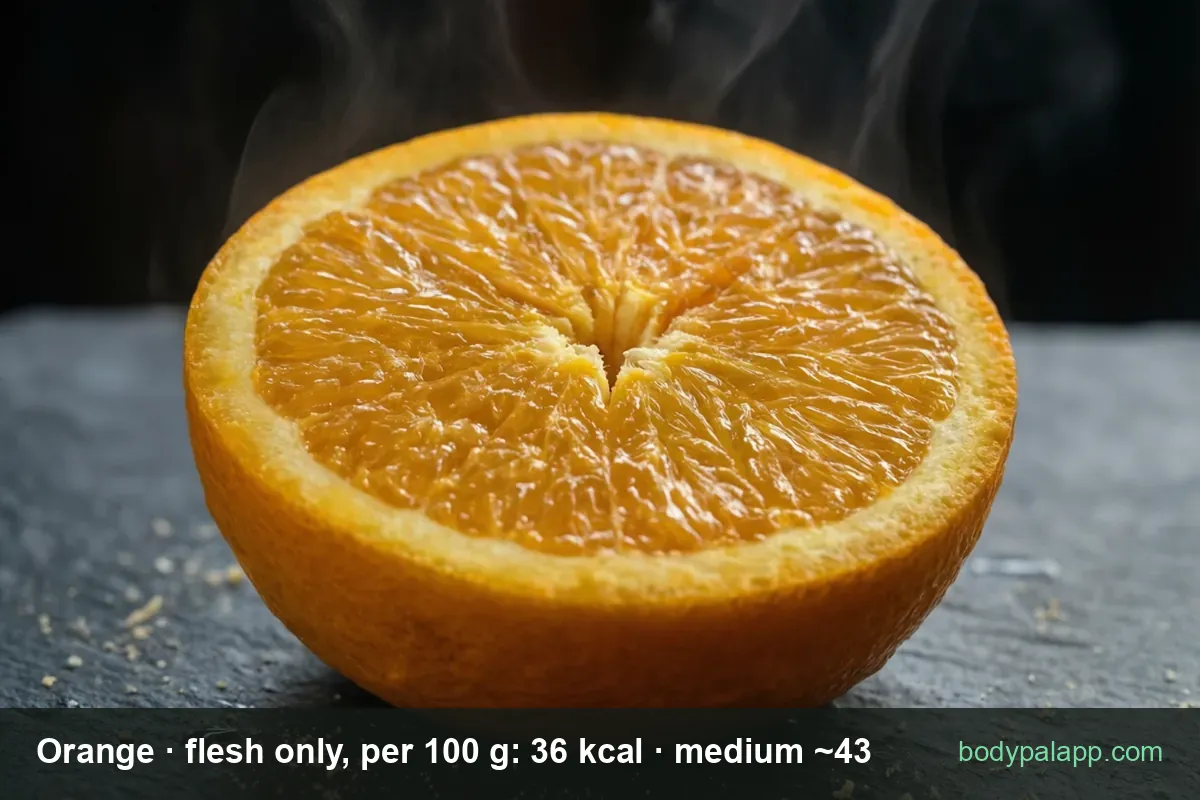
A medium peeled orange has 43 calories, and orange flesh works out at 36 kcal per 100 g — among the lowest figures of any common fruit. A large orange reaches about 54 kcal, and the 80 g portion that counts towards your 5-a-day is just 29. If you're checking calories in an orange before a snack, the short answer is: barely any.
On this page
- Quick facts
- Portion sizes
- Oranges and your 5-a-day
- How does it compare?
- Most popular orange juice brands
- FAQ
Quick facts
The table below covers peeled orange flesh — the part you actually eat. Reference intake (RI) percentages are for the medium fruit, not per 100 g.
Verified nutrition data
Numbers on this page come from CoFID, the UK government’s Composition of Foods Integrated Dataset, and from manufacturer labels where a branded product is named. Last verified August 2026. How we verify our data →
| Nutrient | Per 100 g | Per medium orange (120 g flesh) | % RI (medium orange) |
|---|---|---|---|
| Energy | 36 kcal / 151 kJ | 43 kcal / 180 kJ | 2% |
| Protein | 0.8 g | 1.0 g | 2% |
| Carbohydrates | 8.2 g | 9.8 g | 4% |
| Fat | 0.2 g | 0.2 g | <1% |
| Fibre | 1.2 g | 1.4 g | — |
| Sugars | 8.2 g | 9.8 g | 11% |
| Salt | 0.003 g | 0.004 g | <1% |
RI = reference intake for an average adult: 2,000 kcal, 70 g fat, 260 g carbohydrate, 90 g sugars, 50 g protein, 6 g salt. Fibre has no RI on UK labels.
Two things stand out. First, every gram of carbohydrate in an orange is sugar — 8.2 g of each per 100 g — but it is naturally occurring sugar, wrapped in fibre and water, which is a very different proposition from the free sugars the NHS asks us to cut back on. Second, salt is effectively absent at 0.003 g per 100 g, so oranges are a safe pick if you're watching sodium.
A medium fruit still delivers 11% of your daily sugars reference. That's not a reason to skip it. It's a reason to count it like everything else.
Portion sizes
The weights below are flesh only. The peel comes off before any counting starts, which is why a fruit that feels heavy in the hand logs so light on the plate.
| Portion | Weight | Calories |
|---|---|---|
| Medium orange, peeled | ~120 g flesh | 43 kcal |
| Large orange, peeled | ~150 g flesh | 54 kcal |
| NHS 5-a-day portion | 80 g | 29 kcal |
A medium orange at 43 kcal is the everyday case: the fruit-bowl standard most UK supermarkets sell loose. Large navels push towards 150 g of flesh and 54 kcal, still less than a plain digestive's worth of energy for a lot more food.
The 80 g row matters for one job: it's the official size of a single 5-a-day portion, and it costs you 29 calories. Few foods buy a tick on that list more cheaply.
If you're logging by eye rather than by scales, segments help. A medium orange breaks into roughly ten segments, so half a fruit eaten at your desk is around 22 kcal — close enough for an honest diary.
Oranges and your 5-a-day
An 80 g serving of orange — about two-thirds of a medium fruit — counts as one of your 5-a-day for 29 calories. Eat the whole medium fruit and you've banked the portion with room to spare, still under 45 kcal.
Juice is where people get caught out. A glass of orange juice can count towards your 5-a-day, but only once per day no matter how much you drink, because juicing strips out the fruit's structure and fibre and leaves the sugars behaving like free sugars. The NHS advice is to keep juice small and have it with a meal.
The whole fruit has no such caveats. You get the 1.2 g of fibre per 100 g, the chewing, the fullness — and the same bright flavour. If the choice is fruit or glass, take the fruit and let the juice be an occasional extra rather than a habit.
One common belief worth retiring: "fruit sugar doesn't count." It does — a medium orange carries 9.8 g of sugars and they belong in your day's total. The honest framing is that an orange is one of the cheapest ways, calorie-wise, to satisfy a sweet urge, not that it's free.
How does it compare?
Against the fruit it usually shares a bowl with, the orange is the lightweight of the group.
If you want the most fruit for the fewest calories, the orange wins this table outright — 36 kcal per 100 g against 44 for kiwi, 65 for grapes and 81 for banana. Grapes are the ones to watch: nearly double an orange per gram, and far easier to eat without stopping.
Within the Eatwell Guide, fruit like this is a group you're meant to eat more of, not ration. The orange just happens to make that instruction unusually cheap to follow.
Most popular orange juice brands in the United Kingdom
Ranked by how widely each product appears among foods sold in the United Kingdom, from the BodyPal food database of over 3.3 million products. Calories are the figures printed on each label. These are chilled juices, listed per 100 ml; the whole fruit stays the better pick for fibre.
| Product | Calories (per 100 ml) |
|---|---|
| Tropicana Orange Juice | 48 kcal |
| Solevita Orange Juice (Lidl) | 44 kcal |
| Innocent Orange Juice with Bits | 39 kcal |
Brand popularity: BodyPal food database. Nutrition: manufacturer labels.
FAQ
How many calories are in an orange?
A medium peeled orange has 43 calories and a large one about 54. Orange flesh works out at 36 kcal per 100 g, which puts it among the lightest fruits you can buy. The 80 g serving that counts towards your 5-a-day comes to just 29 calories.
How many calories are in orange juice?
Chilled orange juice is 36 kcal per 100 ml in CoFID, the same figure as the flesh itself. The difference is speed: juicing removes the fibre and keeps the sugars, so a 250 ml glass (90 kcal) goes down far faster than two and a half whole oranges would.
Is orange juice healthy?
Oranges carry 8.2 g of sugar per 100 g, and in juice those sugars count as free sugars because the fruit's structure is gone. The NHS advises treating juice as a small drink with a meal, and it only counts once towards your 5-a-day, however much you pour.
Is orange juice good for you?
A whole medium orange gives you 43 calories plus 1.4 g of fibre; juice keeps the calories and drops the fibre. Juice still brings vitamins, so a small glass is fine, but as a daily default the whole fruit is the better habit for fullness and steadier energy.
How many calories are in orange chicken?
Nothing like the fruit's 36 kcal per 100 g — orange chicken is a battered, fried takeaway dish in a sweet sauce, and recipes vary too widely for one honest number. Treat it as a full main meal in your log, not as anything close to a fruit portion.
How many calories are in an orange pepper?
An orange bell pepper is a different food from the citrus on this page. CoFID lists raw red peppers at 21 and yellow at 23 kcal per 100 g, and orange varieties sit in the same range. An 80 g serving counts towards your 5-a-day too.
Are oranges good for diabetics?
A medium orange contains 9.8 g of sugar, all naturally occurring and eaten alongside fibre, which makes whole oranges a reasonable fruit choice if you're managing blood sugar. Portion size still matters, and whole fruit beats juice here. For personal targets, follow the advice of your diabetes team.
Is orange good for dogs?
At 43 calories for a medium fruit, a segment or two of orange flesh is generally considered safe for dogs, though many dislike the citrus taste. Skip the peel and pips, keep it occasional, and check with your vet if your dog has a sensitive stomach or a health condition.
Similar foods
- Grapefruit — 72 kcal per whole fruit
- Peach — 45 kcal a medium fruit
- Blueberries — 32 kcal per 80 g handful
- Plum — 23 kcal per plum
- Strawberries — 24 kcal per 80 g handful
- Nectarine — 60 kcal per fruit
Count it without the maths
Point your camera at a peeled orange and BodyPal logs it from one photo — calories and macros in seconds.


How long does it take to burn off an orange?
A medium orange (120 g flesh) is 43 kcal. Enter your weight and the amount you ate to see how long it takes you to burn that off:
lb
| Activity | Time to burn 43 kcal |
|---|---|
| Walking, brisk | 9 min |
| Cycling, moderate | 5 min |
| Swimming, moderate | 6 min |
| Jogging | 5 min |
| Weight training, moderate | 10 min |
Times are for a 154 lb (11 st) adult at a steady pace; change the weight to see yours. The amount is set to the portion in the text (120 g); change it to what you actually ate. BodyPal works this out from your steps automatically.
Burning it off is one side of it. The other is knowing your number: work out how many calories you need a day, with macros and a goal date.