
How Many Calories in a Grapefruit?
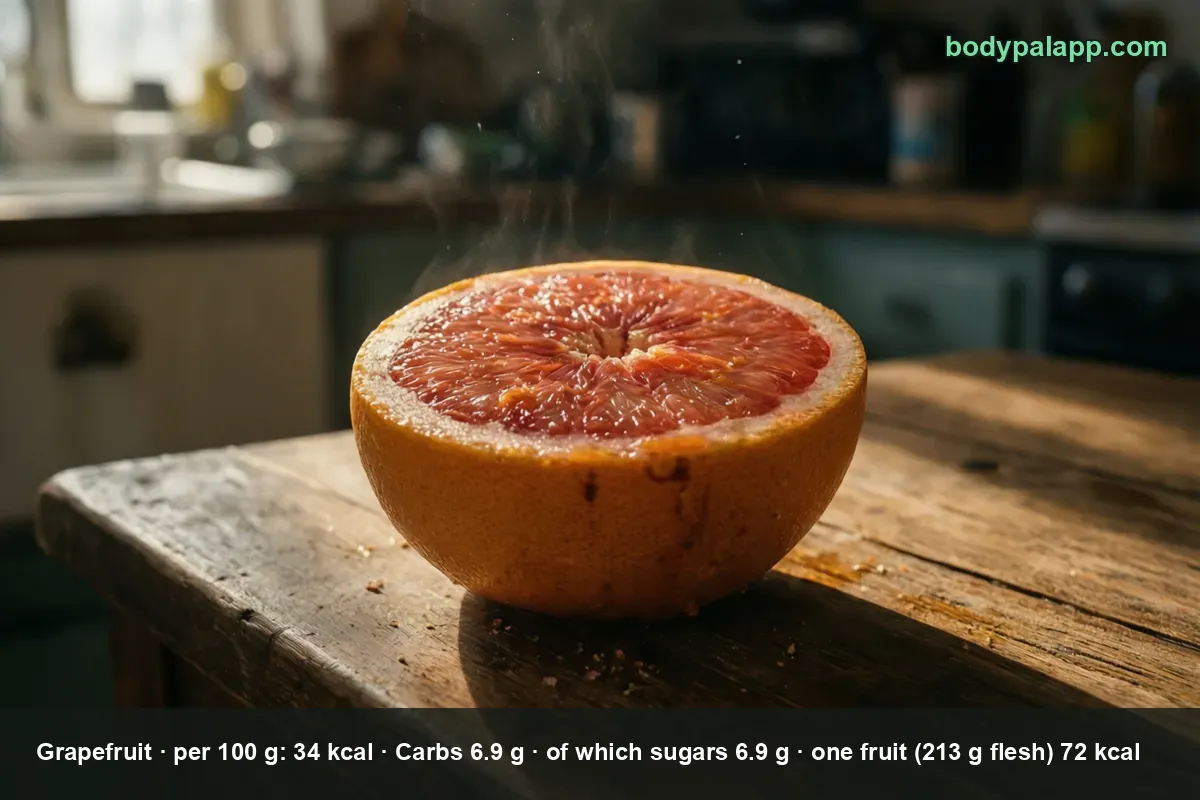
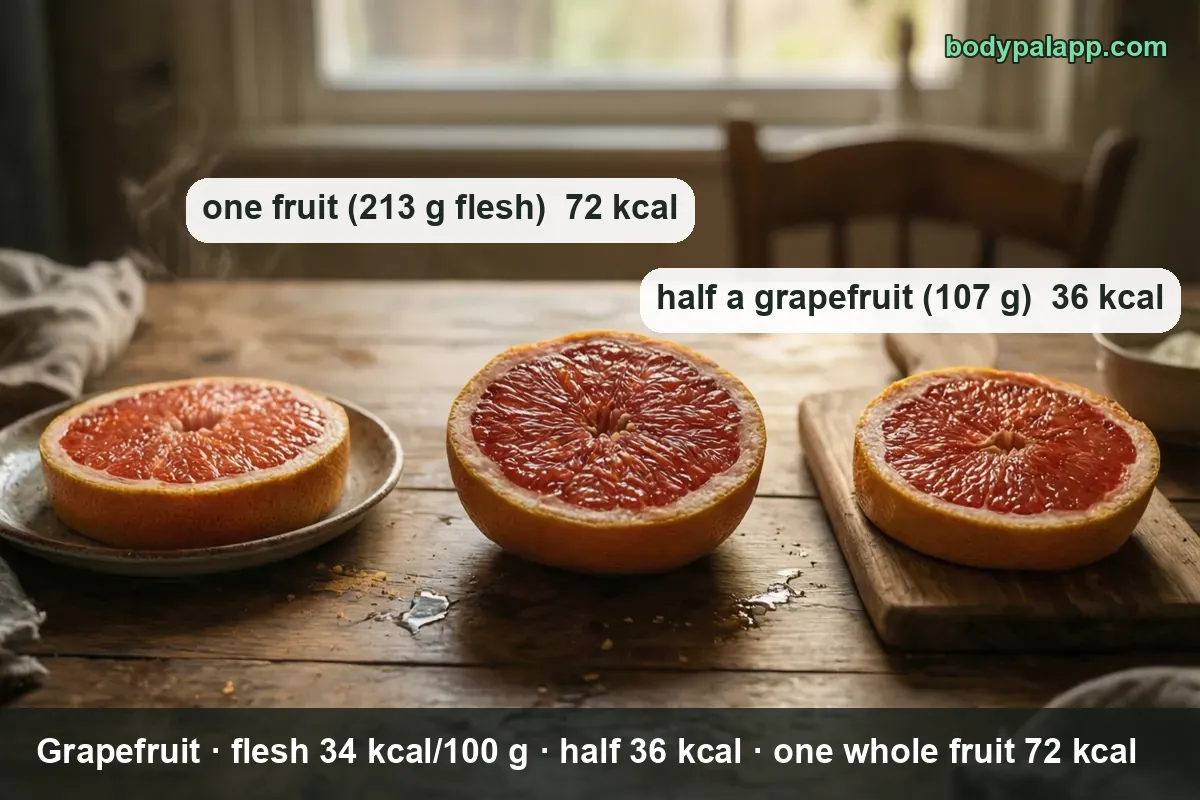
A whole grapefruit is 72 calories. That is a typical 300 g fruit as it comes off the shelf, because only about 213 g of it is flesh — and grapefruit flesh runs 34 kcal per 100 g. Half a grapefruit is 36 kcal. A whole 411 g tin in juice is 123.
On this page
- Grapefruit quick facts
- Peel, pips and the 29% you throw away
- UK portions, half by half
- Tinned, juiced and in syrup
- Why some charts say 42
- Grapefruit and medicines
- How grapefruit compares with other fruit
- Popular grapefruit products
- FAQ
Grapefruit quick facts
The per-100 g column is flesh only — no peel, no pips. The portion column is what a 300 g grapefruit actually gives you.
| Nutrient | Per 100 g | 213 g flesh (one 300 g fruit) | RI%* |
|---|---|---|---|
| Energy | 34 kcal / 143 kJ | 72 kcal / 301 kJ | 4% |
| Protein | 0.9 g | 1.9 g | 4% |
| Carbohydrates | 6.9 g | 14.7 g | 6% |
| – of which sugars | 6.9 g | 14.7 g | 16% |
| Fat | 0.5 g | 1.1 g | 2% |
| – of which saturates | 0.07 g | 0.15 g | <1% |
| Fibre | 1.3 g | 2.8 g | – |
| Salt | 0.002 g | 0.004 g | <1% |
*RI% = one grapefruit's share of an adult's daily reference intake, based on 2,000 kcal.
Verified nutrition data
Numbers on this page come from CoFID, the UK government’s Composition of Foods Integrated Dataset, and from manufacturer labels where a branded product is named. Last verified September 2026. How we verify our data →
Every carbohydrate gram in grapefruit is sugar. There is no starch in it at all, which is why the sugars row and the carbohydrate row are the same number. Salt is as close to zero as food gets: 0.002 g per 100 g, one of the lowest readings in the whole UK dataset.
Peel, pips and the 29% you throw away
Grapefruit is one of the few fruits where the bin gets a serious share of what you paid for.
The UK reference tables carry two separate entries: flesh only, at 34 kcal per 100 g, and the same flesh weighed with peel and pips, at 24 kcal per 100 g. Divide one by the other and you get 0.71. That is the official edible proportion — 71% of a grapefruit is edible, and 29% is skin, pith and pips.
This makes the sum easier than for almost any other fruit. Put the whole grapefruit on the scales, multiply by 0.24, and you have the calories. No guessing at flesh weight, no halving anything.
| Fruit as bought | Flesh (×0.71) | Whole fruit | Half |
|---|---|---|---|
| 250 g (small) | 178 g | 60 kcal | 30 kcal |
| 300 g (typical) | 213 g | 72 kcal | 36 kcal |
| 350 g | 249 g | 84 kcal | 42 kcal |
| 400 g (large) | 284 g | 96 kcal | 48 kcal |
Look at the bottom row. A large grapefruit — a heavy, two-handed object — comes to 96 kcal. The peel is doing 116 g of that weight and none of the calories.
UK portions, half by half
| Portion | Weight | Calories |
|---|---|---|
| Half a typical grapefruit | 107 g flesh | 36 kcal |
| One typical grapefruit | 213 g flesh | 72 kcal |
| One 80 g portion of your five a day | 80 g flesh | 27 kcal |
| Grapefruit segments, chilled pot | 90 g | 17 kcal |
Grapefruit is unusually generous per calorie. An 80 g serving — the portion size the NHS counts towards five a day — is 27 kcal, and half a fruit comfortably clears that bar at 36. Two halves at breakfast is 72 kcal and two of your five, for less than a slice of toast.
The fibre is the weak point. At 1.3 g per 100 g, a whole grapefruit gives 2.8 g, which is respectable but not remarkable; strawberries carry nearly three times as much fibre gram for gram.
Tinned, juiced and in syrup
| Version | Per 100 g | Portion | Calories |
|---|---|---|---|
| Fresh flesh | 34 kcal | 213 g, one fruit | 72 kcal |
| Tinned in juice, drained | 30 kcal | 214 g drained from a 411 g tin | 64 kcal |
| Tinned in juice, tin and all | 30 kcal | whole 411 g tin | 123 kcal |
| Tinned in light syrup | 81 kcal | half a tin, 205 g | 167 kcal |
| Unsweetened juice | 33 kcal | 200 ml glass | 66 kcal |
Two of those rows deserve attention.
Syrup against juice. Segments packed in juice sit at 30–32 kcal per 100 g, near enough identical to the fresh fruit. Segments in light syrup are 81 kcal per 100 g — two and a half times more. Half a tin of the syrup version is 167 kcal, which is where a light pudding quietly becomes a heavy one. The tin will say which it is on the front.
Juice against fruit. A 200 ml glass of unsweetened grapefruit juice is 66 kcal and about 16.6 g of sugars, with essentially no fibre. The same calories eaten as flesh would be roughly 200 g of grapefruit, carrying 2.6 g of fibre and taking ten minutes to get through. The NHS explains why free sugars in juice are counted differently from the sugars locked inside whole fruit. Branded cartons run slightly higher than the reference figure, at 37–38 kcal per 100 ml, so a 200 ml glass of those is 74–76 kcal.
The chilled segment pots supermarkets sell for breakfast are the lightest option of all — 19 kcal per 100 g in one Asda tub, because they are mostly water and sit at 17 kcal for a 90 g pot.
Why some charts say 42
Search for grapefruit calories and you will meet two numbers: 34 and 42. Both are real, and neither is a typo.
The UK figure is 34 kcal per 100 g, from eleven samples of imported pink, red and white grapefruit measured together. The 42 comes from the American dataset, and the gap is not in the fruit — it is in the bookkeeping. The US method counts carbohydrate by difference, arriving at 10.66 g per 100 g. The UK method measures the sugars directly and gets 6.9 g. Nearly four grams of carbohydrate, and roughly eight calories, appear out of an accounting convention.
Two things follow. First, the spread exists inside the American data too: white grapefruit is listed there at 32 to 33 kcal, so pink versus white explains part of the confusion in the search results. Second, the pink-is-heavier idea does not appear in the UK numbers at all, because pink, red and white were averaged into one entry.
For a fruit this light the practical difference is small. Half a grapefruit is 36 kcal on UK figures and 44 on American ones. Eight calories. Worth knowing about, not worth losing sleep over — but if you log the same breakfast 300 times a year, pick one and stay with it.
Grapefruit and medicines
One thing about grapefruit has nothing to do with calories. Grapefruit and grapefruit juice change how the body processes a number of prescription medicines, including some statins and blood pressure drugs. The individual NHS medicines guides state whether grapefruit matters for a given drug, and a pharmacist will know without looking it up. That is the whole of it — the calorie count has no bearing on the question either way.
How grapefruit compares with other fruit
| Fruit | Per 100 g | Typical portion | Calories |
|---|---|---|---|
| Grapefruit, flesh | 34 kcal | one 300 g fruit | 72 kcal |
| Melon | 24 kcal | 80 g slice | 19 kcal |
| Strawberries | 30 kcal | 80 g | 24 kcal |
| Orange | 36 kcal | one medium | 43 kcal |
| Clementine | 45 kcal | one, 100 g | 45 kcal |
| Apple | 51 kcal | one medium | 66 kcal |
Our take: per 100 g grapefruit is mid-table, but per fruit it is the biggest object on the list, and that is the point of it. Seventy-two calories buys you a bowl you eat with a spoon rather than something gone in four bites — the clementine at 45 kcal is lighter on paper and finished in thirty seconds. If you want the lowest number full stop, melon wins at 24 kcal per 100 g. If you want the most fibre for the calories, strawberries beat everything here at 3.8 g per 100 g against grapefruit's 1.3.
Popular grapefruit products in the BodyPal food database
Ranked by how widely each product appears among foods sold in the United Kingdom, from the BodyPal food database of over 3.3 million products. Calories are the figures printed on each label. All four are prepared or canned, which is why they run above the fresh-flesh figure.
| Product | Calories (per 100 g) |
|---|---|
| Kirkland Signature Red Grapefruit | 54 kcal |
| Kirkland Red Grapefruit Segments | 49 kcal |
| Del Monte Red Grapefruit | 60 kcal |
| Del Monte Fruit Naturals in Light Syrup | 51 kcal |
Brand popularity: BodyPal food database. Nutrition: manufacturer labels.
Grapefruit FAQs
How many calories in a grapefruit?
72 kcal for a typical 300 g grapefruit. The flesh is 34 kcal per 100 g, and 71% of the fruit is flesh, so a 300 g grapefruit gives 213 g on the spoon. A small 250 g fruit is 60 kcal and a large 400 g one is 96.
How many calories in half a grapefruit?
36 kcal for half a typical 300 g fruit, which is about 107 g of flesh. Half a small grapefruit is 30 kcal and half a large one 48. Charts using the American figure of 42 kcal per 100 g will say 44 instead.
How many calories in a pink grapefruit?
The same 34 kcal per 100 g. The UK entry averages eleven samples of pink, red and white grapefruit together and finds no useful difference between them. The idea that pink is heavier comes from the American dataset, which lists pink at 42 and white at 32 to 33.
How many calories in 100 g of grapefruit?
34 kcal for 100 g of flesh, with 6.9 g of sugars, 1.3 g of fibre and 0.9 g of protein. If you weigh the fruit whole, with peel and pips, use 24 kcal per 100 g instead — that is the same flesh spread across the uneaten 29%.
How many calories in tinned grapefruit?
123 kcal for a whole 411 g tin in juice, or 64 kcal for the 214 g of segments drained out of one. UK labels run slightly higher at 32 kcal per 100 g, making the tin 132. Light syrup changes everything: 81 kcal per 100 g, so half a tin is 167.
How many calories in grapefruit juice?
66 kcal in a 200 ml glass of unsweetened juice, at 33 kcal per 100 ml. Branded cartons are a little higher at 37 to 38, so the same glass is 74 to 76 kcal. A 150 ml glass is 50 kcal on the reference figure and 56 on the carton.
Is grapefruit good for weight loss?
It is a large amount of food for very few calories — 72 kcal for a whole fruit, and 27 kcal for an 80 g serving counting towards five a day. Nothing in grapefruit burns fat, and the old grapefruit diets were built on that idea rather than on evidence. The volume per calorie is the real advantage.
How much sugar is in a grapefruit?
14.7 g in a typical 300 g fruit, which is 16% of the daily reference intake for sugars. All 6.9 g of carbohydrate per 100 g is sugar, since grapefruit contains no starch. A 200 ml glass of the juice holds about 16.6 g in a fraction of the time.
Similar foods
- Peach — 45 kcal a medium fruit
- Orange — 43 kcal per medium fruit
- Strawberries — 24 kcal per 80 g handful
- Blueberries — 32 kcal per 80 g handful
- Plum — 23 kcal per plum
- Nectarine — 60 kcal per fruit
Weigh it once, stop weighing it
Put the whole grapefruit on the scales, point the camera, and BodyPal does the peel maths for you.


How long does it take to burn off a grapefruit?
A whole 300 g grapefruit is 72 kcal. Enter your weight and the amount you ate to see how long it takes you to burn that off:
lb
| Activity | Time to burn 72 kcal |
|---|---|
| Walking, brisk | 14 min |
| Cycling, moderate | 9 min |
| Swimming, moderate | 10 min |
| Jogging | 8 min |
| Weight training, moderate | 16 min |
Times are for a 154 lb (11 st) adult at a steady pace; change the weight to see yours. The amount is set to the portion in the text (300 g); change it to what you actually ate. BodyPal works this out from your steps automatically.
One food is easy to picture; a whole day is harder. See how many calories you need a day and what a deficit actually looks like.