
Calories in Mango: 48 per 100 g, 38 in a 5 A Day Portion
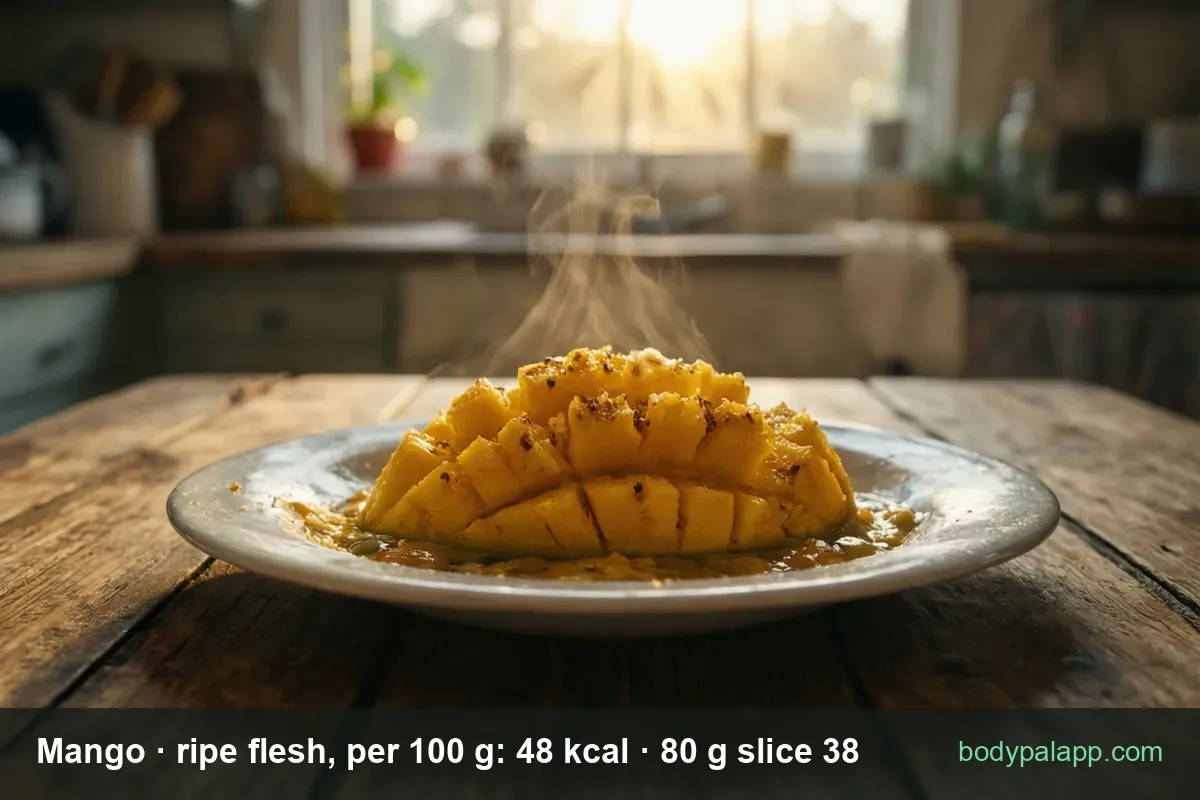
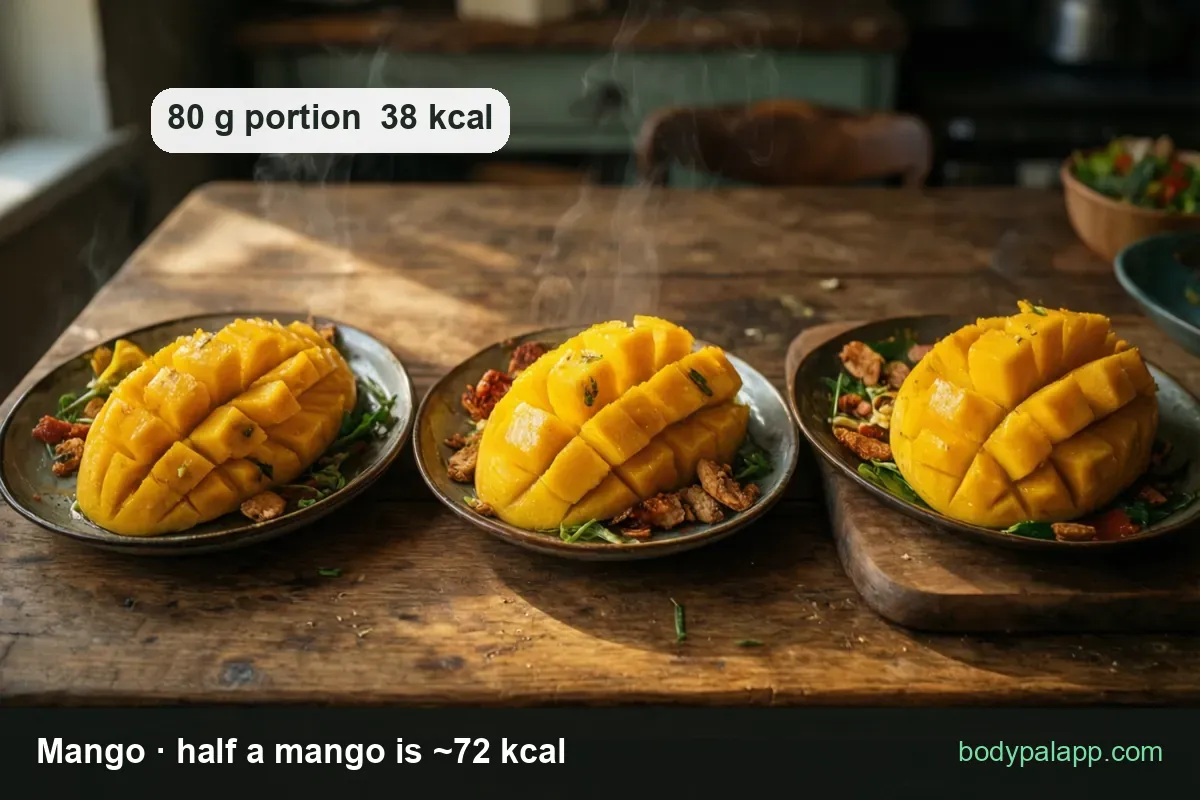
Calories in mango come in at 48 kcal per 100 g of ripe flesh, which makes an 80 g portion — one of your 5 A Day — just 38 kcal. Half a mango, roughly 150 g of flesh, is 72 kcal. Gram for gram, that is fewer calories than a banana, despite the dessert-level sweetness.
On this page
Quick facts
The numbers below are for ripe mango flesh, raw, with the skin and stone removed. The right-hand column shows how an 80 g portion fits into an adult's daily reference intake (RI).
Verified nutrition data
Numbers on this page come from CoFID, the UK government’s Composition of Foods Integrated Dataset, and from manufacturer labels where a branded product is named. Last verified August 2026. How we verify our data →
| Nutrient | Per 100 g flesh | Per 80 g portion | RI% (80 g portion) |
|---|---|---|---|
| Energy | 48 kcal (201 kJ) | 38 kcal (159 kJ) | 2% |
| Protein | 0.7 g | 0.6 g | 1% |
| Carbohydrates | 10.7 g | 8.6 g | 3% |
| Fat | 0.6 g | 0.5 g | <1% |
| Fibre | 1.1 g | 0.9 g | — |
| Sugar | 10.4 g | 8.3 g | 9% |
| Salt | 0.01 g | 0.008 g | <1% |
Two things stand out. Almost everything in mango is carbohydrate, and almost all of that carbohydrate is sugar: 10.4 g of the 10.7 g total per 100 g. Fat and salt are close to zero, so the energy figure rises and falls with the sweetness alone.
UK portion sizes
Mango is an awkward fruit to eyeball. The flesh clings to a flat stone, supermarkets sell fruits in wildly different sizes, and pre-cut chunks hide how much you are actually eating. These are the two portions worth memorising:
| Portion | Weight | Calories |
|---|---|---|
| NHS 5 A Day portion | 80 g | 38 kcal |
| Half a mango, flesh only | ~150 g | 72 kcal |
An 80 g serving of fresh mango counts as one of your 5 A Day, the same as any other fresh fruit. In practice, though, nobody stops at 80 g of mango. Half a decent-sized fruit gives you about 150 g of flesh, and at 72 kcal that is still a lighter dessert than almost anything from the bakery aisle. Even a whole fruit's worth of flesh stays well under the calories many people assume a "sugary" tropical fruit must carry.
If you cube the flesh into a bowl, weigh the bowl, not the fruit. The stone stays behind, and that changes the maths completely, as the next section shows.
Whole mango vs prepared flesh
CoFID lists two entries for ripe raw mango, and the difference between them trips people up constantly.
| CoFID entry | kcal per 100 g | Sugar per 100 g |
|---|---|---|
| Flesh only (peeled, stoned) | 48 kcal | 10.4 g |
| Weighed with skin and stone | 30 kcal | 6.5 g |
The second row exists for one practical reason: when you put a whole mango on the kitchen scale, a big share of that weight is skin and stone you will never eat. The 30 kcal per 100 g figure already discounts the waste. So the rule is simple. Whole, untouched fruit on the scale: log 30 kcal per 100 g. Peeled cubes or slices on the scale: log 48 kcal per 100 g.
Mix those two up and your log can be off by more than a third in either direction. It is one of the most common mango-tracking mistakes we see, and it has nothing to do with willpower.
One more note on the sugar. Mango's 10.4 g per 100 g sounds steep, but the NHS treats sugars in whole fruit differently from free sugars added to food and drinks, because they come packaged with fibre and water. If you are watching sugar closely, hold to the 80 g portion and its 8.3 g; blending mango into juices or shakes releases the sugars and changes that picture.
How does it compare?
Mango sits comfortably mid-table: only 4 kcal per 100 g above a pear and well under a banana's 81. Our verdict: if pure calorie economy decides it, take the orange at 36 kcal, but mango delivers the most dessert-like satisfaction per spoonful of anything on this list and still undercuts the banana by a wide margin.
FAQ
How many calories are in mango?
Mango has 48 kcal per 100 g of ripe flesh. An 80 g portion, which counts as one of your 5 A Day, is 38 kcal, and half a mango (about 150 g of flesh) comes to 72 kcal. Weighed whole with skin and stone, it works out at 30 kcal per 100 g.
How many calories are in 100 g of mango?
There are 48 kcal (201 kJ) in 100 g of ripe mango flesh, alongside 0.7 g protein, 10.7 g carbohydrate, 0.6 g fat and 1.1 g fibre. That figure applies to peeled, stoned flesh; a whole fruit weighed with skin and stone averages 30 kcal per 100 g.
How many calories are in a mango shake?
The mango itself contributes only 48 kcal per 100 g; the rest of a shake's total depends on the milk, ice cream and any added sugar, so there is no single honest number. The fruit is rarely the biggest calorie source in the glass. Check your recipe or log each ingredient separately.
How many calories are in a mango shake without sugar?
Skipping added sugar removes the free sugars, but the mango still brings 10.4 g of natural sugar per 100 g of flesh, and the milk adds its own calories on top. An unsweetened shake is the lighter choice, though it is never calorie-free. Weigh the fruit going in for an accurate log.
How many calories are in mango sticky rice?
Only 48 kcal per 100 g of the dish's weight comes from mango flesh; the sticky rice cooked in coconut milk supplies most of the energy, and portions vary too much between restaurants for one reliable figure. Treat it as a proper dessert rather than a fruit serving when you log it.
Is mango good for you?
At 38 kcal for an 80 g serving, fresh mango counts as one of your 5 A Day, brings 1.1 g of fibre per 100 g and carries almost no fat or salt. The NHS distinguishes the sugars in whole fruit from free sugars, so eaten as fruit rather than juice, it earns its place.
Is mango good for weight loss?
At 48 kcal per 100 g, mango is one of the lighter ways to end a meal on something sweet, and half a fruit costs just 72 kcal. It fits a calorie deficit easily if you portion it. The usual pitfall is dried mango and shakes, where the same sugars concentrate fast.
Is mango good for dogs?
A few small cubes of peeled flesh, around 30 g and roughly 14 kcal, are generally considered safe for most dogs as an occasional treat. Always remove the skin and the stone, which is a choking and blockage hazard. Ask your vet before making it a habit, especially for small breeds.
Similar foods
- Cherries — 5 kcal per cherry
- Grapes — 52 kcal per 80 g handful
- Apple — 66 kcal a medium apple
- Pomegranate — 77 kcal per 150 g bowl of seeds
- Clementine — 45 kcal per 100 g
- Pineapple — 36 kcal per 80 g portion
Count it without the maths
Snap half a mango with BodyPal and the 72 kcal, sugars and fibre land in your log before you have rinsed the chopping board.


How long does it take to burn off mango?
100 g of ripe flesh is 48 kcal. Enter your weight and the amount you ate to see how long it takes you to burn that off:
lb
| Activity | Time to burn 48 kcal |
|---|---|
| Walking, brisk | 10 min |
| Cycling, moderate | 6 min |
| Swimming, moderate | 7 min |
| Jogging | 6 min |
| Weight training, moderate | 11 min |
Times are for a 154 lb (11 st) adult at a steady pace; change the weight to see yours. The amount is set to the portion in the text (100 g); change it to what you actually ate. BodyPal works this out from your steps automatically.
Want the bigger picture? Calculate your daily calorie needs — your maintenance figure, a target for losing or gaining, and the date you get there.