
How Many Calories in Beef?
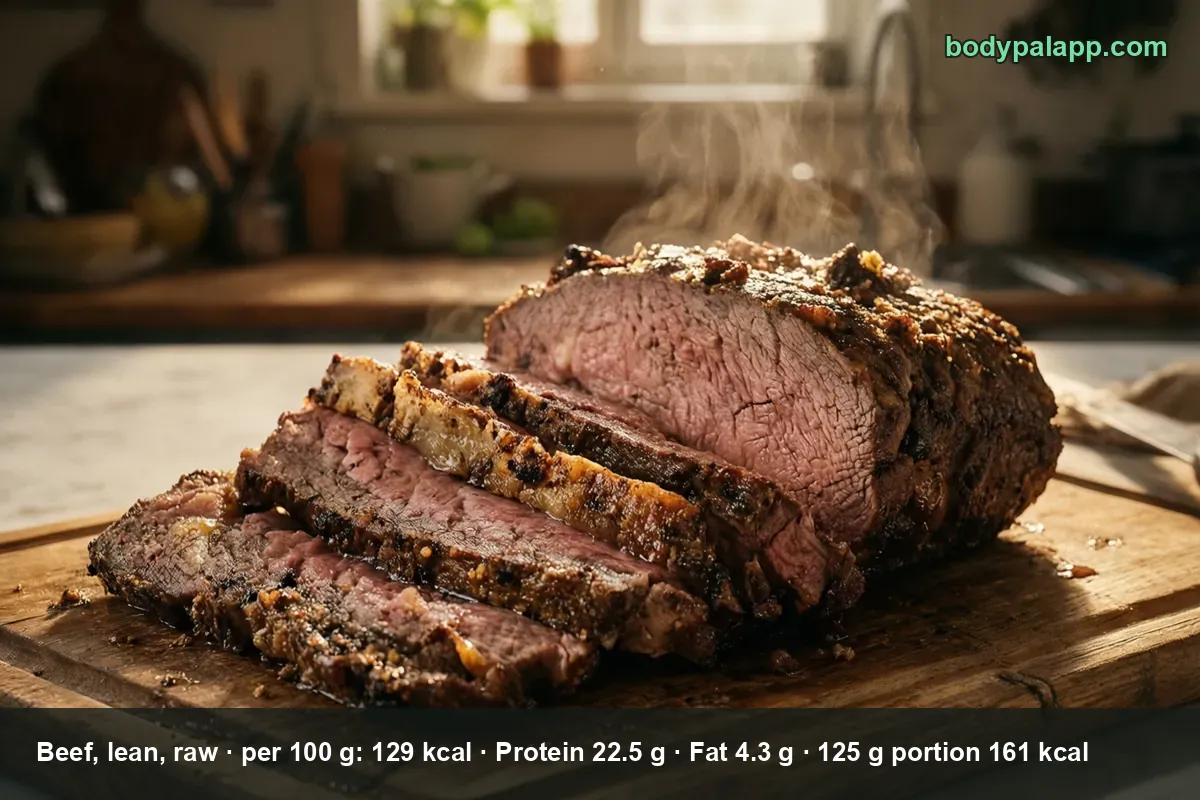
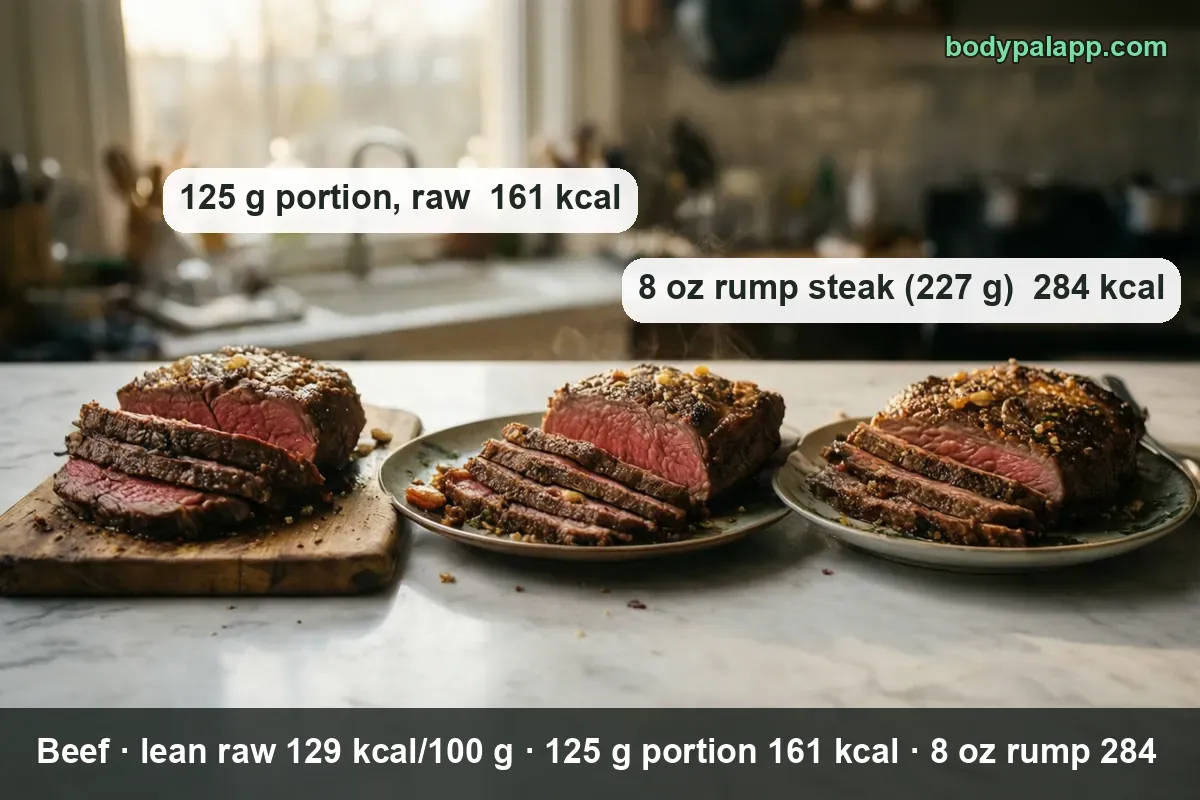
Lean beef is 129 calories per 100 g raw, which makes a 125 g portion 161 kcal carrying 28 g of protein. An 8 oz rump steak trimmed to lean is 284 kcal; the identical steak with the fat left on is 395. Mince swings from 163 kcal a portion to 325.
On this page
- Beef quick facts
- Raw weight is the weight that counts
- Steaks: lean only against lean and fat
- Mince: 5% against 20%
- Roast beef from the oven, roast beef from the packet
- Protein per calorie
- How beef compares
- Popular beef products
- FAQ
Beef quick facts
The reference here is lean beef, raw — an average of ten different cuts with the visible fat trimmed off.
| Nutrient | Per 100 g | 125 g portion, raw | RI%* |
|---|---|---|---|
| Energy | 129 kcal / 540 kJ | 161 kcal / 674 kJ | 8% |
| Protein | 22.5 g | 28.1 g | 56% |
| Carbohydrates | 0 g | 0 g | 0% |
| – of which sugars | 0 g | 0 g | 0% |
| Fat | 4.3 g | 5.4 g | 8% |
| – of which saturates | 1.74 g | 2.2 g | 11% |
| Fibre | 0 g | 0 g | – |
| Salt | 0.16 g | 0.20 g | 3% |
*RI% = one portion's share of an adult's daily reference intake, based on 2,000 kcal.
Verified nutrition data
Numbers on this page come from CoFID, the UK government’s Composition of Foods Integrated Dataset, and from manufacturer labels where a branded product is named. Last verified September 2026. How we verify our data →
Read the protein and energy rows together. A 125 g portion delivers 56% of the day's protein for 8% of the day's calories. Very little else on a supermarket shelf does that, and it is the reason lean beef survives in a calorie-counted diet at all.
The reputation beef has for being heavy belongs to the fat around it, not to the meat. Trimmed rump comes in at 125 kcal per 100 g raw — a figure that matches four separate UK supermarket labels to the calorie.
Raw weight is the weight that counts
Here is where most calorie charts, and one of our own older pages, go wrong.
Beef loses water on the grill. Work it out from the protein: raw trimmed rump holds 22.0 g of protein per 100 g, and grilled trimmed rump holds 31.0 g. Protein does not evaporate, so the yield is 22.0 ÷ 31.0 = 0.71. A 227 g steak leaves the pan at about 161 g.
Now the trap. Take the cooked figure of 177 kcal per 100 g, multiply it by the 227 g you bought, and you get 402 kcal. That counts the calories of meat that no longer exists — you have priced 66 g of evaporated water as though it were steak.
Both correct routes agree:
- 227 g raw × 1.25 kcal/g = 284 kcal
- 161 g cooked × 1.77 kcal/g = 285 kcal
So log beef by its raw weight, which is also the weight printed on the pack. If you only have the cooked steak in front of you, weigh it and use the cooked figure — never mix one with the other.
Steaks: lean only against lean and fat
| Steak | Raw weight | Lean only | Lean and fat |
|---|---|---|---|
| Rump, 8 oz | 227 g | 284 kcal | 395 kcal |
| Rump, supermarket 4-pack | 200 g | 250 kcal | 348 kcal |
| Sirloin, 8 oz | 227 g | 306 kcal | 456 kcal |
| Fillet, single steak | 170 g | 238 kcal | 264 kcal |
| Fillet, large | 227 g | 318 kcal | 352 kcal |
The rump row is the one to remember, because it is the steak most people buy and the number most often quoted wrong. 8 oz of rump, lean, is 284 kcal. 8 oz of rump with the fat rim left on is 395. The 111 kcal between them sit in a strip of fat you can cut off in four seconds. Our own steak page has carried 398 kcal under a "lean" heading — the figure is close to the lean-and-fat answer, not the lean one, and the label is the part that is wrong.
Fillet behaves differently, and that is its whole appeal. It has so little fat to leave on that the gap between trimmed and untrimmed is 26 kcal on a 170 g steak, against 111 on a rump. Sirloin is the opposite: the widest gap on the table at 150 kcal, because the fat cap is thick and continuous.
Grill a rump rather than frying it and you save again. Fried in oil, lean and fat, rump reaches 228 kcal per 100 g cooked against 177 for the grilled lean version.
Mince: 5% against 20%
| Mince | Per 100 g raw | 125 g portion |
|---|---|---|
| 5% fat (extra lean) | 130 kcal | 163 kcal |
| 10% fat | 167 kcal | 209 kcal |
| 12% fat | 165–206 kcal | 206–258 kcal |
| 16% fat | 225 kcal | 281 kcal |
| 20% fat | 260 kcal | 325 kcal |
A quarter of a 500 g pack is the standard UK portion, and between the leanest and fattest packs on the same shelf that quarter varies by 162 kcal. That is a bigger gap than the one between beef and chicken.
Nothing else about the two packs differs much. Both are beef, both cost roughly the same, both brown the same way. The 20% pack renders more fat into the pan, and if you drain it the eaten total lands somewhere between the two label figures — which is exactly why cooked mince is worth weighing after draining rather than trusting the packet.
Stewed, the two versions land at 209 kcal and 137 kcal per 100 g cooked. In a bolognese for four, choosing the leaner pack is a hundred-calorie decision made at the chiller cabinet, before any cooking happens.
Roast beef from the oven, roast beef from the packet
| Beef, cooked | Per 100 g cooked | Portion | Calories |
|---|---|---|---|
| Topside, roasted medium-rare, lean | 175 kcal | 125 g | 219 kcal |
| Topside, roasted well done, lean | 202 kcal | 125 g | 253 kcal |
| Topside, medium-rare, lean and fat | 222 kcal | 125 g | 278 kcal |
| Rump steak, grilled, lean | 177 kcal | 161 g cooked | 285 kcal |
| Mince, stewed | 209 kcal | 125 g | 261 kcal |
| Extra lean mince, stewed | 137 kcal | 125 g | 171 kcal |
| Three slices off the Sunday joint | 175 kcal | 90 g | 158 kcal |
Cooking it well done costs 27 kcal per 100 g over medium-rare, for the mundane reason that a drier slice is a more concentrated one.
The sliced roast beef in the sandwich aisle is a different food, and the numbers say so plainly. Supermarket roast beef slices read 103 to 124 kcal per 100 g — around 30% below a home-roasted joint — because they are wet with brine. That same brine puts the salt at 0.62 g to 1.48 g per 100 g, against 0.17 g for beef roasted in your own oven. Up to nine times the salt, for fewer calories.
Fresh beef is one of the lowest-salt foods you can buy at 0.16 g per 100 g. Cured, sliced and packed, it turns into a meaningful part of the 6 g daily limit the NHS sets. A 90 g sandwich filling of the saltiest brand uses more than a fifth of it.
Protein per calorie
Beef gives 0.17 g of protein per calorie in its lean raw form. Chicken breast does better at 0.22, chicken leg does worse at 0.12, and beef sits comfortably in between while being the more filling of the three by most people's reckoning.
The NHS guidance on meat suggests that anyone eating more than 90 g of red and processed meat a day cuts back to around 70 g. A 125 g raw portion cooks down to roughly 89 g, so a steak dinner sits at the edge of that figure rather than beyond it — and the guidance is about frequency across the week, not about any single plate. The Eatwell Guide puts beans, pulses and fish alongside meat in the same slice of the plate.
Saturated fat is the number that moves most between cuts. A lean 125 g portion carries 2.2 g, or 11% of the day. The same weight of 20% mince carries roughly 8 g.
How beef compares
| Item | Per 100 g | Typical portion | Calories |
|---|---|---|---|
| Beef, lean, raw | 129 kcal | 125 g | 161 kcal |
| Chicken, grilled | 147 kcal | — | — |
| Turkey | 155 kcal | — | — |
| Steak | 177 kcal | 8 oz rump, lean | 284 kcal |
| Burger | 288 kcal | — | — |
| Spaghetti bolognese | 151 kcal | one plate | 680 kcal |
| Cottage pie | 111 kcal | — | — |
| Sunday roast | 160 kcal | one plate | 946 kcal |
Our take: lean beef beats grilled chicken per 100 g, at 129 against 147, which surprises almost everyone. The meat is rarely the problem. Look at the last two rows — the beef in a Sunday roast is maybe 200 of the 946 calories on that plate, and the rest is potatoes, batter and gravy. If you want the leanest hot beef dinner going, cottage pie at 111 kcal per 100 g does it, because the mash and vegetables dilute the mince rather than concentrating it.
Popular beef products in the BodyPal food database
Ranked by how widely each product appears among foods sold in the United Kingdom, from the BodyPal food database of over 3.3 million products. Calories are the figures printed on each label. The mince figures show the fat spread: 5% against standard is nearly 60 kcal per 100 g.
| Product | Calories (per 100 g) |
|---|---|
| British Beef Rump Steak (Tesco) | 171 kcal |
| Irish Beef Roasting Joint (Tesco) | 173 kcal |
| British Lean Beef Steak Mince 5% (Tesco) | 132 kcal |
| Beef Mince (Sainsbury's) | 166 kcal |
| Beef Mince (Asda) | 195 kcal |
Brand popularity: BodyPal food database. Nutrition: manufacturer labels.
Beef FAQs
How many calories in beef?
129 kcal per 100 g for lean beef, raw, averaged across ten trimmed cuts. A standard 125 g portion is 161 kcal with 28.1 g of protein. Leaving the fat on roughly doubles it: rump with its fat rim is 174 kcal per 100 g raw.
How many calories in 100 g of beef?
129 kcal raw and lean, 175 kcal for 100 g of medium-rare roast topside, 209 kcal for 100 g of stewed mince. The raw and cooked figures are not interchangeable, since beef loses about 29% of its weight in the pan.
How many calories in an 8 oz steak?
284 kcal for an 8 oz (227 g) rump steak trimmed lean, or 395 kcal with the fat left on. An 8 oz sirloin is 306 kcal lean and 456 with fat. Both are calculated from the raw weight printed on the pack.
How many calories in lean beef mince?
130 kcal per 100 g raw for 5% fat mince, so a 125 g portion — a quarter of a 500 g pack — is 163 kcal. Stewed, extra lean mince comes to 137 kcal per 100 g. UK labels for 5% packs run from 115 to 130.
What is the calorie difference between 5% and 20% beef mince?
130 kcal against 260 kcal per 100 g raw — exactly double. On a 125 g portion that is 163 kcal against 325, a gap of 162 calories. Draining the pan closes some of it, which is why weighing cooked mince after draining is more accurate than trusting the label.
How many calories in a slice of roast beef?
About 53 kcal for a 30 g slice off a home-roasted topside, so three slices are 158 kcal. Packet roast beef slices are lighter at 103 to 124 kcal per 100 g, because brine adds water, but they carry up to nine times the salt.
How much protein is in beef?
22.5 g per 100 g raw and lean, so a 125 g portion gives 28.1 g — 56% of the daily reference intake for 161 kcal. Cooked, the concentration rises: grilled lean rump holds 31 g of protein per 100 g.
Is beef higher in calories than chicken?
Not when it is lean. Beef trimmed of fat is 129 kcal per 100 g raw against 147 for grilled chicken. Untrimmed cuts and 20% mince are a different story at 174 to 260 kcal per 100 g, which is where beef's reputation comes from.
Similar foods
- Pasta carbonara — 124 kcal per 100 g the finished plate
- Instant noodles — 135 kcal per 100 g made up
- Beans on toast — 338 kcal a plate
- Indian takeaway — 145 kcal per 100 g chicken curry
- Chicken breast — 147 kcal per 100 g grilled
- Chicken chow mein — 588 kcal a takeaway box
Count it without the maths
Weigh the pack, point the camera, and BodyPal tells lean from lean-and-fat before you turn the grill on.


How long does it take to burn off beef?
100 g lean beef, raw is 129 kcal. Enter your weight and the amount you ate to see how long it takes you to burn that off:
lb
| Activity | Time to burn 129 kcal |
|---|---|
| Walking, brisk | 26 min |
| Cycling, moderate | 16 min |
| Swimming, moderate | 18 min |
| Jogging | 15 min |
| Weight training, moderate | 29 min |
Times are for a 154 lb (11 st) adult at a steady pace; change the weight to see yours. The amount is set to the portion in the text (100 g); change it to what you actually ate. BodyPal works this out from your steps automatically.
This table assumes you know your daily total. If you do not, the daily calorie calculator works it out from five numbers.