
Calories in Prawns: The Number Worth Watching Is Not the Calories
Raw king prawns are 77 kcal per 100 g. Grilled they rise to 102, and cooked prawns straight from the chiller are the lightest of the three at 68. The calories in a prawn are so low they barely need tracking. The salt does, because the packaged cooked ones carry three times as much as the raw.
On this page
- Prawn quick facts
- Raw, grilled or out of the packet
- The salt nobody logs
- Half of what you buy is shell
- Protein per calorie
- Prawns in takeaway dishes
- The verdict on prawns
- Most popular prawn brands in the United Kingdom
- Prawn FAQs
Prawn quick facts
Figures are for raw king prawns, the warm-water farmed species that fills most British freezer bags and chiller packs.
| Nutrient | Per 100 g raw | RI%* |
|---|---|---|
| Energy | 77 kcal / 322 kJ | 4% |
| Protein | 17.6 g | 35% |
| Carbohydrates | 0.0 g | 0% |
| – of which sugars | 0.0 g | 0% |
| Fat | 0.7 g | 1% |
| – of which saturates | 0.17 g | 1% |
| Fibre | 0.0 g | – |
| Salt | 0.537 g | 9% |
*Share of an average adult's daily reference intake at 2,000 kcal.
Verified nutrition data
Numbers on this page come from CoFID, the UK government’s Composition of Foods Integrated Dataset, and from manufacturer labels where a branded product is named. Last verified September 2026. How we verify our data →
Read that column top to bottom and it is a strange shape for a food. Four per cent of the day's energy delivering 35 per cent of the day's protein, with a fat figure so small it rounds to nothing. Almost nothing eaten in Britain has a ratio like this.
Then look at the salt. Nine per cent of the day from a raw ingredient nobody has seasoned yet, because prawns live in the sea and hold onto some of it. That figure is the floor, and it only goes up from here.
Raw, grilled or out of the packet
| Per 100 g | Calories | Protein | Fat | Saturates | Salt |
|---|---|---|---|---|---|
| King prawns, cooked, weighed with shells | 37 kcal | 8.7 g | 0.2 g | – | 0.868 g |
| King prawns, purchased cooked | 68 kcal | 16.2 g | 0.4 g | 0.10 g | 1.607 g |
| Standard prawns, purchased cooked | 70 kcal | 15.4 g | 0.9 g | 0.15 g | 1.47 g |
| King prawns, raw | 77 kcal | 17.6 g | 0.7 g | 0.17 g | 0.537 g |
| King prawns, grilled from raw | 102 kcal | 23.5 g | 0.9 g | 0.20 g | 0.762 g |
| Standard prawns, dried | 377 kcal | 83.1 g | 4.9 g | 0.81 g | 7.93 g |
Grilling adds 25 calories per 100 g and 5.9 g of protein at the same time, which looks like something for nothing. It is water. Heat drives moisture out of the flesh, so 100 g of grilled prawns is simply more prawn than 100 g of raw prawns. Nothing has been added but the weight has concentrated.
The cooked ones from the chiller run the same process in reverse. At 68 kcal they read as the lightest option in the table, and the reason is that they have been boiled and packed in brine, which puts water back. If you are buying a 200 g pack of ready-cooked king prawns, you are logging 136 calories.
Dried prawns are a different food entirely at 377 kcal per 100 g. They are used by the spoonful in South East Asian cooking, and nobody eats 100 g of them, but the figure explains what removing water from a protein does: 83.1 g of protein per 100 g, which is a higher concentration than almost any whole food in a British kitchen.
The salt nobody logs
Raw king prawns: 0.537 g of salt per 100 g. The same prawns bought ready-cooked: 1.607 g. Three times as much, and not a grain of it came from your kitchen.
The reason is the brine. Prawns are boiled and packed in salted water, and they hold onto it. Standard prawns behave the same way at 1.47 g, and even the shell-on cooked ones show 0.868 g once you account for the shell taking up half the weight.
Put 100 g of ready-cooked prawns on a salad and you have added around a quarter of the 6 g of salt the NHS advises adults to stay under for the day. The salad dressing has not happened yet. Neither has the bread.
Grilled from raw, the same weight of prawns carries 0.762 g. Buying raw and cooking them yourself more than halves the salt for an extra four minutes of work, and it is the single best reason to walk past the cooked prawns in the chiller if salt is something you watch.
Dried prawns are the extreme case at 7.93 g per 100 g, more than a full day's salt in a single measure of a garnish. Use them as the seasoning they are and do not treat them as a protein source.
Half of what you buy is shell
Cooked king prawn flesh is 68 kcal per 100 g. The same prawns weighed with their shells on are 37.
That ratio is the useful part. Shell-on prawns give you roughly 54 g of edible meat per 100 g bought, so about 45 per cent of the bag is going in the bin. Protein tells the same story: 8.7 g per 100 g weighed with shells against 16.2 g for the flesh alone.
This matters twice. It matters at the till, where shell-on prawns need to be nearly half the price per kilo to break even. And it matters in a log, because 200 g of shell-on prawns is 74 calories and 17.4 g of protein, not 136 and 32.4.
Weigh what goes on the plate, not what came out of the bag.
Protein per calorie
Seventeen point six grams of protein in 100 g of raw prawns, against 0.7 g of fat and no carbohydrate at all. Work that through and roughly 92 per cent of the energy in a prawn is protein.
Grilled, the figure becomes 23.5 g of protein for 102 calories. There are very few foods that deliver protein at that rate, and none of them are cheaper to cook.
Compared with the usual default, grilled chicken breast at 147 kcal per 100 g, prawns come in 45 calories lighter for a comparable weight of meat. On protein the chicken still wins outright, 29.8 g per 100 g grilled against 23.5 g for grilled king prawns, but per calorie the prawns edge ahead, 23.0 g of protein per 100 kcal against 20.3 g. Prawns also cook in three minutes rather than twenty, which is the practical reason to keep a bag of them in the freezer.
They count towards the two portions of fish a week the NHS suggests, though as shellfish rather than as oily fish. Salmon does the oily fish job; prawns do the lean protein job.
Prawns in takeaway dishes
The prawn is almost never the problem. What surrounds it usually is.
| Per 100 g | Calories | Protein | Fat | Salt |
|---|---|---|---|---|
| Szechuan prawns with vegetables | 83 kcal | 7.8 g | 4.7 g | 1.34 g |
| Prawn madras | 115 kcal | – | – | – |
| Prawn curry, average | 118 kcal | 8.2 g | 8.5 g | 0.777 g |
| Prawn bhuna | 120 kcal | – | – | – |
| Prawn crackers | 570 kcal | 0.3 g | 39.0 g | 1.917 g |
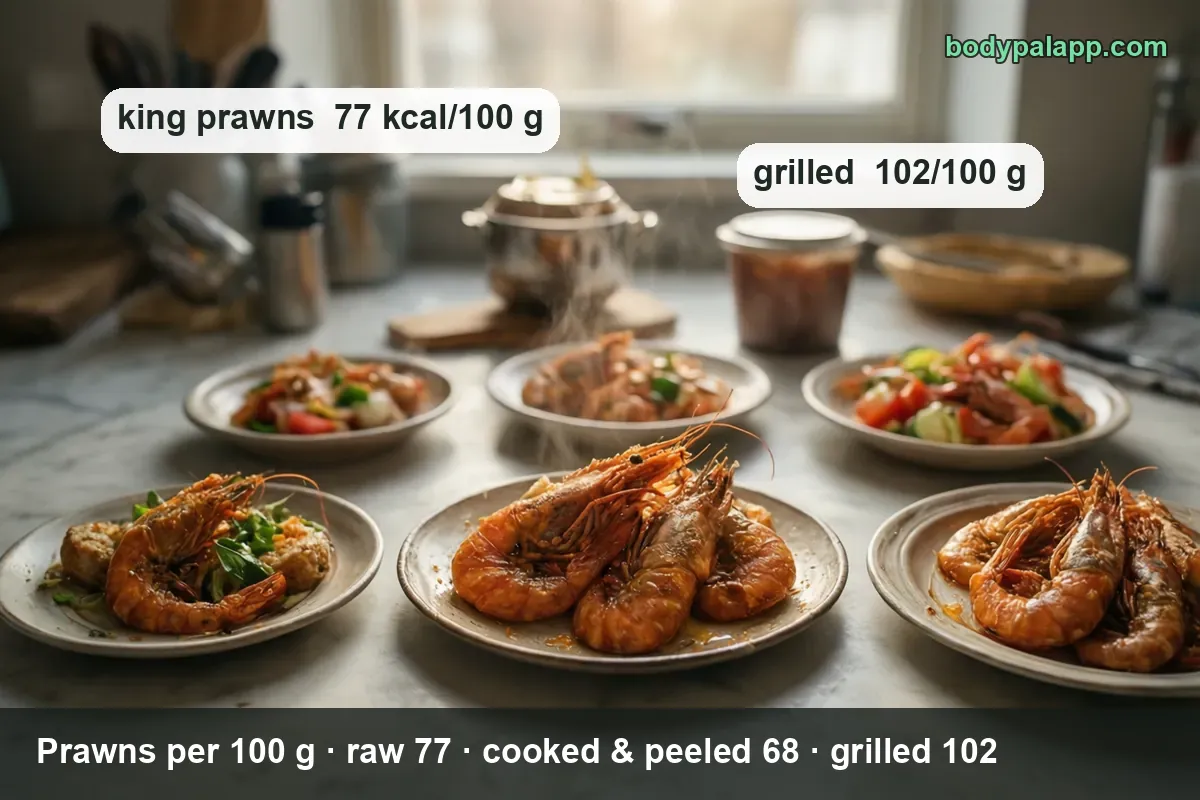
Szechuan prawns with vegetables at 83 kcal per 100 g is one of the lightest hot dishes on any takeaway menu, and the salt at 1.34 g per 100 g is the line to check rather than the calories. A prawn curry at 118 sits comfortably in the middle of the curry house, and the three variations of it separate by five calories, which is well inside the noise.
Prawn crackers are the joke of the table. At 570 kcal per 100 g with 0.3 g of protein, they contain more fat than everything else on this page put together and essentially no prawn. A bag of them can cost more calories than the curry it came with.
A chicken chow mein or a prawn version of the same dish behaves like the Szechuan line: light per 100 g, and heavy only because the box is large. A prawn salad or a plate of prawn sushi is lighter still.
The verdict on prawns
For protein per calorie, prawns are as good as it gets in a British supermarket. Grilled from raw at 102 kcal for 23.5 g of protein, they beat almost anything you could put next to them, and they do it with 0.9 g of fat.
For anyone watching salt, buy them raw. The gap between 0.537 g and 1.607 g per 100 g is entirely about how the packet was processed, and it is the one number on this page that changes a meal.
For value, ignore the shell-on price per kilo until you have halved the weight in your head. Forty-five per cent of that bag is not food.
The one habit worth dropping is treating cooked chiller prawns as the default. They are convenient, they are lighter on the calorie line for the wrong reason, and they are the saltiest ordinary form of the food.
Most popular king prawn brands in the United Kingdom
Ranked by how widely each product appears among foods sold in the United Kingdom, from the BodyPal food database of over 3.3 million products. Calories are the figures printed on each label. Cooked-and-peeled packs sit lower on calories and higher on salt than raw ones.
| Product | Calories (per 100 g) |
|---|---|
| Waitrose Raw Peeled Jumbo King Prawns | 127 kcal |
| Iceland King Prawn Tails | 112 kcal |
| Tesco Cooked & Peeled King Prawns | 80 kcal |
| Tesco King Prawns | 76 kcal |
| Aldi King Prawns | 72 kcal |
Brand popularity: BodyPal food database. Nutrition: manufacturer labels.
Prawn FAQs
How many calories are in prawns?
77 kcal per 100 g for raw king prawns, 102 kcal grilled and 68 kcal for ready-cooked prawns from the chiller. A 200 g pack of cooked prawns is 136 kcal with 32.4 g of protein. Weighed with their shells on, cooked prawns come to just 37 kcal per 100 g.
How many calories in king prawns?
King prawns are 77 kcal per 100 g raw, which rises to 102 kcal once grilled because heat drives out water and concentrates the flesh. Grilled king prawns also carry 23.5 g of protein per 100 g against 17.6 g raw. Standard prawns sit very close, at 70 kcal per 100 g bought cooked.
How many calories in cooked prawns?
68 kcal per 100 g for ready-cooked king prawns and 70 kcal for standard cooked prawns. They read lighter than raw prawns because they are boiled and packed in brine, which adds water weight. That brine also takes the salt to 1.607 g per 100 g, three times the raw figure.
How much protein is in prawns?
17.6 g per 100 g raw and 23.5 g per 100 g grilled, with 0.7 g of fat and no carbohydrate. That works out at roughly 92 per cent of the energy in a prawn coming from protein. Ready-cooked prawns are slightly lower at 16.2 g per 100 g.
Are prawns good for weight loss?
They are one of the most protein-dense low-calorie foods on a British shelf: 102 kcal per 100 g grilled for 23.5 g of protein and under 1 g of fat. The thing to keep an eye on is what goes with them, since a prawn curry is 118 kcal per 100 g and prawn crackers are 570. Buy raw rather than ready-cooked if you are also watching salt.
How many calories in a prawn curry?
118 kcal per 100 g for a takeaway prawn curry, with 8.2 g of protein, 8.5 g of fat and 0.777 g of salt. Bhuna comes in at 120 and madras at 115, so the style barely matters. A Szechuan-style prawn dish with vegetables is lighter again at 83 kcal per 100 g, though its salt is higher at 1.34 g.
How many calories in 100 g of prawns?
77 kcal raw, 102 kcal grilled and 68 kcal ready-cooked. If the 100 g includes the shells, the figure drops to 37 kcal, because roughly 45 per cent of the weight you buy shell-on is shell rather than meat. Always log the weight of what reaches the plate.
How many calories in one prawn?
Work from 77 kcal per 100 g raw and weigh a handful, since prawn sizes vary enormously between a small standard prawn and a jumbo king, and British packs are labelled by net weight rather than by piece. As a rule of thumb, a prawn contributes single-figure calories, and the sauce it arrives in contributes far more.
How much cholesterol is in prawns?
British composition data gives raw king prawns 150 mg per 100 g, purchased cooked ones 162 mg and grilled ones 193 mg, which is high next to most foods. What can be said from the composition data is that prawns are very low in fat at 0.7 g per 100 g raw, of which 0.17 g is saturated, and that saturated fat is the fat measure UK food labels report against a daily reference intake.
How many calories in a prawn cocktail?
There is no measured national figure for the assembled dish. Build it from the parts instead: ready-cooked prawns are 68 kcal per 100 g and the lettuce underneath is negligible, so the sauce is where the whole figure comes from. Weigh the sauce rather than the prawns.
Similar foods
- Potatoes — 130 kcal per boiled serving
- Jacket potato — 277 kcal per medium potato
- Cottage pie — ~444 kcal a portion
- Beans on toast — 338 kcal a plate
- Pasta carbonara — 124 kcal per 100 g the finished plate
- Beef — 161 kcal per 125 g lean portion
Let the camera do the weighing
Prawns are easy to log and everything around them is not. Photograph the plate and BodyPal handles the curry, the rice and the crackers as well.


How long does it take to burn off prawns?
100 g of raw king prawns is 77 kcal. Enter your weight and the amount you ate to see how long it takes you to burn that off:
lb
| Activity | Time to burn 77 kcal |
|---|---|
| Walking, brisk | 15 min |
| Cycling, moderate | 10 min |
| Swimming, moderate | 11 min |
| Jogging | 9 min |
| Weight training, moderate | 17 min |
Times are for a 154 lb (11 st) adult at a steady pace; change the weight to see yours. The amount is set to the portion in the text (100 g); change it to what you actually ate. BodyPal works this out from your steps automatically.
Want the bigger picture? Calculate your daily calorie needs — your maintenance figure, a target for losing or gaining, and the date you get there.