
How Many Calories in Miso Soup?
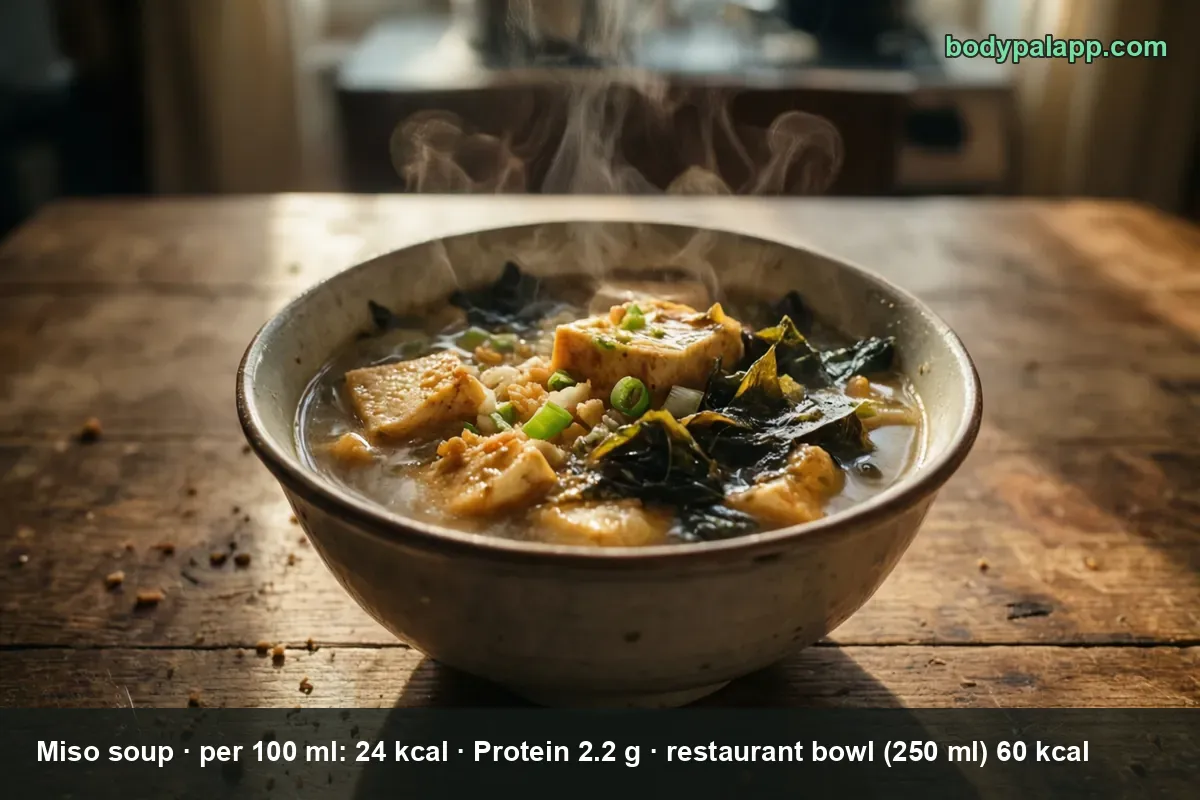
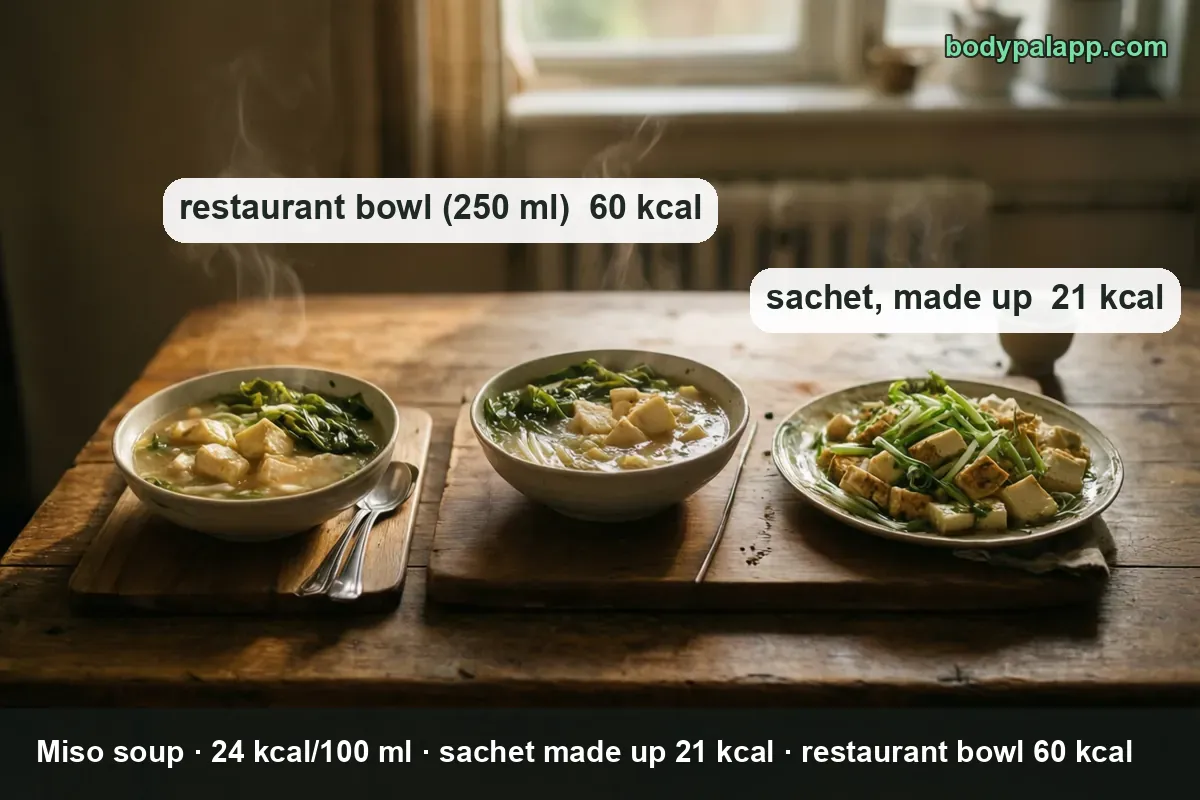
Miso soup is about 21 calories if it came out of an instant sachet, and about 60 calories for a 250 ml restaurant bowl with tofu and wakame in it. Both are miso soup; they are not the same food. And neither number is the one to watch, because a single sachet carries 1.8 g of salt.
On this page
- Two soups under one name
- Miso soup quick facts
- The sachet: three labels, one number
- Two grams of salt for twenty-one calories
- Miso paste by the spoonful
- Miso soup next to everything else on the menu
- Popular miso products
- Miso soup FAQs
Two soups under one name
Search the UK government's food composition dataset for miso and you get nothing back. No paste, no soup, no bowl, in nearly 2,900 rows. There is no official British figure for this dish, which is a large part of why calorie charts for it disagree by a factor of three.
The disagreement is real, though, and it is not a data problem. It is two different bowls.
| Version | Bowl | Calories | Salt |
|---|---|---|---|
| Restaurant miso with tofu and wakame | 250 ml | 60 kcal | 2.00 g |
| itsu sachet, made up | 221 ml | 21 kcal | 1.80 g |
| Yutaka Mellow Yellow sachet, made up | 177 ml | 21 kcal | 1.56 g |
Everything that separates 21 from 60 is solid matter. Restaurant miso arrives with cubes of tofu, a scatter of wakame and often spring onion; the sachet is stock with dissolved paste and a few flakes. So pick your row by what is floating in the bowl, not by which website you trust.
Miso soup quick facts
These figures are the restaurant bowl — the one with tofu — at 250 ml, which is roughly what arrives alongside a sushi order.
| Nutrient | Per 100 ml | 250 ml bowl | RI%* |
|---|---|---|---|
| Energy | 24 kcal / 100 kJ | 60 kcal / 251 kJ | 3% |
| Protein | 2.2 g | 5.5 g | 11% |
| Carbohydrates | 2.3 g | 5.8 g | 2% |
| Fat | 0.85 g | 2.1 g | 3% |
| Salt | 0.80 g | 2.00 g | 33% |
*RI% = one bowl's share of an adult's daily reference intake, based on 2,000 kcal.
Verified nutrition data
Numbers on this page come from CoFID, the UK government’s Composition of Foods Integrated Dataset, and from manufacturer labels where a branded product is named. Last verified September 2026. How we verify our data →
Two rows are missing, and deliberately. Neither the prepared soup figures nor the UK sachet labels break out fibre or saturated fat, so there is nothing honest to put in those lines. Everything else here holds together: 2.2 g of protein, 2.3 g of carbohydrate and 0.85 g of fat per 100 ml add up to 25.7 kcal against a stated 24, which is the kind of agreement you want from a nutrition row.
Look at the last two columns side by side. The energy line uses 3% of the day. The salt line uses 33%. An eleven-fold gap between what a food costs you in calories and what it costs you in sodium is unusual, and it is the whole story of miso.
The sachet: three labels, one number
Instant miso is sold as paste in a foil sachet, 15 g to 21 g of it, stirred into hot water. Three independent British labels put the same figure on it.
itsu's paste is 100 kcal per 100 g and the sachet holds 21 g, giving 21.0 kcal. itsu's ready-made soup is 9.5 kcal per 100 ml over a 221 ml serving, giving 21.0 kcal. Yutaka's ready-made is 12 kcal per 100 ml over 177 ml, giving 21.2 kcal. Three products, two manufacturers, one answer: a sachet of miso soup is 21 calories.
| Sachet | Weight | Calories | Salt | Share of 6 g |
|---|---|---|---|---|
| itsu miso'easy Traditional | 21 g | 21 kcal | 1.80 g | 30% |
| Yutaka Wakame | 18 g | 18 kcal | 2.16 g | 36% |
| Clearspring White Miso | 15 g | 23 kcal | 2.24 g | 37% |
| Clearspring Brown Rice Miso | 15 g | 25 kcal | 2.07 g | 35% |
| Clearspring Creamy Sesame | 15 g | 34 kcal | 1.89 g | 32% |
Seven calories separate the cheapest sachet from the dearest, apart from the sesame one, which is a different recipe. For a food eaten as a warm-up before a meal, the brand on the packet makes no practical difference to your day.
The salt column is where the brands part company. Clearspring's paste is 14.9 g of salt per 100 g against itsu's 8.57 g — close to double — and that difference survives into the bowl.
Two grams of salt for twenty-one calories
Miso is fermented in salt. That is not a manufacturing shortcut, it is how the paste is made and kept, and it puts miso among the saltiest things in a British kitchen. Per 100 g, miso paste carries around 12 g of salt. The only ordinary ingredient that beats it is soy sauce at 13.75 g.
The adult limit is 6 g of salt a day, about a level teaspoon. Here is what one bowl spends against it:
- One itsu sachet: 1.80 g, or 30% of the day
- One Clearspring sachet: 2.24 g, or 37%
- One 250 ml restaurant bowl: 2.00 g, or 33%
Two sachets in a day — a normal habit for anyone who keeps a box at their desk — comes to between 3.6 g and 4.5 g of salt. That is 60% to 75% of the daily limit for 42 calories.
This is the reason miso soup is worth logging even though the calories are trivial. As a low-calorie, warm, savoury thing to have at four in the afternoon, it is genuinely hard to beat: 21 kcal, and it takes ten minutes to drink. As a daily habit stacked on top of bread, bacon and a ready meal, it quietly eats a third of your salt allowance each time. The Eatwell Guide puts the same point more broadly: British diets rarely fail on the calories in soup.
Miso paste by the spoonful
Type "miso calories" into a search box and you will be handed something near 190 kcal per 100 g. That number is correct and almost useless, because nobody eats 100 g of miso paste.
| Form | Amount | Calories | Salt |
|---|---|---|---|
| White miso paste | per 100 g | 190 kcal | ~12 g |
| Paste, tablespoon | 18 g | 32 kcal | 2.1 g |
| Paste, teaspoon | 6 g | 11 kcal | 0.7 g |
| Sachet, made into soup | 21 g | 21 kcal | 1.80 g |
| Restaurant bowl with tofu | 250 ml | 60 kcal | 2.00 g |
UK jars run from 141 kcal per 100 g for Clearspring's white miso up to 208 for a red one, with most white pastes near 190. Red miso is fermented longer and comes out slightly higher in carbohydrate; the calorie difference across the whole shelf is under 70 kcal per 100 g, which is a couple of calories per spoon.
Used as a glaze on salmon or stirred into a dressing, a tablespoon adds 32 calories and 2.1 g of salt to the dish. The salt is the part to plan around — a recipe calling for two tablespoons has spent 70% of the day's allowance before anything else goes in the pan.
Miso soup next to everything else on the menu
| Item | Per 100 g / ml | Typical serving | Calories |
|---|---|---|---|
| Miso soup, restaurant bowl | 24 kcal | 250 ml | 60 kcal |
| Miso soup, from a sachet | 9.5 kcal | 221 ml | 21 kcal |
| Instant dried soup, made up | 37 kcal | — | — |
| Canned minestrone | 31 kcal | — | — |
| Sushi | 160 kcal | — | — |
| Instant noodles | 135 kcal | — | — |
| Prawns | 77 kcal | — | — |
| Cup of tea | 5 kcal | mug with milk | 13 kcal |
Miso from a sachet is lighter per 100 ml than any tinned or dried soup on the British shelf, and closer to tea than to lunch. Even the restaurant bowl, tofu included, is under a third of what a packet of instant noodles delivers.
Our take: as the thing you order before sushi, miso soup is the best-value item on the table — 60 calories, and 5.5 g of protein from the tofu, which the NHS lists among the protein sources for a meat-free diet. As a snack you keep in a drawer, the sachet at 21 kcal is unbeatable on calories and the worst thing in the drawer on salt. One a day is a rounding error. Three a day is more salt than a bag of crisps and a bacon roll combined.
Popular miso products in the BodyPal food database
Ranked by how widely each product appears among foods sold in the United Kingdom, from the BodyPal food database of over 3.3 million products. Calories are the figures printed on each label. The first three are paste; the last two are the made-up soup, which is where the 21 kcal bowl comes from.
| Product | Calories (per 100 g) |
|---|---|
| Yutaka Miso Paste | 176 kcal |
| Hikari Miso | 202 kcal |
| Hikari Organic White Miso | 189 kcal |
| Hikari Miso Tofu Soup, made up | 21 kcal |
| Hikari Instant Miso Soup, made up | 16 kcal |
Brand popularity: BodyPal food database. Nutrition: manufacturer labels.
Miso soup FAQs
How many calories in miso soup?
About 21 calories for a bowl made from an instant sachet, and about 60 for a 250 ml restaurant bowl containing tofu and wakame. The prepared soup works out at 24 kcal per 100 ml with tofu in it, or 9.5 to 12 kcal per 100 ml from a sachet.
How many calories in a bowl of miso soup?
A 250 ml restaurant bowl is 60 kcal, a 200 ml bowl is 48 kcal and a large 300 ml bowl is 72 kcal. Made at home from a sachet, the same bowl is 21 kcal, because the calories come from the tofu rather than the miso.
How many calories in itsu miso soup?
21 calories per 21 g sachet of itsu miso'easy Traditional. The ready-made version agrees: 9.5 kcal per 100 ml across a 221 ml serving is also 21 calories. Each sachet carries 1.80 g of salt, which is 30% of the adult daily limit.
How much salt is in miso soup?
Between 1.56 g and 2.24 g in one sachet, and about 2.00 g in a 250 ml restaurant bowl. That is 26% to 37% of the 6 g adult daily limit. Miso paste itself is around 12 g of salt per 100 g, second only to soy sauce.
How many calories in a tablespoon of miso paste?
About 32 calories for an 18 g tablespoon, and 11 calories for a 6 g teaspoon. UK jars run from 141 to 208 kcal per 100 g, with most white pastes near 190. The tablespoon also brings 2.1 g of salt, which is the figure to plan a recipe around.
How much protein is in miso soup?
5.5 g in a 250 ml restaurant bowl, which is 11% of the daily reference intake. Nearly all of it comes from the tofu rather than the miso, so a sachet made up with water is a much lighter bowl in every sense at 21 calories.
Is miso soup healthy?
It is very light on calories and heavy on salt. A bowl costs 3% of a day's energy and 30% to 37% of a day's salt. If you are cutting back on salt, one bowl a day sits comfortably inside the 6 g limit; three do not.
Why do miso soup calorie figures vary so much?
Because there is no entry for miso in the UK government food composition dataset, and because two different dishes share the name. A sachet stirred into water is 21 kcal; the same bowl with tofu and wakame is 60. Charts that pick one and call it miso soup are half right.
Similar foods
- Potatoes — 130 kcal per boiled serving
- Prawns — 77 kcal per 100 g raw king prawns
- Jacket potato — 277 kcal per medium potato
- Cottage pie — ~444 kcal a portion
- Beans on toast — 338 kcal a plate
- Pasta carbonara — 124 kcal per 100 g the finished plate
Skip the sums
Hold the phone over the bowl and BodyPal logs the calories and the salt together, which is the pair that matters here.


Burning it off is one side of it. The other is knowing your number: work out how many calories you need a day, with macros and a goal date.