
Calories in a Scone: 229 Before the Jam Goes On
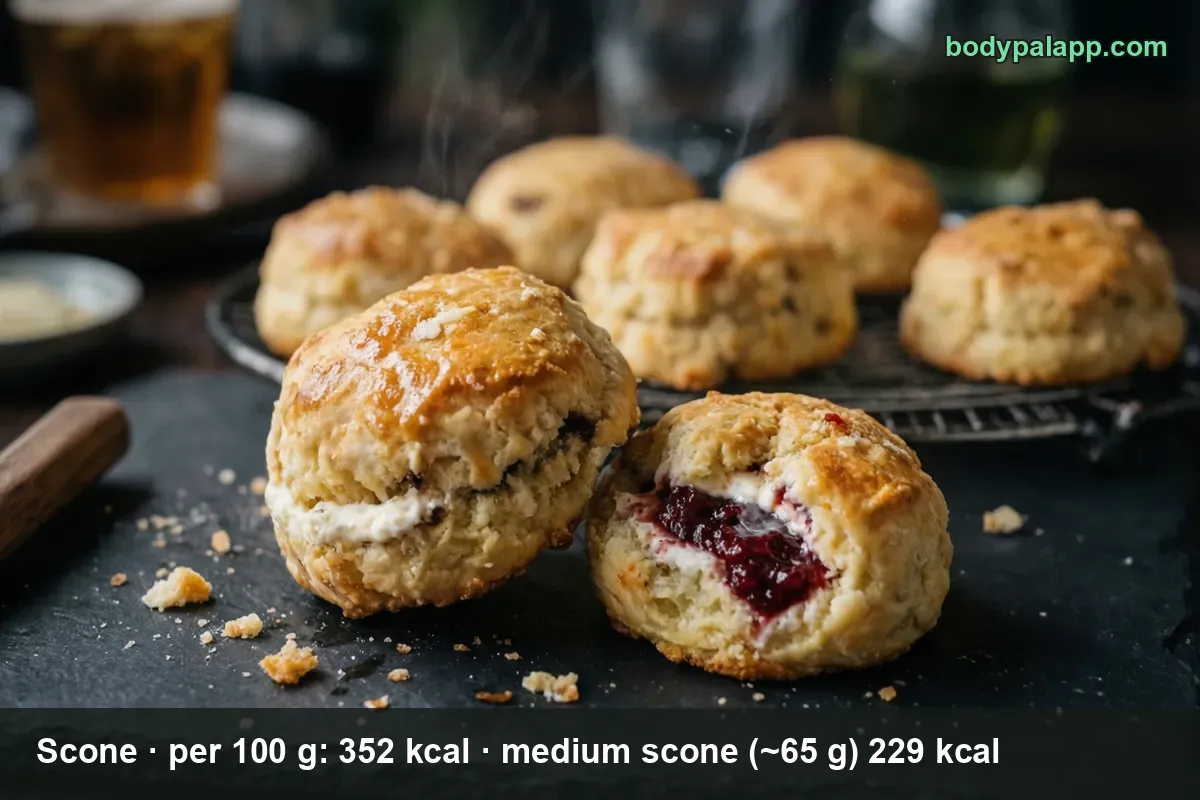
Afternoon tea has its own accounting, and it starts here: the calories in a scone come to 229 for a medium plain one of about 65 g, or 352 per 100 g. That is the price of the bare scone. The butter, jam and cream are all separate line items, and they add up faster than the scone did.
On this page
- Scone nutrition at a glance
- Portions, from teatime to coffee shop
- Cheese, fruit, wholemeal and the rest
- The salt nobody tastes
- Scone against crumpet, bagel and bread
- The fruit scone myth
- Most popular scone brands
- FAQ
Scone nutrition at a glance
| Nutrient | Per 100 g | Per medium scone (~65 g) | %RI* per scone |
|---|---|---|---|
| Energy | 352 kcal / 1,473 kJ | 229 kcal / 958 kJ | 11% |
| Protein | 7.2 g | 4.7 g | 9% |
| Carbohydrate | 55.9 g | 36.3 g | 14% |
| of which sugars | 5.4 g | 3.5 g | 4% |
| Fat | 12.7 g | 8.3 g | 12% |
| of which saturates | 4.4 g | 2.9 g | 14% |
| Fibre | 2.4 g | 1.6 g | – |
| Salt | 1.6 g | 1.0 g | 17% |
*%RI = percentage of the reference intake for an average adult (2,000 kcal; 70 g fat, 20 g saturates, 260 g carbohydrate, 90 g sugars, 50 g protein, 6 g salt).
Verified nutrition data
Numbers on this page come from CoFID, the UK government’s Composition of Foods Integrated Dataset, and from manufacturer labels where a branded product is named. Last verified August 2026. How we verify our data →
Those figures are for a plain homemade scone. The headline is not the energy, which sits where most small baked goods sit. It is the bottom row: a single scone carries a gram of salt, and nothing about a scone tastes salty.
The other quiet number is the sugar. At 3.5 g per scone, a plain one is barely sweet at all. What makes a cream tea sweet arrives on a spoon, not in the bake.
Portions, from teatime to coffee shop
| Portion | Weight | Calories |
|---|---|---|
| Medium plain scone | ~65 g | 229 kcal |
| Large coffee-shop scone | ~95 g | 334 kcal |
| Retail fruit scone | ~80 g | 270 kcal |
| Butter on top, thin scrape | ~7 g | +52 kcal |
The size drift is the real story. A scone from a home recipe cutter is about 65 g; the one in the coffee-shop cabinet is nearer 95 g, and at 334 kcal it costs almost half as much again before anything is spread on it. Same food, same recipe, third more calories.
Add a thin scrape of butter and a medium scone lands at 281 kcal. A generous knife does not stay at 7 g, which is why the spread so often outgrows its estimate.
For the full cream tea, the arithmetic keeps going: jam, then cream, each a separate addition on top of the 229. The combined dish is covered in the variants below, and the number behaves oddly when you look at it per 100 g.
Cheese, fruit, wholemeal and the rest
Every scone in the UK dataset lands between 279 and 358 kcal per 100 g. The spread is small; the character changes completely.
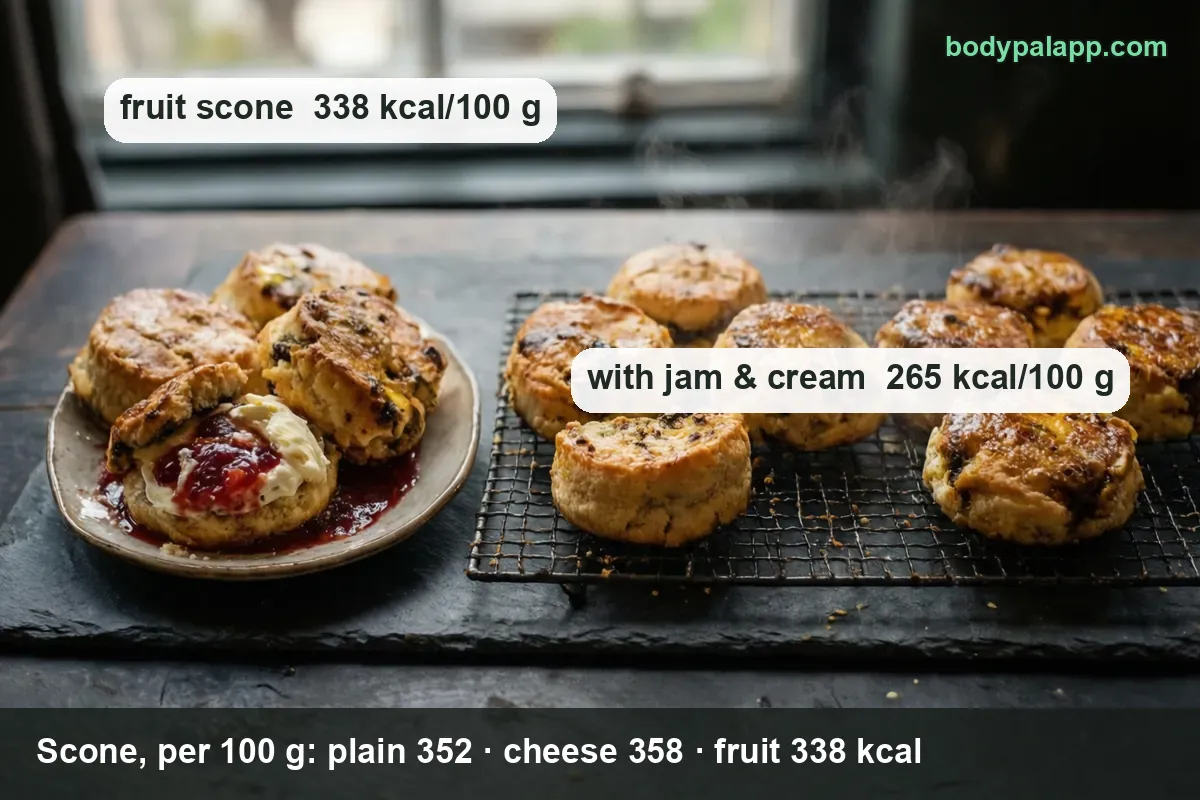
Cheese scone: 358 kcal per 100 g. The heaviest of the family, though only just. Fat rises to 16.4 g and saturates to 7.2 g because of the cheese, but so does protein, at 10.1 g the highest of any scone. Sugars drop to 1.9 g. As an occasional savoury lunch with soup, it is a more balanced item than its reputation.
Fruit scone: 338 kcal per 100 g. Slightly lighter than plain, and much sweeter: 18.9 g of sugars against the homemade plain's 5.4 g. The sultanas replace some flour, trading starch for sugar almost one for one. The salt is the fruit scone's quiet win, at 1.0 g per 100 g the lowest here.
Wholemeal scone: 319 kcal per 100 g. The fibre pick, and by a wide margin: 5.8 g per 100 g, more than double the plain scone's 2.4 g. Set against the 30 g of fibre a day the NHS recommends, one wholemeal scone does more work than any two of its cousins.
Potato scone: 279 kcal per 100 g. The lightest per 100 g, because potato carries water that flour does not. A tattie scone from the frying pan is a different breakfast tradition from the cream-tea scone, but the dataset treats them as one family.
Shop-bought vs homemade: the sugar doubles. A retail plain scone reads 346 kcal per 100 g, near enough identical to homemade at 352. The difference hides in one line: sugars are 12.7 g per 100 g retail against 5.4 g homemade. The supermarket version is more than twice as sweet, and you would struggle to taste where the calories moved.
Scone with jam and cream: 265 kcal per 100 g. Lower than the plain scone's 352, which looks like a mistake until you see why: jam and cream are heavy, moist additions, so they dilute the calories per 100 g while raising the total on the plate. The number per gram falls; the number you eat goes up. It is the neatest example of why per-100 g figures mislead on assembled food.
The salt nobody tastes
A plain scone carries 1.6 g of salt per 100 g. That is crisp-packet territory, hiding in something served with a cup of tea and jam.
The raising agents do it. Baking powder and bicarbonate of soda are sodium salts, so the fluffiness and the salt arrive together, along with any salt in the recipe. A large 95 g coffee-shop scone holds roughly 1.5 g, a quarter of the 6 g daily limit the NHS advises for adults, before the butter adds its own.
If you are watching salt, the fruit scone at 1.0 g per 100 g is the better pick, and it is not close. Cheese, plain and potato all sit at 1.6 g.
Scone against crumpet, bagel and bread
| Food | Per item | Per 100 g |
|---|---|---|
| Scone (medium, plain) | 229 kcal | 352 kcal |
| Bagel | 230 kcal | 264 kcal |
| Crumpet | 95 kcal | 207 kcal |
| White bread (slice) | 85 kcal | 236 kcal |
The verdict: per item, a scone and a bagel are twins at 229 and 230 kcal, and both cost nearly three crumpets. Per 100 g the scone is the densest thing on the table, because butter is baked into the dough; the bakery items take their fat later, from the knife. For an afternoon bite that stays under 100 kcal, the crumpet wins before the toppings decide the rest.
A scone is the only one of the four that arrives sweet enough to need nothing, which is precisely why it never gets nothing.
The fruit scone myth
"The fruit scone is the light option." Not really. At 338 kcal per 100 g against 352 for plain, the saving is 4%, and a typical retail fruit scone is bigger, so the plate difference vanishes. What actually changes is the sugar, 18.9 g against 5.4 g per 100 g. Choose the fruit scone because you like sultanas, or for its lower salt. Choosing it for the calories is a rounding error.
Most popular scone brands in the United Kingdom
Ranked by how widely each product appears among foods sold in the United Kingdom, from the BodyPal food database of over 3.3 million products. Calories are the figures printed on each label. Every one is a fruit scone, because that is what the supermarkets bake; all five sit within the CoFID homemade-to-retail range.
| Product | Calories (per 100 g) |
|---|---|
| Tesco Finest All Butter Sultana Scones | 360 kcal |
| Sainsbury’s Raisin Scones | 355 kcal |
| Tesco Sultana Scones | 351 kcal |
| Waitrose All Butter Sultana Scones | 312 kcal |
| M&S Fruit Scone | 285 kcal |
Brand popularity: BodyPal food database. Nutrition: manufacturer labels.
How long does it take to burn off a scone?
A medium plain scone (~65 g) is 229 kcal. Enter your weight and the amount you ate to see how long it takes you to burn that off:
lb
| Activity | Time to burn 229 kcal |
|---|---|
| Walking, brisk | 46 min |
| Cycling, moderate | 29 min |
| Swimming, moderate | 33 min |
| Jogging | 27 min |
| Weight training, moderate | 51 min |
Times are for a 154 lb (11 st) adult at a steady pace; change the weight to see yours. The amount is set to the portion in the text (65 g); change it to what you actually ate. BodyPal works this out from your steps automatically.
Want the bigger picture? Calculate your daily calorie needs — your maintenance figure, a target for losing or gaining, and the date you get there.
Frequently asked questions
How many calories are in a plain scone?
A medium plain scone of about 65 g is 229 kcal, and the figure per 100 g is 352. A large coffee-shop scone nearer 95 g comes to 334 kcal. Those numbers are for the scone alone, before butter, jam or cream are added.
How many calories are in a cheese scone?
Cheese scones are 358 kcal per 100 g, the highest of the scone family, with 16.4 g of fat. They also carry the most protein at 10.1 g per 100 g and the least sugar at 1.9 g, so as a savoury option alongside soup they hold their own.
How many calories are in a scone with butter?
About 281 kcal: 229 for a medium plain scone plus 52 for a thin 7 g scrape of butter. A generous spread is easily double the weight, which pushes the total past 330. The butter is the quietest addition on the plate and often the largest.
How many calories are in a scone with jam and cream?
As a combined dish it measures 265 kcal per 100 g, which is lower than a plain scone's 352 because jam and cream dilute the calories per gram while adding to the total. The whole cream-tea plate weighs far more than the scone did, so the overall count rises well past the bare 229.
Why do scones have so much salt?
A plain scone holds 1.6 g of salt per 100 g, roughly 1.0 g in a medium one, because baking powder and bicarbonate are sodium salts. A large scone reaches about 1.5 g, a quarter of the NHS 6 g daily limit, without tasting salty at all. Fruit scones are lower at 1.0 g per 100 g.
Are shop-bought scones worse than homemade?
On calories they are almost identical: 346 kcal per 100 g retail against 352 homemade. The real gap is sugar, 12.7 g per 100 g in the shop version against 5.4 g homemade, more than double. Baking your own mostly buys you control of the sweetness, not a lighter scone.
Is a fruit scone healthier than a plain one?
It is 338 kcal per 100 g against 352, a difference too small to matter, and it carries far more sugar at 18.9 g per 100 g. Its genuine advantage is salt, at 1.0 g per 100 g versus 1.6. If fibre is the goal, the wholemeal scone at 5.8 g per 100 g beats both.
Is a scone more calorific than a crumpet or a bagel?
Per item a scone at 229 kcal and a bagel at 230 are level, while a crumpet is 95. Per 100 g the scone leads at 352 because the butter is baked in. A crumpet with a scrape of butter still comes in under 150 kcal, which makes it the lighter teatime bread by a distance.
Can a scone fit into weight loss?
A 229 kcal medium scone fits most calorie targets as an occasional afternoon treat, especially alongside a plain cup of tea. The total is decided by what goes on top and by size: coffee-shop scones run to 334 kcal bare. Keeping the toppings to one, jam or cream rather than both, halves the add-ons.
Similar foods
- Sausage roll — 348 kcal a Greggs roll
- Croissant — 224 kcal each
- Jam doughnut — ~241 kcal each
- Hot cross bun — 218 kcal each
- Greggs Yum Yum — 310 kcal each
- Tortilla wrap — 196 kcal per large wrap
Count it without the maths
BodyPal logs the scone, the butter and whatever the tearoom added from one photo, so the cream tea stops being a mystery number.

