
Calories in a Croissant: 224 kcal [45 Minutes of Walking]
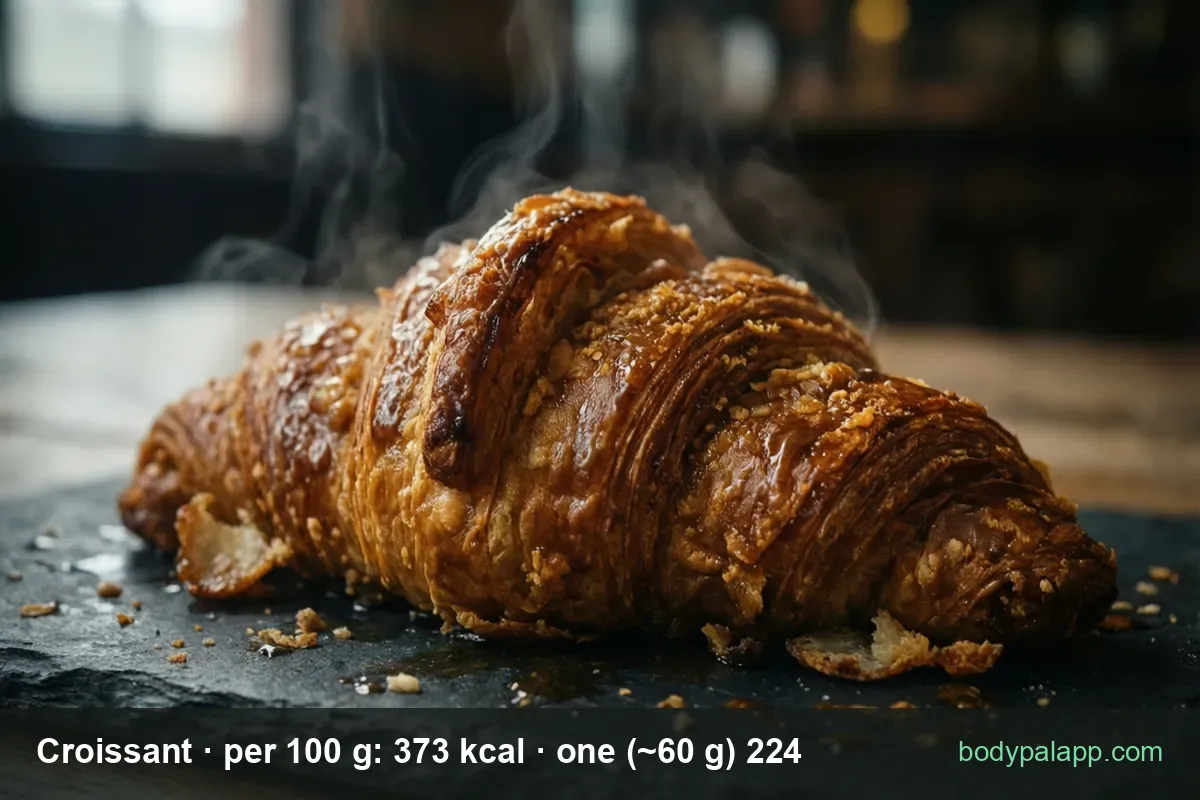
A standard all-butter croissant weighing about 60 g contains 224 calories, and per 100 g croissants provide 373 kcal (1,561 kJ). Choose the large 80 g bakery version and you are at 298 calories before any jam appears. The calories in a croissant come overwhelmingly from butter, and that changes how you should log it.
On this page
- Quick facts
- Portions: how big is your croissant?
- Why croissant calories run so high
- How does it compare?
- The "it's basically a bread roll" mistake
- Most popular croissant brands
- FAQ
Quick facts
| Nutrient | Per 100 g | Per croissant (60 g) | % RI (60 g)* |
|---|---|---|---|
| Energy | 373 kcal (1,561 kJ) | 224 kcal (937 kJ) | 11% |
| Protein | 8.3 g | 5.0 g | 10% |
| Carbohydrates | 43.3 g | 26.0 g | 10% |
| Fat | 19.7 g | 11.8 g | 17% |
| Fibre | 3.1 g | 1.9 g | — |
| Sugar | 5.3 g | 3.2 g | 4% |
| Salt | 0.825 g | 0.50 g | 8% |
*Reference intake for an average adult, calculated for the 60 g croissant.
Verified nutrition data
Numbers on this page come from CoFID, the UK government’s Composition of Foods Integrated Dataset, and from manufacturer labels where a branded product is named. Last verified August 2026. How we verify our data →
Two numbers on that table deserve a second look. First, fat: nearly a fifth of a croissant's weight is fat, and one 60 g pastry uses up 17% of the day's reference intake on its own. Second, sugar: at just 3.2 g per croissant, it is genuinely modest. A croissant tastes rich, not sweet, and the nutrition label agrees.
The salt is the quiet one. Half a gram per croissant sounds like nothing, yet it is 8% of the 6 g daily maximum the NHS recommends — from something that doesn't taste salty at all.
There is one small consolation in the table: fibre. At 3.1 g per 100 g, croissants do better than their image suggests, and a single pastry contributes 1.9 g towards the day. It doesn't redeem the fat column, but it is more than zero, which is what most people would have guessed.
Portions: how big is your croissant?
| Portion | Typical weight | Calories |
|---|---|---|
| All-butter croissant, supermarket size | ~60 g | 224 kcal |
| Large bakery croissant | ~80 g | 298 kcal |
Croissant sizes drift more than most people realise. The neat supermarket multipack croissant sits around 60 g, while an independent bakery or coffee-shop croissant is often nearer 80 g. That size difference alone is worth 74 calories, roughly a third of the smaller pastry again.
Whatever the size, the figure covers the plain pastry only. A teaspoon of jam, a curl of butter or a chocolate filling is logged on top, not included. If you eat croissants regularly, weigh one from your usual source once; after that you will know which of the two rows above is yours.
Why croissant calories run so high
A croissant is laminated dough: a yeasted sheet folded again and again around a slab of butter until the pastry holds dozens of alternating layers. Those layers are the whole point. In the oven the butter steams, the sheets separate, and you get the shatter and pull that no ordinary roll can produce.
They are also the whole calorie story. Fat is the most energy-dense thing on any label, and at 19.7 g per 100 g a croissant carries more of it than almost any plain baked good you might put in the same basket. The flour, by contrast, behaves normally: 43.3 g of carbohydrate per 100 g is standard bakery territory.
That is why the NHS Eatwell Guide would file croissants under "eat less often and in small amounts" rather than under everyday starchy carbohydrates. It is also why swapping to a "lighter" spread on top misses the point; the fat you can see is a fraction of the fat already folded inside.
None of this makes a croissant a mistake. At 224 calories, one all-butter croissant is 11% of a 2,000-kcal day, entirely affordable as a planned breakfast. The trouble starts when it is logged as "roll, 90 kcal-ish" or not logged at all.
How does it compare?
The verdict: a croissant sits far closer to a brownie than its breakfast image suggests, and a plain scone is barely lighter. If you want something bread-shaped with your morning coffee and room left in the day, the crumpet at 207 kcal per 100 g wins by a distance.
The "it's basically a bread roll" mistake
The most common croissant error isn't greed, it's classification. A croissant looks like a breakfast roll, sits in the bakery aisle next to rolls, and so gets logged as one. Nutritionally it is a different object: a pastry whose defining ingredient is butter, with 11.8 g of fat in a single 60 g piece.
The fix is boringly simple. Log it by name, at its real weight, and treat the 224–298 kcal range as the honest cost of a proper croissant. Underestimating breakfast by a couple of hundred calories every Saturday is exactly the kind of leak that makes a tracking week look inexplicable.
The reverse mistake exists too: treating a croissant as a blowout that "ruins the day". It doesn't. One 60 g pastry is 11% of a 2,000-kcal budget — a planned breakfast, not a crisis — and the day carries on from there like any other.
Most popular croissant brands in the United Kingdom
Ranked by how widely each product appears among foods sold in the United Kingdom, from the BodyPal food database of over 3.3 million products. Calories are the figures printed on each label.
| Product | Calories (per 100 g) |
|---|---|
| Lidl Croissant | 415 kcal |
| Maître Jean Pierre Croissant (Lidl) | 458 kcal |
Brand popularity: BodyPal food database. Nutrition: manufacturer labels.
Croissant questions, answered
How many calories are in one croissant?
A typical 60 g all-butter croissant has 224 calories, and a large 80 g bakery croissant has 298. Per 100 g the figure is 373 kcal. Weight is everything here: a slightly bigger pastry adds calories faster than a slightly bigger slice of bread would.
How many calories are in a chocolate croissant?
Plain croissant pastry runs at 373 kcal per 100 g, and a chocolate version adds filling on top of that, so expect a higher total for a similar size. The pastry alone already provides 224 calories at 60 g; check the label or weigh the finished item for the rest.
What about a croissant sandwich?
The croissant base contributes 224 calories at 60 g before any filling goes in. Ham, cheese, butter and sauces all stack on top, which is how a filled croissant overtakes an ordinary sandwich so easily. Log the pastry and each filling separately for an honest total.
How many calories in a cheese croissant?
Start from 224 calories for a 60 g plain croissant; baked-in or melted cheese raises both the fat and the salt, so the finished pastry lands higher. Cheese croissants also tend to be made on the larger 80 g size, where the plain base alone is already 298 kcal.
How many calories in a coffee-shop or Starbucks croissant?
Coffee-shop croissants usually sit at the larger end, so the 80 g figure of 298 calories is a better anchor than the 224-calorie supermarket size. UK chains display calories at the counter and online, so check the card for the exact recipe you are buying.
Is a croissant a bread?
With 19.7 g of fat per 100 g, a croissant is a laminated yeast pastry — what bakers call viennoiserie — rather than a bread. The dough is folded repeatedly around butter, which creates both the flaky layers and most of the energy. Nutritionally, treat it as pastry.
Is a croissant healthy?
At 373 kcal and 19.7 g of fat per 100 g, a croissant is an occasional pleasure rather than an everyday staple by NHS Eatwell standards. There is nothing alarming about one, though: a single 60 g croissant is 11% of a 2,000-kcal day, with only 3.2 g of sugar.
Are croissants actually French?
The 224-calorie crescent on your plate was perfected in France, but its ancestor is the Austrian kipferl, which reached Paris in the 19th century. France's contribution was the laminated butter dough — precisely the technique responsible for most of a croissant's 373 kcal per 100 g.
Similar foods
- Sausage roll — 348 kcal a Greggs roll
- Scone — 229 kcal per medium scone
- Greggs Yum Yum — 310 kcal each
- Doughnut — 413 kcal per 100 g iced ring
- Jam doughnut — ~241 kcal each
- Flapjack — 260 kcal a slice
Count it without the maths
Point your camera at the pastry counter and BodyPal returns the croissant's calories, fat and salt from a single photo.


How long does it take to burn off a croissant?
A 60 g all-butter croissant is 224 kcal. Enter your weight and the amount you ate to see how long it takes you to burn that off:
lb
| Activity | Time to burn 224 kcal |
|---|---|
| Walking, brisk | 45 min |
| Cycling, moderate | 28 min |
| Swimming, moderate | 32 min |
| Jogging | 26 min |
| Weight training, moderate | 50 min |
Times are for a 154 lb (11 st) adult at a steady pace; change the weight to see yours. The amount is set to the portion in the text (60 g); change it to what you actually ate. BodyPal works this out from your steps automatically.
This table assumes you know your daily total. If you do not, the daily calorie calculator works it out from five numbers.