
Calories in a Crunchie: 186 kcal [37 Minutes of Walking]
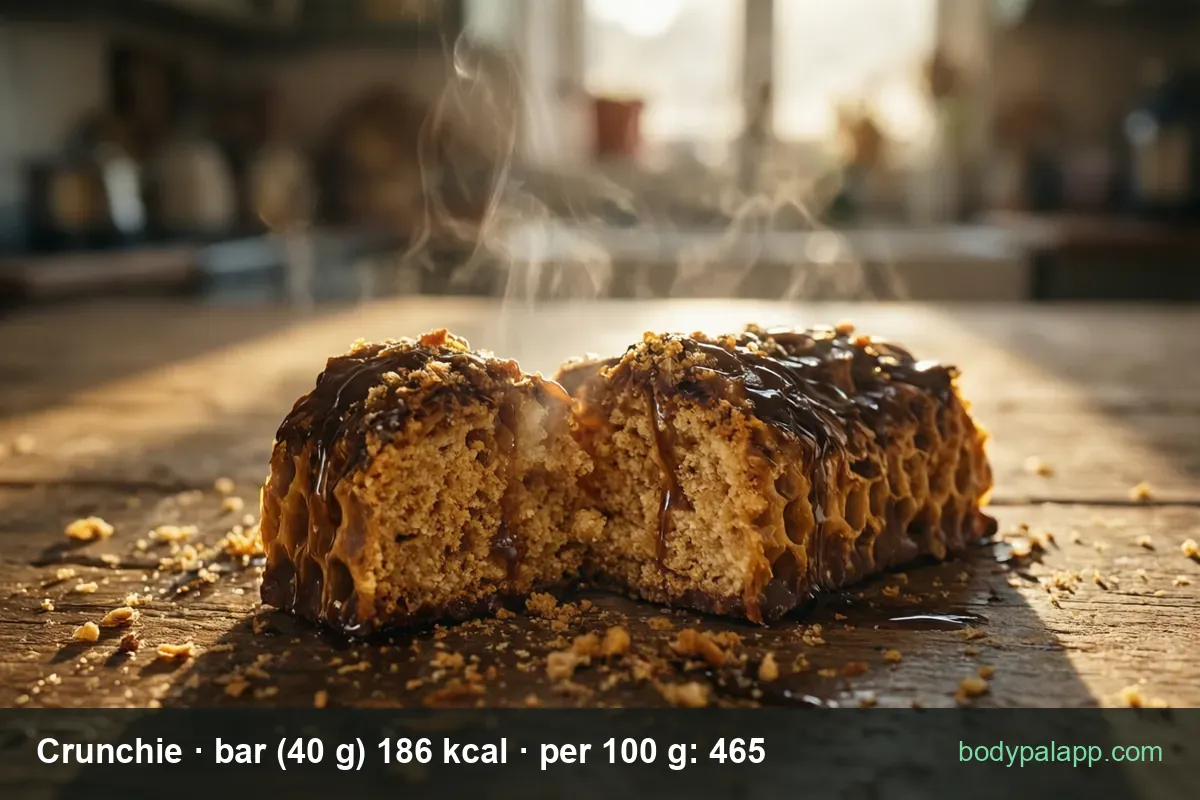
There are 186 calories in a Crunchie, the standard 40 g bar, which works out at 465 kcal per 100 g. Honeycomb sounds airy, and it is; air is also why the sugar figure startles people. At 65 g per 100 g, roughly two thirds of a Crunchie's weight is sugar.
On this page
- Crunchie nutrition at a glance
- The bar in your hand
- What honeycomb actually is
- Sugar by bar: Crunchie against the rest
- Most popular Crunchie products
- FAQ
Crunchie nutrition at a glance
| Nutrient | Per bar (40 g) | Per 100 g | %RI* per bar |
|---|---|---|---|
| Energy | 186 kcal / 778 kJ | 465 kcal / 1,946 kJ | 9% |
| Protein | 1.2 g | 3.0 g | 2% |
| Carbohydrate | 29.6 g | 74 g | 11% |
| of which sugars | 26.0 g | 65 g | 29% |
| Fat | 6.8 g | 17 g | 10% |
| of which saturates | 4.0 g | 10 g | 20% |
| Fibre | – | – | – |
| Salt | 0.29 g | 0.72 g | 5% |
*%RI = percentage of the reference intake for an average adult (2,000 kcal; 70 g fat, 20 g saturates, 260 g carbohydrate, 90 g sugars, 50 g protein, 6 g salt). The label does not publish a fibre figure.
Verified nutrition data
Numbers on this page come from CoFID, the UK government’s Composition of Foods Integrated Dataset, and from manufacturer labels where a branded product is named. Last verified August 2026. How we verify our data →
Read the fat column against other chocolate and the Crunchie looks restrained: 17 g per 100 g where solid milk chocolate runs about twice that. The honeycomb centre carries no fat at all, so the bar's fat lives entirely in the chocolate coat.
The trade is in the sugar row. At 65 g per 100 g, a single bar delivers 26 g, which brushes against the 30 g free-sugar ceiling the NHS suggests for a whole day. One bar, one day's worth, more or less.
The bar in your hand
| Portion | Weight | Calories |
|---|---|---|
| Single bar | 40 g | 186 kcal |
| Half a bar | 20 g | 93 kcal |
The single 40 g bar is the standard unit, and 186 kcal is the honest log for it. Multipack bars are usually a size down from the single, so if yours came out of a four-pack, check the wrapper weight before copying this page's number; the per-100 g figure of 465 does the conversion for any size.
Half a Crunchie at 93 kcal is a genuinely useful stopping point, since honeycomb snaps cleanly. Whether anyone stops there is between you and the food label reading habit you are building.
What honeycomb actually is
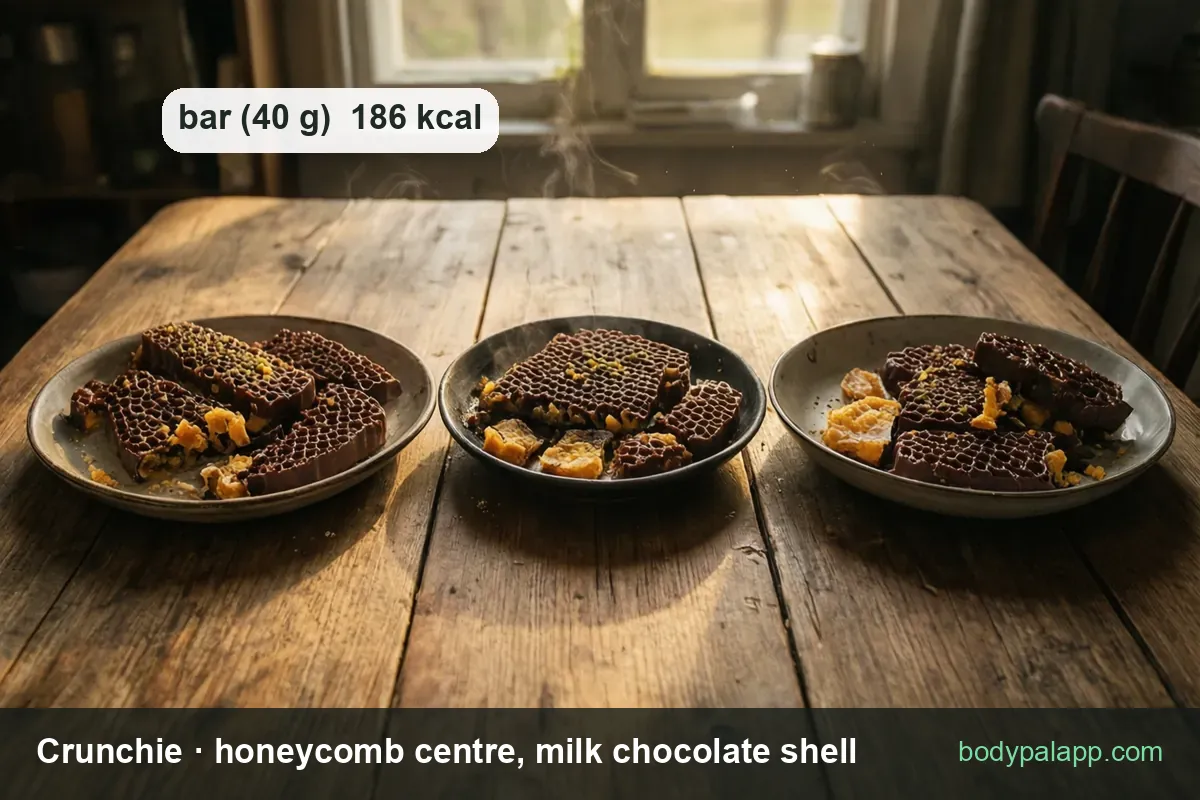
Honeycomb, cinder toffee, sponge candy: all names for the same thing, which is boiled sugar puffed up with air bubbles. There is no honey requirement, no dairy in the centre and nothing structural except sugar. That is why the bar's carbohydrate count, 74 g per 100 g, towers over solid chocolate's, while its fat count sits far below.
The air matters for the calorie count in a sneaky way. A Crunchie is physically large for its 40 g, so it reads as a bigger treat than a dense 40 g of chocolate would. Per gram it is actually the lightest bar in the comparison below. Per mouthful of sugar, it is the heaviest.
Sugar by bar: Crunchie against the rest
| Bar | Calories per item | Sugar per item |
|---|---|---|
| Freddo (18 g) | 96 kcal | 10.1 g |
| Crunchie (40 g) | 186 kcal | 26.0 g |
| Twirl twin pack (43 g) | 228 kcal | 24.9 g |
| Twix twin (50 g) | 246 kcal | 24.0 g |
| Bounty twin (57 g) | 278 kcal | 28.0 g |
The verdict: on calories the Crunchie is the second lightest full bar here, beaten only by the tiny Freddo, and that makes it a solid pick when you want a proper bar for under 200 kcal. On sugar it punches above its weight: 26 g from a 40 g bar, more than a Twirl or Twix that each weigh and cost more calories. If sugar is the line you watch, the honeycomb is the wrong place to save.
A Kinder Bueno makes the opposite trade, more fat and less sugar, and the NHS Eatwell guidance files both in the same occasional-treats corner. "Chocolate bar", in other words, covers two quite different recipes.
Most popular Crunchie products in the United Kingdom
Ranked by how widely each product appears among foods sold in the United Kingdom, from the BodyPal food database of over 3.3 million products. Calories are the figures printed on each label.
| Product | Calories (per 100 g) |
|---|---|
| Cadbury Crunchie | 466 kcal |
| Cadbury Crunchie Blast Ice Cream | 230 kcal |
| McDonald’s Crunchie McFlurry (Mini) | 189 kcal |
Brand popularity: BodyPal food database. Nutrition: manufacturer labels.
How long does it take to burn off a Crunchie?
A 40 g bar is 186 kcal. Enter your weight and the amount you ate to see how long it takes you to burn that off:
lb
| Activity | Time to burn 186 kcal |
|---|---|
| Walking, brisk | 37 min |
| Cycling, moderate | 23 min |
| Swimming, moderate | 27 min |
| Jogging | 22 min |
| Weight training, moderate | 41 min |
Times are for a 154 lb (11 st) adult at a steady pace; change the weight to see yours. The amount is set to the portion in the text (40 g); change it to what you actually ate. BodyPal works this out from your steps automatically.
Want the bigger picture? Calculate your daily calorie needs — your maintenance figure, a target for losing or gaining, and the date you get there.
Frequently asked questions
How many calories are in a Crunchie bar?
186 kcal for the standard 40 g single bar, from a label of 465 kcal per 100 g. Multipack bars are typically smaller than the single, so weigh the wrapper claim against the per-100 g figure if yours came from a four-pack.
How much sugar is in a Crunchie?
26 g in one 40 g bar, because the honeycomb centre is essentially aerated sugar at 65 g per 100 g. That is close to the 30 g of free sugars the NHS suggests as a daily maximum, packed into a single wrapper.
What is the honeycomb in a Crunchie made of?
Boiled sugar aerated into a brittle foam; there is no honey obligation in it and no fat. It contributes 74 g of carbohydrate per 100 g to the bar while the 17 g of fat comes almost entirely from the milk chocolate coating around it.
Is a Crunchie lower in calories than other chocolate bars?
Per 100 g, yes: 465 kcal against roughly 490 to 570 for most rivals, because air is free. Per bar it is 186 kcal, under a Twirl's 228 and a Twix's 246. Only on sugar does it outrank them, with 26 g per bar.
How much fat is in a Crunchie?
6.8 g per bar, of which 4.0 g is saturated, a fifth of the daily reference intake. For a chocolate bar that is a low fat load; the honeycomb centre carries none, so everything on the fat line belongs to the chocolate shell.
Why does a Crunchie feel bigger than its calories suggest?
Air. At 186 kcal the bar is physically larger than denser bars with more calories, because the honeycomb foam takes up volume without adding weight. That works in your favour if satisfaction scales with size; the sugar concentration is the price.
How many calories in half a Crunchie?
93 kcal for a clean 20 g half. Honeycomb snaps neatly, which makes the half-bar one of the more realistic partial portions in the chocolate aisle, and it keeps the sugar at 13 g rather than 26 g. Wrap the rest, or the maths resets.
Does the salt in a Crunchie matter?
0.29 g per bar, around 5% of the 6 g daily reference intake, which is high for confectionery; most chocolate bars carry under half that. It comes with the honeycomb-making process. Against a day's food it is minor, but it is not zero.
Similar foods
- Popcorn — 141 kcal per 30 g bag
- Oreo — 52 kcal per biscuit
- Milky Way — 96 kcal per 21.5 g bar
- Biscoff biscuit — 38 kcal per biscuit
- Bourbon biscuit — 68 kcal each
- Rich tea biscuit — 38 kcal per biscuit
Count it without the maths
BodyPal logs a Crunchie from one photo of the bar, sugar line included, so the honeycomb goes in your diary and not just past it.

