
How Many Calories in a Bounty? 139 per Bar, 278 per Pack
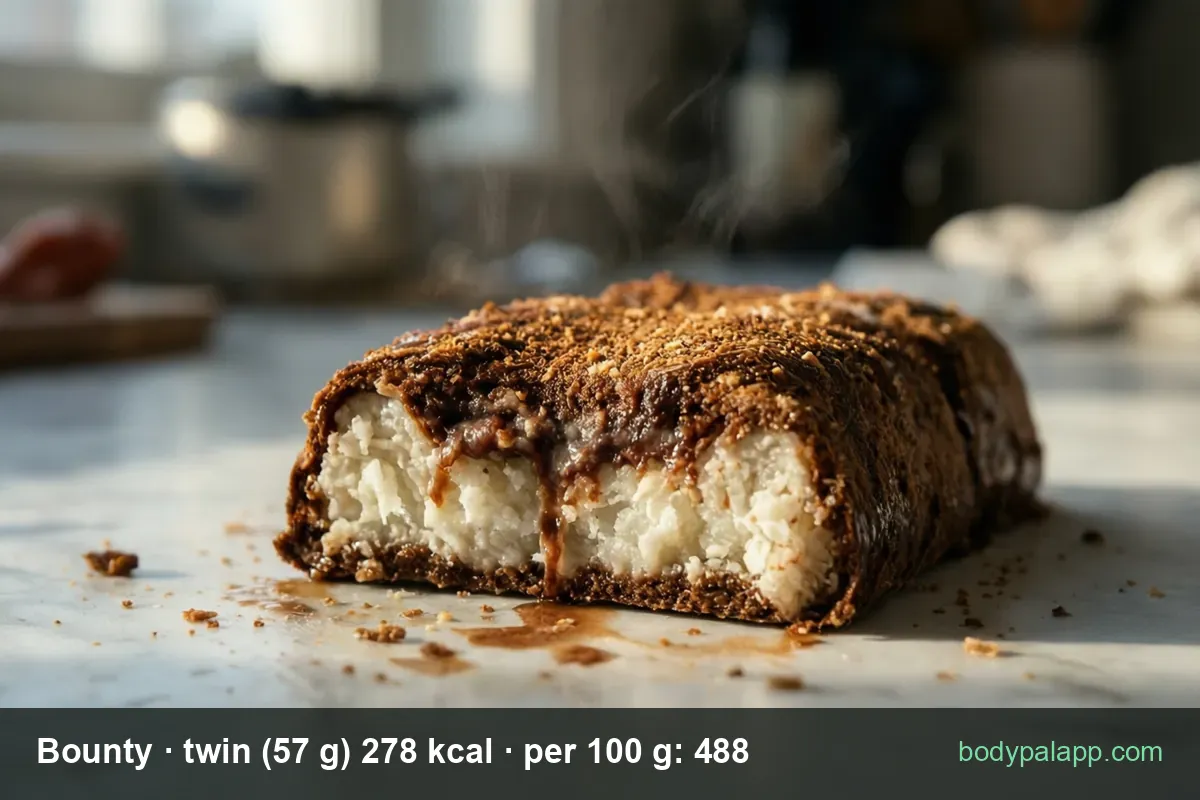
A Bounty costs 278 calories for the 57 g twin pack, 139 for a single bar, and 488 kcal per 100 g. The calories are ordinary for chocolate. What is not ordinary is the saturated fat: 21 g per 100 g, the highest figure in the mainstream bar aisle, and the coconut is entirely responsible.
On this page
- Bounty nutrition at a glance
- Why the coconut changes the fat line
- Portions: one bar or the pack
- The ice cream trap
- Bounty against the other bars
- Most popular Bounty products
- FAQ
Bounty nutrition at a glance
| Nutrient | Per 100 g | Per twin pack (57 g) | %RI* per pack |
|---|---|---|---|
| Energy | 488 kcal / 2,042 kJ | 278 kcal / 1,163 kJ | 14% |
| Protein | 3.9 g | 2.2 g | 4% |
| Carbohydrate | 59.6 g | 34.0 g | 13% |
| of which sugars | 49 g | 28.0 g | 31% |
| Fat | 25.6 g | 14.6 g | 21% |
| of which saturates | 21 g | 12.0 g | 60% |
| Fibre | – | – | – |
| Salt | 0.25 g | 0.14 g | 2% |
*%RI = percentage of the reference intake for an average adult (2,000 kcal; 70 g fat, 20 g saturates, 260 g carbohydrate, 90 g sugars, 50 g protein, 6 g salt).
Verified nutrition data
Numbers on this page come from CoFID, the UK government’s Composition of Foods Integrated Dataset, and from manufacturer labels where a branded product is named. Last verified August 2026. How we verify our data →
Read the saturates line twice. One twin pack delivers 12 g, which is 60% of the 20 g daily reference intake, more than any other line on this label gets close to. The sugars are heavy too, 28 g in the pack against the 30 g of free sugars the NHS uses as a daily adult ceiling, but plenty of bars can match that. The saturates figure they cannot.
Why the coconut changes the fat line
Coconut has a reputation as the wholesome one in the sweet aisle, and it earns the opposite numbers. Coconut fat is overwhelmingly saturated, so swapping caramel or wafer for a coconut filling drags the saturates up even while total fat stays in the normal chocolate range. A Bounty holds 25.6 g of total fat per 100 g, which is unremarkable; 21 g of it saturated, which is not.
For scale, a Twix runs 14 g of saturates per 100 g and a Kinder Bueno 16.8 g. The Bounty clears both while being the lowest-calorie bar of the three per 100 g.
That is the honest summary of this bar: middling energy, top-of-class saturates. If saturated fat is the line you watch, this is the wrapper to put back.
Portions: one bar or the pack
| Portion | Weight | Calories |
|---|---|---|
| One bar (half the pack) | 28.5 g | 139 kcal |
| Twin pack | 57 g | 278 kcal |
| Per 100 g | 100 g | 488 kcal |
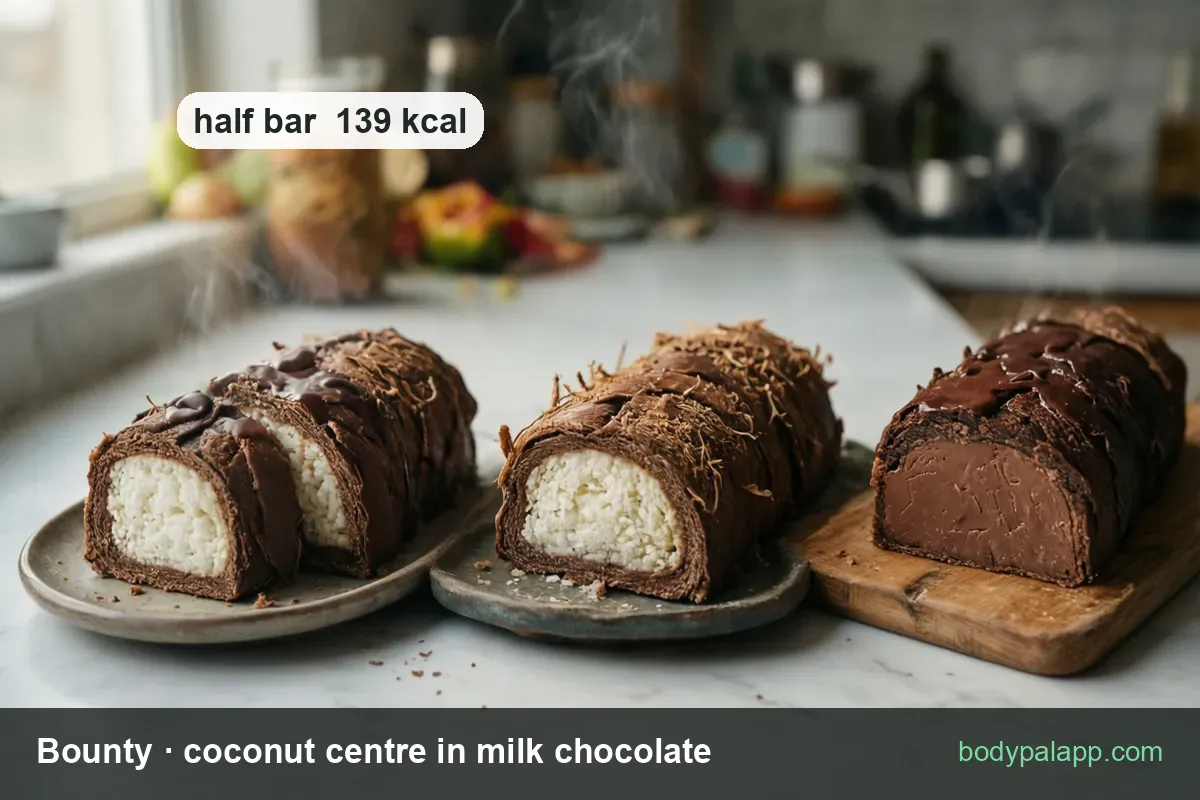
The two-bar format is doing you a favour if you let it. A single bar at 139 kcal is a legitimate snack; the full pack at 278 is a small meal's worth of energy with 12 g of saturates attached. The bars are individually solid, they keep, and the second one is exactly as nice tomorrow.
Milk and dark versions of the bar sit close enough on the label that the choice is taste rather than arithmetic.
The ice cream trap
Food databases list a Bounty ice cream bar at around 269 kcal per 100 g, and it regularly gets logged in place of the chocolate bar. That is a different product at nearly half the energy density; frozen desserts carry water that chocolate does not.
If an app search for Bounty offers you a suspiciously low number, you have found the ice cream. The chocolate twin pack is 278 kcal for 57 g; anything claiming 100 g of Bounty for 269 kcal is worth reading the label on.
Bounty against the other bars
| Bar | Per item | Per 100 g |
|---|---|---|
| Bounty twin (57 g) | 278 kcal | 488 kcal |
| Twix twin (50 g) | 246 kcal | 493 kcal |
| Kinder Bueno (43 g) | 245 kcal | 571 kcal |
| Twirl twin (43 g) | 228 kcal | 530 kcal |
| Maltesers, a dozen (24 g) | 121 kcal | 503 kcal |
The verdict: per 100 g the Bounty is, oddly, the lightest bar on this table, because coconut carries some water into the filling. Per wrapper it is the heaviest, because the pack weighs the most. Both things are true and only one of them matters at the till: you buy wrappers, not hundred-gram units, and this wrapper is 278. If you want coconut for fewer calories, half the pack at 139 is the play; if you just want chocolate, a Twirl saves 50 kcal on format, and a mug of hot chocolate stretches the same idea over twenty minutes.
Most popular Bounty products in the United Kingdom
Ranked by how widely each product appears among foods sold in the United Kingdom, from the BodyPal food database of over 3.3 million products. Calories are the figures printed on each label.
| Product | Calories (per 100 g) |
|---|---|
| Bounty | 487 kcal |
| Bounty Hi-Protein | 393 kcal |
| Bounty Ice Cream | 269 kcal |
Brand popularity: BodyPal food database. Nutrition: manufacturer labels.
How long does it take to burn off a Bounty?
A 57 g twin pack is 278 kcal. Enter your weight and the amount you ate to see how long it takes you to burn that off:
lb
| Activity | Time to burn 278 kcal |
|---|---|
| Walking, brisk | 56 min |
| Cycling, moderate | 35 min |
| Swimming, moderate | 40 min |
| Jogging | 33 min |
| Weight training, moderate | 1 hr 2 min |
Times are for a 154 lb (11 st) adult at a steady pace; change the weight to see yours. The amount is set to the portion in the text (57 g); change it to what you actually ate. BodyPal works this out from your steps automatically.
One food is easy to picture; a whole day is harder. See how many calories you need a day and what a deficit actually looks like.
Frequently asked questions
How many calories are in a Bounty bar?
One bar, half of the standard twin pack, is 139 kcal at 28.5 g. The full 57 g pack is 278 kcal. Per 100 g a Bounty reads 488 kcal, which sits slightly under most chocolate bars because the coconut filling carries a little water.
How many calories in a whole Bounty twin pack?
278 kcal for the 57 g pack, alongside 28 g of sugars and 12 g of saturated fat. That saturates figure is 60% of an adult's 20 g daily reference intake, which is the standout number on the label, well ahead of the calories themselves.
Why is a Bounty so high in saturated fat?
Because coconut fat is overwhelmingly saturated. At 21 g of saturates per 100 g a Bounty tops the mainstream bar aisle, ahead of a Twix at 14 g and a Bueno at 16.8 g, even though its total fat of 25.6 g per 100 g is ordinary for chocolate.
Is a Bounty healthier because of the coconut?
No. The coconut brings the highest saturated fat concentration in the bar aisle, 21 g per 100 g, and 28 g of sugars per pack sits just under the NHS's 30 g daily free-sugars ceiling. It is confectionery with a tropical filling, and the label treats it accordingly.
Is Bounty ice cream the same calories as the bar?
No, and this is a common logging mistake. The ice cream version runs around 269 kcal per 100 g against 488 for the chocolate bar, because frozen desserts carry water. If a database result for Bounty looks surprisingly low, it is almost certainly the ice cream entry.
How much sugar is in a Bounty?
28 g of sugars in the 57 g twin pack, or 49 g per 100 g. One pack takes an adult to within touching distance of the NHS's suggested 30 g daily limit for free sugars, so it works far better as the day's single sweet event than as one of several.
Is half a Bounty a reasonable portion?
Yes, and the packaging agrees: the two bars are wrapped as separable halves at 139 kcal each. Six grams of saturates still ride along with each bar, but 139 kcal is normal snack territory, and the second bar keeps perfectly well for another day.
How does a Bounty compare with a Twix?
Per 100 g they are five calories apart, 488 against 493. The real differences are the pack, 57 g versus 50 g, which makes the Bounty 278 kcal to the Twix's 246, and the fat profile, where the Bounty's 21 g of saturates per 100 g clears the Twix's 14 g comfortably.
Similar foods
- Snickers — 235 kcal per bar
- Biscoff biscuit — 38 kcal per biscuit
- Bourbon biscuit — 68 kcal each
- Crisps — 123 kcal per 25 g bag
- Twix — 246 kcal per twin bar
- Maltesers — ~10 kcal per Malteser
Log it before the second bar argues
BodyPal reads a Bounty from one photo and logs the half or the whole pack, so the difference between 139 and 278 stays a decision instead of a surprise.

