
How Many Calories in a Malteser? About 10 per Ball
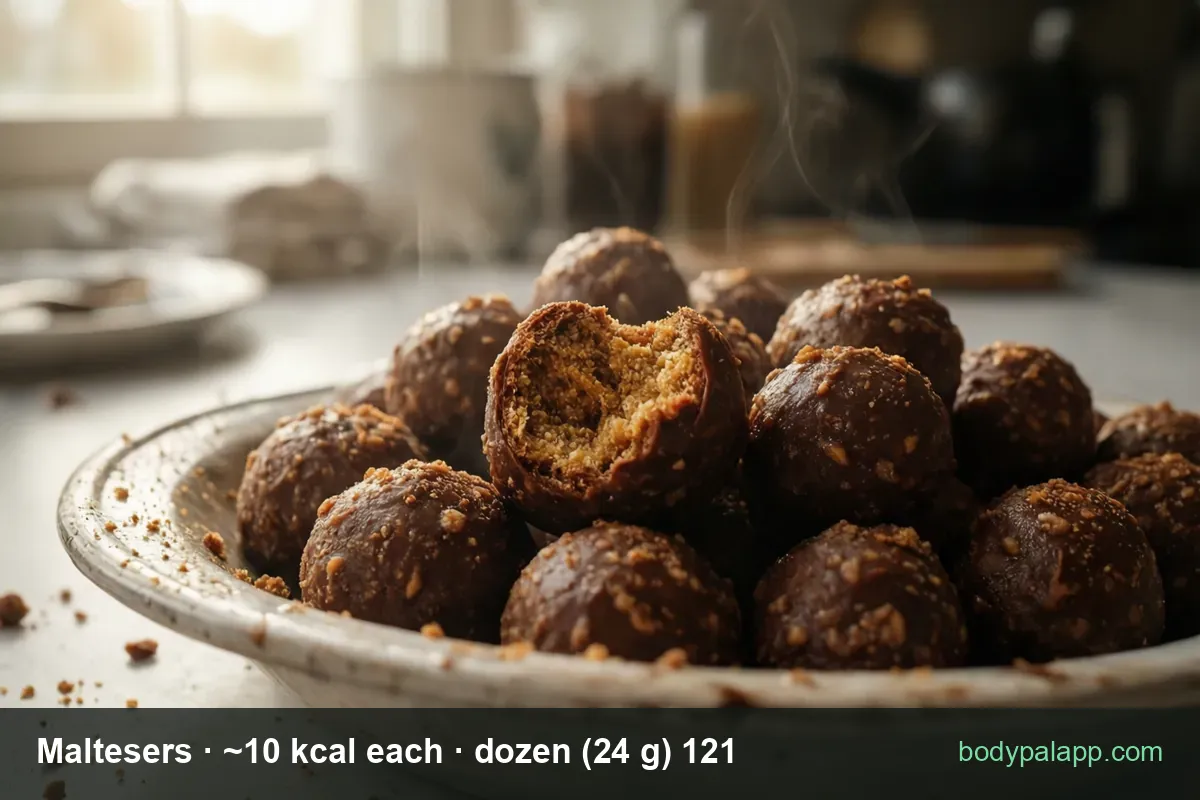
One Malteser is about 10 calories. A dozen, roughly 24 g, comes to 121 kcal, and the label reads 503 kcal per 100 g. No other mainstream chocolate lets you decide your portion one piece at a time, and that single fact is worth more than anything else on the packet.
On this page
- Maltesers nutrition at a glance
- Counting by the ball
- Bags, pouches and buckets
- Lighter than air?
- Maltesers against the bars
- Most popular Maltesers products
- FAQ
Maltesers nutrition at a glance
| Nutrient | Per 100 g | Per dozen (~24 g) | %RI* per dozen |
|---|---|---|---|
| Energy | 503 kcal / 2,105 kJ | 121 kcal / 506 kJ | 6% |
| Protein | 8.5 g | 2.0 g | 4% |
| Carbohydrate | 61 g | 14.6 g | 6% |
| of which sugars | 53 g | 12.7 g | 14% |
| Fat | 25 g | 6.0 g | 9% |
| of which saturates | 15 g | 3.6 g | 18% |
| Fibre | – | – | – |
| Salt | 0.42 g | 0.10 g | 2% |
*%RI = percentage of the reference intake for an average adult (2,000 kcal; 70 g fat, 20 g saturates, 260 g carbohydrate, 90 g sugars, 50 g protein, 6 g salt).
Verified nutrition data
Numbers on this page come from CoFID, the UK government’s Composition of Foods Integrated Dataset, and from manufacturer labels where a branded product is named. Last verified August 2026. How we verify our data →
A dozen Maltesers for 121 kcal is one of the softer deals in the chocolate aisle, and the protein line explains the name: malted milk pushes it to 8.5 g per 100 g, unusually high for confectionery. The sugars still dominate, 53 g per 100 g, so a dozen carries 12.7 g, about 42% of the 30 g of free sugars the NHS treats as a daily adult ceiling.
Counting by the ball
| Portion | Weight | Calories |
|---|---|---|
| One Malteser | ~2 g | ~10 kcal |
| Six | ~12 g | 60 kcal |
| A dozen | ~24 g | 121 kcal |
| Twenty | ~40 g | 201 kcal |
The whole appeal is that the unit is tiny and the arithmetic is trivial: every ball is a ten. Five with a cup of tea is a 50 kcal event. That precision simply does not exist with a bar, where the only choices are half, all, or pretending there is such a thing as a third of a Twix.
The same precision cuts both ways. A film-night hand that goes back twenty times has quietly logged 200 kcal, and nothing about a 2 g sphere warns you. Count them out before the film, not during.
Bags, pouches and buckets
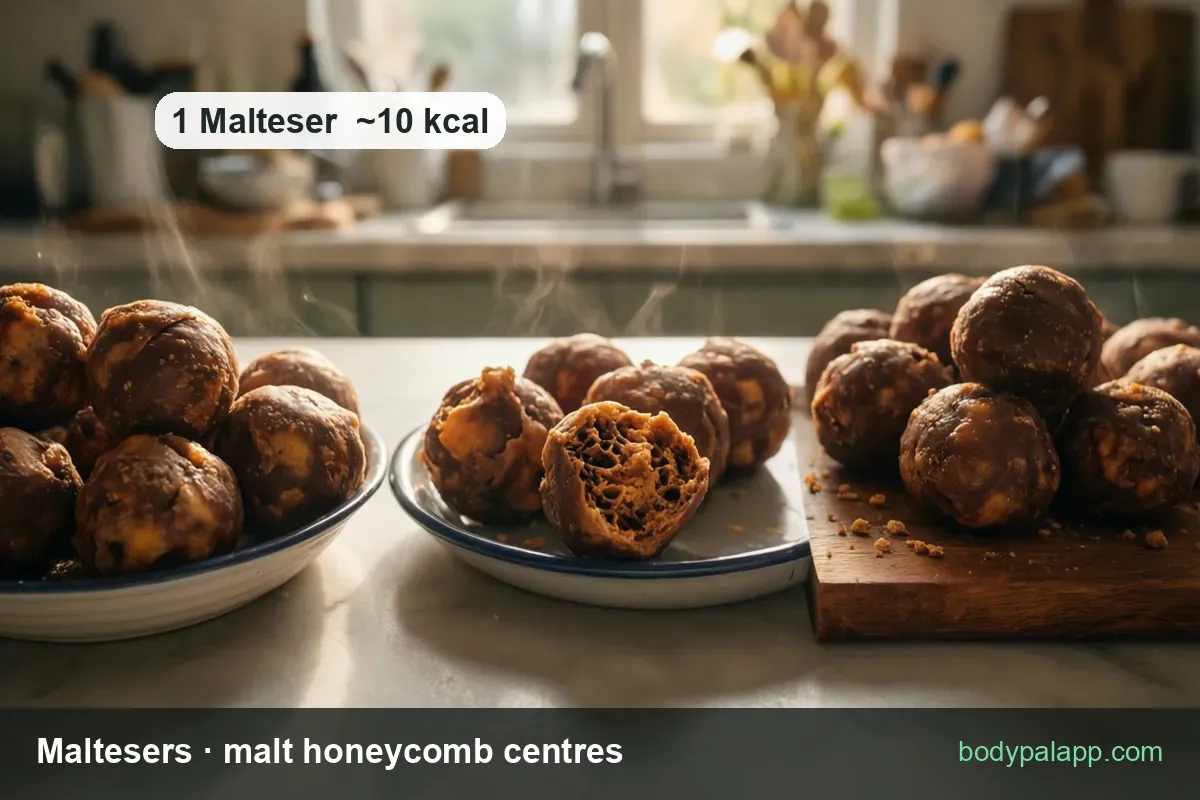
Maltesers come in everything from pocket bags to roughly 93 g share pouches to buckets over 400 g, and the range keeps changing. That is precisely why this page prices the ball and the dozen instead of the bag: whatever packaging this year's shelf carries, ~2 g and ~10 kcal per ball stays true, and the label's per-100 g figure of 503 does the rest.
A share pouch emptied solo is in the 450-500 kcal region. The name on the front was the serving suggestion.
Lighter than air?
The advertising has always leaned on lightness, and by weight it is honest: an aerated honeycomb centre makes each ball feather-light, which is why a whole dozen weighs only 24 g. Per gram, nothing special is happening. At 503 kcal per 100 g, Maltesers sit squarely between a Twix at 493 and plain milk chocolate at 519 on the CoFID figure.
The lightness is in the portion, not the recipe. It is a real advantage, but it belongs to the 2 g ball, and it evaporates the moment the bag becomes the unit.
Maltesers against the bars
| Chocolate | Per item | Per 100 g |
|---|---|---|
| Maltesers, a dozen (24 g) | 121 kcal | 503 kcal |
| Twirl twin (43 g) | 228 kcal | 530 kcal |
| Kinder Bueno (43 g) | 245 kcal | 571 kcal |
| Twix twin (50 g) | 246 kcal | 493 kcal |
| Bounty twin (57 g) | 278 kcal | 488 kcal |
The verdict: on concentration everything here is chocolate, 488 to 571 kcal per 100 g, and choosing between them on that basis is rearranging deckchairs. On portions, Maltesers win outright: a dozen at 121 kcal is half the cost of any wrapper on the table, and the count-them-out format is the only one that scales down gracefully. If the evening calls for chocolate that lasts, a mug of hot chocolate is the other slow option; among the solid bars, per-wrapper weight decides, and everything above 250 kcal deserves logging rather than rounding to zero.
Most popular Maltesers products in the United Kingdom
Ranked by how widely each product appears among foods sold in the United Kingdom, from the BodyPal food database of over 3.3 million products. Calories are the figures printed on each label.
| Product | Calories (per 100 g) |
|---|---|
| Maltesers | 503 kcal |
| Maltesers Teasers | 531 kcal |
| Maltesers Biscuits | 509 kcal |
Brand popularity: BodyPal food database. Nutrition: manufacturer labels.
Frequently asked questions
How many calories are in one Malteser?
About 10 kcal. A single ball weighs roughly 2 g and the label runs 503 kcal per 100 g, so the maths lands at ten per ball. It is one of the few chocolates where counting individual pieces is both possible and genuinely useful.
How many calories in a dozen Maltesers?
A dozen weighs about 24 g and comes to 121 kcal, with 12.7 g of sugars and 3.6 g of saturated fat. That is roughly half the calories of any standard chocolate bar wrapper, which is what makes the counted-out dozen such a strong default portion.
How many calories in a share bag of Maltesers?
It depends on the bag, and the formats change often, which is why the reliable maths is per ball: about 10 kcal each, 503 per 100 g. A pouch in the region of 93 g carries roughly 470 kcal if one person finishes it, so check the weight on the front and multiply.
Are Maltesers lower in calories than chocolate bars?
Per 100 g, no: at 503 kcal they sit between a Twix at 493 and milk chocolate at 519. Per portion, yes, if you count: a dozen is 121 kcal against 228 to 278 for the standard bar wrappers. The honeycomb centre makes the balls light in weight, not light per gram.
Why do Maltesers have more protein than most chocolate?
The malted milk in the centre lifts protein to 8.5 g per 100 g, roughly double what plain chocolate manages. A dozen still only delivers 2 g of protein, so it is a curiosity rather than a nutritional argument, but it explains the malt in the name.
How much sugar is in Maltesers?
53 g per 100 g, so a counted dozen carries 12.7 g, about 42% of the NHS's suggested 30 g daily ceiling for free sugars. Empty a share pouch alone and the sugar arithmetic goes the way of the calorie arithmetic: several days' ceiling in one sitting.
Are Maltesers a good choice for a low-calorie treat?
Counted, yes: five with a coffee is 50 kcal, a dozen is 121, and no bar format gets that low without leaving most of the wrapper unfinished. Uncounted, the advantage disappears, because a wandering hand meets a 2 g unit that never feels like it needs logging.
How many Maltesers make up 100 calories?
Ten balls, near enough. At about 10 kcal per ball, ten of them weigh roughly 20 g and land on 100 kcal, which makes Maltesers one of the easiest sweets to fit to a round-number budget. Count them into a bowl and put the bag away first.
Similar foods
- Crisps — 123 kcal per 25 g bag
- Twix — 246 kcal per twin bar
- Kit Kat — 106 kcal per two fingers
- Snickers — 235 kcal per bar
- Bounty — 278 kcal per twin bar
- Biscoff biscuit — 38 kcal per biscuit
Ten a ball, counted for you
BodyPal logs a counted handful of Maltesers from one photo of the bowl, so the tens add themselves up while you watch the film.


One food is easy to picture; a whole day is harder. See how many calories you need a day and what a deficit actually looks like.